
Understanding what is Flare Network requires shifting your perspective from traditional smart contract platforms to data-centric architectures. Flare is a full-stack, EVM-compatible Layer 1 blockchain explicitly engineered for data-intensive use cases. By enshrining core data acquisition protocols directly into its network consensus layer, Flare eliminates the security trade-offs, high costs, and latency constraints associated with third-party, off-chain oracle networks.
In the 2026 digital asset ecosystem, Flare has emerged as the structural backbone for XRPFi (XRP Decentralized Finance). Through its trust-minimized bridging infrastructure, Flare effectively transforms static, non-smart contract assets like XRP, Bitcoin (BTC), and Dogecoin (DOGE) into highly productive liquidity and yield-bearing collateral. Backed by institutional custody giants like Hex Trust and governed by a sustainable, long-term tokenomics framework, the platform bridges the gap between isolated legacy networks and advanced smart contract utility.
This guide explores the architectural mechanics of Flare, tracing its evolution into a high-performance data hub and detailing the core technologies that define how it works.
What Is Flare Network?
At its architectural core, Flare Network is a decentralized, permissionless, EVM-compatible Layer 1 blockchain built on the Snowman++ consensus protocol, an adaptation of Avalanche consensus. Unlike conventional blockchains that treat data delivery as an external add-on service, Flare treats data as a primitive, a foundational utility built natively into the network's state transition machine.
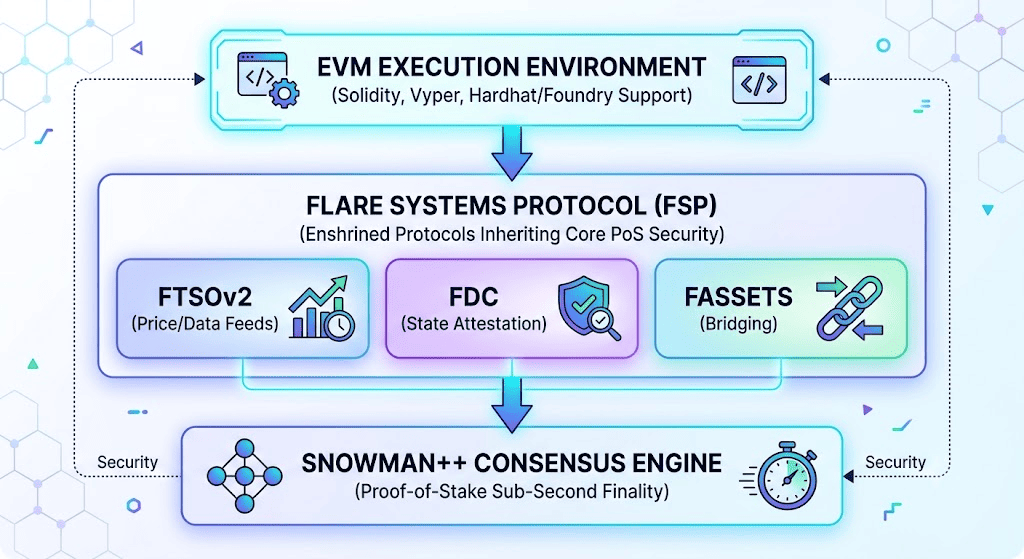
The system operates via a Proof-of-Stake (PoS) Sybil resistance mechanism, where validator nodes are responsible for dual duties: processing transactions within the EVM and operating as independent data providers for the network’s native oracles. This alignment ensures that any malicious manipulation of data directly triggers economic penalties against the validator’s staked capital, guaranteeing that data integrity inherits the full economic security of the entire network.
How Flare Network Works: The Data Layer Vision
The core design thesis of Flare is that sustainable blockchain scaling requires verifiable access to high-integrity, real-world data without introducing centralized trust vectors. In standard smart contract ecosystems, dApps rely on third-party oracles to fetch off-chain asset prices, API data, or external blockchain states. These external middleware setups create a fragmented security model, where an application processing billions of dollars is only as secure as the independent, often obscure multi-signature wallet governing its oracle feed.
Flare solves this through its Enshrined Data Protocols. By baking data verification directly into the core network logic, Flare acts as a secure, decentralized execution layer for data-intensive calculations. This architecture opens up a new class of utility:
- Verifiable AI Integration: Leveraging Flare Confidential Compute (FCC) alongside hardware-isolated Trusted Execution Environments (TEEs) to process secure, off-chain machine learning scripts with verifiable on-chain outputs.
- Complex Multi-Chain DeFi: Allowing protocols to automatically execute logic based on real-time parameters from external web APIs or sovereign ledger histories.
- Gas-Abstracted Financial Railing: Deploying custom smart accounts that interpret cross-chain signals to execute multi-hop financial swaps in a single transaction.
Flare Network's Transition From Bootstrapping to Utility
The network has undergone a structural transition from an early ecosystem bootstrapping phase to its current operational utility era. This evolution has been systematically executed across two main verticals: distribution mechanics and programmatic tokenomics.
The Conclusion of FlareDrops
Under the foundational governance framework of FIP.01, Flare initiated a 36-month token distribution phase designed to allocate the network's native asset, FLR, directly into the hands of wrapped FLR (WFLR) community participants. This programmatic distribution officially concluded on January 30, 2026.
With the termination of the FlareDrop component, WFLR and staked FLR no longer accrue passive distribution rewards. Instead, the network has transitioned entirely into its operational utility phase, where token emissions are strictly tied to protocol-level contributions, including:
- Active validation and Proof-of-Stake consensus locking.
- High-fidelity data provision to the native Time Series Oracle.
- Collateral backing and agent infrastructure participation in the cross-chain asset bridging system.
FIP.16 Tokenomics Restructuring
To solidify long-term network sustainability, Flare governance overwhelmingly approved FIP.16, which concluded voting on April 24, 2026. This proposal aggressively optimized the network’s macroeconomic architecture to curb structural dilution and enhance value accrual for network participants:
|
Parameter |
Pre-FIP.16 Architecture |
Post-FIP.16 Target Configuration |
|
Annual Inflation Rate |
5% of circulating supply |
3% of calculated inflatable supply |
|
Annual Inflation Cap |
5 Billion FLR |
3 Billion FLR |
|
Base Gas Fees |
Legacy Baseline |
20× Baseline Increase (Post v1.13.0) |
|
Fee Dynamic |
100% Base Fees Burned |
100% Burned + Cross-Chain Attestation Fee Redirection |
Additionally, FIP.16 established the FIRE (Flare Income Reinvestment Entity) framework. FIRE programmatically routes protocol revenues generated from attestation requests, bridging fees, and MEV (Maximal Extractable Value) capture toward systematic supply reduction and targeted ecosystem growth, turning the native utility asset into a deflating mechanism as network usage scales.
Key Protocols in the Flare Network Ecosystem: FTSO, FDC, and FAssets
Flare’s structural advantages are driven by three native, enshrined protocols integrated into the core architecture.
1. Flare Time Series Oracle (FTSOv2)
The FTSOv2 is the network’s highly scaled, low-latency pricing engine, supplying decentralized feeds to smart contracts at block-speed.
- How It Works: Every single block produced on Flare, approximately every 1.8 seconds, initiates a selection process utilizing a stake-weighted Verifiable Randomness Function (VRF). A sub-sample of the network's 100 independent data providers is chosen at random to submit fixed incremental delta updates, capped at 1/213≈0.0122%, based on real-time global markets.
- Long-Term Anchor: To prevent statistical drift, these block-latency deltas anchor to deep Scaling Feeds, which run a full commit-reveal process across all data providers every 90 seconds, calculating an Interquartile Range (IQR) band to reward accurate nodes.
- Volatility Buffer: In times of market stress, a permissionless volatility incentive mechanism allows external protocols to pay a fee to temporarily scale up the active data provider sample size, capturing quick, sharp macro price movements seamlessly.
2. Flare Data Connector (FDC)
The FDC is a native state attestation engine that allows smart contracts on Flare to trustlessly verify events occurring on external Web2 APIs or other sovereign blockchains.
- How It Works: Rather than using a trusted multisig relayer, the FDC allows any user to submit an attestation request to the on-chain FdcHub contract. Independent data providers fetch the external data, verify its validity via deterministic proofs, and vote on its accuracy using cryptographic BitVectors.
- Security and Storage: Once a threshold weight of 50%+ of the network's validators sign off on the response, consensus is achieved. The verified data is structured into an off-chain Merkle tree stored by the Data Availability (DA) Layer, while only the single cryptographic Merkle root is committed to the Flare ledger. Users then present a lightweight Merkle proof to a destination smart contract to verify an action, e.g., a Bitcoin transfer or an API state change, securely and cost-effectively.
3. The FAssets System and XRPFi Integration
The FAssets system is a trust-minimized, over-collateralized bridging architecture that introduces advanced smart contract functionality to legacy tokens that do not natively support them, primarily anchoring the expanding ecosystem of XRPFi alongside BTCfi and DOGEfi.
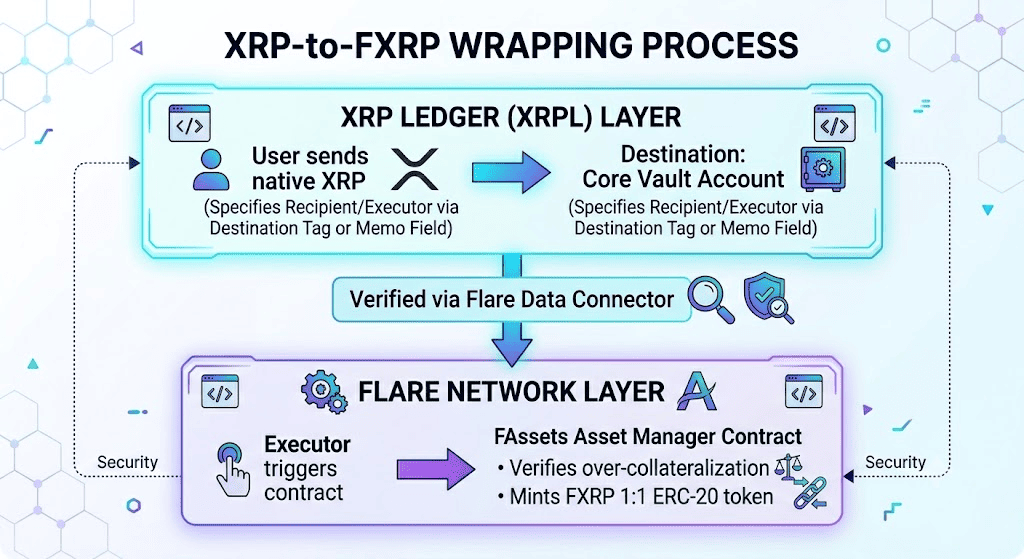
- Minting and Backing Architecture: Under standard conditions, minting an FAsset requires a user to lock assets with an Agent who provides a mix of cross-collateral (Stablecoins/ETH + native FLR/SGB). The FAsset is then minted as an ERC-20 token on Flare.
- FAssets v1.3 Direct Minting Engine: Released in late April 2026, the v1.3 upgrade introduces direct minting via XRPL Destination Tags or custom Memo Fields. XRP holders no longer need to navigate fragmented web-bridge interfaces. They can route native XRP directly from any standard centralized exchange or wallet to the Flare Core Vault multi-signature account. The system reads the transaction metadata via the FDC and programmatically mints FXRP directly to the user's destination address on Flare.
- Ecosystem Capital Efficiency: The introduction of the Core Vault aggregates pooled assets under strict governance oversight, freeing up capital constraints for agents and stabilizing system solvency through continuous decentralized monitoring by liquidators and challengers.
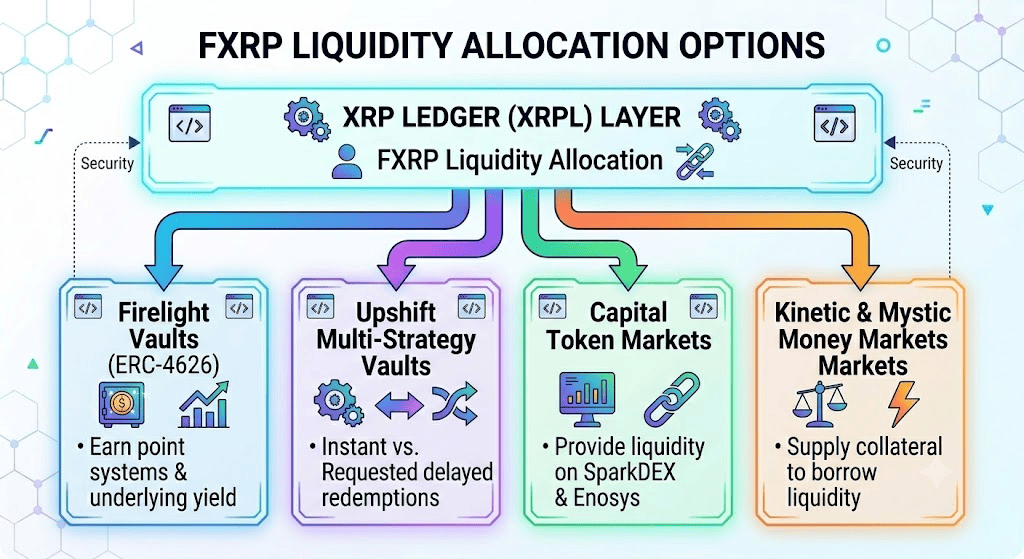
Once wrapped into FXRP, users can deploy their assets across a structured suite of yield and liquidity optimization protocols within the ecosystem:
How to Trade Flare Network (FLR) on BingX
Trading Flare Network (FLR) is streamlined by the BingX AI ecosystem, featuring next-generation intelligence tools like the BingX AI Claw and AI Skills Hub to deliver real-time technical analysis and programmatic trading indicators directly to your dashboard.
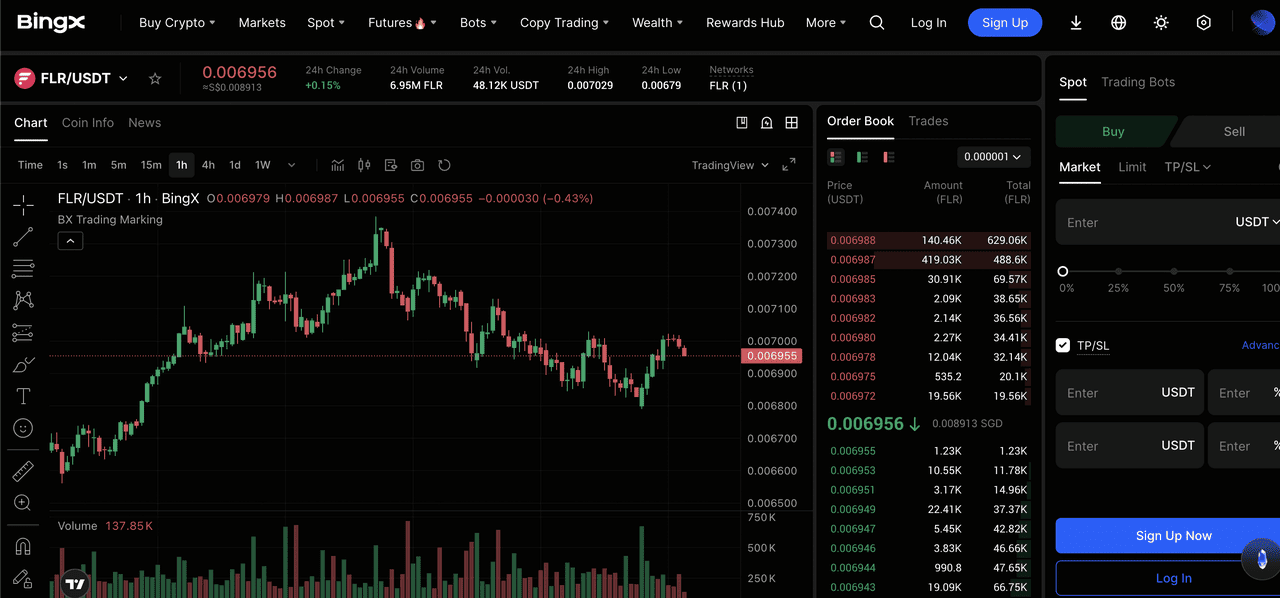
FLR/USDT trading pair on BingX spot market
Buy, Sell, or HODL FLR Tokens on the Spot Market
- Fund Your Account: Log in to your BingX app or desktop terminal, navigate to Deposit, and fund your wallet with a stable base pair like USDT using local fiat gateways or a direct crypto transfer.
- Access the Trading Terminal: Navigate to the Spot interface from the top navigation menu and use the search bar to find the FLR/USDT pair.
- Deploy BingX AI Strategy (Optional): Input your parameters into the BingX AI panel to analyze current market structures, parse real-time FTSOv2 data trendlines, or configure an automated AI Grid Trading bot.
- Configure Your Order Parameters: Choose your execution style (Market Order for instant entry or Limit/Trigger Order to buy at a specific technical baseline) and input your desired trade value.
- Set Risk Management Buffers: Always apply strict Take Profit (TP) and Stop Loss (SL) triggers within the confirmation window to shelter your position against localized intraday volatility.
- Execute and Monitor: Click Buy FLR and monitor your live position dynamics directly through the Orders tab at the bottom of the layout.
Final Thoughts: How to Navigate the Flare Ecosystem on BingX
Understanding how Flare Network works highlights its role as a premier infrastructure framework for the next generation of decentralized finance. By redefining the blockchain as a self-sufficient data collector, Flare removes the oracle security vulnerabilities that have historically plagued DeFi.
For users looking to capitalize on this expanding ecosystem, tracking the asset's underlying performance metrics and monitoring the growth of FXRP capital pools provides a clear window into macro utility adoption. As FAssets expand to include native BTC and alternative Layer 1 protocols later this year, Flare’s full-stack data environment is well-positioned to serve as a hub for institutional-grade cross-chain liquidity.
Risk Reminder: Digital asset values remain vulnerable to systemic market adjustments and local smart contract parameters. Ensure you perform exhaustive background research and evaluate individual protocol audits before locking liquidity into advanced on-chain yield strategies.
Related Reading
- What Is XRP? A Beginner's Guide to How the XRP Ledger Works (2026)
- How to Invest in XRP Ledger (XRPL), a Beginner’s Guide to Buying XRP
- Spot XRP ETFs to Launch on November 13: What Is a Spot XRP ETF?
- What Are the Top BTCFi (Bitcoin DeFi) Projects in 2026?
FAQs on Flare Network
1. What is the contract standard for bridged FAssets like FXRP?
Every FAsset minted on Flare is fully compliant with the ERC-20 standard. This ensures comprehensive, out-of-the-box interoperability with all legacy Ethereum Virtual Machine developer tools, automated market makers (AMMs), lending protocols, and non-custodial wallet infrastructures.
2. How can I participate in Flare network security after the conclusion of the FlareDrops?
While passive FlareDrop distribution components have wrapped up, users can securely lock values into the ecosystem by staking native FLR directly to validation infrastructure via the P-Chain or wrapping tokens into WFLR to delegate voting authority to decentralized FTSO data providers to earn continuous protocol-level emissions.
3. How does the FAssets v1.3 direct minting process manage execution security?
Direct minting parameters are processed natively through the MintingTagManager smart contract on Flare. This system maps XRPL destination tags to specific addresses using an ERC-721 token structure, shielding in-flight transactions with a mandatory 10-minute cooldown window to prevent protocol spoofing or malicious front-running.
