



USA Rare Earth (USAR) is building an integrated Western rare-earth supply chain spanning mines, separation, metals, alloys and neodymium permanent magnets. Less Common Metals provides established metal and alloy production, while the Round Top project, Pela Ema mine and planned Stillwater and Blacksburg manufacturing sites expand the upstream and downstream footprint. The strategy creates exposure to defense, semiconductors, data centers and industrial electrification, but the stock remains sensitive to construction schedules, integration and capital requirements.
USA Rare Earth Q2 2026 showed how quickly the company has expanded and why execution remains unsettled. Revenue reached $5.8 million and cash stood at $1.53 billion, while USA Rare Earth secured a Commerce Department package of up to $1.6 billion. Operating loss widened to $46.3 million from $8.8 million and six-month operating cash use reached $75.3 million, leaving the investment case dependent on turning funded projects into qualified production.
The USAR stock forecast for 2026 now centers on two competing views:
- The integrated supply-chain and government-funding case: Pela Ema, Round Top, Less Common Metals and U.S. magnet capacity create a differentiated mine-to-magnet platform, while grants and loans reduce the amount of shareholder capital needed to reach commercial scale.
- The integration and commissioning case: Multiple acquisitions, facilities and qualification programs create schedule risk, and an extended ramp could keep operating losses and cash use high before customer orders become recurring revenue.
This guide breaks down the USAR stock forecast, 2026 price scenarios, key risks and analyst outlooks, drawing on USA Rare Earth's August 10, 2026 Q2 earnings release, quarterly filing and market data through September 24, plus how to trade USAR stock futures on BingX TradFi with USDT collateral.
Top 5 Things for USA Rare Earth Investors to Know in September 2026
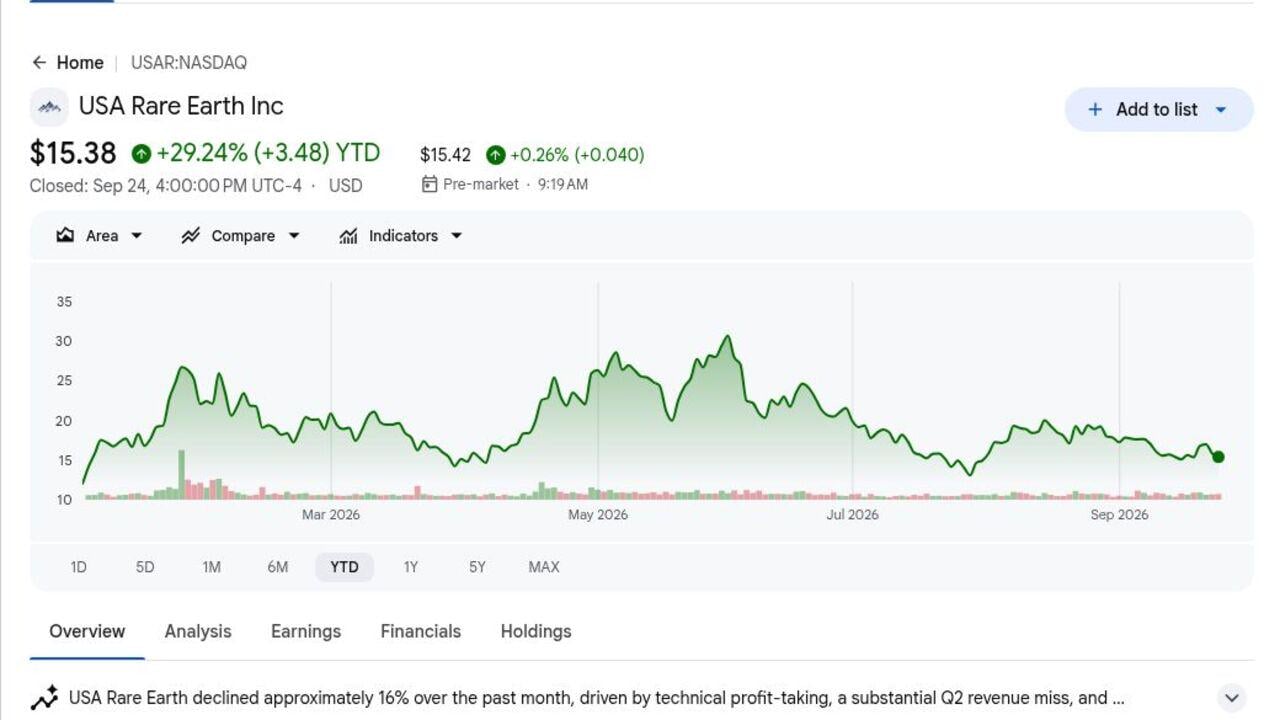
- $15.38 left USAR up 29.24% YTD through September 24: The reference close remained below the $21 to $45 range of the latest analyst targets. The gap shows how heavily valuation depends on future facilities and acquisitions rather than the current $5.8 million quarterly revenue base.
- $5.8 million of Q2 revenue marked the transition from development toward operations: Less Common Metals gave USA Rare Earth an operating revenue base, yet the $46.3 million operating loss shows that corporate, development and integration costs remain much larger than present sales.
- $1.53 billion of cash expanded the execution runway: Cash increased from $359.9 million at year-end, giving the company resources for transaction and project commitments. Six-month operating cash use of $75.3 million still makes disciplined capital allocation and milestone control important.
- Up to $1.6 billion of Commerce Department support can reduce financing risk: The package includes up to $277 million of federal funding and $1.3 billion of senior secured loan capacity. Disbursements remain tied to project milestones, so the headline amount is not unrestricted cash.
- 10,000 metric tons of planned U.S. magnet capacity defines the long-term opportunity: Stillwater and Blacksburg are intended to reach 10,000 tpa of NdFeB magnets and 10,000 tpa of metals and alloys. Blacksburg commissioning is targeted for 2028, leaving a multi-year execution bridge.
What Is USA Rare Earth (USAR)?
USA Rare Earth is a critical-minerals and advanced-materials company assembling a supply chain outside China. Its assets cover the Round Top polymetallic deposit in Texas, the Pela Ema ionic-clay mine in Brazil, Less Common Metals in the United Kingdom and planned magnet manufacturing in Oklahoma and South Carolina. Revenue can eventually come from concentrates, separated oxides, metals, alloys and finished NdFeB magnets. That breadth is designed to serve aerospace, defense, semiconductor, energy, mobility, healthcare and industrial customers.
The long-term strategy is to connect feedstock, processing and manufacturing so customers can source traceable rare-earth materials from one Western-aligned platform. The U.S. Commerce Department funding framework supports domestic expansion, Carester adds separation and recycling expertise in France, and Pasqal plus Riven Systems are exploring quantum-assisted separation chemistry. Pela Ema can provide magnetic rare-earth feedstock, while Round Top and recycled magnet swarf broaden supply options. Those relationships matter because customer qualification, secure supply and consistent product specifications determine whether capacity becomes contracted revenue.
Read More: MP Materials (MP) Price Prediction 2026: Can U.S. Rare Earth Demand Push MP Toward $120?
USA Rare Earth (USAR) Q2 2026 Earnings Overview: New Revenue Base and $1.53B Cash Support Expansion
USA Rare Earth reported Q2 revenue of $5.8 million, an operating loss of $46.3 million versus $8.8 million a year earlier, and adjusted diluted EPS of negative $0.15 versus negative $0.21. Cash reached $1.53 billion, while six-month operating cash use rose to $75.3 million. Management also retained a Q4 2026 target for 600 MTPA of Stillwater run-rate capacity, leaving funded expansion balanced against commissioning and cash-burn risk.
Read More: USA Rare Earth (USAR) Q2 2026 Earnings Overview: $5.8M Revenue and Wider Loss Send Shares Down
|
Financial Metric |
Guidance / Consensus |
Reported / Actual |
Surprise |
|
Q2 2026 revenue |
Pre-commercial in Q2 2025 |
$5.8M |
New. contribution from acquired operating assets. |
|
Q2 operating loss |
-$8.8M a year earlier |
-$46.3M |
Changed. Widened by $37.5M. |
|
Q2 GAAP diluted EPS |
-$1.54 a year earlier |
-$0.05 |
Improved. as fair-value movements reversed. |
|
Q2 adjusted diluted EPS |
-$0.21 a year earlier |
-$0.15 |
Improved. by $0.06. |
|
Q2 adjusted net loss |
-$19.1M a year earlier |
-$33.5M |
Changed. Widened by $14.4M. |
|
Six-month operating cash use |
-$18.2M a year earlier |
-$75.3M |
Changed. Cash use increased by $57.1M. |
|
Cash and cash equivalents |
$359.9M at prior year-end |
$1.530B |
Expanded. by $1.170B. |
|
Commerce Department package |
— |
Up to $1.6B |
Changed. Includes up to $277M in grants and $1.3B in loans. |
|
Stillwater 2026 target |
— |
600 MTPA run rate |
Changed. Targeted for Q4 2026. |
- $5.8 million of Q2 revenue established an operating base: The acquired metals and alloys platform moved USAR beyond a purely pre-revenue profile. Sales remain small relative to a $46.3 million operating loss, so scaling and mix matter more than the first quarter of consolidation alone.
- Negative $0.15 of adjusted EPS improved by $0.06: Adjusted net loss widened to $33.5 million from $19.1 million because the share count changed the per-share comparison. Investors should track both absolute losses and dilution rather than relying on EPS improvement in isolation.
- $1.53 billion of cash increased by $1.17 billion from year-end: The balance supports acquisitions, plant equipment and qualification work. Six-month operating cash use of $75.3 million shows that transaction cash and operating runway must remain clearly separated.
- Up to $1.6 billion of federal support de-risks only completed milestones: The package combines $277 million of grants with $1.3 billion of loans. Project schedules, matching capital and compliance requirements still determine when funding becomes available and how much debt the platform carries.
- 600 MTPA of Stillwater run-rate capacity is targeted for Q4 2026: Reaching that level would provide a measurable bridge from prototypes to customer qualification. Missing it would push revenue conversion later and weaken the argument that current spending is approaching commercial payoff.
USA Rare Earth (USAR) 2026 Investment Outlook: $35 Bull Case vs. $11 Bear Case
USA Rare Earth's 2026 outlook depends on whether funded capacity, customer qualification, and federal support can translate into commercial production without excessive cash burn. The upside comes from successful Stillwater ramp-up and stronger integration across the rare-earth supply chain, while project delays, operating losses, and dilution remain the main risks.
The Bull Case: Strong Production Progress Pushes USAR Toward $35
The Bull Case assumes Stillwater reaches 600 MTPA, Pela Ema and Less Common Metals integrate on schedule, and federal milestones release capital without excessive dilution. Commercial oxide samples and a swarf pathway capable of supplying up to 30% of future feedstock also strengthen the operating model.
A move toward $35 would require customer qualifications, visible contracted volumes, and progress toward the 10,000-tpa magnet plan. Cash remaining above $1 billion as facilities advance would show that expansion is creating value without consuming the balance sheet too quickly.
The Base Case: Steady Project Progress Keeps USAR Between $20 and $28
The Base Case assumes projects keep advancing, though commercial ramps take longer than headline capacity targets suggest. Government support and integrated assets support the valuation, while operating losses and multi-country integration limit how much of the long-term opportunity investors price in immediately.
USAR could trade mainly between $20 and $28 if Stillwater qualification progresses, Round Top feasibility work stays on schedule, and quarterly revenue expands from $5.8 million. A major acquisition delay or another sharp increase in operating cash use would weaken the range.
The Bear Case: Project Delays and Dilution Pull USAR Toward $11
The Bear Case assumes commissioning slips, customer orders remain nonbinding, or federal disbursements take longer than expected. Staffing, engineering, and transaction costs would then continue before facilities generate enough gross profit to absorb them.
A move toward $11 would become more likely if cash falls rapidly from $1.53 billion, Stillwater misses the 600-MTPA target, or integration creates additional fu
USAR Stock Price Forecasts for 2026 By Wall Street Analysts
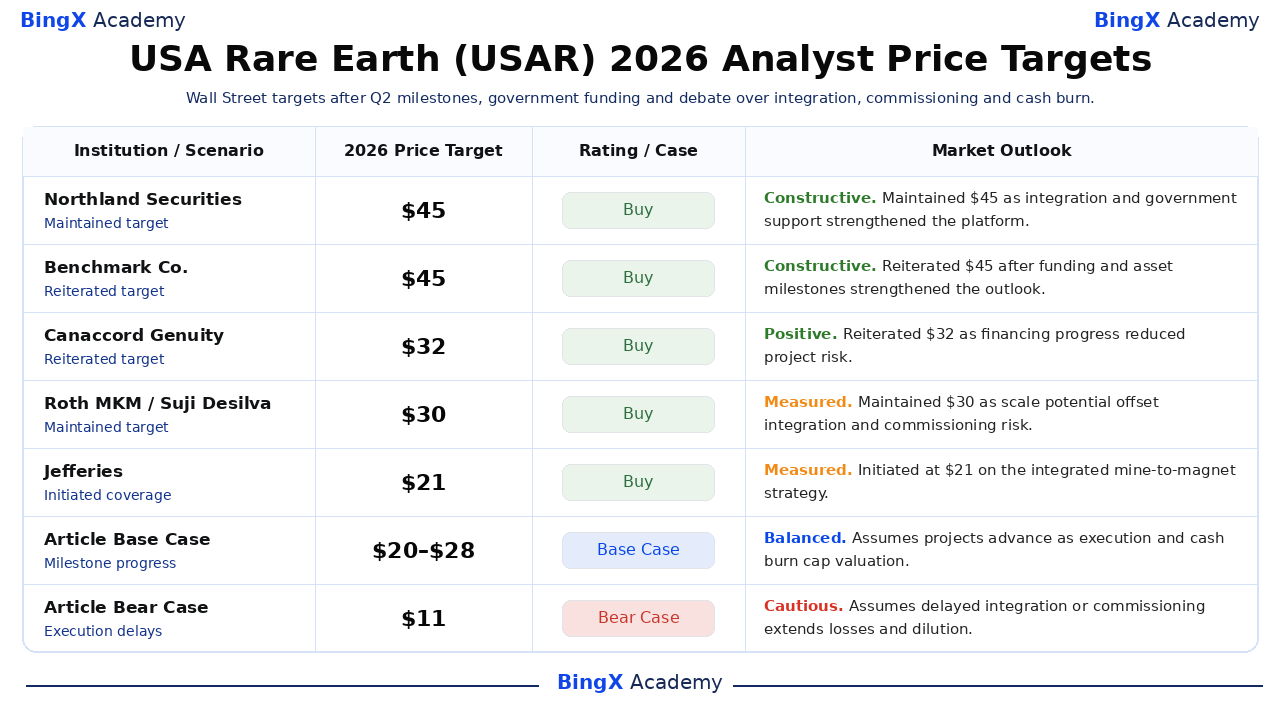
The five dated analyst actions below span $21 to $45, compared with the $15.38 reference close. They are third-party reference points rather than price promises, and their dispersion reflects different assumptions about integration and commissioning. The Base and Bear rows are BingX Academy editorial scenarios and remain separate from Wall Street targets.
|
Institution / Scenario |
2026 Price Target |
Rating / Case |
Market Outlook |
|
Northland Securities / Jeff Grampp |
$45 |
Buy |
Constructive. August 25: maintained $45 because the integrated mine-to-magnet platform and government-backed financing supported the maintained target. |
|
Benchmark Co. / Subash Chandra |
$45 |
Buy |
Constructive. August 12: maintained $45 because the Commerce funding framework and strategic asset buildout supported the reiterated target. |
|
Canaccord Genuity / George Gianarikas |
$32 |
Buy |
Positive. August 11: maintained $32 because q2 milestones reduced financing risk even as execution across several projects remained important. |
|
Roth MKM / Suji Desilva |
$30 |
Buy |
Measured. August 20: maintained $30 because the scale opportunity remained attractive, balanced by integration and commissioning requirements. |
|
Jefferies / Laurence Alexander |
$21 |
Buy |
Measured. September 2: initiated at $21 because coverage began with a positive view of the vertically integrated rare-earth and magnet strategy. |
|
Article Base Case |
20–28 |
Base Case |
Balanced. Assumes projects advance as execution and cash burn cap valuation. |
|
Article Bear Case |
$11 |
Bear Case |
Cautious. Assumes delayed integration or commissioning extends losses and dilution. |
How to Trade USA Rare Earth (USAR) Stock on BingX
Trade USA Rare Earth's financing, integration and commissioning outlook using BingX TradFi and BingX AI tools. Because USAR can react sharply to government policy, funding milestones and facility updates, traders should define both the catalyst and risk limits before entering a position.
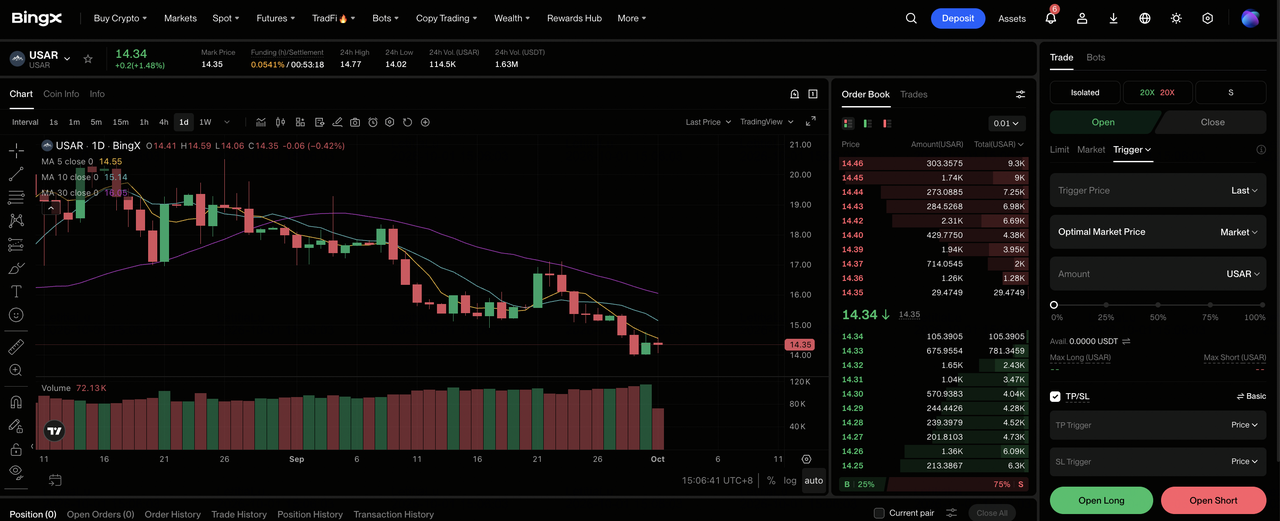
Step 1: Access BingX TradFi. Sign up and navigate to the specialized TradFi section on the BingX exchange dashboard.
Step 2: Select USA Rare Earth (USAR). Search for and select the USAR-USDT perpetual futures contract.
Step 3: Choose your direction. Select Open Long if funded projects convert into qualified output. Select Open Short if commissioning delays or cash burn weaken per-share value.
Step 4: Select leverage and margin mode. Choose Isolated or Cross-Margin based on your risk tolerance. The 29.24% YTD rise and wide analyst range show why conservative leverage is important.
Step 5: Execute strict risk protocols. Set Take-Profit and Stop-Loss (TP/SL) levels before or immediately after entering the trade. USAR can react quickly to grants, loans, rare-earth policy and plant milestones.
Top 5 Risks to Watch for USA Rare Earth Investors in 2026
USA Rare Earth's valuation depends on turning acquisitions, government support, and planned capacity into commercial production. Delays could push revenue further out, increase funding needs, or reduce future value per share.
- Acquisition integration can delay operating benefits: Pela Ema, Less Common Metals, Carester-linked activity, and Round Top span several countries and operating models. Poor integration could delay supply-chain synergies and keep corporate costs elevated.
- Commissioning may take longer than capacity targets suggest: Stillwater targets a 600 MTPA run rate in Q4 2026, while Blacksburg commissioning begins in 2028. Equipment qualification or product-specification issues could delay shipments even if nameplate capacity remains unchanged.
- Cash burn could lead to dilution: Six-month operating cash use reached $75.3 million before the largest construction commitments mature. If the $1.53 billion cash balance falls faster than project milestones are completed, new equity financing could reduce per-share upside.
- Rare-earth prices can weaken project returns: China remains dominant across separation and magnet production. Lower market prices or aggressive competitor pricing could pressure margins even if USA Rare Earth reaches planned production volumes.
- Government funding remains conditional: Up to $1.6 billion of federal support depends on project milestones and compliance requirements. Delays could increase bridge financing, debt costs, or construction timelines and reduce the value investors assign to future facilities.
Final Thoughts: Should You Invest in USA Rare Earth in 2026?
USA Rare Earth has assembled unusually broad strategic assets and a large funding runway. Q2 added $5.8 million of revenue, $1.53 billion of cash and a federal package of up to $1.6 billion, but the $46.3 million operating loss confirms that commercial scale remains ahead rather than complete.
The Bull Case requires funded facilities, integration and customer qualification to support a path toward $35. The Bear Case reflects delays and dilution that could pull USAR toward $11. Conservative traders may monitor Stillwater's 600-MTPA target, operating cash use, federal milestone releases and binding customer volumes together before treating announced capacity as dependable per-share earnings.
Risk Reminder: Trading and investing in equities like USAR involves a risk of capital loss. Project execution, commodity pricing, policy changes and leveraged trading can produce rapid losses. Conduct independent research before allocating capital.
Related Reading
- Top Energy Stocks and ETFs to Buy in 2026: The AI Power Crunch Meets Geopolitical Volatility
- Top AI Energy Stocks to Buy in 2026: Nuclear, Gas, Fuel Cells, and the AI Power Buildout
- MP Materials 2026 Price Prediction: Can MP Break $90 as the Rare Earth Supply Chain Scales?
- ExxonMobil (XOM) Price Prediction 2026: Can Oil and Production Growth Push XOM Toward $205?
- Bloom Energy (BE) Price Prediction 2026: Can AI Data-Center Power Push BE Toward $350?
