


Artificial intelligence (AI) has become an energy story as much as a computing one. Every model trained and every query answered consumes electricity, and the scale of that consumption has turned power into the single biggest constraint on the AI data center buildout. A large AI data center can draw as much electricity as a small city, and hyperscalers are now signing 20-year power agreements and funding new reactors to lock up supply years in advance. As power availability becomes the binding constraint, the companies that generate and deliver electricity have become some of the most direct public-market plays on the AI infrastructure cycle.
This guide focuses on the key stocks behind the AI energy theme, grouped by power source: fuel cells for on-site generation, small modular reactors for next-generation nuclear, established nuclear and gas producers, and grid and power equipment. Rather than looking at chips or servers, the article examines the businesses that keep AI data centers running and explains how global traders can gain exposure to selected names on BingX TradFi through USDT-margined perpetual contracts.
2026 AI Power Trend: Surging Data Center Demand Meets Grid Bottleneck
AI data centers require far more electricity than traditional computing facilities, and power availability is increasingly limiting how quickly new capacity can come online. Three forces explain why nuclear operators, gas turbine makers, fuel-cell companies, and utilities are all becoming part of the AI infrastructure buildout.
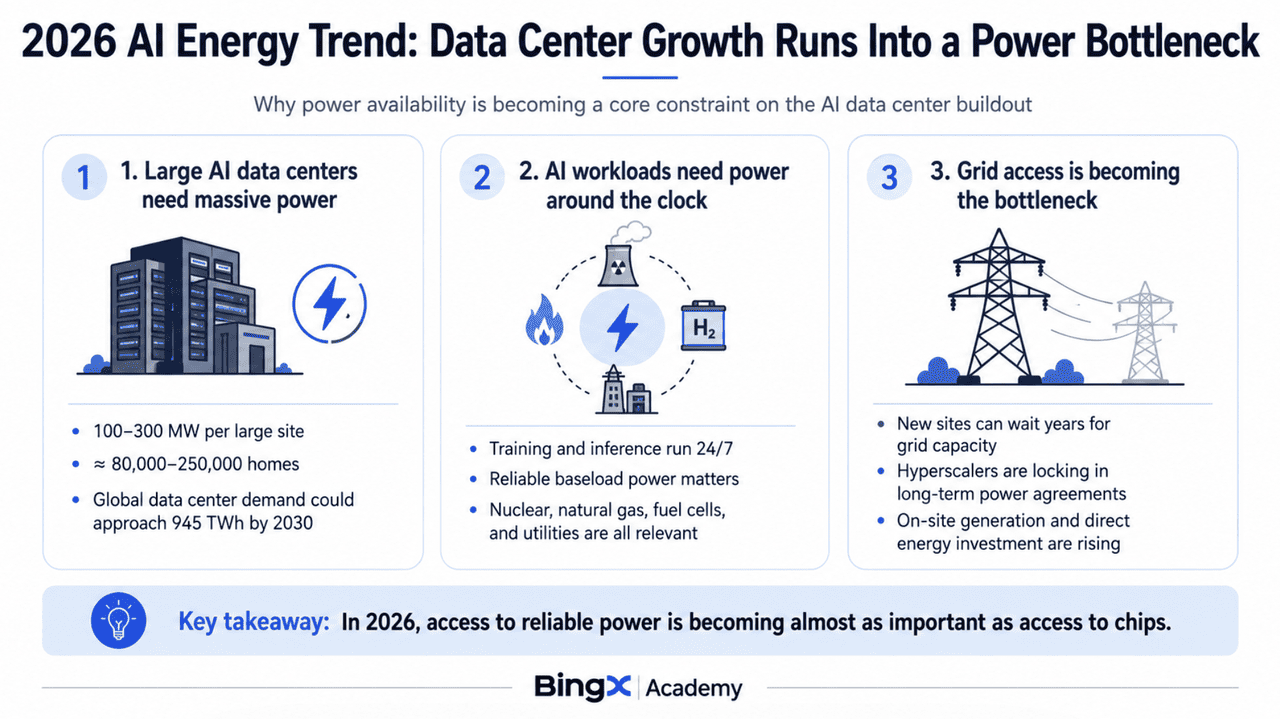
- A large AI data center can require 100 to 300 megawatts of power. That is roughly equivalent to the electricity used by 80,000 to 250,000 homes. Global data center electricity demand could more than double by 2030 to nearly 945 terawatt-hours, with AI expected to be a major driver.
- AI workloads need electricity around the clock. Training and inference run continuously, so data centers need reliable power that can support high utilization. This is increasing interest in nuclear, natural gas, fuel cells, and other sources that can provide steady power alongside renewable energy.
- Grid connections are becoming a major bottleneck. In some markets, new data centers can wait years for enough grid capacity. Hyperscalers are responding with long-term power agreements, on-site generation, and direct investment in new energy infrastructure to secure electricity before facilities are completed.
The key shift in 2026 is that access to reliable power is becoming almost as important as access to chips. Companies that can generate, supply, or deliver large amounts of electricity quickly are therefore gaining more direct exposure to the AI data center investment cycle.
Read More: Top AI Data Center Stocks to Buy in 2026: Cloud, Servers, and AI Compute Infrastructure
2026 AI Energy Stocks Overview and Comparison by Power Source
AI energy stocks span the full power stack, from on-site fuel cells and next-generation reactors to established nuclear, gas, and grid infrastructure. This comparison shows how each company captures a different part of the 2026 AI power buildout.
|
Company |
Ticker |
Primary Role |
Key Advantages |
What to Watch in 2026 |
|
Bloom Energy |
BE |
Fuel cells and on-site power |
Delivers electricity directly at data centers without waiting for grid expansion |
Revenue growth, hyperscaler deals, and new data center deployments |
|
Oklo |
OKLO |
Small modular reactors |
Pure-play exposure to next-generation compact nuclear reactors |
Customer pipeline, licensing progress, and hyperscaler partnerships |
|
Constellation Energy |
CEG |
Nuclear power producer |
Operates the largest nuclear fleet in the United States |
Long-term power agreements with major technology companies |
|
Vistra |
VST |
Nuclear and gas producer |
Large low-cost generation fleet with direct exposure to rising data center demand |
Nuclear contracts, gas generation demand, and hyperscaler power deals |
|
GE Vernova |
GEV |
Gas turbines and grid equipment |
Major supplier of gas turbines, generators, and grid infrastructure |
Backlog growth, turbine demand, and grid investment |
|
NextEra Energy |
NEE |
Renewables, nuclear, and gas |
Large U.S. utility and renewable energy developer with broad generation exposure |
Renewable backlog, grid investment, and hyperscaler power agreements |
2026 AI Power Market Overview: Why Energy Supply Is Becoming the Next Bottleneck
The 2026 AI power cycle is being driven by a simple shift: electricity is becoming one of the hardest resources to secure for new data centers. Hyperscalers are signing long-term power contracts, nuclear plants are being restarted, gas turbine demand is surging, and on-site generation is expanding as companies look for ways around grid constraints. Four forces explain where the strongest demand is emerging.
- Hyperscalers are signing power deals lasting up to 20 years. Major technology companies are locking in electricity years ahead of demand. Vistra has signed 20-year nuclear agreements to supply Amazon with up to 1,200 megawatts and Meta with more than 2,600 megawatts, showing how strategic power access has become for AI infrastructure.
- Nuclear is becoming a major source of always-on AI power. Data centers need reliable electricity around the clock, making nuclear especially attractive. Constellation, which operates the largest U.S. nuclear fleet, signed a 20-year agreement to restart a reactor for Microsoft and raised its 2026 earnings guidance as demand strengthened.
- Gas turbine demand is surging as companies need power faster. New nuclear and grid projects can take years, while gas generation can often be deployed sooner. GE Vernova’s quarterly orders rose 71% year over year to $18.3 billion, helping push its backlog to a record $163 billion.
- On-site power is growing more than 130% as data centers bypass the grid. Fuel cells and next-generation reactors can provide electricity directly at or near data centers. Bloom Energy’s revenue increased more than 130% year over year as demand for behind-the-meter power grew, while small modular reactor developers continued signing large future supply agreements.
What Are the Top AI Energy Stocks in 2026?
Six companies stand out across four major parts of the AI power stack:
- On-site power: Bloom Energy (BE)
- Next-generation nuclear: Oklo (OKLO)
- Nuclear and gas generation: Constellation Energy (CEG) and Vistra (VST)
- Grid, turbines, and utilities: GE Vernova (GEV) and NextEra Energy (NEE)
Together, they cover the main ways AI data centers secure electricity, from behind-the-meter generation and small modular reactors to large-scale nuclear, gas, and grid infrastructure.
A. Fuel Cells and On-Site Power
When grid connections take years, data centers increasingly generate power on-site. Fuel cells convert natural gas or hydrogen into electricity through a chemical reaction, delivering clean, reliable power behind the meter, without waiting for the grid.
1. Bloom Energy (BE)
Core Role: On-site fuel cells for behind-the-meter power
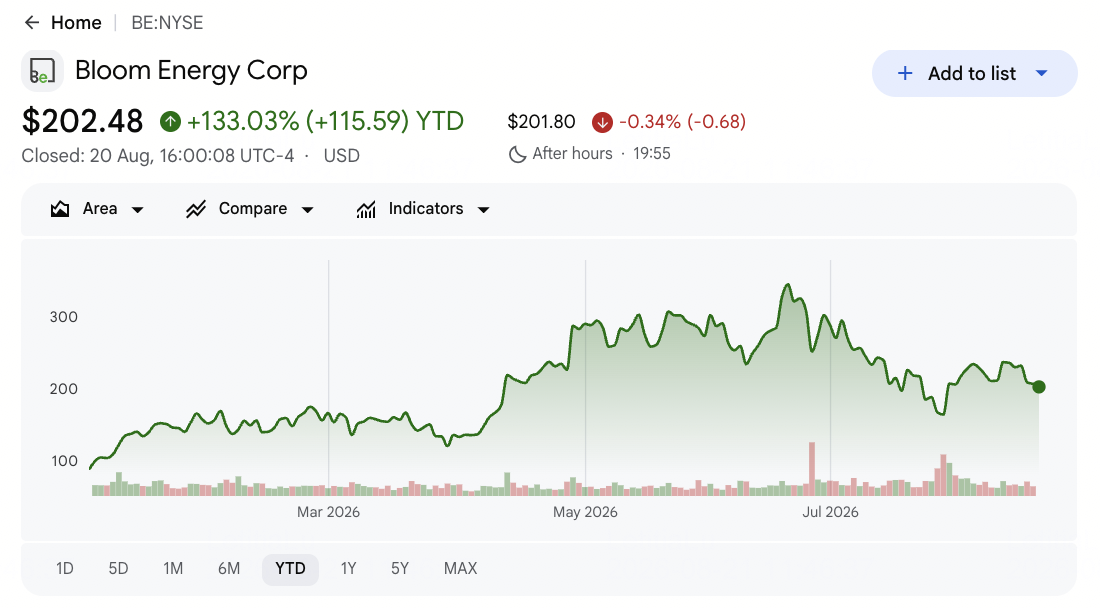
Bloom Energy makes solid-oxide fuel cells that generate electricity on-site, letting data centers produce their own power without waiting for grid interconnection. As power access becomes the binding constraint on AI buildouts, Bloom's behind-the-meter approach has become a strategic solution for hyperscalers and neoclouds that need capacity fast, and its fuel cells can run on natural gas today with a path to hydrogen over time.
Bloom's revenue surged more than 130% year over year in early 2026, and management raised full-year guidance to 3.4-3.8 billion, implying roughly 80% growth at the midpoint, up from prior guidance of about 60%. A high-profile win came when a major AI cloud operator named Bloom as the behind-the-meter power partner for a planned 300-megawatt New Jersey data center. The main risks are extreme volatility, with a beta near 3.7, a valuation well above consensus targets, and sensitivity to individual project timing, but Bloom offers the most direct exposure to the on-site AI power theme.
Read More: Bloom Energy Stock Outlook 2026: Could BE Hit $300+ on Solid Oxide Fuel Cells, AI Data Center Power?
BE Price Trend (2020-2026 YTD)
|
Year |
Yearly High |
Yearly Low |
Annual Return |
Market Conditions |
|
2020 |
$30.00 |
$2.00 |
290% |
Pandemic recovery; hydrogen narrative emerges |
|
2021 |
$44.00 |
$16.00 |
-47% |
Hydrogen hype fades; unprofitability concerns |
|
2022 |
$32.00 |
$12.00 |
2% |
Energy transition demand; margin pressure |
|
2023 |
$31.00 |
$9.00 |
-42% |
Rate hikes weigh on clean energy |
|
2024 |
$28.00 |
$8.00 |
20% |
AI power narrative begins; data center interest |
|
2025 |
$60.00 |
$16.00 |
160% |
Behind-the-meter AI power demand accelerates |
|
2026 YTD |
~$130 (Aug) |
~$55 (Jan) |
+55% YTD |
Revenue +130%; FY guide raised; hyperscaler wins |
B. Small Modular Reactors (SMRs)
Small modular reactors are a next-generation form of nuclear power: compact, factory-built reactors designed to deploy faster and at smaller scale than traditional plants. They have become a favored long-term answer to AI power demand, though most are still pre-revenue and depend on regulatory and construction milestones.
2. Oklo (OKLO)
Core Role: Small modular nuclear reactors for AI data centers
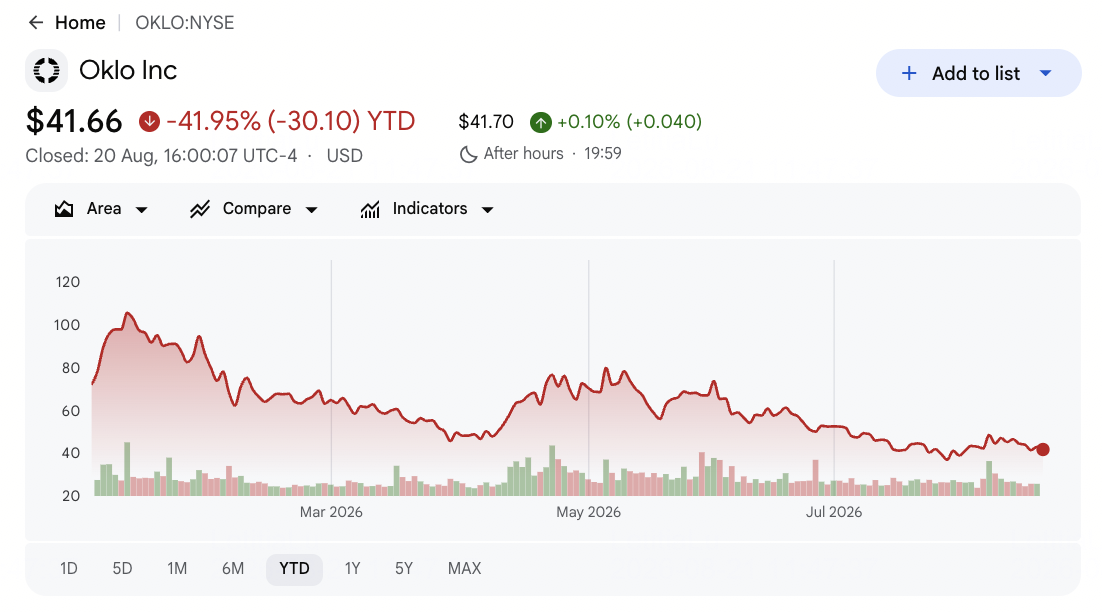
Oklo is a pure-play advanced nuclear company developing compact reactors designed to provide reliable, carbon-free power for data centers, military sites, and industrial facilities. Its flagship Aurora powerhouse is aimed at customers that need dedicated electricity without relying entirely on the grid, making Oklo one of the clearest listed plays on small modular reactors and AI power demand.
Oklo is still pre-revenue and reported a year-to-date net loss of $81.6 million through Q2 2026, but ended the quarter with about $3 billion in cash. Its customer pipeline is near 14 gigawatts, supported by agreements with Switch, Meta, and other partners, while Aurora continues through regulatory development. The main risks are delayed reactor timelines, non-binding customer agreements, and a valuation driven more by future milestones than current revenue.
Note: Oklo began trading via SPAC in 2024, so multi-year historical data is limited and the company remains pre-revenue.
OKLO Price Trend (2024 IPO-2026 YTD)
|
Year |
Yearly High |
Yearly Low |
Annual Return |
Market Conditions |
|
2024 |
$30.00 |
$6.00 |
90% |
SPAC listing; advanced nuclear narrative |
|
2025 |
$172.00 |
$6.00 |
180% |
SMR hype; NRC progress; NVIDIA collaboration |
|
2026 YTD |
~$140 (est.) |
~$45 (est.) |
+10% YTD |
Aurora NRC milestones; 14 GW pipeline; $3B cash |
C. Nuclear Power Producers
Established nuclear operators run the large reactor fleets that provide reliable, carbon-free baseload power. As AI data centers seek around-the-clock electricity, these producers have signed some of the largest and longest power agreements in the sector.
3. Constellation Energy (CEG)
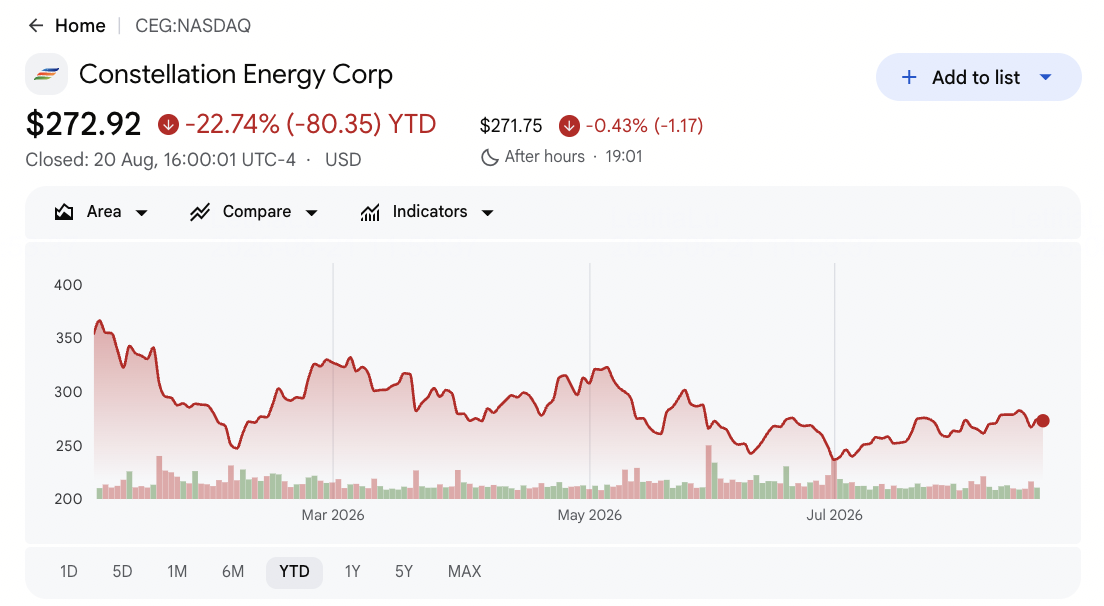
Core Role: Nuclear power leader for AI data centers
Constellation Energy operates the largest nuclear fleet in the United States and also has substantial natural gas generation following its Calpine acquisition. Its nuclear plants provide the reliable, around-the-clock electricity AI data centers need, and the company has signed major long-term power agreements with hyperscalers, including Microsoft and Meta.
Q2 2026 adjusted EPS reached $2.55, and management raised full-year guidance to $11.50 to $12.50 per share as hyperscaler demand strengthened. The Calpine deal also expanded Constellation’s gas-generation exposure and earnings base. The main risks are weaker merchant power margins and the long timelines required to add new nuclear capacity, but CEG remains one of the clearest large-cap plays on AI-driven power demand.
CEG Price Trend (2022 Spinoff-2026 YTD)
|
Year |
Yearly High |
Yearly Low |
Annual Return |
Market Conditions |
|
2022 |
$50.00 |
$37.00 |
109% |
Spinoff from Exelon; nuclear repricing begins |
|
2023 |
$120.00 |
$40.00 |
100% |
AI power narrative emerges; nuclear premium |
|
2024 |
$270.00 |
$100.00 |
92% |
Microsoft PPA; hyperscaler nuclear demand |
|
2025 |
$350.00 |
$122.00 |
25% |
Calpine acquisition; capacity deals expand |
|
2026 YTD |
~$350 (est.) |
~$200 (est.) |
-20% YTD |
Q2 EPS beat; FY guide raised to 11.50-12.50 |
4. Vistra (VST)
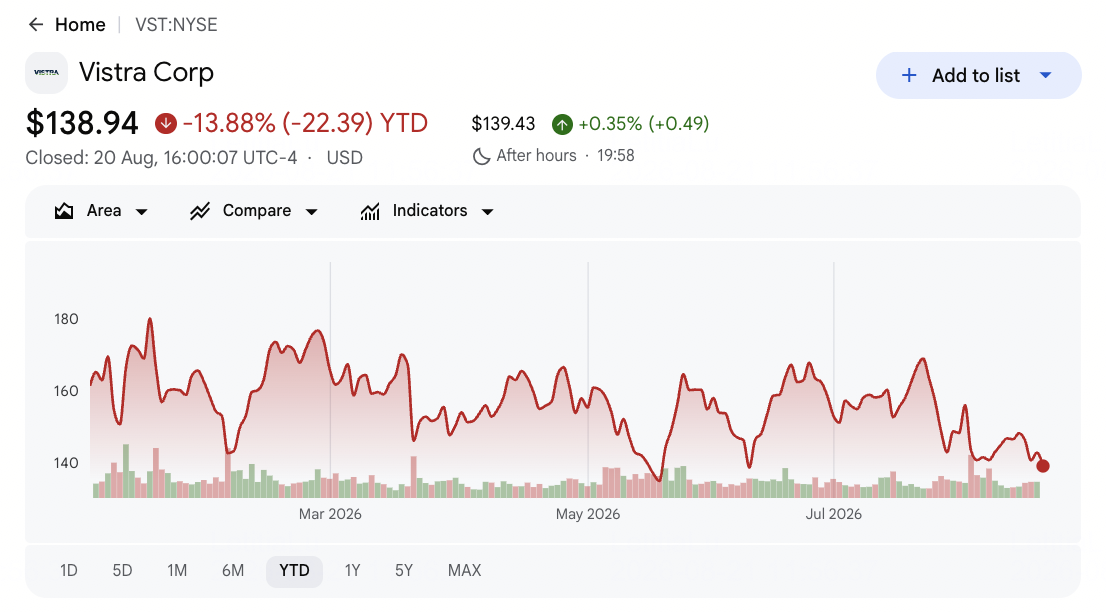
Core Role: Nuclear and natural gas power for AI data centers
Vistra is one of the largest competitive power producers in the United States, with roughly 44 gigawatts of capacity across natural gas, nuclear, coal, and renewables. Its low-cost nuclear and gas fleet gives it direct exposure to rising data center electricity demand, and the company has increasingly positioned its generation assets around long-term hyperscaler power needs.
Q1 2026 revenue rose 43% year over year, while management guided full-year adjusted EBITDA to $6.8 billion to $7.6 billion. Vistra also signed 20-year nuclear agreements with Meta for more than 2,600 megawatts and Amazon for up to 1,200 megawatts, and joined the NVIDIA-backed Helix Digital Infrastructure venture as a preferred power provider. The main risks are power-price volatility, hedge-accounting swings, and execution on new capacity, but Vistra offers strong exposure to AI-driven nuclear and gas demand.
VST Price Trend (2020-2026 YTD)
|
Year |
Yearly High |
Yearly Low |
Annual Return |
Market Conditions |
|
2020 |
$24.00 |
$12.00 |
-25% |
Pandemic disruption; power demand base |
|
2021 |
$22.00 |
$16.00 |
-3% |
Texas winter storm; merchant power volatility |
|
2022 |
$27.00 |
$19.00 |
21% |
Energy demand recovery; capacity value |
|
2023 |
$39.00 |
$22.00 |
65% |
AI power narrative emerges; nuclear premium |
|
2024 |
$150.00 |
$37.00 |
258% |
Nuclear deals; hyperscaler demand surges |
|
2025 |
$200.00 |
$120.00 |
15% |
Meta and Amazon PPAs; capacity expansion |
|
2026 YTD |
~$215 (52-wk) |
~$130 (est.) |
+5% YTD |
Q1 rev +43%; Helix JV; $6.8-7.6B EBITDA guide |
D. Natural Gas, Grid, and Renewables
Beyond reactors, AI data centers need gas turbines for fast, dispatchable power, grid equipment to move electricity, and large-scale renewables. These companies supply the equipment and diversified generation that connect AI demand to the power system.
5. GE Vernova (GEV)
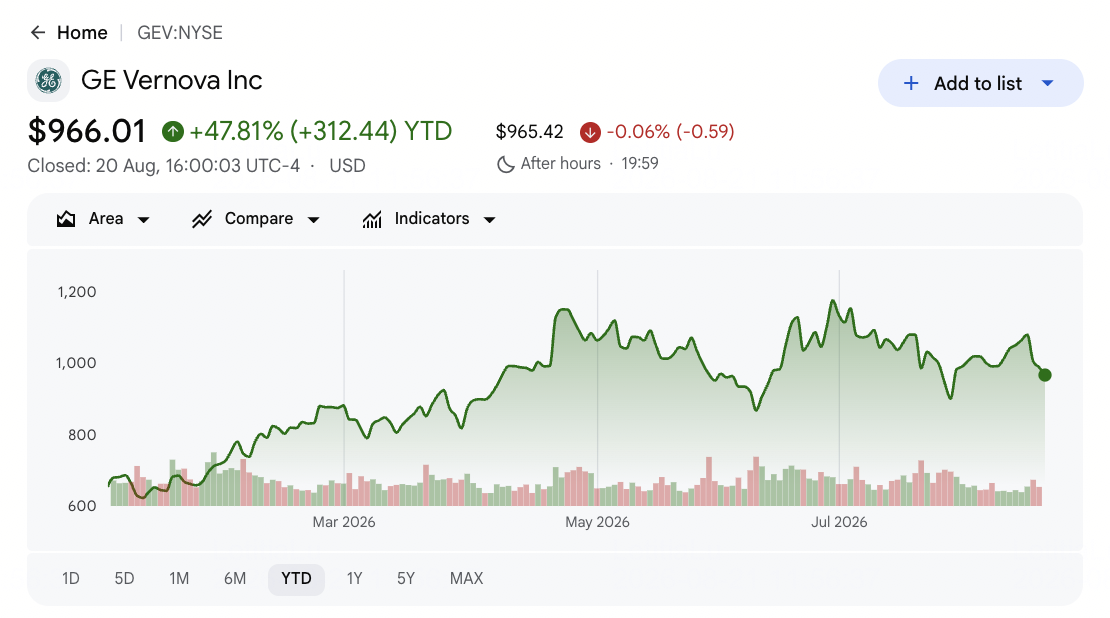
Core Role: Gas turbines and grid equipment for AI power
GE Vernova is a major supplier of gas turbines, transformers, switchgear, and other equipment used to generate and move electricity. Its gas turbines are especially relevant to AI data centers because they can provide fast, reliable power when grid connections are delayed, while its electrification business supplies the infrastructure needed to connect new generation capacity.
Q1 2026 revenue reached $9.34 billion and adjusted EPS was $2.01, while orders rose 71% year over year to $18.3 billion and backlog reached a record $163 billion. Data-center equipment orders in electrification totaled $2.4 billion in the quarter, more than the entire prior year. The main risks are supply-chain constraints, execution as turbine production scales, and the cyclical nature of large equipment orders, but GEV offers direct exposure to the gas-and-grid side of AI power.
GEV Price Trend (2024 Spinoff-2026 YTD)
|
Year |
Yearly High |
Yearly Low |
Annual Return |
Market Conditions |
|
2024 |
$180.00 |
$115.00 |
150% |
Spinoff from GE; power demand narrative |
|
2025 |
$600.00 |
$130.00 |
65% |
AI power surge; gas turbine backlog builds |
|
2026 YTD |
~$1,065 (Aug) |
~$300 (est.) |
+30% YTD |
Q1 orders +71%; $163B backlog; data center demand |
Note: GE Vernova began trading after its spinoff from General Electric in 2024, so multi-year historical data is limited.
6. NextEra Energy (NEE)
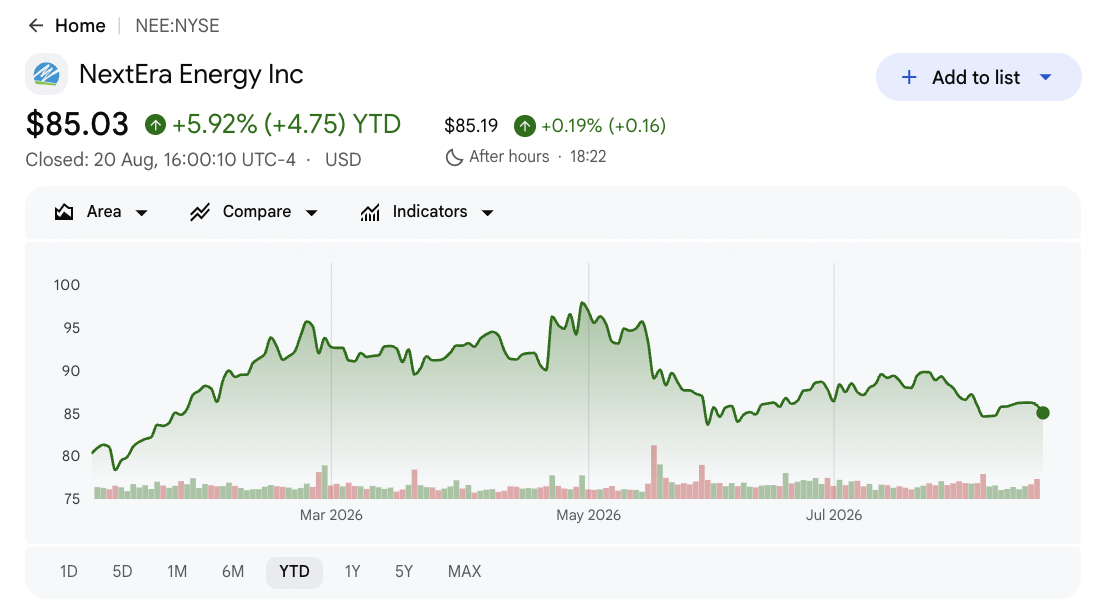
Core Role: Utility and clean energy provider for AI data centers
NextEra Energy is one of the largest U.S. power companies, combining Florida Power & Light with a major renewable energy and storage business. Its mix of solar, wind, battery storage, natural gas, and nuclear gives it several ways to supply the large and reliable electricity loads required by AI data centers.
Q2 2026 adjusted EPS rose 9.5% year over year to $1.15, while revenue increased 12.4% to $7.53 billion. Its renewables and storage backlog reached 35.1 gigawatts, and Florida Power & Light has about 12 gigawatts of large-load projects in advanced discussions. The main risks are heavy capital spending and execution across a large project pipeline, but NextEra offers one of the more diversified ways to gain exposure to rising AI power demand.
NEE Price Trend (2020-2026 YTD)
|
Year |
Yearly High |
Yearly Low |
Annual Return |
Market Conditions |
|
2020 |
$83.00 |
$42.00 |
30% |
Pandemic recovery; renewables leadership |
|
2021 |
$93.00 |
$68.00 |
23% |
Clean energy demand; rate environment |
|
2022 |
$92.00 |
$67.00 |
-10% |
Energy transition; rate-hike pressure |
|
2023 |
$88.00 |
$47.00 |
-28% |
Rate hikes weigh; renewables headwinds |
|
2024 |
$86.00 |
$53.00 |
28% |
AI power narrative; demand recovery |
|
2025 |
$88.00 |
$61.00 |
2% |
Data center demand; nuclear restart plans |
|
2026 YTD |
~$90 (Aug) |
~$65 (Jan) |
+8% YTD |
Q2 EPS +9.5%; 35 GW backlog; hyperscaler deals |
How to Trade AI Energy Stocks on BingX
BingX offers a crypto-native way to gain exposure to leading AI energy stocks without using a traditional brokerage account. The main execution path is through USDT-margined perpetual contracts on BingX TradFi, which allow active traders to go long or short and trade around earnings, power purchase agreements, capacity announcements, and broader AI power-cycle trends.
Long or Short AI Energy Stock Futures with USDT on BingX TradFi
For active traders looking to capitalize on short-term momentum, earnings volatility, or AI power catalysts, BingX TradFi allows users to trade energy-linked stock futures with USDT. These USDT-settled perpetual contracts mirror the price movements of underlying equities, offering flexible long and short exposure without requiring users to hold the physical stock.
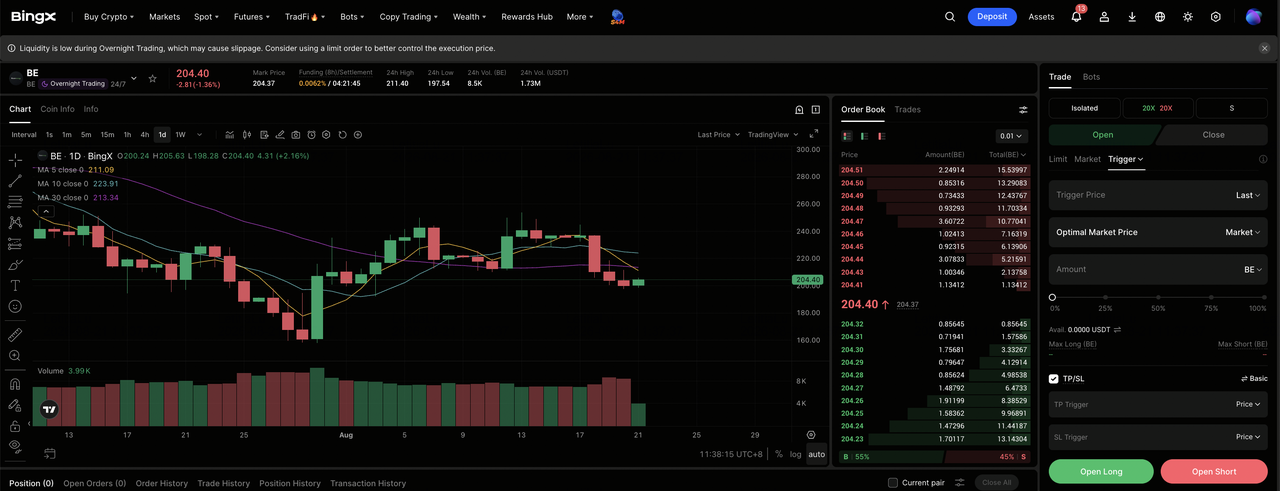
Step 1: Account setup and security. Sign up and log into your BingX account, complete the identity verification (KYC) required in your region, and enable two-factor authentication.
Step 2: Allocate trading capital. Transfer USDT from your spot wallet into your futures account, where it will serve as collateral.
Step 3: Select your contract. Navigate to the TradFi markets page or the futures trading section. Choose energy-linked perpetual contracts such as BE-USDT, OKLO-USDT, CEG-USDT, VSTUS-USDT, GEV-USDT, or NEE-USDT.
Step 4: Set direction and leverage. Open long if you expect the stock price to rise, or open short if you expect a pullback. Choose leverage based on your risk plan.
Step 5: Execute and manage risk. Set stop-loss and take-profit orders before submitting the trade. PnL settles dynamically in USDT.
Risks and Core Considerations When Trading AI Energy Stocks
AI energy stocks benefit from rising data center power demand, but the sector also carries risks tied to AI spending, project execution, regulation, and high valuations.
- AI power demand could grow more slowly than expected. Many of these stocks are priced for continued expansion in data center electricity demand. If hyperscaler spending slows, power contracts, equipment orders, and valuations could come under pressure.
- Power projects can take years to complete. Nuclear plants, grid upgrades, and new generation capacity often face construction, interconnection, and regulatory delays. Slower project timelines can push revenue further into the future.
- Pre-revenue nuclear names remain highly speculative. Companies such as Oklo are valued largely on licensing milestones, future projects, and customer agreements rather than current revenue. Any setback can trigger sharp stock declines.
- Regulation and power prices can affect earnings. Utilities and power producers operate in heavily regulated markets, while merchant generators are also exposed to changing wholesale electricity prices and hedging effects.
- Volatility can be amplified by leverage. AI energy stocks can move sharply on contracts, earnings, regulatory decisions, or changes in AI demand expectations. Traders using USDT-margined futures should keep position sizes controlled and use clear stop-loss levels.
Final Thoughts: Should You Add AI Energy Stocks to Your 2026 Portfolio?
The six stocks above offer different ways to gain exposure to the AI power buildout. Bloom Energy represents on-site fuel cells, Oklo next-generation nuclear, Constellation and Vistra large-scale nuclear and gas generation, GE Vernova gas turbines and grid equipment, and NextEra Energy diversified utility and renewable power. Together, they cover the main ways AI data centers secure electricity.
The main difference is risk. Bloom Energy and Oklo offer higher upside but depend more heavily on project execution and future demand, while Constellation and Vistra are tied to power prices and long-term contracts. GE Vernova and NextEra provide broader infrastructure exposure but still face capital spending and execution risks. For traders using BingX TradFi, position sizing, leverage control, and stop-loss orders are especially important because AI energy stocks can move sharply on contracts, earnings, regulatory decisions, and changes in data center demand.
Related Reading
- Top AI Data Center Stocks to Buy in 2026: Cloud, Servers, and AI Compute Infrastructure
- Top AI Hyperscaler Stocks to Watch in 2026: The $700 Billion Cloud Infrastructure Race
- Top AI Server Stocks to Buy in 2026: Rack-Scale Systems, GPU Servers, and AI Servers Infrastructure
- Top AI Optical Stocks to Buy in 2026: Photonics, Optics, Fiber, and Data Center Interconnects
- Top AI Networking Stocks 2026: AI Fabric, Switches, Copper, Fiber, and Optics Connectivity
- Top AI Compute and GPU Stocks to Buy in 2026: The Shift to Inference and Custom Silicon
