
Since the collapse of FTX in November 2022, which wiped out approximately 8 billion dollars in customer funds according to Chainalysis data, the question every Brazilian trader should ask before depositing any amount into an exchange has changed. It is no longer “which exchange has the lowest fees?” but rather “can this exchange prove that my money is actually there?” Proof of reserves emerged as a direct response to this crisis of trust, and understanding how it works is no longer just technical curiosity—it has become a survival skill in the crypto market.
Quick answer: Proof of reserves is an audit mechanism that allows an exchange to publicly demonstrate that customer assets held in custody actually exist in its wallets. To verify whether your exchange is trustworthy: (1) confirm that it publishes proof of reserves audits, (2) check whether the reserve ratio is equal to or greater than 100%, (3) verify your own balance through the Merkle tree hash, and (4) prefer exchanges audited by recognized independent firms.
What Is Proof of Reserves and Why It Matters
Imagine you keep money in a bank, and suddenly the bank starts saying it has all your money but refuses to show statements. Under normal conditions, the Central Bank of Brazil requires these institutions to prove their solvency. In the crypto market, until recently, no equivalent regulation existed—and some exchanges took advantage of that.
Proof of reserves is the mechanism that fills this gap. Technically, it is a cryptographic audit that combines two elements: verification of the actual balances in the exchange’s wallets (visible on-chain) and confirmation that those balances cover the totality of customer deposits. When both match, the exchange is considered solvent.
This matters to Brazilian traders because, unlike bank deposits, funds held on crypto exchanges are not protected by the Brazilian Credit Guarantee Fund (FGC). If an exchange fails, there is no government body that will reimburse you. For now, proof of reserves is the main protection available.
Positive and Negative Proof of Reserves
There is an important distinction that many articles ignore: an exchange can have 100% of reserves verified and still be in a fragile position if it has hidden liabilities on its balance sheet. That is why the stronger concept is proof of solvency, which combines proof of reserves with proof of liabilities. An exchange showing 1.2 billion dollars in reserves in BTC but carrying 900 million in undisclosed loans is not necessarily safe—something made clear by Celsius and other platforms that collapsed in 2022.
How the Merkle Tree Works
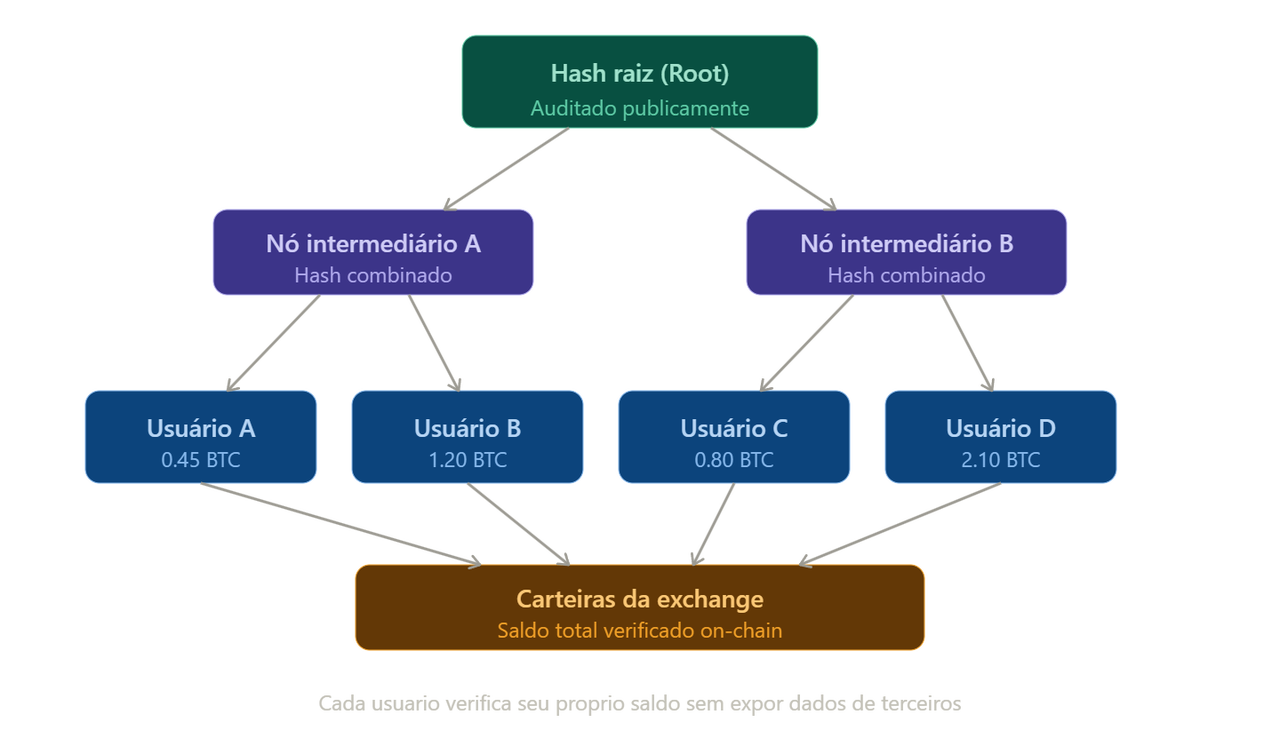
The technical core of proof of reserves is a data structure called the “Merkle tree.”
Each exchange customer has a “leaf node” containing their anonymized ID and total account balance. These nodes are grouped and mathematically combined (via hash functions) to generate intermediate nodes, which are then combined again until a single “root hash” is produced. This root hash is published by the exchange and can be audited by anyone.
The elegant property of the Merkle tree is that you can verify that your own balance is correctly included in the total without needing to see any other customer’s data. Each user receives a “Merkle proof”—a set of hashes connecting their leaf node to the root hash. If the result matches, you know your balance was included correctly. If it does not, there is a serious problem.
How to Verify It Yourself
- Access the proof of reserves page of the exchange where you trade (BingX Proof of Reserves)
- Download your individual Merkle proof (usually available in your account area)
- Use the verification tool provided by the exchange or an independent open-source verifier
- Confirm that the root hash shown in your verification matches exactly the one published by the exchange
- Check blockchain explorers to confirm that the exchange wallet addresses actually contain the declared amounts
Reserve Ratio: The Number You Need to Monitor
The reserve ratio is the most direct metric for evaluating the financial health of an exchange. The formula is simple:
Reserve Ratio = Assets in Custody / Customer Liabilities x 100%
A ratio of 100% means the exchange has exactly enough to honor all withdrawals simultaneously. Any value below that is a serious warning sign—it indicates that the exchange is using customer funds for other purposes, which would represent, at minimum, poor management and, in the worst-case scenario, fraud.
Practical example: if an exchange declares it holds 50,000 BTC in verifiable wallets and the combined deposits of all customers total 48,000 BTC, the reserve ratio is approximately 104%. This surplus may come from the exchange’s own capital or reinvested operating revenue.
Exchanges with ratios consistently above 100% across multiple assets offer the highest level of security. BingX publishes monthly proof of reserves reports covering BTC, ETH, USDT, and other major assets, with ratios verifiable on the official website and audited by independent firms. This level of asset-by-asset detail matters because an exchange may have 100% reserves in BTC but still be underfunded in stablecoins—and that is exactly the kind of detail granular audits reveal.
CEX vs. DEX: Who Really Needs Proof of Reserves
The discussion about proof of reserves is, by definition, a discussion about centralized exchanges (CEXs). In a decentralized exchange (DEX) such as Uniswap or Curve, you never transfer custody of your assets to a third party—the transactions happen directly between wallets via smart contracts, and the concept of “exchange reserves” simply does not exist in the same way.
This does not mean DEXs are risk-free. Smart contract vulnerabilities, flash loan attacks, and oracle manipulation are real risks in the decentralized ecosystem. But institutional insolvency risk—the type of risk proof of reserves aims to mitigate—is exclusive to CEXs.
For the typical Brazilian trader profile, who uses CEXs because of superior liquidity, easier onboarding with Brazilian reais (BRL) through the P2P market, and the availability of products such as futures and copy trading, proof of reserves remains the most relevant security metric to monitor.
The Brazilian Regulatory Context in 2026
Law 14.478/2022, which established the legal framework for virtual asset service providers (VASPs) in Brazil, created the foundation for the Central Bank to require greater transparency from exchanges operating in the country. In 2023, Bacen was designated as the main regulator of the sector, and since then it has been advancing rules that include asset segregation requirements between the exchange’s own funds and customer funds.
This segregation point is directly connected to proof of reserves: an exchange that mixes its operating capital with customer deposits cannot present clean proof of reserves. Brazilian regulation is therefore moving in the same direction as the best international market standards.
For traders operating in Brazil, this means exchanges that already adopt proof of reserves voluntarily are better positioned to meet future regulatory requirements without disruption. It is a selection criterion that goes beyond immediate security and touches on the long-term sustainability of the platform.
Which Exchanges Publish Proof of Reserves and How They Compare
BingX has implemented proof of reserves with Merkle tree verification and publishes monthly reports by asset. The platform uses third-party auditing and provides an individual verification tool directly to end users—a level of transparency that goes beyond what many exchanges offer, especially in terms of asset-by-asset detail and the frequency of data updates.
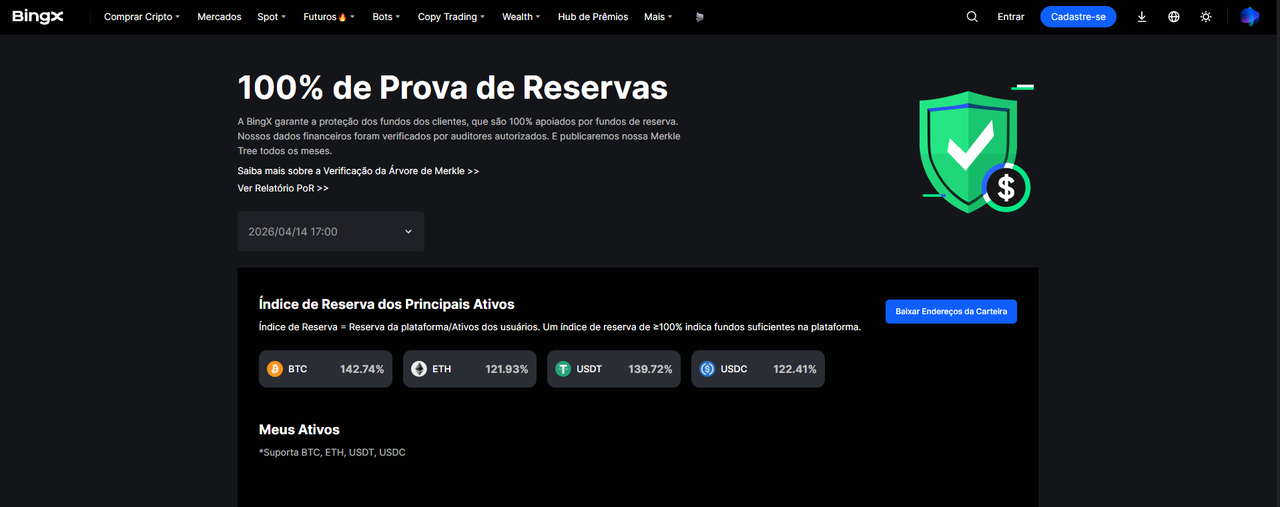
Other major exchanges also publish proof of reserves reports on a monthly basis with Merkle tree verification.
What differentiates platforms is not only the existence of an audit, but also its granularity: audits that show a separate reserve ratio for BTC, ETH, USDT, and other major assets reveal much more about real financial health than an aggregated number that may hide unbalanced exposure to a specific asset.
Warning Signs: When an Exchange May Be at Risk
Some behaviors are red flags regardless of what the exchange claims publicly:
The exchange delays or suspends withdrawals without a clear explanation. This was one of the first signs of the FTX and Celsius crises—solvent platforms honor withdrawals immediately. Any unexplained delay should be treated with extreme caution.
The exchange does not publish proof of reserves or only publishes aggregated data without individual verification. Real transparency means that an ordinary user, without advanced technical knowledge, can verify their own balance using the tools provided.
The exchange offers yields far above the market without explaining the source of the returns. Rates of 20% or 30% per year in stablecoins usually involve high counterparty risk or the use of deposits in undisclosed risky strategies.
The exchange’s native token represents a significant share of declared reserves. This was a central problem at FTX, which used FTT—its own token—as collateral. An asset controlled by the exchange itself can be manipulated and does not represent a real reserve.
FAQ — Real Questions from Brazilian Traders
1. What is proof of reserves in crypto?
It is a cryptographic audit mechanism that makes it possible to publicly verify whether a centralized exchange holds the assets it claims to custody for its customers. It uses Merkle tree technology so each user can confirm their own balance without exposing third-party data.
2. How do I verify my exchange’s proof of reserves?
Go to the exchange’s proof of reserves section, download your individual Merkle proof, and use the verification tool provided by the platform or an independent open-source verifier. Confirm that the root hash matches the published one and check the wallet addresses on blockchain explorers. On BingX, the process is handled directly through the support center.
3. Is a 100% reserve ratio enough to guarantee total safety?
Not entirely. A 100% ratio confirms that the assets exist, but it does not reveal hidden liabilities such as loans or contractual obligations. The more complete concept is proof of solvency, which considers both assets and liabilities. A ratio consistently above 100% and audited by independent firms is the safest standard available today.
4. What is the difference between a proof of reserves audit and a traditional financial audit?
A proof of reserves audit is publicly verifiable by anyone in near real time using cryptography. A traditional financial audit is conducted by an accounting firm at periodic intervals, and the results are usually not accessible to the general public. Combining both offers the highest level of assurance.
5. Why does the Brazilian regulatory context make proof of reserves even more important?
Because Central Bank regulation for VASPs is evolving toward requiring asset segregation and greater transparency. Exchanges without proof of reserves may face difficulties operating legally in Brazil in the coming years, which represents an additional risk beyond immediate solvency.
6. Does proof of reserves guarantee that I will not lose my money?
It is not an absolute guarantee, but it is the best protection currently available for those who use centralized exchanges. Proof of reserves confirms that the assets exist at the time of the audit, but it does not prevent every risk, such as hacks or operational errors. That is why you should always enable 2FA on your account and follow good risk management practices. The golden rule remains: do not keep funds on exchanges that you cannot afford to lose.
Key Takeaways
- Proof of reserves is a cryptographic audit mechanism that verifies whether an exchange actually holds its customers’ assets
- The Merkle tree allows each user to confirm their own balance without exposing other customers’ data
- The ideal reserve ratio is equal to or above 100% per asset, verified by an independent firm
- Proof of solvency goes beyond reserves and also considers the exchange’s liabilities
- Exchanges that do not publish proof of reserves or delay withdrawals represent elevated risk
- Brazilian regulation, including Law 14.478/2022 and Bacen rules, is moving toward requiring greater transparency, making exchanges with proof of reserves better prepared for the regulatory future
- Never keep funds on exchanges that you could not afford to lose. Proof of reserves reduces risk, but it does not eliminate it. Consider hardware wallets to store larger amounts outside platforms
Related Articles
- What Are Cold Wallets and Hot Wallets: Differences and When to Use Each One
- Crypto Regulation in Brazil in 2026: What Changed and How It Affects Your Investment
- How to Choose a Secure Cryptocurrency Exchange: Complete Checklist
- CEX, DEX, or P2P: How to Buy Crypto in Brazil in 2026
- What are Crypto Proof of Reserves (PoR) and Why Does It Matter?
- Top 10 Safest Crypto Exchanges in 2026 and How to Choose The Best One For You
- Top 5 Crypto Exchanges with the Best User Experience (UX) for Beginners in 2026
