

Lightwave Logic (LWLG) develops proprietary electro-optic polymers for high-speed optical modulators used in data communications and photonic systems. Its Perkinamine materials are designed to move more data with lower drive voltage than conventional approaches, while material supply, intellectual-property licensing and production royalties form the long-term revenue model. That opportunity gives LWLG exposure to AI data-center connectivity, but makes the stock highly sensitive to customer qualification, foundry yields and commercialization timing.
The latest quarter showed technical and customer progress without a meaningful revenue inflection. Lightwave Logic Q2 2026 licensing and royalty revenue reached $32,751, up 27.9% from $25,605, while net loss widened 33% to $6.61 million. Cash and marketable securities totaled $95.91 million with no debt, giving management runway to pursue five Stage 3 customer programs even though volume-production revenue is not expected before 2027 at the earliest.
The LWLG stock forecast for 2026 now centers on two competing views:
- The qualification and foundry-integration case: Five late-stage customer programs, multiple foundry paths and the SilTerra PDK convert technical validation into production commitments, giving investors evidence that the 18-to-24-month design-win cycle can support a 2027 ramp.
- The delay and dilution case: Reliability, yield or customer schedules slip beyond 2027 while quarterly operating expenses remain above $7 million, extending the gap between modest licensing revenue and the capital required for commercialization.
This guide breaks down the LWLG stock forecast, 2026 price scenarios, key risks and analyst outlooks, drawing on Lightwave Logic's August 14, 2026 Q2 filing and market data through September 24, plus how to trade LWLG stock futures on BingX TradFi with USDT collateral.
Top 5 Things for Lightwave Logic Investors to Know in September 2026
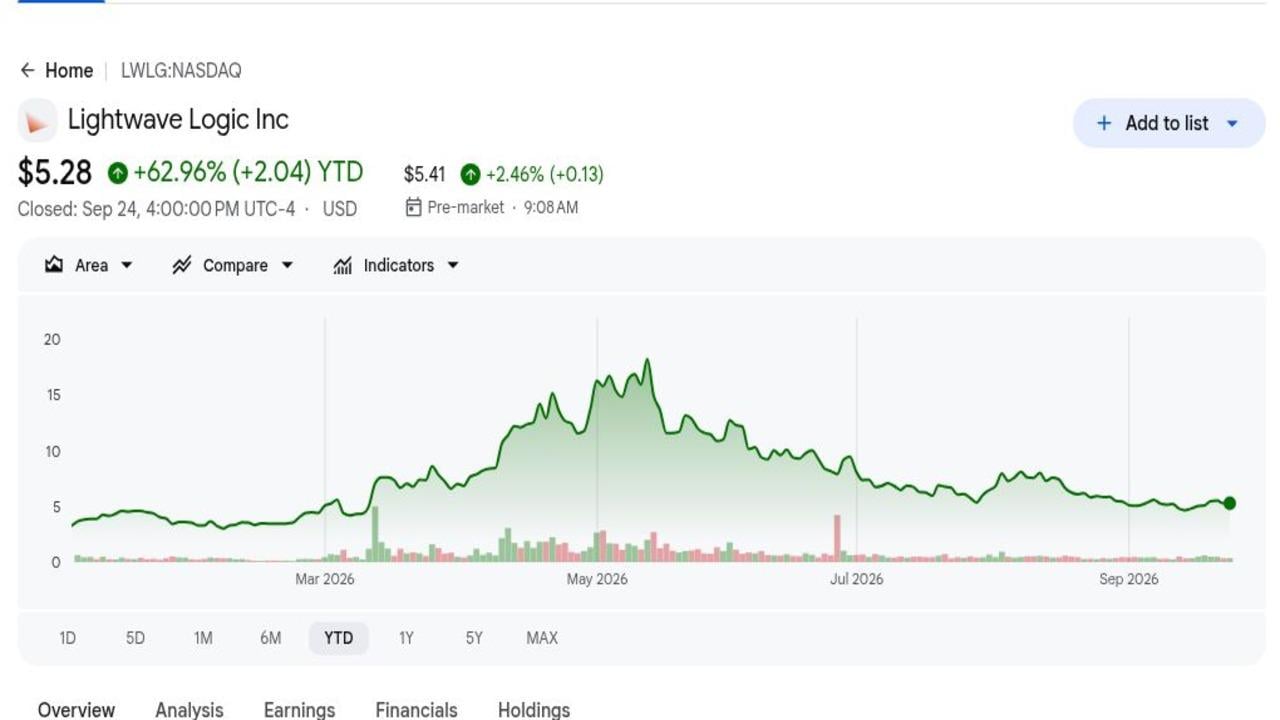
- $5.28 left LWLG up 62.96% YTD: The September 24 reference close reflected a substantial re-rating from the start of 2026, yet remained 47.2% below Freedom Capital Markets' $10 target. That gap shows how much of the valuation still depends on customer programs reaching production.
- $32,751 of Q2 revenue increased 27.9%: Licensing and royalty revenue rose from $25,605 a year earlier, but remained tiny relative to $7.30 million of quarterly operating expense. Revenue growth therefore confirms activity and customer engagement, not commercial scale or sustainable profitability.
- Five customer programs reached Stage 3: Stage 3 normally covers prototype-to-final-product work and can last 12 to 18 months. Progress at this stage is more decision-useful than early evaluations, though it still does not guarantee a production order, acceptable yield or final customer qualification.
- $95.91 million of liquidity supports operations through December 2027: Cash totaled $47.21 million and marketable securities added $48.70 million at June 30. The debt-free balance sheet reduces immediate financing pressure while qualification work continues across multiple foundry and customer programs.
- 2027 remains the earliest expected volume-production year: Management said 2026 revenue should mainly come from materials, NRE and prototypes. The timetable means investor returns depend on technical milestones and binding customer decisions arriving before operating losses consume too much of the current runway.
What Is Lightwave Logic (LWLG)?
Lightwave Logic is a specialty-materials and intellectual-property company developing Perkinamine electro-optic polymers for silicon photonics and other photonic integrated circuits. The materials alter their optical properties when an electric field is applied, enabling compact modulators that convert electrical data into optical signals. LWLG does not manufacture complete transceivers or modules. It aims to sell polymer materials, license compositions and integration processes, enable customer PDKs and earn royalties when qualified devices enter production.
The long-term strategy is to make polymer integration repeatable across established semiconductor foundries. Lightwave Logic has worked with Advanced Micro Foundry on 200-millimeter silicon-photonics processes, with SilTerra and Luceda Photonics on a PDK that completed an initial 2026 tapeout, and with QPICs on quantum-photonics applications. Its commercial pipeline targets 800-Gbps and 1.6-Tbps links for AI clusters, and the design-win framework guides foundries, module makers and system customers through evaluation, product design, qualification and production readiness.
Read More: Top AI Optical Stocks to Buy in 2026: Photonics, Optics, Fiber, and Data Center Interconnects
Lightwave Logic (LWLG) Q2 2026 Earnings Overview: Revenue Growth and $95.91M Liquidity Offset Wider Losses
Lightwave Logic reported Q2 licensing and royalty revenue of $32,751, up 27.9% from $25,605, while net loss widened 33% to $6.61 million and loss per share remained $0.04. R&D expense increased 48% to $3.88 million and G&A rose 49% to $3.42 million. Cash of $47.21 million plus $48.70 million of marketable securities funded the commercialization plan, but the quarterly cost base still dwarfed revenue.
|
Financial Metric |
Guidance / Consensus |
Reported / Actual |
Surprise |
|
Q2 licensing and royalty revenue |
$25,605 a year earlier |
$32,751 |
Increased. Up 27.9% YoY. |
|
Q2 net loss |
$4.97M a year earlier |
$6.61M |
Widened. Loss increased 33%. |
|
Q2 loss per share |
-$0.04 a year earlier |
-$0.04 |
Flat. Share issuance offset the wider loss per share. |
|
Q2 R&D expense |
$2.62M a year earlier |
$3.88M |
Increased. Up 48% on commercialization work. |
|
Q2 G&A expense |
$2.30M a year earlier |
$3.42M |
Increased. Up 49% YoY. |
|
Cash and equivalents |
— |
$47.21M |
Funded. Part of $95.91M total liquidity. |
|
Marketable securities |
— |
$48.70M |
Liquid. Supports runway through December 2027. |
- Revenue of $32,751 increased by $7,146: The 27.9% gain came from licensing and royalties, with no cost of sales reported. The agreement shows commercial activity, though revenue remains far too small to support the current cost base.
- Net loss widened by $1.65 million to $6.61 million: Higher salary, stock compensation, professional services, and patent-related costs drove the increase. The wider loss raises the importance of faster customer conversion before the stated runway ends.
- R&D expense rose 48% to $3.88 million: Spending supported materials, wafer fabrication, prototypes, and foundry integration. The increase becomes more valuable if it moves Stage 3 programs toward qualification and larger customer payments.
- Quarterly operating expenses rose 48% to $7.30 million: G&A increased alongside R&D, leaving expenses more than 200 times reported revenue. Operating leverage therefore remains a future commercialization goal rather than a current financial strength.
- Liquidity reached $95.91 million: Lightwave Logic held $47.21 million of cash and $48.70 million of marketable securities, supporting its stated runway through December 2027. The company also raised $27.88 million through its Roth sales agreement in the first half, showing that further delays could still increase dilution risk.
Lightwave Logic (LWLG) 2026 Investment Outlook: $10 Bull Case vs. $3 Bear Case
Lightwave Logic's 2026 outlook depends on whether its late-stage customer programs can move from qualification into credible production commitments before the current cash runway becomes a constraint. The upside comes from successful foundry integration and stronger customer validation, while qualification delays, high operating costs, and dilution remain the main risks.
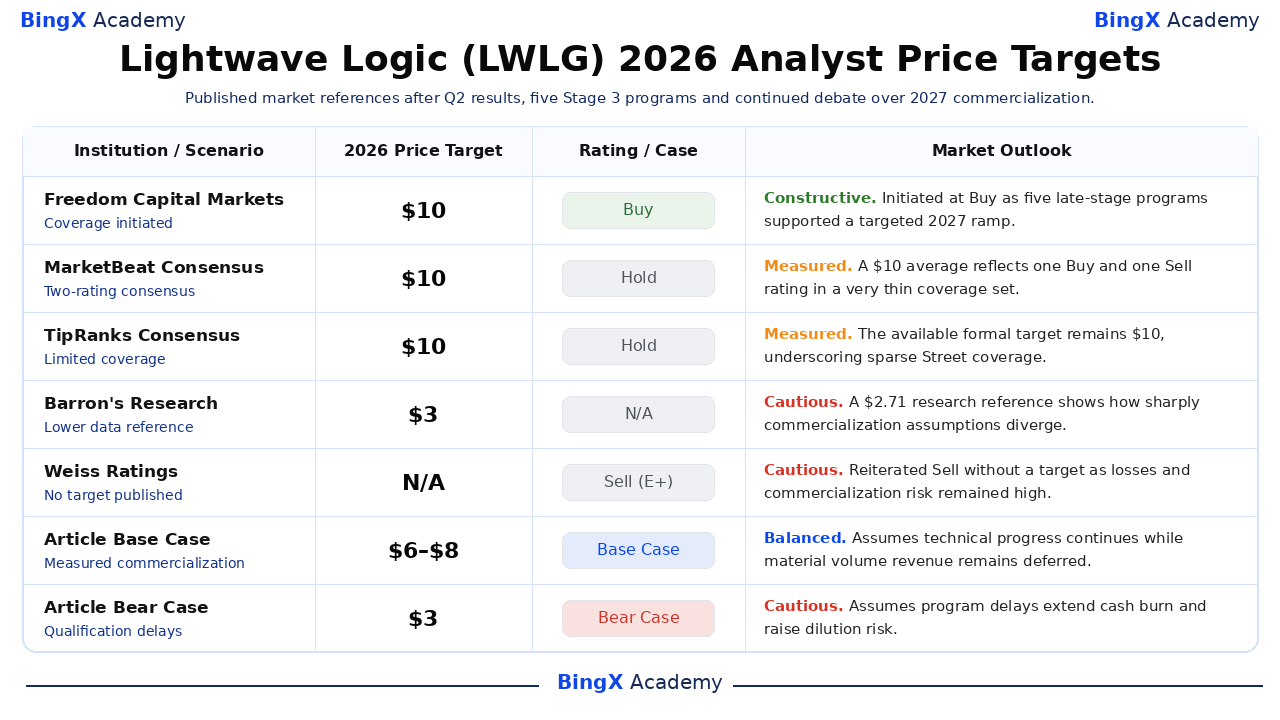
The Bull Case: Customer Qualification Progress Pushes LWLG Toward $10
The Bull Case assumes several Stage 3 programs complete reliability and foundry qualification, with at least one customer establishing a credible 2027 production schedule. SilTerra's early-2026 tapeout and five late-stage programs provide tangible evidence that commercialization is moving forward.
A move toward $10 would require signed production commitments, repeatable wafer results, and clearer unit economics before the December 2027 runway becomes a constraint. Material or NRE revenue rising meaningfully above $32,751 would provide the first financial confirmation.
The Base Case: Steady Customer Progress Keeps LWLG Between $6 and $8
The Base Case assumes PDK and customer work continues advancing without meaningful volume revenue in 2026. The $95.91 million liquidity position limits near-term financing pressure, but investors still discount the 12-to-18-month Stage 3 timetable and uncertain production yields.
LWLG could trade mainly between $6 and $8 if all five late-stage programs remain active and management preserves at least six quarters of runway. Losses accelerating beyond the Q2 level or customers moving backward in the design cycle would weaken the range.
The Bear Case: Qualification Delays Pull LWLG Toward $3
The Bear Case assumes reliability, yield, or customer schedules push production beyond 2027. With quarterly operating expenses at $7.30 million and revenue below $33,000, further delays would increase the probability of additional equity financing.
A move toward $3 would become more likely if Stage 3 programs fail to produce commitments, liquidity falls faster than planned, or management extends the volume-production timetable. Additional dilution would reduce future licensing value on a per-share basis.
LWLG Stock Price Forecasts for 2026 By Wall Street Analysts
LWLG does not have five independent, named Wall Street price targets. The table therefore separates Freedom Capital Markets' formal $10 initiation from consensus aggregators, a lower research-data reference and a no-target sell rating. This thin coverage is itself a risk signal, and the two BingX Academy article scenarios remain clearly labeled.
|
Institution / Scenario |
2026 Price Target |
Rating / Case |
Market Outlook |
|
Freedom Capital Markets |
$10 |
Buy |
Constructive. September 17: initiated as five late-stage programs and funding through 2027 supported commercialization. |
|
MarketBeat Consensus |
$10 |
Hold |
Measured. September 25: two published ratings included one Buy and one Sell. |
|
TipRanks Consensus |
$10 |
Hold |
Measured. September 24: the available formal target remained $10 after the new initiation. |
|
Barron's Research Data |
$2.71 |
N/A |
Cautious. September 22: a lower reference illustrated unusually wide valuation dispersion. |
|
Weiss Ratings |
N/A |
Sell (E+) |
Cautious. July 17: reiterated Sell without publishing a price target. |
|
Article Base Case |
6–8 |
Base Case |
Balanced. Assumes technical progress continues while material volume revenue remains deferred. |
|
Article Bear Case |
$3 |
Bear Case |
Cautious. Assumes program delays extend cash burn and raise dilution risk. |
How to Trade Lightwave Logic (LWLG) Stock on BingX
Trade Lightwave Logic's customer-qualification, foundry-integration and cash-runway outlook using BingX TradFi and BingX AI tools. Because LWLG can react sharply to technical milestones and financing, traders should define the catalyst and risk limits before entering a position.
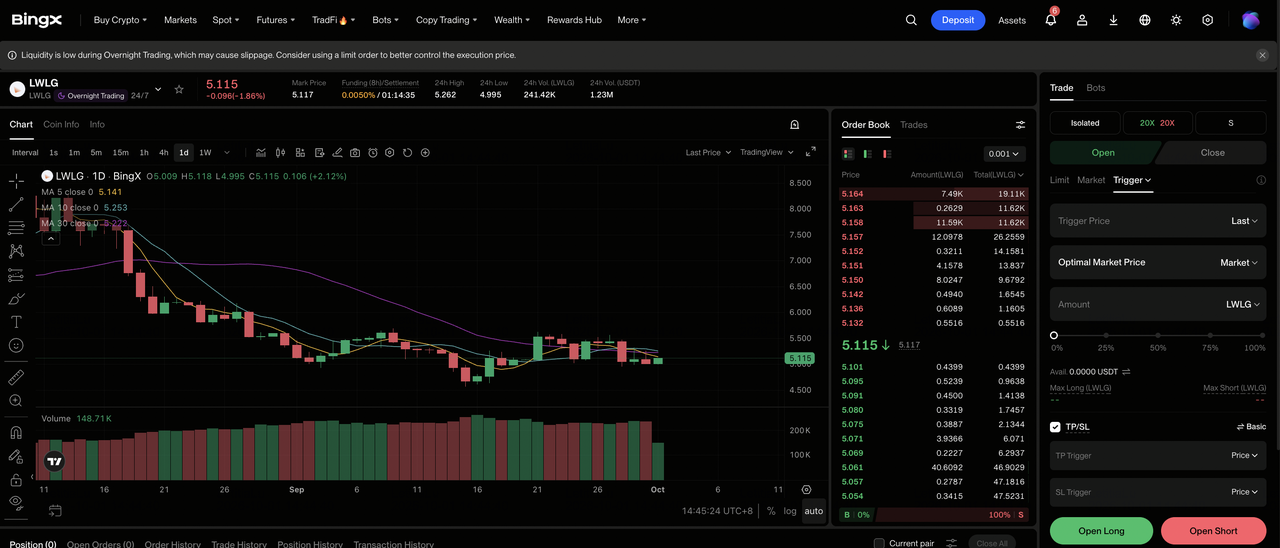
Step 1: Access BingX TradFi. Sign up and navigate to the specialized TradFi section on the BingX exchange dashboard.
Step 2: Select Lightwave Logic (LWLG). Search for and select the LWLG-USDT perpetual futures contract.
Step 3: Choose your direction. Select Open Long if customer qualification and foundry progress strengthen. Select Open Short if program timing slips or dilution risk rises.
Step 4: Select leverage and margin mode. Choose Isolated or Cross-Margin based on your risk tolerance. The 62.96% YTD gain shows why conservative leverage and clear position sizing matter.
Step 5: Execute strict risk protocols. Set Take-Profit and Stop-Loss (TP/SL) levels before or immediately after entering the trade. LWLG can react quickly to foundry results, design wins, cash burn and equity issuance.
Top 5 Risks to Watch for Lightwave Logic Investors in 2026
Lightwave Logic's valuation depends on technical programs turning into commercial production. Delays in qualification, foundry execution, or customer conversion could push revenue further out and increase dilution risk.
- Qualification may take longer than expected: Reliability, yield, and customer-system requirements can keep programs from advancing beyond Stage 3. Delays beyond 2027 would postpone royalties while R&D and engineering costs continue.
- Revenue depends on a small number of customers: One customer represented at least 10% of revenue, while all first-half sales came from Switzerland. A delay or loss of one program could materially affect an already small revenue base.
- Foundry execution is partly outside LWLG's control: Wafer schedules, PDK readiness, and integration yields depend on external partners. Missed tapeouts or inconsistent results could delay customer testing and production milestones.
- Operating losses can lead to dilution: Q2 net loss reached $6.61 million, while first-half equity proceeds exceeded $27 million through the Roth agreement. Further share issuance would reduce each existing share's claim on future licensing revenue.
- The 62.96% YTD rally raises execution sensitivity: LWLG closed at $5.28 after a strong 2026 gain. Failure to convert five Stage 3 programs into customer commitments could quickly pressure the valuation even if technical progress continues.
Final Thoughts: Should You Invest in Lightwave Logic in 2026?
Lightwave Logic has five late-stage customer programs, multiple foundry relationships, and $95.91 million of liquidity to support continued qualification work. Q2 revenue grew 27.9%, but $32,751 of sales remains very small compared with a $6.61 million net loss and $7.30 million of operating expenses.
The Bull Case depends on customer commitments, repeatable manufacturing results, and clearer production timing supporting a path toward $10. The Bear Case centers on qualification delays and further dilution that could pull LWLG toward $3. Investors can track Stage 3 progress, binding production dates, quarterly cash use, and share issuance for evidence of which scenario is developing.
Risk Reminder: Trading and investing in equities like LWLG involves a risk of capital loss. Commercialization setbacks, dilution, valuation changes, and leveraged trading can produce rapid losses. Conduct independent research before allocating capital.
Related Reading
- Top AI Data Center Stocks to Buy in 2026: Cloud, Servers, and AI Compute Infrastructure
- Top AI Optical Stocks to Buy in 2026: Photonics, Optics, Fiber, and Data Center Interconnects
- Top AI Networking Stocks 2026: AI Fabric, Switches, Copper, Fiber, and Optics Connectivity
- Coherent (COHR) Price Prediction 2026: Can AI Optics Demand Push COHR Toward $500?
- Lumentum (LITE) Price Prediction 2026: Can AI Optics Push LITE Toward $1,300?
