Crude oil is one of the world's most liquid commodities and the most sensitive indicator of macroeconomic and geopolitical conditions. The crude oil market in 2026 has seen dramatic changes: at the beginning of the year, the EIA and JPMorgan still predicted oversupply, with Brent crude averaging around $60 per barrel, but after the escalation of US-Iran conflict and the blockade of the Strait of Hormuz on March 9, WTI achieved its largest weekly gain of 35.6% in history, with Brent crude once surging to $119.50 per barrel. For Taiwanese investors, such event-driven market conditions present both opportunities and challenges.
The commonly referred "crude oil" in the market actually has two main benchmarks: WTI crude (West Texas Intermediate) represents the US benchmark price, while Brent is the pricing benchmark for approximately 80% of international oil products globally. Although both are light, sweet crude oils, they have different response patterns to geopolitical events, USD trends, and inventory data, and choosing the wrong target could render strategies ineffective.
This article provides Taiwanese crude oil investors with a comprehensive overview of the differences between WTI and Brent crude, 2026 market outlook, 5 entry timing indicators, allocation ratio recommendations, and compares four main investment approaches: BingX TradFi WTI and Brent crude perpetual futures, BingX XOP oil & gas stock perpetual futures, crude oil futures ETFs, and offshore futures through sub-brokerage. This content is for reference only and does not constitute investment advice. Leveraged products carry high risks, and investors should assess their risk tolerance before investing.
Key Takeaways
- WTI and Brent are two different crude oil benchmarks: WTI crude reflects US domestic supply and demand and inventory, primarily driven by the US EIA weekly inventory and DXY; Brent crude is the pricing benchmark for global seaborne oil products, more sensitive to Middle East geopolitical risks, OPEC+ policies, and transportation corridors.
- BingX TradFi offers both WTI and Brent crude perpetual futures: Priced and settled in USDT, with maximum leverage of 500x, funding fees settled every 8 hours, no need to open futures accounts or foreign currency accounts, making it the most direct way for Taiwan's crypto-native investors to participate in the crude oil market.
- 2026 crude oil market dominated by geopolitics: After the US-Iran conflict escalation in March, Brent crude once surged to $119.50, with WTI gaining 35.6% in a single week, currently in high-level consolidation between $90-110 per barrel, with direction dependent on shipping route recovery progress and G7 strategic reserve releases.
- Crude oil allocation in investment portfolios should not be too high: Conservative Taiwanese investors are advised to control allocation to 0%-2%, aggressive investors 2%-5%, crypto-focused investors 3%-8% for cross-market hedging, with leverage recommendations of 2-5x for beginners and 5-10x for experienced traders.
- 5 entry timing indicators: EIA weekly inventory, OPEC+ policy developments, geopolitical risks, US Dollar Index, futures curve structure (Backwardation vs Contango).
WTI vs. Brent Crude Oil: What Are the Differences Between the Two Oil Benchmarks?
The commonly seen "crude oil" prices in the market actually refer to crude oils from different regions and specifications. For Taiwanese investors, the most important distinction to clarify before entering is between WTI and Brent, the two most watched global benchmarks. While their prices are highly correlated in the long term, their response patterns to individual events are completely different.
WTI Crude Oil (West Texas Intermediate)
WTI is light, sweet crude oil produced in West Texas, primarily traded on NYMEX (New York Mercantile Exchange), serving as the US domestic crude oil pricing benchmark. The core characteristic of WTI is "onshore crude," with main storage and delivery points in Cushing, Oklahoma, transported via pipelines, making it most sensitive to US domestic supply and demand, shale oil production, and inventory changes.
Key factors affecting WTI prices include: US EIA weekly crude inventory reports, shale oil producers' drilling and production changes, US economic data and the US Dollar Index (DXY), and transportation bottlenecks (such as pipeline maintenance or Cushing capacity issues). When US inventory declines for consecutive weeks and DXY weakens, WTI typically shows bullish trends. For Taiwanese investors tracking US energy independence, shale oil cycles, or inventory events, WTI is a more direct tool.
Brent Crude Oil
Brent crude is produced from five major North Sea oil fields (Brent, Forties, Oseberg, Ekofisk, Troll), traded on ICE (Intercontinental Exchange), serving as the pricing benchmark for approximately 80% of global seaborne oil products. The core characteristic of Brent is "offshore crude," which can be directly shipped worldwide via tankers, making it more sensitive to international trade flows, geopolitical events, and shipping route conditions.
Key factors affecting Brent prices include: OPEC+ production decisions, Middle East geopolitics (especially transportation routes like the Strait of Hormuz and Red Sea), European and Asian refinery purchases, and global demand changes (Chinese economy, European winter heating). After the US-Iran conflict escalation in March 2026, Brent gained 23% in a single day, surging to $114, with a response magnitude significantly higher than WTI, as shipping route blockades directly threatened Brent's supply structure. For investors tracking geopolitical events, OPEC+ policies, or global demand changes, Brent is a more sensitive tool.
|
Comparison Dimension |
WTI Crude Oil |
Brent Crude Oil |
|
Origin & Transportation |
Texas onshore, pipeline transportation |
North Sea offshore, tanker transportation |
|
Primary Exchange |
NYMEX (New York) |
ICE (Intercontinental) |
|
Pricing Influence |
US domestic market |
~80% of global seaborne oil products |
|
Core Drivers |
EIA inventory, shale oil production, DXY |
OPEC+ policy, geopolitics, shipping routes |
|
Suitable Strategies |
US energy cycles, inventory events |
Geopolitics, global demand changes |
|
BingX Maintenance Break |
~80 minutes daily (UTC) |
~140 minutes daily (UTC) |
In practice, the two price movements are highly correlated in the long term, with typical spreads ranging from $2-8 per barrel. When the spread significantly widens or narrows, it usually represents structural market changes and can serve as a strategy signal. For Taiwanese investors in 2026, if focusing on geopolitical events as trading themes, Brent responds more directly; if based on US inventory and economic data, WTI is more relevant.
Is Crude Oil Worth Investing in 2026? WTI and Brent Crude Market Outlook
The 2026 crude oil market represents a confrontation between traditional supply-demand fundamentals and geopolitical black swans. At the beginning of the year, the consensus from EIA, IEA, and JPMorgan Chase was oversupply: increased US shale oil and Guyanese production, with demand growth of only about 930,000 barrels per day, estimating Brent crude fair value at $58-60 per barrel. This was the fundamental backdrop for WTI finding support around $57.68 and Brent encountering resistance around $63.80 in February 2026.
March 9th marked a significant shift in market structure. The escalation of US-Iran conflict, the replacement of Iran's Supreme Leader with hardliner Mojtaba Khamenei, and the effective blockade of the Strait of Hormuz put approximately 20 million barrels per day of global crude oil supply at risk. Iraq and Kuwait were forced to reduce production by 70% due to storage capacity limits and declared force majeure. WTI recorded its largest weekly gain of 35.6% in history, while Brent crude surged from around $63 to a high of $119.50, creating the most dramatic event-driven market movement of 2026.
Entering Q2 2026, crude oil has been consolidating at high levels between $90-110 per barrel. JPMorgan notes that historically, regime changes in oil-producing countries push oil prices up by an average of 76%, and "war premiums" may become a new structural phenomenon. However, technical analysis shows significant liquidity gaps between $90-95, and if Middle East conflicts ease or G7 releases strategic reserves, it could trigger a rapid retracement of $20 per barrel. For Taiwanese investors, 2026 crude oil is not suitable for passive long-term holding but is more appropriate for event-driven short to medium-term strategies with strict leverage and position control.
Extended reading: 2026 Crude Oil Price Forecast: Will War Premiums Drive Oil Prices to $140, or Will They Fall Back to $60?
Crude Oil Price Performance Review (2016–2026)
The following table summarizes the annual highs and lows of WTI and Brent crude over the past 11 years along with market conditions, helping readers quickly grasp past cycles and price contexts of major events.
|
Year |
WTI High/Low (Approx.) |
Brent High/Low (Approx.) |
Market Condition Summary |
|
2016 |
$54 / $26 |
$57 / $27 |
OPEC production cut agreement, rebound from lows |
|
2017 |
$60 / $42 |
$67 / $44 |
OPEC+ continued production cuts, moderate rise |
|
2018 |
$76 / $42 |
$86 / $50 |
US sanctions on Iran, surge then pullback |
|
2019 |
$66 / $46 |
$74 / $54 |
Range trading, Saudi oil facility attacks |
|
2020 |
$63 / -$37 (First negative oil price in history) |
$70 / $19 |
COVID-19 demand collapse, storage overflow |
|
2021 |
$85 / $47 |
$86 / $50 |
Demand recovery, economic reopening boost |
|
2022 |
$130 / $71 |
$139 / $76 |
Russia-Ukraine war pushes to 14-year highs |
|
2023 |
$95 / $66 |
$98 / $72 |
OPEC+ cuts but weak demand |
|
2024 |
$87 / $66 |
$92 / $71 |
Range trading, geopolitical risks intermittent |
|
2025 |
$83 / $55 |
$87 / $58 |
Rebound from lows, loose supply-demand |
|
2026 YTD |
$110 / $57 |
$119 / $60 |
US-Iran conflict surge, record weekly gains |
Note: High/low points are approximate ranges compiled from public historical data for market context explanation. Actual values may vary slightly depending on data sources. In April 2020, WTI May futures contracts once closed at -$37.63 before settlement, the first negative value in commodity futures history, mainly due to storage reaching capacity limits and buyers preferring to pay to avoid delivery.
When Is the Best Time to Invest in Crude Oil? 5 Key Market Indicators
Crude oil prices are highly volatile with frequent event-driven movements, making absolute price levels insufficient for timing decisions. For short to medium-term traders, a more practical approach is observing inventory, production policy, geopolitical risks, USD trends, and futures curve structure. When multiple signals align, it usually indicates clearer short to medium-term direction.
1. EIA Weekly Crude Inventory: The US Energy Information Administration (EIA) publishes weekly crude inventory data every Wednesday, which is the most direct price driver for WTI in the short term. When inventory declines for consecutive weeks and the decline exceeds market expectations, it usually indicates demand exceeding supply, favorable for oil price rises.
2. OPEC+ Policy Developments: OPEC+ monthly meetings and ad-hoc decisions directly affect global crude supply. When OPEC+ announces production cuts or extends cuts, Brent typically responds more strongly; conversely, production increases pressure oil prices. Monitor public statements from Saudi and Russian energy ministers as early signals of policy changes.
3. Geopolitical Risks: Crude oil is highly sensitive to geopolitical events, especially Middle East conflicts, shipping routes (Strait of Hormuz, Red Sea), and regime changes in oil-producing countries. In the early stages of events, Brent usually rises first with WTI following; if events persist, consider short to medium-term long positions. However, event-driven movements can reverse easily, requiring strict stop-loss settings.
4. US Dollar Index (DXY): Crude oil is priced in US dollars, so USD weakness makes oil cheaper for other currency users, increasing demand and pushing prices higher. When DXY breaks below 100 or forms a clear downtrend, it's usually favorable for oil trends.
5. Futures Curve Structure: Observe near-month versus far-month futures spreads. When near-month prices exceed far-month (Backwardation), it indicates tight spot demand, usually a signal of supply constraints; conversely, when near-month is below far-month (Contango), it indicates loose supply. During the March 2026 conflict, Brent entered deep backwardation, reflecting real supply pressure.
In practice, these indicators are suitable for confirming entry timing and direction. For example, when EIA inventory consecutively declines, DXY weakens, and Brent enters backwardation simultaneously, it's usually a short to medium-term bullish signal; if OPEC+ announces production increases and geopolitical risks subside, consider short positions or reducing positions.
|
Indicator |
Reference Threshold |
Trading Focus |
|
EIA Weekly Crude Inventory |
Consecutive weekly declines |
Bullish signal, WTI more direct response |
|
OPEC+ Policy Developments |
Announce cuts or extend cuts |
Brent responds more strongly |
|
Geopolitical Risks |
Transportation routes threatened, oil producer conflicts |
Brent premium expands, short-term follow |
|
US Dollar Index (DXY) |
Break below 100 or downtrend |
USD weakness, WTI and Brent rally together |
|
Futures Curve Structure |
Backwardation (spot > far-month) |
Supply tightness signal, favorable for bullish strategies |
How Much Crude Oil Exposure Should You Hold in Your Portfolio?
Crude oil has high volatility and obvious event-driven characteristics, and unlike gold, it doesn't have long-term store-of-value properties, so its allocation ratio in investment portfolios should not be too high. Crude oil is more suitable as an "event-driven strategy" or "short to medium-term trading tool" rather than a long-term passive holding hedge asset. The following outlines common allocation approaches for three types of investors.
1. Conservative Taiwanese Investors (mainly holding Taiwan stocks, ETFs, or deposits): Crude oil allocation should be controlled to 0%-2% of total investable assets, avoiding leverage use. If participating, consider BingX XOP perpetual futures with low leverage (2-3x) for indirect oil & gas industry exposure, or crude oil futures ETFs for medium to long-term holding. For these investors, crude oil should not be viewed as core allocation but as satellite positions.
2. Aggressive Taiwanese Investors (already having stocks, ETFs, and diversified allocations): Crude oil ratio can reach 2%-5% of total investable assets, using BingX TradFi perpetual futures for event-driven trading, with leverage controlled at 5-10x and strict stop-loss settings. Focus on clear event-driven movements (OPEC+ meetings, geopolitical events, EIA inventory) and avoid directionless long-term positions.
3. Taiwanese Investors with Cryptocurrency as Main Investment Focus: Crude oil can serve as cross-market hedge positions, occupying 3%-8% of total investment assets. When crypto markets are affected by liquidity tightening or geopolitical risks, crude oil often shows independent movements, smoothing overall portfolio volatility. BingX TradFi's advantage is cross-market operations with USDT margin in the same account, suitable for crypto-native investors to quickly establish crude oil exposure.
How to Invest in Oil in Taiwan? 4 Popular Oil Investment Methods
Taiwanese investors have different cost, leverage, and operational threshold options for participating in crude oil markets. The following introduces four main approaches in order of priority and accessibility for Taiwanese users.
1. Trade WTI and Brent Crude Perpetual Futures on BingX TradFi
BingX TradFi offers both Oil WTI/USDT and Oil Brent/USDT perpetual futures, making it the most direct way for Taiwan's crypto-native investors to enter crude oil markets in 2026. All contracts are priced, margined, and settled in USDT, with maximum leverage up to 500x, funding fees settled every 8 hours, and prices sourced from institutional-grade providers like IG and Bloomberg. WTI has approximately 80 minutes of daily maintenance downtime, Brent approximately 140 minutes (UTC), with normal trading available during all other periods.
Compared to opening futures accounts with traditional brokers, BingX TradFi doesn't require foreign currency accounts or learning complex contract specifications and margin call mechanisms. Users only need to complete BingX registration and KYC to trade crypto and crude oil in the same account, while also combining BingX AI market analysis, Copy Trading, and VIP benefits for cross-market strategy execution. Here's the actual operation process.
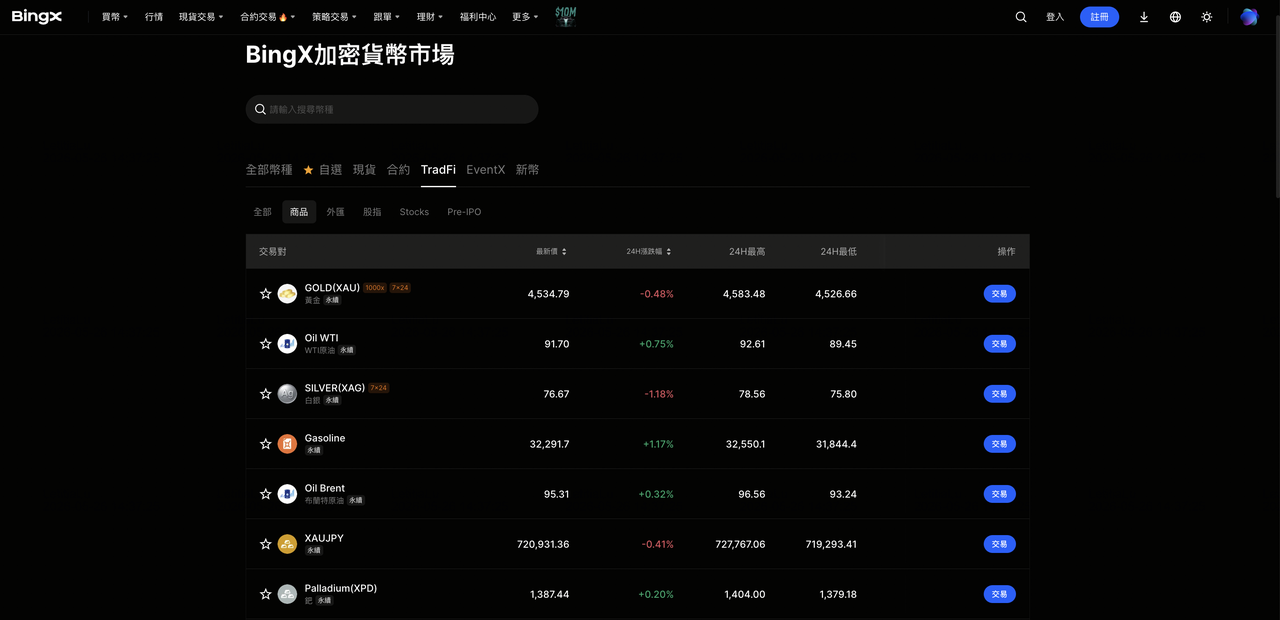
1. Register BingX Account and Complete KYC: Visit BingX official website or App to register an account, complete basic identity verification and security settings. After KYC approval, perpetual futures trading permissions are unlocked, including BingX TradFi crude oil product lines.
2. Deposit USDT to Futures Account: Through credit cards, third-party payments or Taiwan local exchanges (MAX, BitoPro) via USDT TRC-20 network to transfer USDT to BingX, then use "Assets" → "Fund Transfer" to move USDT from spot account to perpetual futures account. USDT TRC-20 withdrawal fees are typically under $1, making it the mainstream path for Taiwanese users to buy USDT and transfer funds across platforms.
3. Select WTI or Brent and Analyze Market: In BingX trading interface, select "Futures Trading" → "TradFi" → "Commodities", choose Oil WTI/USDT or Oil Brent/USDT. Before placing orders, refer to BingX AI market trend summaries and combine with this article's 5 indicators (EIA inventory, OPEC+ policy, geopolitical risks, DXY, futures curve) for entry decisions. Event-driven strategies should prioritize Brent, while inventory and USD-related strategies should choose WTI.
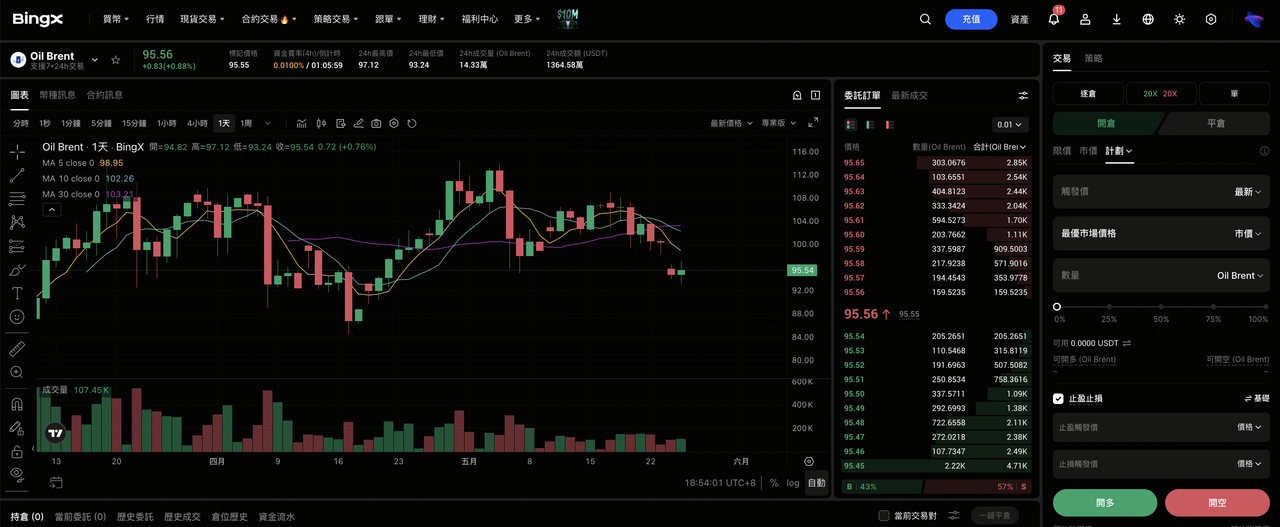
4. Select Isolated Mode, Set Leverage and Place Orders: Recommend choosing Isolated mode to limit individual trade risk to that specific margin. Leverage recommendations are 2-5x for beginners and 5-10x for experienced traders, prioritizing limit orders with 0.02% maker fees to reduce costs. BingX TradFi supports up to 500x leverage for some commodities, but with 2026 crude oil's daily volatility of $10-15 becoming normal, leverage above 30x is extremely prone to liquidation during event-driven gaps and is not recommended.
5. Immediately Set Stop Loss and Take Profit, Monitor Positions: After opening positions, immediately set Stop Loss and Take Profit. Crude oil 4-hour chart stop loss ranges should be 2%-4%, daily charts 4%-7%. Weekend position risks are particularly high as geopolitical events often develop over weekends causing Monday opening gaps, so reduce positions or lower leverage before Fridays. Funding fees settle every 8 hours and should be included in overall cost evaluation for long-term positions.
2. Trade XOP Oil and Gas Stock Futures on BingX
Besides WTI and Brent crude perpetual futures, BingX also offers XOP/USDT stock perpetual futures. XOP Oil & Gas ETF (SPDR S&P Oil & Gas Exploration & Production ETF) tracks the S&P Oil & Gas Exploration & Production Select Industry Index, holding US-listed oil & gas exploration and production stocks including ConocoPhillips, Diamondback Energy, EOG Resources. Through BingX, Taiwanese investors can directly trade XOP perpetual futures with USDT margin without opening US stock sub-brokerage accounts or foreign currency accounts.
The difference between XOP perpetual futures and direct WTI/Brent trading lies in price drivers. XOP prices are influenced by three factors: oil & gas company fundamentals (earnings, production, capex), overall US stock performance, and crude oil spot prices, with correlation to crude oil spot typically ranging 0.7-0.85. This means XOP movements sometimes diverge from crude oil: when oil prices rise but US stocks overall decline, XOP gains may be suppressed; conversely, during strong US stock performance, XOP may rise even with flat oil prices. For investors seeking to diversify pure crude oil spot risk, XOP perpetual futures can serve as "comprehensive US oil & gas industry exposure" tools.
Operationally, XOP perpetual futures use the same BingX account and USDT margin as WTI/Brent perpetual futures, with switching available in the same interface. Here's the actual operation process.
Extended reading: 2026 XOP Oil & Gas ETF Price Forecast: Can Geopolitics Drive XOP Stock Price to $210?
1. Confirm BingX Account and USDT Margin: If you've already completed BingX registration, KYC, and have USDT in your perpetual futures account (refer to previous WTI/Brent operation process), you can directly trade XOP perpetual futures without reopening accounts or converting margin currencies. New users can deposit via credit cards, third-party payments, or MAX/BitoPro with USDT TRC-20.
2. Access XOP/USDT Perpetual Futures Page: In BingX trading interface, select "Futures Trading" → "TradFi" or "Stocks" category, click XOP/USDT. Before placing orders, refer to BingX AI market analysis, TradingView charts, and compare current WTI/Brent trends to determine whether it's "oil-driven" or "US stock-driven" market phases.
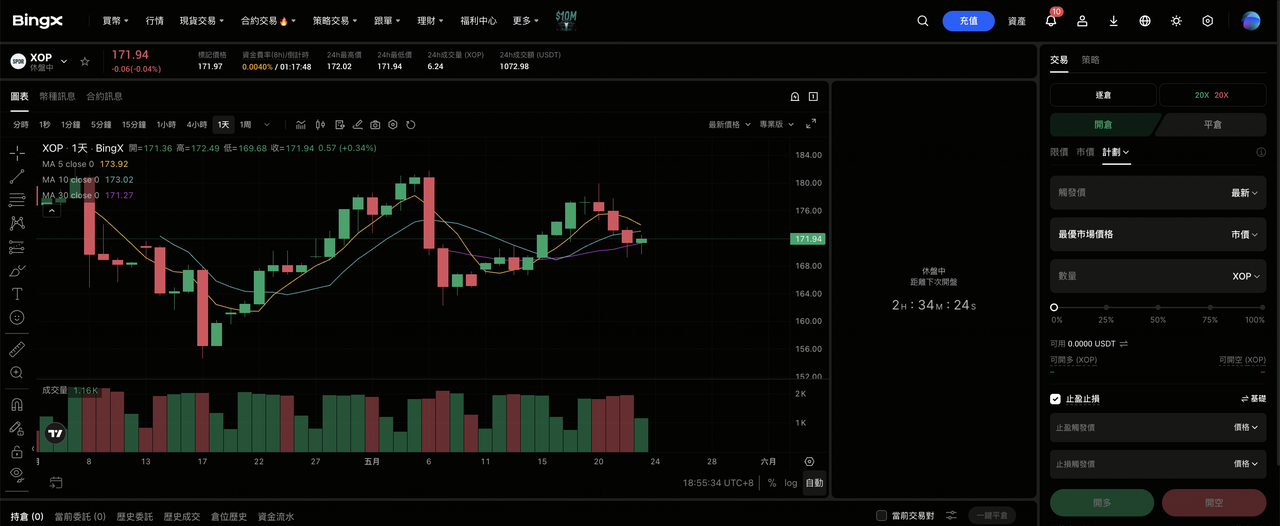
3. Analyze XOP and Crude Oil Price Context: Before entry, observe three data points simultaneously: WTI/Brent crude spot prices, XOP's relative performance during corresponding periods, and US major indices (like S&P 500 or Nasdaq 100) movements. When all three align directionally, XOP trends have higher certainty; if they diverge, it indicates complex market structure requiring position reduction or avoiding entry.
4. Select Isolated Mode, Set Leverage and Place Orders: Recommend choosing Isolated mode to limit individual trade risk to that specific margin. Leverage recommendations are 2-5x for beginners and 5-10x for experienced traders, prioritizing limit orders for lower maker fees. XOP is a stock perpetual futures with better liquidity during US stock trading hours (Taiwan evening to early morning), with potentially wider spreads during weekends and US market holidays. Large entries should avoid low liquidity periods.
5. Immediately Set Stop Loss and Take Profit: After opening positions, immediately set Stop Loss and Take Profit. XOP 4-hour chart stop loss ranges should be 2%-4%, daily charts 4%-7%. For strategic investors, consider simultaneously holding WTI longs (tracking crude spot) and XOP longs (comprehensive US oil & gas industry exposure) to diversify event risk; or when oil rises but US shale producers report poor earnings, go long WTI and short XOP for spread strategies.
3. Invest in Oil Futures ETFs
Besides stock ETFs, the market also offers futures ETFs that track crude oil futures contracts, directly holding WTI or Brent futures contracts. The advantage of these ETFs is high price synchronization with crude oil spot, suitable for tracking short to medium-term crude oil movements. However, futures ETFs have two significant limitations: first, futures contracts have expiration dates, requiring ETFs to regularly roll near-month contracts to far-month contracts. When futures curves are in Contango (normal backwardation) structure, long-term holding accumulates roll costs that can reach several percentage points annually; second, internal expense ratios are typically higher than stock ETFs.
For Taiwanese investors, crude oil futures ETFs are suitable for "investors who want to participate with TWD or USD accounts, don't want to open futures accounts, and can accept roll costs" for short to medium-term investments. For specific ETF symbols and specifications, check the latest information on fund company websites or stock exchange sites, and evaluate expense ratios, tracking errors, and roll costs before deciding on subscriptions.
4. Trade Crude Oil Through Overseas Futures or Sub-Brokerage Accounts
For Taiwanese investors seeking the most direct crude oil exposure with larger trading scale, consider opening offshore futures accounts to trade NYMEX WTI futures (symbol CL) or ICE Brent futures (symbol BZ). These channels directly trade standardized futures contracts (WTI and Brent each representing 1,000 barrels per contract), with leverage and margin rules consistent with international markets, suitable for advanced investors familiar with futures mechanisms.
Offshore futures accounts offer advantages of high liquidity, tight spreads, and transparent pricing; however, account opening procedures are complex, requiring familiarity with contract specifications, margin call mechanisms, and expiration rolls. Each contract size is large (WTI 1,000 barrels, requiring approximately $100,000 margin for non-leveraged holding at $100). SWIFT wire transfer fees are fixed at approximately $25-45, making cost ratios high for small amounts. For Taiwanese investors with smaller trading scales or seeking flexible entry/exit, BingX TradFi perpetual futures typically offer better flexibility and cost advantages.
Why Trade Crude Oil on BingX TradFi? 5 Key Advantages
For Taiwanese investors, BingX TradFi crude oil perpetual futures advantages go beyond just fees, but how the overall trading environment reduces operational complexity. Here are 5 core differentiating advantages.
1. Simultaneously Offers WTI, Brent, and XOP Three Crude Oil Product Lines: BingX lists Oil WTI/USDT, Oil Brent/USDT, and XOP/USDT three perpetual futures in the crude oil space, allowing investors to choose appropriate tools based on event nature and strategy needs. WTI responds to US inventory and economic data, Brent is more sensitive to geopolitics, and XOP covers comprehensive US oil & gas industry exposure, making strategy selection more flexible while enabling cross-underlying spread strategies.
2. Unified USDT Margin Settlement, No Multi-Currency Conversion Needed: All BingX TradFi crude oil contracts are priced, margined, and settled in USDT, with a single USDT balance enabling simultaneous trading of cryptocurrency and crude oil. Taiwanese users don't need to open USD accounts for crude oil trading or bear frequent currency exchange costs.
3. Institutional-Grade Price Sources with Both Depth and Transparency: BingX TradFi prices come from institutional-grade data providers like IG and Bloomberg, not simply relying on single exchange data. During high volatility periods like OPEC+ meetings, EIA inventory releases, and geopolitical events, it maintains stable execution quality.
4. Extended Trading Hours Covering Major Global Market Volatility: WTI and Brent perpetual futures trading hours are nearly 24 hours Monday to Friday, with only approximately 80-140 minutes of daily maintenance downtime. Taiwanese investors can enter after Taiwan stock market close and before US market open, covering Asian, European, and American market sessions.
5. Integrated BingX AI, Copy Trading, and VIP System: BingX TradFi is fully integrated with BingX AI, Copy Trading, and VIP benefits. Users can access crude oil market analysis through BingX AI, follow experienced traders to copy strategies, and have crypto and commodity trading volumes combined for VIP level calculation.
5 Important Risks to Know Before Investing in Crude Oil
While crude oil investment can provide event-driven returns and inflation hedging functions, its volatility and event risks are significantly higher than gold. Before entering, the following 5 risks and preparations should be evaluated.
1. Wrong Choice Between WTI and Brent May Render Strategies Ineffective: Brent typically responds more strongly to geopolitical events initially, while WTI is more sensitive to inventory and US data. Betting on WTI with Middle East conflicts as strategy focus may miss some gains; vice versa. Confirm event themes before entry and select corresponding targets.
2. High Leverage Extremely Prone to Liquidation During Event-Driven Gaps: 2026 crude oil daily volatility of $10-15 has become normal. With 30x leverage positions, adverse moves of 3.3% may trigger forced liquidation, while crude oil daily ranges exceeding 5% are not uncommon. Beginners should start with 2-5x, gradually adjusting after familiarizing with patterns, and avoid high leverage positions before high volatility events.
3. Cannot Adjust Positions During Maintenance Downtime: BingX TradFi WTI has approximately 80 minutes daily maintenance downtime, Brent approximately 140 minutes (UTC). No new positions or stop-loss adjustments possible during downtime. If major events occur during maintenance periods, position risk exposure cannot be managed immediately. Confirm stop-loss settings before maintenance periods.
4. Weekend Gap Risks: Geopolitical events often develop over weekends, with potential large gaps at Monday openings that may exceed original stop-loss levels. Reduce positions or lower leverage before Friday closes, consider closing positions during major event brewing periods.
5. Long-Term Holding Should Consider Tax Records and Fund Proof: Trading crude oil perpetual futures through BingX may involve capital gains reporting when withdrawing profits. Regularly download BingX transaction records, preserving details of each opening, closing, fees, and funding rates. Withdrawals to Taiwan domestic accounts exceeding NT$500,000 per transaction trigger bank reporting to the Investigation Bureau. Plan large withdrawals in advance with batch processing.
Conclusion: Should You Invest in Crude Oil in 2026?
The 2026 crude oil market represents a confrontation between traditional supply-demand and geopolitics, unsuitable for passive long-term holding but offering clear event-driven trading opportunities. From market structure perspective, EIA and JPMorgan's oversupply fundamentals remain, but US-Iran conflicts and Strait of Hormuz blockades have made "war premiums" a new structural phenomenon, with high-level consolidation of $90-110 potentially continuing until Middle East situations clarify. For Taiwanese investors, crude oil is more suitable for event-driven short to medium-term strategies rather than core hedge allocations, with ratios kept moderate.
For crypto-native investors and Taiwanese users seeking low-threshold crude oil market participation, BingX TradFi WTI and Brent crude perpetual futures are the most flexible choice for 2026. Unified USDT margin, dual product line coverage, institutional-grade pricing, integration with BingX AI and Copy Trading make cross-market operations manageable without multiple accounts. Operationally, focus on clear event-driven movements (OPEC+ meetings, geopolitical events, EIA inventory), control leverage within 5-10x, and strictly set stop-losses and weekend risk controls. Overall, crude oil should focus on "event-driven returns" rather than long-term passive holding.
Related Reading
- Taiwan Cryptocurrency Exchange Fee Comparison Complete Guide (2026): Spot, Futures, Copy Trading, DCA and VIP Fee Analysis
- Taiwan Cryptocurrency Futures Trading Platform Complete Comparison and Recommendations (2026): Trading Fees, Liquidity and Security Comparison
- How to Trade Forex, Commodities, Stocks and Indices with BingX TradFi: Beginner's Guide (2026)
- How to Trade Commodities with Crypto in 2026 as Gold, Silver, Oil and TradFi Go On-Chain
- 2026 Crude Oil Price Forecast: Will War Premiums Drive Oil Prices to $140, or Will They Fall Back to $60?
