

BNB, originally known as Binance Coin, is a unified multi-utility cryptocurrency and the native token of the BNB Chain, one of the largest and most active blockchain ecosystems in the world. As of May 2026, BNB continues to serve as gas for transactions, fuel for decentralized applications, and a key asset for governance and staking. Issued by the Binance ecosystem, BNB powers one of the most vibrant blockchain environments, supporting high-speed DeFi, gaming, and Web3 applications. With ongoing network upgrades, quarterly token burns, and growing institutional interest, BNB remains a cornerstone asset for users seeking low fees, high performance, and deep ecosystem utility in crypto space.
Key Takeaways
- BNB is the native token of the BNB Chain, used for transaction fees, staking, governance, and ecosystem incentives.
- It benefits from a deflationary mechanism through regular token burns, reducing total supply over time.
- BNB Chain is undergoing upgrades to reach 20,000 transactions per second while adding privacy features.
- The token provides trading fee discounts on Binance and power launches on Binance Launchpad.
What Is BNB Chain (BNB)?
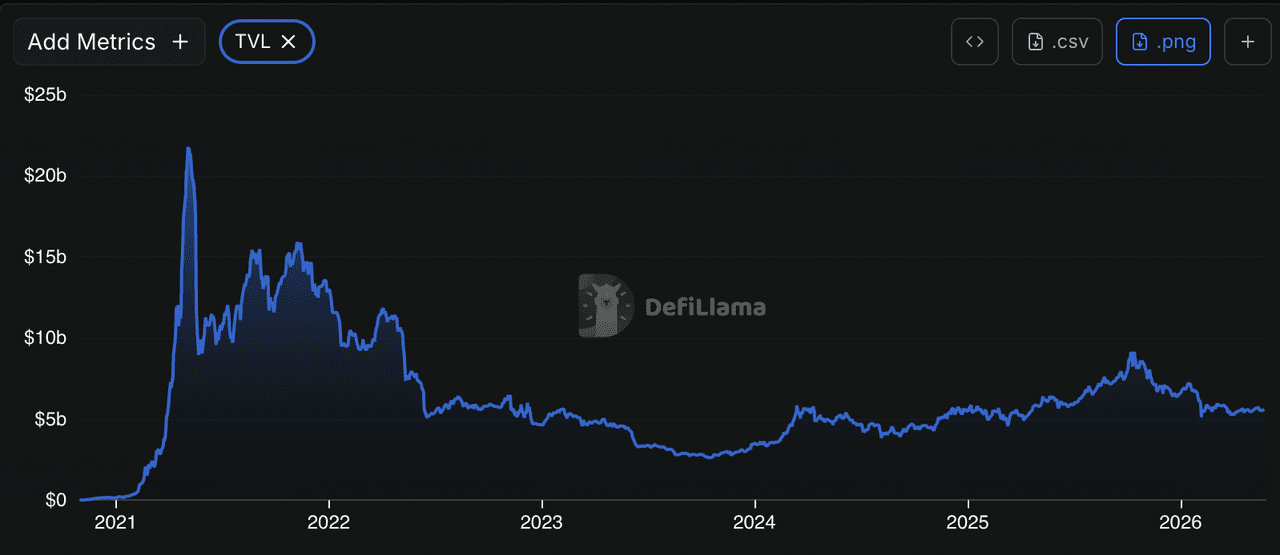
Source: BNB TVL
Binance Coin is the native cryptocurrency of the BNB Chain, the high-performance blockchain ecosystem originally created by the Binance cryptocurrency exchange. In 2026, BNB functions as a multi-utility asset used to pay network transaction fees, fuel decentralized finance applications, execute smart contracts, and participate in governance.
According to BNBChain, BNB stands for "Build and Build." It serves as the native gas token of BNB Chain, used to pay for transaction fees and smart contract execution, much like ETH on Ethereum. Additionally, BNB functions as a governance token, allowing holders to participate in the ecosystem’s decentralized on-chain decision-making. Originally launched via an ICO from June 26 to July 3, 2017, at a price of 1 ETH = 2,700 BNB or 1 BTC = 20,000 BNB, BNB started as an ERC-20 token on Ethereum before transitioning to its own blockchain with the BNB Chain mainnet launch on April 18, 2019.
Instead of serving only as a simple exchange token, Binance Coin has evolved into a core utility asset that powers one of the most active blockchain ecosystems. It is widely used for staking, yield farming, token launches, and fee discounts, making it essential for users and developers active on the BNB Chain. A core aspect of Binance Coin is its deflationary design and strong integration with the broader Binance ecosystem, providing both practical utility and long-term value accrual mechanisms.
How BNB Works
Binance Coin works as the primary gas token on the BNB Chain. Users pay BNB to execute transactions, interact with smart contracts, and use decentralized applications. The BNB Chain employs a Proof-of-Staked Authority (PoSA) consensus mechanism that combines high throughput with energy efficiency.
Quarterly token burns permanently remove a portion of BNB from circulation, creating deflationary pressure. This mechanism, combined with growing network usage, supports long-term scarcity. BNB also plays a central role in governance, allowing holders to influence protocol decisions and ecosystem development.
The modern BNB Chain employs multichain architecture designed for scalability, flexibility, and high performance. It consists of three core components:
- BNB Smart Chain (BSC): The flagship Layer-1 blockchain. It offers full EVM compatibility and uses a Proof-of-Stake Authority (PoSA) consensus mechanism, delivering fast and cost-effective transactions.
- opBNB: A high-performance Layer-2 scaling solution built on the OP Stack. It significantly boosts throughput, capable of processing 5,000–10,000 transactions per second (TPS) with ultra-low fees.
- BNB Greenfield: The decentralized data storage layer of the ecosystem. It provides secure, private, and censorship-resistant data storage, enabling developers to build data-intensive decentralized applications.
Read more: BNB Treasury Explained: Top Corporate and Institutional BNB Holders in 2026
BNB Audits and Network Security
The BNB Chain undergoes regular security audits and maintains a robust validator set to ensure network reliability. As of 2026, the chain continues to strengthen its infrastructure with upgrades focused on scalability and compliance-friendly features. These efforts, along with ongoing transparency reports, help maintain user confidence in the network’s security and operational integrity.
Key Trends & Utility in 2026
Binance Coin continues to expand its real-world utility. Institutional interest is growing, with major asset managers exploring spot BNB exchange-traded funds. The BNB Chain is implementing upgrades to boost network capacity to 20,000 transactions per second while introducing privacy features for token transfers. Deflationary Burns remain a core feature, with Binance executing quarterly auto-burns to reduce the maximum circulating supply toward a target of 100 million BNB. This mechanism supports long-term value dynamics as network adoption increases.
BNB’s value is backed by multifaceted utility across the broader ecosystem:
- Gas Fees: Used to pay for transactions and gas fees on the BNB Smart Chain (BSC) and BNB Beacon Chain.
- Ecosystem Access: Acts as the primary asset for participating in token sales via the Binance Launchpad.
- Exchange Discounts: Provides users with discounted trading fees when used on the Binance centralized exchange.
- Staking & Governance: Used to stake with validators to secure the network under a Proof-of-Staked-Authority (PoSA) consensus model, allowing holders to earn yields and vote on network upgrades.
- DeFi: Widespread collateral, liquidity, and lending operations within the BNB Chain decentralized finance ecosystem.
Benefits and Advantages of BNB Chain (BNB)
Binance Coin offers numerous advantages including low transaction fees, fast confirmation times, and deep integration with one of the largest crypto ecosystems. It provides trading fee discounts on Binance, powers token launches on Binance Launchpad, and enables staking and yield farming opportunities across DeFi protocols. Users benefit from high performance, strong liquidity, and continuous ecosystem development. BNB’s deflationary model and multi-utility design make it attractive for both active traders and long-term holders.
Read more: BNB Price Prediction (2026): Will BNB Reach $2,000 After Its All-Time High?
BNB vs. ETH
Binance Coin and ETH are both leading smart contract platform tokens, but they serve different strengths. ETH offers the most mature and decentralized DeFi ecosystem with the highest institutional trust. Binance Coin provides significantly lower fees, faster transactions, and a more user-friendly experience for everyday DeFi and gaming activities. While Ethereum remains the leader in overall developer activity and security, BNB Chain excels in accessibility, speed, and cost efficiency, making it a popular choice for retail users and high-frequency applications.
What Are the Tokenomics of BNB?
BNB has a maximum supply of 200 million tokens, with ongoing quarterly burns reducing the circulating supply over time. The token is used for gas fees, staking, governance, and ecosystem incentives. Binance’s auto-burn mechanism permanently removes tokens from circulation based on trading volume, creating deflationary pressure as the ecosystem grows.
- Total Supply: 200 million tokens (pre-mined)
- Circulating Supply: ~144 million tokens.
- Current Allocation: 50% ICO, 40% Founding Team, 10% Angel Investors. (All tokens are unlocked).
- Model: Deflationary, transitioning toward a target supply of 100 million BNB
Read more: Top 7 DEXs in the BNB Chain Ecosystem: Updated List in 2026
How to Trade BNB on BingX
BNB (Build and Build) is the native utility token of the BNB Chain ecosystem, used for transaction fees, staking, and access to token launches and ecosystem rewards. It is available on both the BingX Spot Market and Perpetual Futures Market, giving traders flexibility for long-term holding or short-term trading. BingX AI also provides real-time market analysis to support smarter decisions.
Step 1: Search for BNB/USDT on Spot or Perpetual Futures
For Spot Trading
Go to the Spot Market on BingX and search for BNB/USDT. Place a market order to buy instantly or set a limit order at your preferred price. Spot trading is ideal for users who plan to hold BNB long term or use it for ecosystem activities such as staking or transaction fees.
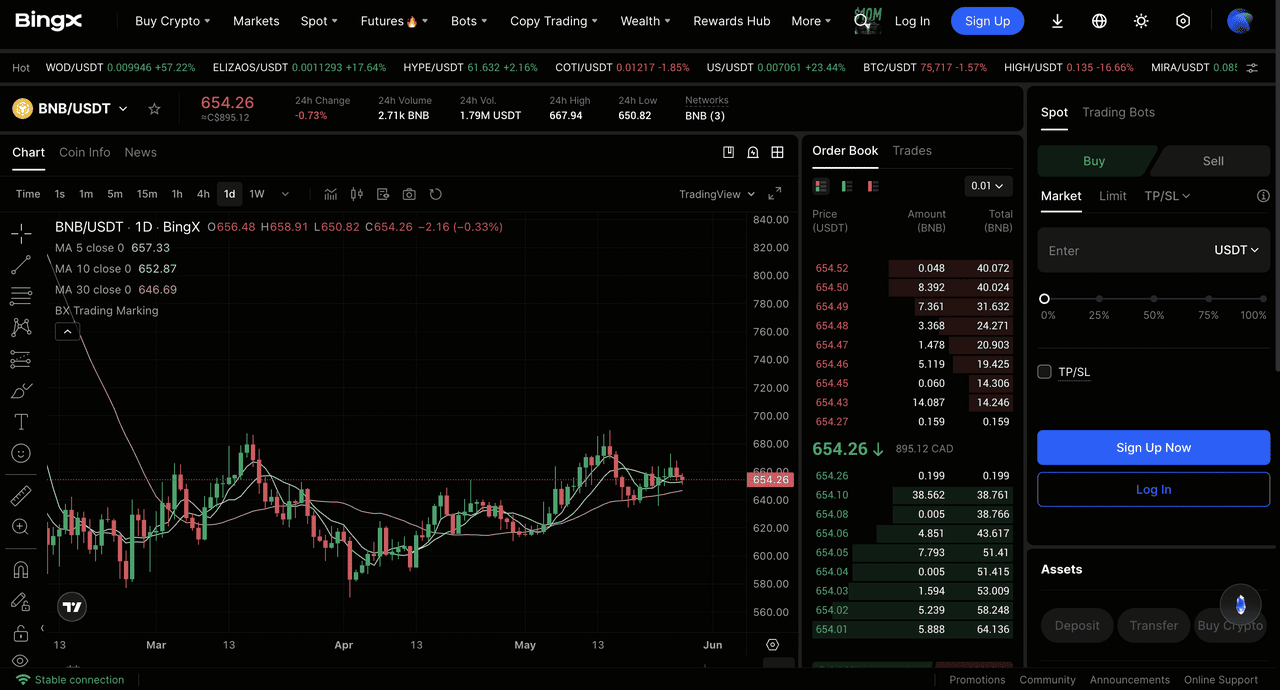
Source: BNB/USDT on BingX Spot Market
For Perpetual Futures
Search for BNB/USDT perpetual contract in the Perpetual Futures Market to go long or short without an expiration date. This setup suits traders with bullish or bearish views. Leverage can amplify potential returns but also increases risk, so always use it cautiously and set a stop-loss to protect your capital.
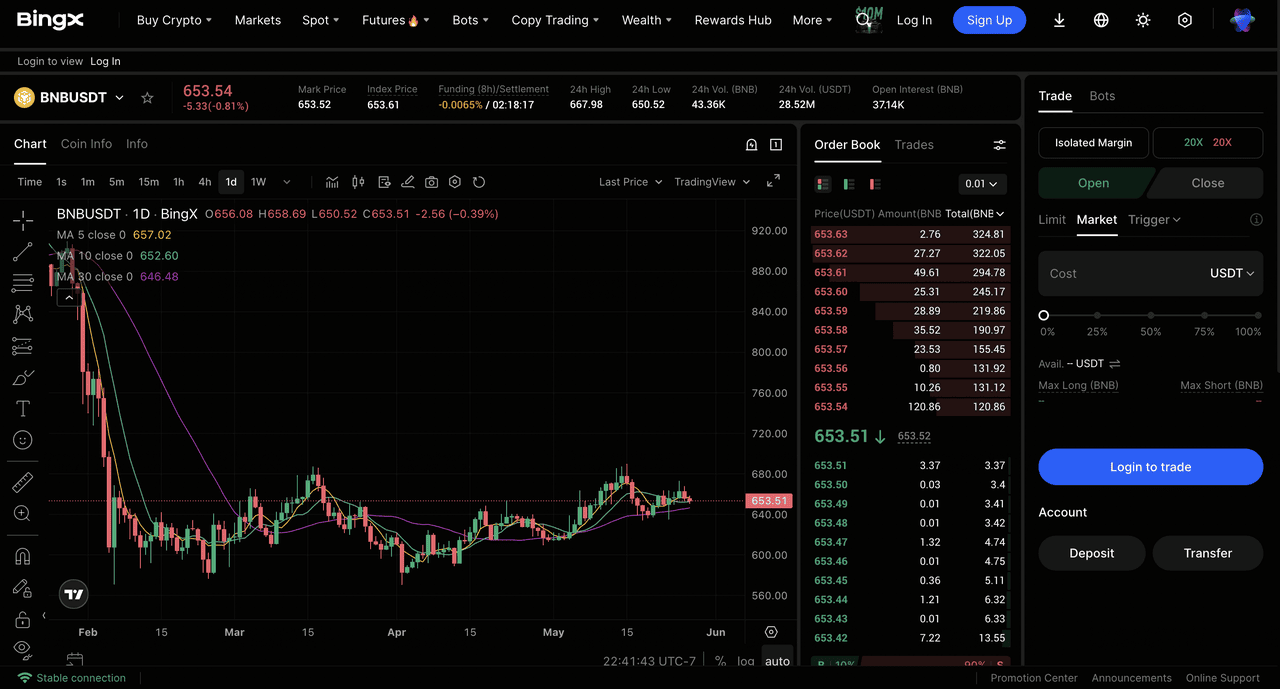
Step 2: Use BingX AI for Real-Time Market Insights
Click the AI icon on the chart to activate BingX AI, which identifies key support and resistance levels, trend direction, and major market events. These insights can help refine your timing and decision-making process.
Read more: How to Use BingX AI? A Beginner’s Guide to Trading Crypto with AI Assistant
Step 3: Execute and Monitor Your Trade
Choose a market order for instant execution or a limit order to enter at a specific price. Monitor your trade using BingX AI and market indicators to adjust your position when necessary.
Read more: How to Connect MetaMask to BNB Smart Chain (BSC)
Conclusion: Why Is BingX the Best Platform to Trade BNB?
Binance Coin remains a cornerstone asset in 2026 thanks to its strong utility, deflationary mechanics, and central role in one of the most active blockchain ecosystems. With network upgrades, institutional interest, and continuous burns, it offers both practical usage and long-term value potential.
BingX serves as the top choice for trading BNB, offering deep liquidity, low fees, and seamless integration for both spot and futures markets. Whether participating in the BNB Chain ecosystem, staking, or trading, BingX enables efficient and secure management of BNB holdings. As blockchain adoption continues to expand, holding and trading BNB on reliable platforms like BingX provides users with utility, performance, and confidence in navigating the evolving crypto landscape.
Related Reading
- Top 7 DeFi Projects to Watch on BNB Ecosystem in 2026
- BNB Treasury Explained: Top Corporate and Institutional BNB Holders in 2026
- What Is PancakeSwap (CAKE) Decentralized Exchange(DEX) on BNB Chain?
- What Are the Top 10 BNB Meme Coins to Buy in 2026?
- Top 7 BNB Ecosystem Projects to Watch (2026 Guide)
