



Artificial intelligence (AI) has successfully expanded from local software prototyping to trigger the largest physical computing infrastructure boom in modern history. By mid-2026, the global tech industry is no longer just tracking chip designers, but the massive, scaled cloud platforms deploying these accelerators. the hyperscalers.
The world’s primary cloud providers are projected to spend a combined $650 billion to $725+ billion, and some Wall Street forecasts pushing toward $800 billion, in capital expenditures (capex) this year alone. This capital is entirely targeted at physical data center construction, gigawatt-scale power acquisition, high-performance networking fabrics, and advanced liquid cooling deployments.
As these tech giants lock in multi-year infrastructure pipelines, traditional capital boundaries are dissolving. The rise of tokenized stocks, digital assets that track real-world equities 1:1 on public blockchains, allows crypto-native capital to integrate directly into global equity markets.
Platforms like BingX TradFi let global investors trade leading U.S. stock futures using USDT collateral. This framework provides 24/7 fractional exposure to premier AI cloud and infrastructure leaders without requiring traditional, cross-border brokerage accounts, channeling liquidity straight into the foundational layer of the modern digital economy.
Key Structural Trends in the Global AI Hyperscaler Market in 2026
The AI cloud infrastructure landscape has evolved into a highly complex, capital-intensive race. Building data centers has shifted from a standardized real estate exercise into a highly specialized technology stack. The 2026 hyperscaler supercycle is defined by four foundational structural trends:
1. The Monetization and Inference Inflection
While 2024 and 2025 focused heavily on model training, 2026 marks a pivotal prove-it phase for Wall Street. Investors are shifting their scrutiny from raw capex increases to sustainable monetization, revenue run rates, and commercial adoption. Cloud revenues are accelerating rapidly as enterprise AI workloads transition entirely into production inference, driving massive demand for cloud capacity.
2. The Private Equity Valuation Interdependency
A highly unique financial dynamic has emerged in 2026 regarding how hyperscalers account for their massive AI lab investments. In Q1 2026, Alphabet and Amazon generated a staggering $53 billion combined in other income, which accounted for nearly 60% of their joint income.
This line item was heavily driven by non-cash, unrealized markups on their private equity stakes in entities like Anthropic and OpenAI (with Anthropic’s private valuation hitting $380 billion). This money is frequently funneled right back to the hyperscalers as multi-billion dollar cloud contracts, making the AI tech industry intensely co-dependent.
3. Severe Grid Power and Energy Bottlenecks
Physical hardware availability is no longer the sole constraint; access to raw electricity has become the definitive operational logjam. Single next-generation AI data centers now command gigawatt-scale energy footprints, forcing hyperscalers to secure specialized nuclear power restarts, small modular reactors (SMRs), alternative grid deals, and power trading structures. Localized power limits are creating major order backlogs across the sector.
4. Custom Silicon and Multi-Cloud Architecture
To protect long-term operating margins and bypass premium third-party processor markups, major cloud providers are aggressively scaling custom in-house application-specific integrated circuits (ASICs) and Tensor Processing Units (TPUs). Concurrently, enterprise clients are prioritizing multi-cloud strategies rather than relying on a single cloud vendor, allowing nimble infrastructure players to capture significant market share.
What Are the Best AI Hyperscaler Stocks to Buy in 2026?
The following list identifies the leading cloud providers, infrastructure platforms, and specialized AI factories driving the global technology cycle in the second half of 2026.
1. Microsoft (MSFT)
- Core Role: Enterprise AI Integration, Azure Cloud, and OpenAI Strategic Alliance
Microsoft Azure holds an estimated 25% global cloud market share, acting as the fastest-growing incumbent at scale with 31% YoY cloud growth in early 2026, with 12 full percentage points driven purely by AI services.
Microsoft’s projected 2026 capex escalated sharply to $190 billion, driven by data center construction and a $25 billion impact from soaring global memory and component prices. Its commercial remaining performance obligations (RPO) stand at a massive $627 billion, while its specialized AI business reached a $37 billion annual revenue run-rate (+123% YoY).
Microsoft is currently heavily capacity-constrained through the end of 2026 due to localized power limits. Strategically, Microsoft updated its long-standing relationship with OpenAI, ending exclusive Azure model-hosting revenue structures in exchange for a non-exclusive, royalty-free intellectual property license extending through 2032, granting MSFT structural stability while managing massive infrastructure backlogs.
2. Amazon (AMZN)
- Core Role: Dominant Global Cloud Provider via AWS and Custom Chip Deployment
Amazon AWS remains the undisputed global cloud infrastructure leader, commanding a 30% market share as of Q1 2026. Cloud revenues grew 19% YoY, with AWS contributing the vast majority of Amazon's corporate operating income.
Amazon has committed to a massive $200 billion capex run-rate for 2026, with Q1 spending clearing $43 billion. Critically, AWS disclosed an annualized generative AI services run-rate exceeding $15 billion, growing at triple digits YoY.
Amazon is successfully protecting its infrastructure gross margins by expanding its proprietary Trainium and Inferentia custom silicon chips, lowering its reliance on high-cost third-party processors. Furthermore, Amazon is locking in multi-decade regional dominance, executing over $33 billion in planned cloud and AI infrastructure investments across Southeast Asia (Singapore, Malaysia, Indonesia, Thailand) through 2039.
3. Alphabet (GOOGL)
- Core Role: Google Cloud Platform (GCP), Proprietary TPUs, and Full-Stack AI Moat
Google Cloud officially turned highly profitable at scale, with Q1 operating margins hitting a record 17% (operating profit surged past $6.6 billion). Total cloud revenue crossed the $20 billion quarterly milestone for the first time, growing a standout 63% YoY.
Alphabet raised its full-year 2026 capex guidance to $180–$190 billion to expand core computing infrastructure, warning that 2027 capex will increase significantly over 2026 levels. Google Cloud's contracted backlog (RPO) nearly doubled quarter-over-quarter to a record $460 billion, driven by massive multi-year enterprise AI commitments.
CEO Sundar Pichai stated that Alphabet is actively compute-constrained in the near term, confirming that cloud revenue would have been even higher if immediate customer infrastructure demand could be met. The company’s deep integration of generative AI search continues to drive query volume to all-time highs, supporting 19% core search revenue growth.
4. Oracle (ORCL)
- Core Role: Enterprise Multi-Cloud Database Systems and Fast-Growing Specialized OCI
Oracle has fully solidified its position as the emerging "fourth hyperscaler." Its Oracle Cloud Infrastructure (OCI) posted a historic Q3 FY2026, delivering 21.7% total revenue growth ($17.19 billion)—marking the first time both organic revenue and organic EPS grew at 20% or better in fifteen years.
Oracle is guiding toward a ~$50 billion capex pipeline. While lower-margin infrastructure buildouts compressed total gross margin to 64.6%, massive scale and utilization benefits drove core operating income up 27% to $5.62 billion. Its total RPO sits at an enormous $553 billion.
Oracle’s standout catalyst is its multi-cloud database revenue, which exploded 531% YoY. Oracle has successfully deployed live regions across all three legacy incumbents - 33 with Microsoft, 14 with Google, and expanding from 8 to 22 with AWS. Furthermore, Oracle signed over $29 billion in new AI infrastructure contracts using innovative customer-funded and bring-your-own-hardware structures, allowing it to scale massive clusters for entities like OpenAI without incurring incremental corporate capital debt.
5. Meta Platforms (META)
- Core Role: Internal Mega-Hyperscaler, Open-Source Llama Architecture, and Ad Optimization
While Meta does not operate a commercial public cloud, it functions as a primary internal hyperscaler, deploying massive compute clusters to support its core Family of Apps, serving 3.56 billion daily active users. Q1 revenue climbed 33% to $56.3 billion, though net income included a non-sustainable $8.03 billion one-time tax benefit.
Driven by higher data center costs and elevated component prices, Meta pushed its full-year 2026 capex guidance up to $125–$145 billion.
Meta's massive infrastructure outlays are actively driving core business returns: AI integration pushed ad impressions up 19% and average ad prices up 12%, yielding $55 billion in quarterly ad revenue. To lock in compute capacity running through 2032, Meta executed a major long-term infrastructure agreement with specialized GPU cloud platform CoreWeave to deploy NVIDIA's next-generation Vera Rubin architecture. Concurrently, Meta enacted strict cost-cutting measures, cutting 10% of its workforce, around 8,000 employees, and phasing out headset-driven virtual world spaces to focus exclusively on frontier mobile AI tools.
Comparison of Leading AI Hyperscaler Companies
Based on consolidated 2026 data, operational market positions, and verified backlogs, here is an updated comparison table of the top AI hyperscaler stocks:
|
Ticker |
Q1 2026 Cloud Share |
Core AI Monetization Indicator |
Estimated 2026 Capex |
Core Operational Advantage & Strategy |
|
AMZN |
30% Market Leader |
>$15 Billion AI Services Run-Rate |
$200 Billion |
Protecting cloud margins via Trainium silicon; multi-decade expansion across Southeast Asia. |
|
MSFT |
25% Enterprise King |
$37 Billion Specialized AI Run-Rate |
$190 Billion |
Deep enterprise Copilot seat penetration; non-exclusive OpenAI IP licensing through 2032. |
|
GOOGL |
13% Scaled Challenger |
$460 Billion Total Cloud Backlog |
$180–$190 Billion |
Outstanding 63% cloud revenue growth; high-margin full-stack Gemini to TPU chip vertical. |
|
ORCL |
Emerging Multi-Cloud |
243% AI Infrastructure Revenue Growth |
$50 Billion |
Massive $553B RPO; multi-cloud integration across all three incumbents; customer-funded hardware. |
|
META |
N/A (Internal Cloud) |
19% Ad Impression Volume Expansion |
$125–$145 Billion |
AI-driven ad targeting yields $55B; 10% structural layoffs to finance frontier superintelligence. |
How to Trade AI Hyperscaler Stocks on BingX
BingX provides global market participants with highly optimized, crypto-native tools to capture price exposure across the premier AI cloud and infrastructure ecosystem. Traders can execute macro theses through two distinct, secure pathways depending on capital allocation styles and structural preferences.
Trade Tokenized Hyperscaler Stocks on BingX Spot
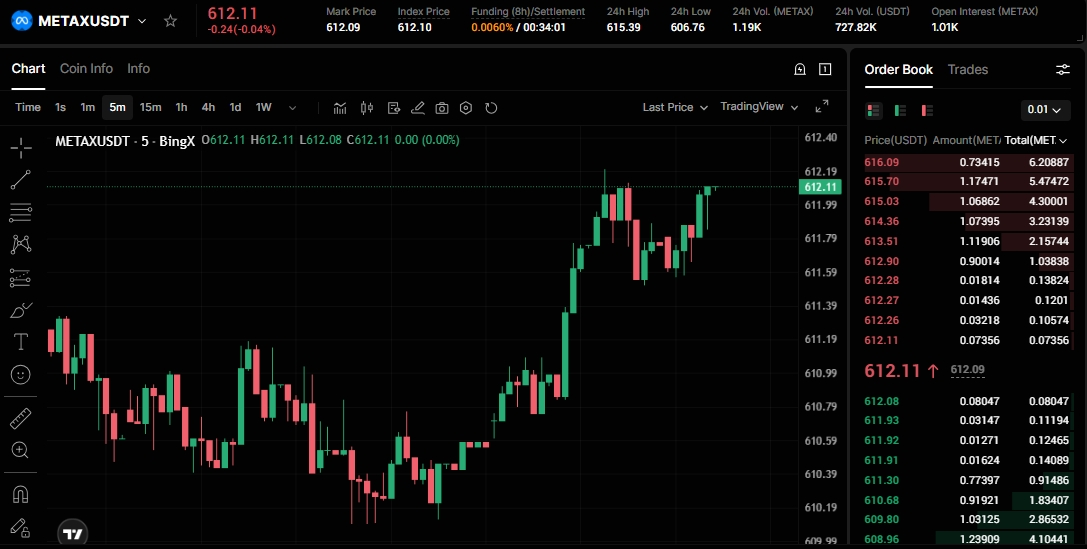
METAX/USDT trading pair on BingX spot market
For investors targeting direct, non-leveraged asset exposure tracking real-world equities on a 1:1 economic basis, the BingX Spot market provides secure access to tokenized tech shares issued via regulated asset frameworks.
- Log into your verified BingX account and activate comprehensive security protocols, such as Google 2FA.
- Fund your Spot Wallet by depositing stablecoins like USDT through your preferred network layer, e.g., TRC-20, ERC-20, or Arbitrum.
- Navigate to the Spot Trading terminal and search for fully backed tokenized stock symbols, such as GOOGLX/USDT and GOOGLON/USDT (Alphabet tokenized stock) or Meta tokenized stocks METAX/USDT and METAON/USDT.
- Deploy the built-in BingX AI Analyst panel within the chart window to instantly visualize automated support/resistance zones, volume anomalies, and real-time technical indicators.
- Define your parameters via a Market or Limit order, specify your USDT transaction volume, and confirm execution. Your tokenized equity balance will instantly reflect inside your spot account.
Trade AI Hyperscaler Stock Futures with USDT on BingX TradFi
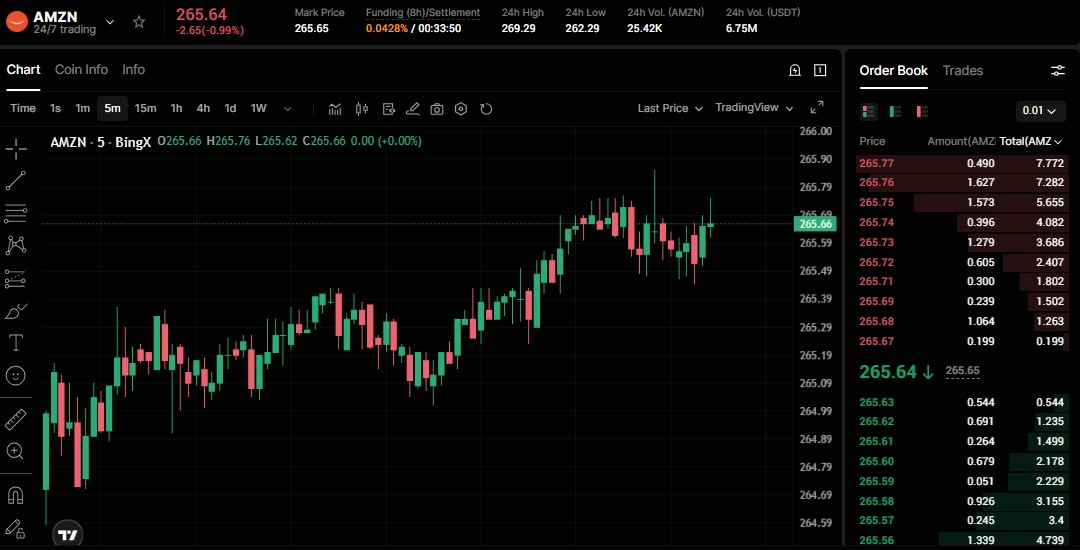
AMZN/USDT perpetuals on BingX futures market
For active market participants seeking to capture near-term earnings momentum, hedge existing structural spot allocations, or utilize directional flexibility, BingX TradFi offers USDT-settled perpetual contracts mirroring leading U.S. technology equities.
- Head to the BingX TradFi portal or the Advanced Futures interface.
- Allocate working capital by moving your desired quantity of USDT from your main Spot account into your Futures account.
- Select your targeted asset contract from a highly liquid directory of equity perpetual pairs, such as MSFT-USDT, AMZN-USDT, or ORCL-USDT.
- Determine your macro direction. Select Open Long if you anticipate near-term upside from data center capital deployments, or Open Short to capitalize on tech sector pullbacks. Configure your leverage parameters defensively based on your personal risk threshold.
- Integrate the BingX AI trading assistant to scan immediate order-book liquidity. Input your position sizing, establish precise Take-Profit (TP) and Stop-Loss (SL) orders to insulate against sudden volatility spikes, and execute the trade. Real-time PnL will settle dynamically inside your wallet in USDT.
Risks and Key Considerations When Trading AI Hyperscalers
Despite the undeniable multi-year structural tailwinds backing the AI infrastructure cycle, market participants must manage capital allocation against significant systemic risks:
- Capex Intensity and FCF Compression: Hyperscaler capex intensity has climbed above 30% of total revenue for the first time in history. If the timeline between massive infrastructure outlays and actual enterprise software revenue realization lags further, extensive asset depreciation schedules will compress free cash flows, sparking valuation multiple compression.
- Accounting Circularity Risks: The massive concentration of other income derived from private equity markups highlights structural codependency. If private funding rounds for top-tier AI research labs down-round or face liquidity constraints later in 2026, hyperscalers will experience significant non-operating net income drops.
- Macro and Geopolitical Overlays: Data center supply chains and component costs are highly sensitive to global macro conditions. Rising commodity prices and geopolitical disruptions can drastically inflate construction, networking, and hardware procurement budgets.
- Tokenized Asset Governance Structures: Tokenized equity pairs function exclusively as structured price-tracking vehicles. They capture 1:1 real-world economic movements using crypto rails but do not convey corporate voting architecture, physical stock delivery, or traditional shareholder legal rights.
Final Thoughts: Should You Add AI Hyperscaler Stocks to Your 2026 Portfolio?
The technology sector in the second half of 2026 features a distinct infrastructure bottleneck: while underlying chip designers are producing massive volumes, the cloud hyperscalers are the ones orchestrating the deployment layer. Diversifying capital across distinct layers of the hyperscaler stack, ranging from dominant cloud incumbents like Amazon and Microsoft, to high-momentum growth assets like Alphabet, and multi-cloud infrastructure plays like Oracle, offers a comprehensive mechanism to gain exposure to this physical technology cycle. Utilizing tokenized spot vehicles or flexible stock futures via BingX TradFi enables global capital to execute these macro-driven equity theses efficiently using unified, crypto-native rails.
However, navigating this high-growth ecosystem requires absolute capital discipline. Hyperscaler infrastructure assets are highly sensitive to sudden capex adjustments, energy grid availability, and quarterly revenue metrics. Market participants should carefully assess their individual risk profiles, maintain strict risk mitigation protocols, and treat these high-beta technology exposures as a specialized component of a well-balanced, globally diversified portfolio.
Related Reading
- Top AI Cloud Infrastructure Stocks to Buy in 2026 Amid Hyperscaler Capex and the Neocloud Boom
- Top Energy Stocks and ETFs to Buy in 2026: The AI Power Crunch Meets Geopolitical Volatility
- Top AI Compute and GPU Stocks to Buy in 2026: The Shift to Inference and Custom Silicon
- Top 10 AI Infrastructure Stocks to Buy in 2026: Chip Manufacturing and Design Leaders
