
Commodities are one of the most historically significant asset classes in traditional financial markets, covering physical materials such as gold, silver, crude oil, and natural gas. They have long been regarded as important allocations for hedging against inflation and diversifying stock market risks. For Taiwanese investors, participating in these markets in the past typically required opening futures accounts through brokers, purchasing Taiwan stock futures ETFs, or buying physical gold—processes that were cumbersome and involved multiple account fees.
The market environment in 2026 has brought commodities back into focus. Gold touched a historical high of approximately $5,595 per ounce in January 2026, WTI crude oil rose above $100 per barrel driven by geopolitical factors, and silver's year-to-date gains once approached 120%. These movements reflect multiple changes in global safe-haven demand, energy supply, and inflation expectations. For Taiwanese investors, how to participate in commodity markets with greater flexibility, rather than being constrained by traditional broker account opening and foreign currency conversion, has become a new focus.
This article starts from the practical operational scenarios of Taiwanese commodity investors, introduces the operational logic of BingX TradFi commodity perpetual contracts, compares four investment methods—physical gold, Taiwan stock futures ETFs, sub-brokerage futures, and BingX TradFi—and summarizes the historical performance, entry timing judgment, and allocation ratios for gold, crude oil, and silver. The content of this article is for reference only and does not constitute investment advice. Leveraged products carry high risks, and investors should assess their risk tolerance before investing.
Key Takeaways
- BingX TradFi commodity perpetual contracts are priced and settled in USDT: Covering nearly 20 commodities including gold, silver, WTI crude oil, Brent crude oil, and natural gas, with maximum leverage up to 500x. No need to open futures or foreign currency accounts—trade directly with USDT margin, suitable for Taiwan's crypto-native investors to enter traditional financial markets.
- The 2026 commodity market is dominated by safe-haven demand and geopolitical factors: Gold touched approximately $5,595 historical high in January, WTI crude oil once rose above $100 due to US-Iran conflicts, and silver's catch-up rally was evident. These trends are highly correlated with central bank buying, real interest rate changes, and geopolitical risks.
- Commodities play a role in diversifying risk and hedging against inflation in investment portfolios: Conservative investors are recommended to allocate 5% to 10%, with gold as the core; aggressive investors can expand to 8% to 23%, adding more volatile commodities like crude oil and silver.
- BingX TradFi is fully integrated with BingX AI, copy trading, and VIP system: Users can operate cryptocurrency and commodity perpetual contracts in the same account, switch between markets without additional accounts, and follow experienced traders to copy commodity strategies.
- Leverage is a double-edged sword—risk management is more critical than entry timing: Although commodity volatility is lower than cryptocurrencies, leverage above 50x can still lead to forced liquidation due to short-term gaps. Beginners should start with 5 to 10x leverage and immediately set stop-loss and take-profit after opening positions.
2026 Commodity Market Outlook: Gold, Oil, and Silver Investment Trends
From historical price performance, commodities show low correlation with stocks and bonds over the long term, often serving as important assets in portfolios to hedge against systemic risks and inflation. From 2024 to 2026, commodity markets experienced multiple structural changes: global central banks continued to increase gold reserves, with Asian buying replacing Western institutions as the main driver of gold prices; geopolitical conflicts pushed up oil prices, with WTI crude rising from relative lows in 2025 to above $100 per barrel; silver broke above $55 per ounce at the end of 2025 and showed catch-up rallies in early 2026, with year-to-date gains once approaching 120%.
The 2026 gold market is supported by several long-term factors. High US government spending, sticky inflation, declining real yields, and a weakening dollar against other major currencies have made gold a priority allocation asset for institutions and central banks. Investment banks' average forecast for 2026 gold prices falls in the $4,500 to $6,500 per ounce range, with some extreme scenarios seeing $6,900 per ounce. After gold touched approximately $5,595 historical high in January, it experienced significant corrections, consolidating in the $4,500 to $4,700 per ounce range in early May 2026.
The oil market is dominated by geopolitical factors. After US-Iran conflicts escalated from late February 2026, both WTI and Brent crude surged simultaneously, with WTI once reaching $105 per barrel. Although EIA estimates that the oil market will remain oversupplied from 2026 to 2028 based on supply-demand fundamentals, short-term transportation disruptions and refineries rushing for spot purchases have kept oil prices at high levels. For Taiwanese investors, crude oil's high volatility and rapid directional changes make it suitable for short-term and event-driven strategies, not passive long-term holding. Silver, due to gold-silver ratio corrections and rising industrial demand (including AI-related electronics manufacturing and solar energy), still has catch-up potential in 2026, but with higher volatility than gold.
Key Commodity Price Performance Review (2024–2026)
The following table summarizes the performance of five major commodities—gold, silver, WTI crude oil, Brent crude oil, and natural gas—over the past three years, helping readers quickly grasp the cycle position and volatility characteristics of each commodity.
|
Commodity |
2024 Performance |
2025 Performance |
2026 YTD Performance |
Recent ATH (Approx.) |
Market Status Summary |
|
Gold |
+27% |
+63.68% |
+17.81% |
$5,595 (2026-01-29) |
Supported by central bank buying and safe-haven demand |
|
Silver |
+21% |
+124% |
Continued uptrend |
Above $55 (End of 2025) |
Gold-silver ratio correction, industrial demand catch-up |
|
WTI Crude |
Range-bound |
Low-level rebound |
Geopolitical surge |
$105 (2026 conflict period) |
Driven by US-Iran conflict, supply-demand still loose |
|
Brent Crude |
Range-bound |
Low-level rebound |
Geopolitical surge |
$108 (2026 conflict period) |
North Sea five oil fields pricing benchmark |
|
Natural Gas |
Seasonal volatility |
+30%+ |
Range-bound volatility |
Seasonal variations |
Driven by supply side and winter demand |
Note: Annual returns are compiled from public historical data; highs and lows are approximate ranges based on public historical data for market context explanation. Actual values may vary slightly depending on data sources and exchange quotes.
When Is the Best Time to Invest in Commodities? 5 Key Market Indicators
Commodity prices are highly volatile, making it difficult to judge whether now is suitable for entry based on absolute prices alone. For medium to long-term investors, a more practical approach is to simultaneously observe macroeconomic, geopolitical, central bank behavior, and technical signals. These indicators don't all need to appear simultaneously to indicate entry opportunities, but when multiple signals align within the same period, it usually represents that the market has entered a range worth gradual positioning.
- US Dollar Index (DXY) Trend: The US Dollar Index typically shows an inverse relationship with commodity prices. When the dollar weakens, USD-denominated gold, oil, and silver become cheaper for other currency users, increasing demand and pushing prices higher. When DXY breaks below 100 or forms a clear downtrend, it's usually a signal for gradual commodity positioning.
- 10-Year US Treasury Real Interest Rate: Real interest rates (nominal rates minus inflation) reflect the opportunity cost of holding non-yielding assets like gold. When real rates continue declining, gold's relative attractiveness increases; conversely, when real rates rise, gold faces pressure. Historically, when real rates are below 1%, gold mostly shows bullish trends.
- Geopolitical Risk Index (GPR): Geopolitical events (such as wars, sanctions, energy transport disruptions) directly boost demand for oil and gold. When the GPR index rises significantly, it usually indicates elevated market risk-off sentiment. Consider establishing partial gold or oil positions during the initial stages of geopolitical events. However, event-driven markets are volatile and quick to retrace—avoid excessive chasing.
- Central Bank Gold Net Purchases: Central bank purchase data in the World Gold Council (WGC) quarterly reports is an important indicator of long-term gold demand. When central banks maintain high levels of net purchases for consecutive quarters, it indicates stable structural demand, making it less likely to break long-term support even during short-term corrections. From 2024 to 2026, emerging market central banks' gold reserve ratios continued rising, serving as one of the core drivers of long-term gold strength.
- US CPI and Inflation Expectations: Commodities themselves are real assets, showing positive correlation with inflation over the long term. When US CPI remains above 3% or market inflation expectations rise, investors typically increase commodity allocations for hedging. For Taiwanese investors, observing changes in inflation expectations helps judge whether the current environment favors commodities.
|
Indicator |
Reference Threshold |
Operational Focus |
|
US Dollar Index (DXY) |
Below 100 or forming downtrend |
Favorable for gold and silver, consider gradual accumulation |
|
10-Year US Treasury Real Rate |
Below 1% or continuously declining |
Signal for increased safe-haven asset allocation |
|
Geopolitical Risk Index (GPR) |
Significant increase |
Oil and gold typically strengthen simultaneously |
|
Central Bank Gold Net Purchases |
Consecutive quarters of net buying |
Long-term demand support, suitable for regular allocation |
|
US CPI & Inflation Expectations |
Consistently above 3% |
Rising real asset demand, favorable for commodities overall |
In practice, these indicators are better used to adjust positioning pace rather than predict short-term highs and lows. For example, when DXY weakens, real rates decline, and central bank buying continues, consider increasing commodity allocation ratios; if geopolitical risks escalate but inflation has moderated, positions should favor gold over oil.
How Much Commodity Exposure Should You Hold in Your Portfolio?
The allocation ratio of commodities in investment portfolios should be determined based on overall financial situation, risk tolerance, investment horizon, and judgment of the macroeconomic environment. Since commodity volatility varies greatly (gold is relatively stable, while oil and natural gas are more volatile), it's recommended to separate "core safe-haven assets" (gold) from "volatile commodities" (oil, silver, natural gas) when allocating. The following outlines common allocation methods for three types of investors.
- Conservative Taiwanese investors (mainly holding Taiwan stocks, ETFs, or time deposits): Commodities should be controlled at 5% to 10% of total investable assets, with gold as core allocation. This can be gradually accumulated through physical gold, gold passbooks, or Taiwan stock gold futures ETFs, with no leverage recommended. More volatile commodities like oil and silver, if included, should not exceed 3%. For these investors, commodities serve to balance stock market volatility and inflation risks, not to pursue short-term high returns.
- Aggressive Taiwanese investors (already having diversified allocations in stocks, ETFs, etc.): Commodity ratios can increase to 8% to 23% of total investable assets, with gold occupying 5% to 15%, and volatile commodities like oil and silver occupying 3% to 8%. These investors can use BingX TradFi perpetual contracts for short-term operations or event-driven trading, but should keep leverage at 5 to 10x and strictly set stop-losses to avoid excessive losses from single events.
- Taiwanese investors primarily focused on cryptocurrencies: Commodities can serve as cross-market hedge positions, occupying 5% to 15% of total investment assets. When cryptocurrency markets enter correction phases, gold and oil often show low correlation with Bitcoin, helping smooth overall portfolio volatility. BingX TradFi's advantage lies in cross-market operations with USDT margin in the same account, eliminating the need for separate broker or futures accounts, suitable for crypto-native investors to quickly establish commodity exposure.
How to Invest in Commodities in Taiwan? 4 Popular Commodity Investment Methods
For investing in commodities in Taiwan, different investors with varying capital scales, operational preferences, and risk tolerance are suitable for different approaches. Generally, common methods include BingX TradFi perpetual contracts, physical gold and gold passbooks, Taiwan stock futures ETFs, and sub-brokerage or overseas futures accounts. The following introduces four methods in order of priority and accessibility for Taiwanese users.
1. Trade Commodity Perpetual Futures on BingX TradFi
BingX TradFi commodity perpetual contracts are the most direct way for Taiwan's crypto-native investors to enter commodity markets in 2026. BingX TradFi integrates traditional financial instruments (including forex, commodities, stocks, indices) into the USDT margin perpetual contract framework. Users can trade nearly 20 commodities including gold, silver, WTI crude oil, Brent crude oil, and natural gas in the same BingX account with the same USDT balance, with maximum leverage up to 500x. Price sources come from institutional-grade quote providers like IG and Bloomberg, with funding rates settled every 8 hours, consistent with cryptocurrency perpetual contract logic.
These products track actual commodity prices but don't require physical delivery or storage, nor foreign currency accounts or broker account opening. For Taiwanese investors, the biggest advantage is significantly reduced entry costs and account complexity, while integrating with BingX AI market analysis, copy trading, and VIP benefits for cross-market strategy execution. The following is the actual operational process.
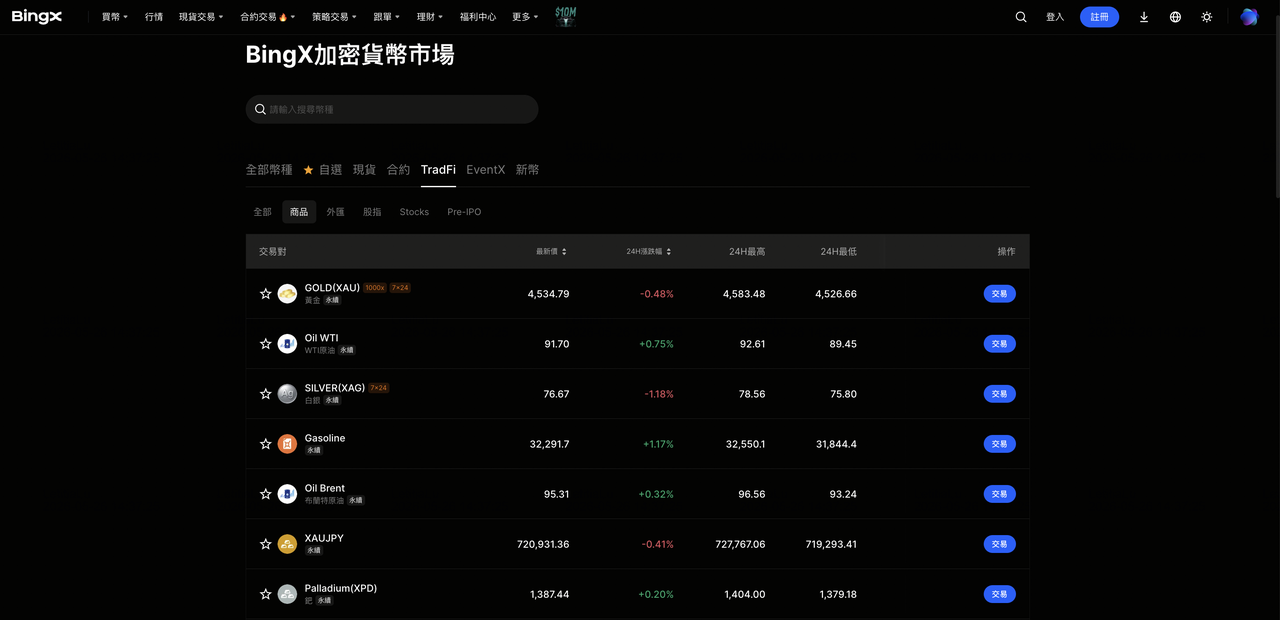
1. Register BingX Account and Complete KYC: Visit BingX official website or app to register an account, complete basic identity verification and security settings. After KYC approval, perpetual contract trading privileges are unlocked, including BingX TradFi commodity product lines.
2. USDT Deposit to Futures Account: Through credit cards, third-party payments, or Taiwan local exchanges (MAX, BitoPro) via USDT TRC-20 path to transfer USDT to BingX, then from "Assets" → "Fund Transfer" to move USDT from spot account to perpetual contract account. USDT TRC-20 withdrawal fees are typically under $1, making it the mainstream path for Taiwanese users to buy USDT and transfer funds across platforms.
3. Enter USDT Margin Perpetual Contract Page and Select Commodities: In BingX trading interface, select "Futures Trading" → "TradFi" → "Commodities" category, choose Gold, Silver, WTI Crude Oil, Brent Crude Oil, or Natural Gas contracts. Before placing orders, refer to BingX AI's market trend summaries, technical signals, and TradingView charts as entry judgment basis.
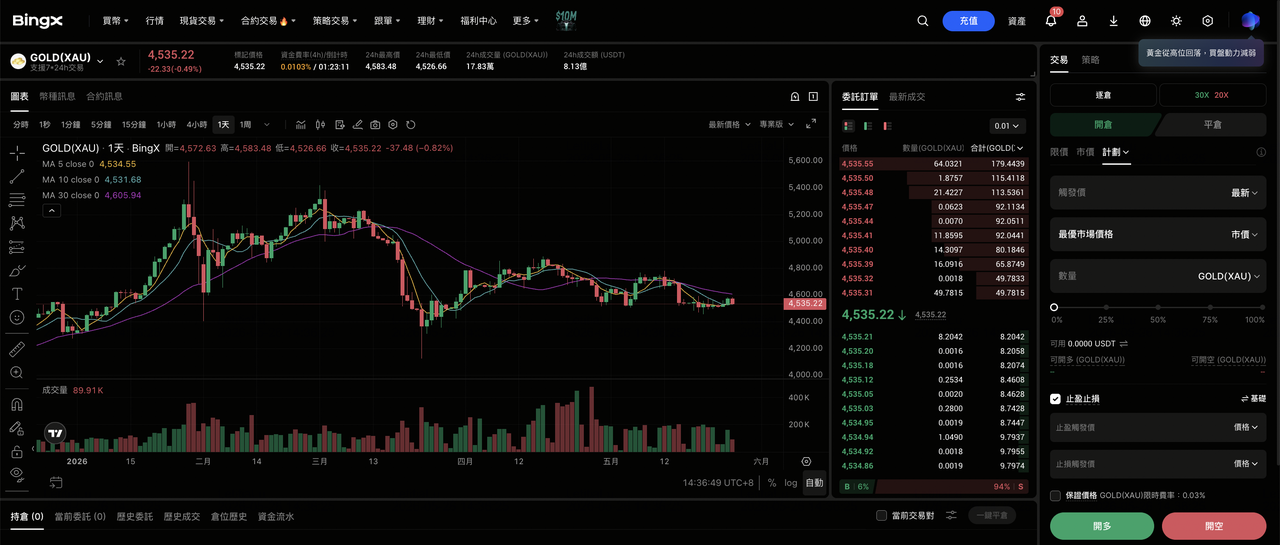
4. Select Isolated Mode, Set Leverage and Place Orders: Recommend choosing Isolated mode to limit single trade risk within that margin amount. Leverage can initially be set at 5 to 10x, prioritizing limit orders to establish positions, reducing trading costs with 0.02% maker fees. Although BingX TradFi supports up to 500x leverage for some commodities, beginners should avoid using above 50x to prevent forced liquidation from short-term gaps.
5. Immediately Set Stop-Loss and Take-Profit: After opening positions, immediately set Stop Loss and Take Profit. Gold 4-hour stop-loss range should be 1% to 3%, daily 3% to 5%; oil has higher volatility, 4-hour stop-loss 2% to 4%, daily 4% to 7%. Commodity trading sessions (Monday to Friday) have approximately 1-hour daily maintenance interruptions. Special attention should be paid to risk control settings when holding positions overnight.
6. Monitor Positions and Funding Rates: During holding periods, monitor unrealized PnL, funding rate settlement times, and mark prices at any time. BingX commodity perpetual contract funding rates settle every 8 hours. For long-term positions, this should be included in overall cost assessment. Regularly download trading records as subsequent asset management and tax filing references.
2. Buy Physical Gold and Gold Savings Accounts
Physical gold is Taiwan's most widespread traditional commodity investment method, including gold bars, coins, jewelry, and gold passbooks provided by banks. This method suits conservative investors who pursue the "actual holding" experience, prefer not to use leverage, and focus primarily on value preservation. Taiwan jewelry store gold selling prices broke through NT$20,000 per tael in early 2026, compared to approximately NT$4,000 to 5,000 per tael in 2015-2016, meaning long-term holders' assets have multiplied several times.
1. Physical Gold Bars and Coins: Available at Taiwan jewelry stores, banks (some branches), or qualified precious metals dealers. Common specifications include 1 tael, 5 tael, 10 tael gold bars, and Panda gold coins, Maple Leaf gold coins, and other international coins. Advantages include actual possession and strong inheritance properties, but require self-custody and typically have larger bid-ask spreads (hundreds of NT$ per tael).
2. Gold Passbooks: Provided by multiple Taiwan banks (including Bank of Taiwan, Land Bank, Mega Bank, etc.), denominated in USD or NT$, with minimum purchase units typically 1 gram. Advantages include high liquidity and no physical custody needs, allowing anytime trading, suitable for long-term dollar-cost averaging gold positions. However, gold passbooks typically cannot be exchanged for physical gold, only cash settlement.
3. Gold Bar Subscription Services: Some banks provide "gold passbook to physical" services, converting accumulated gold positions into physical bars or coins. This service requires additional handling fees and suits investors who have accumulated certain positions and wish to hold physical gold.
Physical gold's limitations include only long positions (no shorting), unsuitability for short-term trading, and inability to participate in other commodities like oil, silver, and natural gas. For Taiwanese investors seeking diversified commodity allocation, physical gold typically serves as core safe-haven positions, combined with other tools to participate in overall commodity markets.
Extended reading: How to Invest in Gold in Taiwan? Complete Gold Investment Guide (2026)
3. Invest in Commodity Futures ETFs
The Taiwan stock market has multiple futures ETFs tracking gold, oil, silver, and other commodity prices, tradable through broker sub-brokerage or general Taiwan stock accounts. These ETFs are issued by investment trust companies, using futures contracts as primary investment targets, indirectly tracking commodity spot prices, suitable for investors familiar with Taiwan stock trading interfaces.
The advantages of commodity futures ETFs include direct trading in Taiwan stock sessions with NT$, no foreign currency accounts needed, and subscription processes identical to regular stocks. However, these ETFs also have several limitations to note: First, futures ETFs require regular roll-overs (rolling near-month contracts to far-month contracts). Long-term holding may incur "roll costs" due to contango structures, causing ETF price movements to diverge from spot prices, especially evident in commodities with steep futures curves like oil and natural gas. Second, Taiwan stock futures ETF expense ratios are typically higher than regular equity ETFs, with non-negligible long-term holding costs. Third, some commodities (like silver and natural gas) have low liquidity Taiwan stock ETFs, potentially facing slippage during large transactions.
For Taiwanese investors, commodity futures ETFs suit "those wanting NT$ commodity participation, avoiding futures account opening, and accepting roll costs" for medium to long-term investment. For specific ETF codes and specifications, check the latest information on investment trust official websites or stock exchange listings, and evaluate expense ratios, tracking errors, and liquidity before deciding on subscriptions.
4. Trade Commodities Through Overseas Futures or Sub-Brokerage Accounts
For Taiwanese investors seeking the most direct commodity exposure with larger trading scales, they can trade commodities through broker sub-brokerage (investing in overseas ETFs and stocks) or opening overseas futures accounts (such as CME, ICE futures exchange contracts). These channels typically denominate in USD, allowing direct trading of futures contracts or overseas commodity ETFs (such as GLD, USO, SLV, etc.).
Sub-brokerage advantages include relatively familiar processes (brokers are typically Taiwan local ones like Cathay, Fubon, Yuanta, etc.), allowing USD account trading of overseas-listed commodity ETFs, suitable for long-term holding. Overseas futures accounts provide the most direct futures contract trading, with leverage and margin rules consistent with international markets, but have more cumbersome account opening processes and require familiarity with futures contract specifications, margin call mechanisms, and expiry rollovers.
Common limitations of both methods include: funds need conversion to USD first, requiring foreign currency accounts, sub-brokerage and futures fees significantly higher than Taiwan stock trading, and SWIFT wire transfer withdrawal fixed costs around $25-45, making cost ratios high for small transactions. For investors familiar with traditional financial operations and larger trading scales, sub-brokerage and overseas futures remain suitable tools; but for Taiwanese investors seeking quick entry and low barriers, BingX TradFi perpetual contracts' flexibility and cost advantages are typically more evident.
Why Trade Commodities on BingX TradFi? 5 Key Advantages
For Taiwanese investors, BingX TradFi commodity perpetual contracts' advantages extend beyond single aspects like fees or leverage, but how the overall trading environment reduces operational complexity and funding costs. The following summarizes 5 core advantages with the most differentiation for Taiwanese users.
1. USDT Margin Unified Settlement, No Multi-Currency Conversion Needed: All BingX TradFi commodity perpetual contracts are priced, margined, and settled in USDT. A single USDT balance can simultaneously trade gold, oil, silver, natural gas, and other commodities. Taiwanese users don't need to open multiple foreign currency accounts for different commodities or bear hidden costs from frequent currency exchanges, greatly simplifying fund management.
2. Complete Commodity Coverage, Nearly 20 Commodity Types: BingX TradFi provides core commodities including gold, silver, WTI crude oil, Brent crude oil, natural gas, plus aluminum, lead, cocoa, soybeans, and other less common market contracts. For Taiwanese investors seeking diversified allocation, this commodity coverage far exceeds typical cryptocurrency exchanges, approaching professional futures broker levels.
3. Institutional-Grade Quote Sources, Both Depth and Transparency: BingX TradFi prices come from institutional-grade data providers like IG and Bloomberg, rather than relying solely on single exchange data. This means quote depth, stability, and transparency all approach traditional futures market standards, maintaining stable execution quality during high volatility periods.
4. Extended Trading Hours, Covering Global Major Market Volatility: BingX TradFi commodity perpetual contract trading hours are approximately 23 hours Monday to Friday, opening Sunday 22:30 UTC and closing Friday 22:30 UTC, with only about 1 hour of maintenance interruption daily from 22:30 to 23:30 UTC. For Taiwanese investors, this means entry is possible during periods after Taiwan stock close and before US stock open, covering key volatility across Asian, European, and American market sessions.
5. Integrated with BingX AI, Copy Trading, and VIP System: BingX TradFi is fully integrated with BingX AI, copy trading, and VIP benefits. Users can access commodity market analysis through BingX AI, follow experienced traders to copy commodity strategies, and have crypto and commodity trading volumes calculated together for VIP levels. For crypto-native investors, entering commodity markets no longer requires rebuilding operational habits and benefit systems.
4 Important Risks to Know Before Investing in Commodities
While commodity investment can provide diversification and inflation hedging functions, it also has unique risk characteristics. Before entry, the following 4 risks and preparations should be evaluated.
1. Leverage Proportionally Amplifies Losses: BingX TradFi supports up to 500x leverage for some commodities, but this doesn't represent recommended multiples. With 50x leverage, a 2% adverse price movement could trigger forced liquidation, losing all margin. Beginners should start with 5 to 10x leverage, gradually adjust after familiarizing with mechanisms, and avoid high leverage positions before high volatility events (such as OPEC meetings, CPI releases, geopolitical events).
2. Geopolitical Events May Cause Gaps: Commodity prices are highly sensitive to geopolitical events, such as war outbreaks, sanction announcements, or transport route blockades, potentially causing weekend or intraday gaps. Gap magnitudes may exceed originally set stop-loss levels, resulting in actual execution prices far below expectations. Consider reducing positions and adjusting leverage before known events, or use guaranteed price functions to lock execution prices.
3. Commodity Volatility Characteristics Differ from Cryptocurrencies: Gold's daily average volatility is about 1% to 2%, while oil and natural gas can reach 3% to 5%. Mainstream cryptocurrency daily volatility commonly ranges 5% to 10%. For investors accustomed to cryptocurrency volatility, commodities may seem to have "lower volatility," but this doesn't mean lower risk. Long-term accumulated trending movements can still cause significant losses, requiring special caution with leverage use.
4. Long-term Holding Should Consider Tax Records and Fund Proof: Trading commodity perpetual contracts through BingX may involve property transaction income reporting when withdrawing profits. Regularly download BingX trading records, preserve details of each opening, closing, fees, and funding rates as subsequent tax filing and asset management references. When withdrawing to Taiwan local accounts, single transactions above NT$500,000 trigger bank reporting to the Investigation Bureau, Ministry of Justice. Large withdrawals should be planned in batches in advance.
Conclusion: Should You Invest in Commodities in 2026?
The 2026 commodity market still has allocation value, but with the prerequisite that investors understand each commodity's independent cycles and volatility characteristics. From market structure perspectives, gold is supported by central bank buying, declining real rates, and geopolitical risks with solid long-term demand; oil is dominated by short-term geopolitical events, suitable for event-driven strategies rather than passive long-term holding; silver connects with industrial demand and still has catch-up potential during gold-silver ratio correction phases. For Taiwanese investors, a more reasonable approach isn't betting heavily on single commodities at once, but first establishing commodities' role in overall investment portfolios (hedging, inflation protection, cross-market hedging), then selecting suitable tools and ratios based on personal risk tolerance.
For crypto-native investors and Taiwanese users seeking low-barrier commodity market participation, BingX TradFi commodity perpetual contracts are among the most flexible choices in 2026. USDT unified margin, nearly 20 commodity coverage, institutional-grade quotes, and integration with BingX AI and copy trading make cross-market operations no longer require multi-account management. In practice, starting with gold to establish basic positions is recommended, extending to oil and silver after familiarizing with perpetual contract mechanisms, while strictly controlling leverage and single position ratios. Overall, commodities should still focus on "risk diversification, inflation hedging, and portfolio enhancement" as core purposes, rather than simply pursuing high-leverage short-term returns. Leverage control, stop-loss settings, and macroeconomic indicator tracking remain key to determining final returns.
Related Reading
- Complete Guide to Taiwan Cryptocurrency Exchange Fee Comparison (2026): Comprehensive Analysis of Spot, Futures, Copy Trading, DCA, and VIP Fees
- Complete Comparison and Recommendation of Taiwan Cryptocurrency Futures Trading Platforms (2026): Trading Fees, Liquidity, and Security Comparison
- How to Trade Forex, Commodities, Stocks and Indices on BingX TradFi: Beginner's Guide (2026)
- How to Trade Commodities with Crypto as Oil, Gold, Silver and Traditional Finance Go On-Chain in 2026
- How to Plan Gold Investment Strategies in 2026? Day Trading, Swing Trading, and Hedging Operations Summary
