


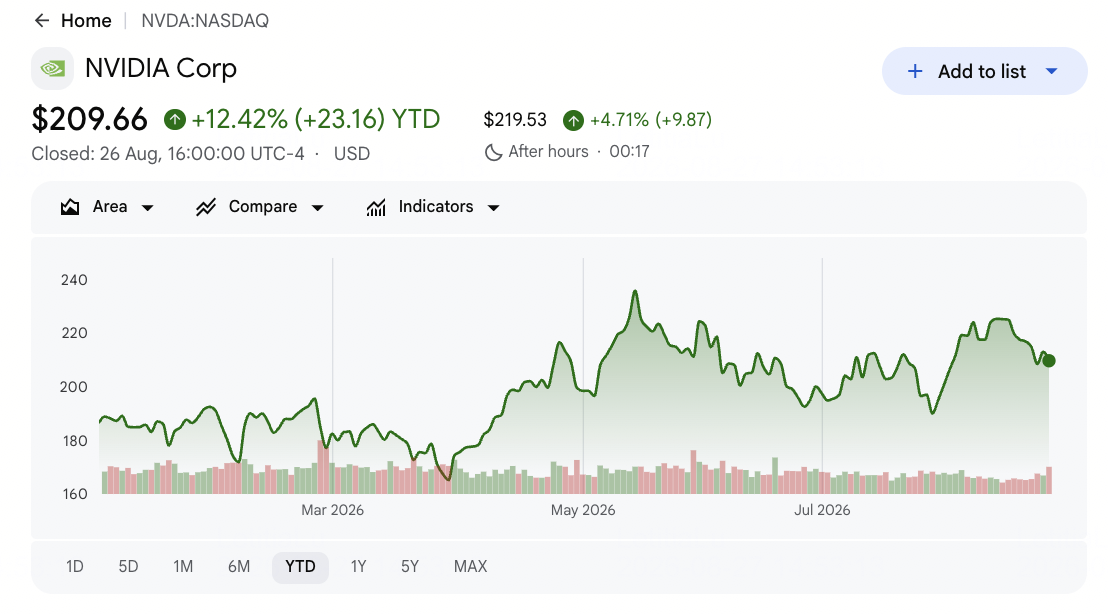
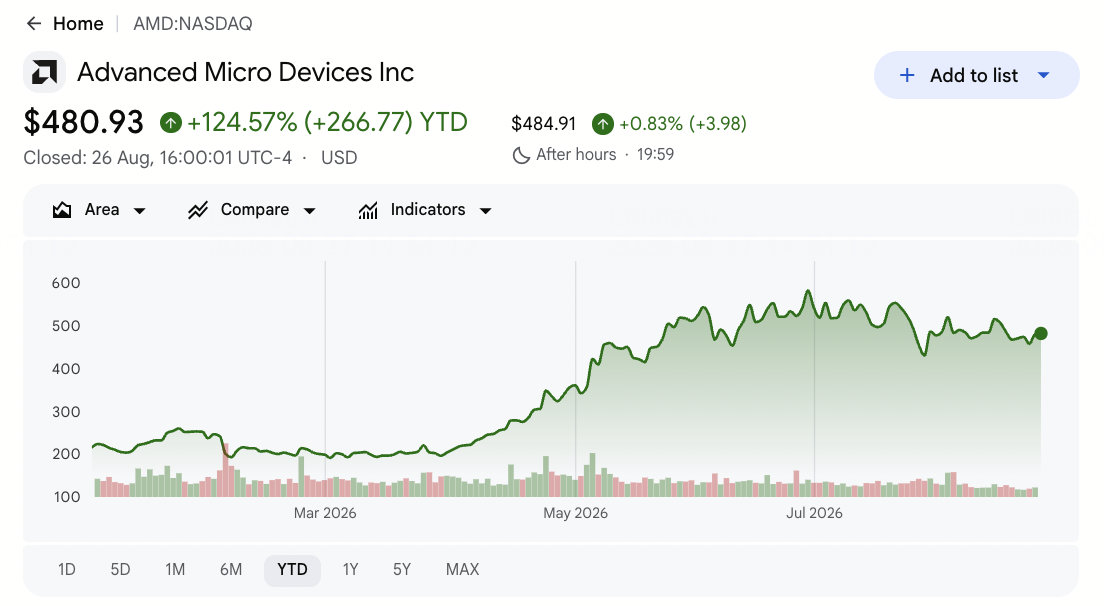
Nvidia Corporation (NVDA) and Advanced Micro Devices (AMD) are the two most-watched names in the AI chip trade and both sit at the center of the global AI data-center buildout. Nvidia leads in AI accelerators through its GPUs and CUDA software ecosystem, while AMD has become the main alternative with its Instinct GPUs and growing EPYC server-CPU business. Their 2026 stock performance has diverged sharply: AMD is up roughly 122% year to date after reaching an all-time high near $581 in June, while Nvidia is up about 13%, leaving investors to weigh Nvidia’s dominance against AMD’s faster momentum and share-gain potential.
The NVDA vs AMD debate for 2026 now centers on two competing views:
- The dominance-and-value case (Nvidia): Nvidia owns roughly 80%+ of the AI accelerator market, earns 60%+ net margins, and trades at a forward P/E near 21x, making it the lower-risk way to own AI compute.
- The momentum-and-share case (AMD): AMD is growing faster off a smaller base, winning major AI deals and taking server-CPU share, but its roughly 66x forward P/E leaves less room for a data-center miss.
This guide compares Nvidia (NVDA) and AMD (AMD) across AI chip market share, growth, valuation, key risks, and the 2026 outlook, plus how to trade NVDA and AMD stock futures on BingX TradFi with USDT collateral.
Top 5 Things to Know About Nvidia vs AMD in 2026
- AMD is the momentum winner: AMD is up roughly 122% YTD versus about 13% for Nvidia.
- Nvidia still dominates AI GPUs: Nvidia holds roughly 75–87% of the AI accelerator market, while AMD remains the smaller challenger.
- Nvidia is much larger and more profitable: Nvidia leads on revenue, margins, and market value despite AMD’s faster growth.
- AMD trades at a much higher valuation: AMD’s roughly 66x forward P/E leaves less room for execution misses than Nvidia’s roughly 21x.
- The key debate is dominance versus share gains: Nvidia offers established AI leadership, while AMD offers more upside if it keeps gaining GPU and server-CPU share.
What Does Nvidia (NVDA) Do?
Nvidia Corporation is a semiconductor and computing company best known for the GPUs and AI accelerators used to train and run large AI models. What makes Nvidia different from a traditional chip company is that it sells a broader computing platform around those chips, combining GPUs, CPUs, networking, systems, and software. This has made Nvidia a central supplier to hyperscalers, cloud providers, and AI data centers, with data center revenue now representing the core of the business.
- AI computing: Blackwell B200 GPUs and GB200 systems for large-scale training and inference
- Software and networking: CUDA plus high-speed networking for connecting large GPU clusters
- Next-generation platforms: Vera Rubin and Rubin Ultra on Nvidia’s future AI roadmap
The investment case now centers on whether Nvidia can maintain its AI-compute lead as competition increases and customers move through the next wave of data center upgrades.
Read More: Nvidia (NVDA) Stock Price Outlook for 2026: Can Blackwell and Vera Rubin Take NVDA Back to $300?
Nvidia (NVDA) Stock Price Trend (2021-2026)
Nvidia’s stock has risen dramatically with the AI boom, though the path has included major corrections during weaker semiconductor and macro cycles.
|
Year |
Yearly High |
Yearly Low |
Annual Return |
Market Conditions |
|
2021 |
~$34 |
~$12 |
~+125% |
Pandemic demand and gaming GPU boom |
|
2022 |
~$30 |
~$11 |
~-50% |
Rate hikes, crypto downturn, and weaker demand |
|
2023 |
~$50 |
~$14 |
~+239% |
Generative AI boom and surging H100 demand |
|
2024 |
~$153 |
~$39 |
~+171% |
Data center growth and 10-for-1 stock split |
|
2025 |
~$212 |
~$86 |
~+35% |
Blackwell ramp and export-control volatility |
|
2026 YTD |
~$237 |
~$164 |
~+13% |
Consolidation after a strong multi-year AI rally |
What Does AMD Do?
Advanced Micro Devices (AMD) is a diversified semiconductor company competing across AI accelerators, server CPUs, PC processors, gaming chips, and embedded computing. Its data center business is the main growth engine, led by Instinct AI GPUs and EPYC server CPUs, while Ryzen processors support the client PC segment and Radeon and semi-custom chips serve gaming. Compared with Nvidia, AMD offers broader exposure across several chip markets, with a smaller but faster-growing AI business.
- AI computing: Instinct MI350/MI355X GPUs, with MI400 as the next-generation platform
- Data center and PCs: EPYC server CPUs and Ryzen desktop and laptop processors
- Gaming and software: Radeon GPUs, semi-custom chips, and the ROCm AI software platform
The investment case centers on whether AMD can keep gaining AI GPU and server CPU share while improving its ROCm software ecosystem enough to compete more effectively with Nvidia’s CUDA advantage.
Read More: AMD Price Prediction 2026: $525 AI Sovereignty or $300 Valuation Trap?
AMD Stock Price Trend (2021-2026)
AMD has historically been more volatile than Nvidia, with its latest rally increasingly driven by AI accelerators, EPYC server CPUs, and expectations for further data-center growth.
|
Year |
Yearly High |
Yearly Low |
Annual Return |
Market Conditions |
|
2021 |
~$162 |
~$73 |
~+57% |
Ryzen and EPYC share gains; strong PC demand |
|
2022 |
~$150 |
~$56 |
~-55% |
PC slowdown, rate hikes, and semiconductor selloff |
|
2023 |
~$149 |
~$62 |
~+128% |
AI optimism builds around MI300 |
|
2024 |
~$211 |
~$119 |
~-18% |
AI expectations cool as the Instinct ramp develops |
|
2025 |
~$187 |
~$76 |
~+21% |
MI350 launch and renewed data-center momentum |
|
2026 YTD |
~$585 |
~$149 |
~+122% |
Record Q2, major AI deals, and sharp valuation re-rating |
Nvidia vs AMD Stock Comparison 2026: Financials, Earnings, and Valuation
Nvidia and AMD benefit from the same AI spending cycle, but they operate at very different scales. Nvidia generates far more revenue and earns much higher margins, while AMD is growing quickly from a smaller base and trades at a much higher valuation because investors expect further AI and server-CPU share gains.
Nvidia leads on scale and margins, while AMD trades at a higher valuation because investors expect faster growth and future market-share gains.
|
Metric |
Nvidia (NVDA) |
AMD (AMD) |
|
Share price |
~$213 |
~$476 |
|
Market cap |
~$5.1 trillion |
~$770 billion |
|
2026 YTD performance |
~+13% |
~+122% |
|
Q2 revenue |
$96.2B, up 106% YoY |
$11.5B, up 32% YoY |
|
Data-center revenue |
$89.0B, up 117% YoY |
$6.7B, up 107% YoY |
|
Non-GAAP EPS |
$2.22 |
$1.66 |
|
Gross margin |
~75% |
~56% |
|
Forward P/E |
~21x |
~66x |
|
Average analyst target |
~$305 |
~$577 |
Nvidia vs AMD Product Comparison 2026: AI GPUs, CPUs, and Market Share
Nvidia and AMD compete across AI accelerators, software, server processors, and gaming GPUs. The scale of their positions differs significantly by market, with Nvidia dominating AI and graphics while AMD has a much stronger position in server CPUs.
Nvidia dominates AI GPUs, software, and gaming, while AMD’s main advantage is its EPYC server CPU business and broader product mix.
|
Category |
Nvidia (NVDA) |
AMD (AMD) |
Who Leads |
|
AI accelerators |
~75–87% market share; Blackwell B200 and GB200 lead large AI deployments |
~5–7% market share; Instinct MI350/MI355X, with MI400 coming |
Nvidia |
|
AI software |
4M+ CUDA developers; mature ecosystem of AI libraries and tools |
ROCm supports AMD Instinct GPUs; smaller but expanding software ecosystem |
Nvidia |
|
Server CPUs |
Limited traditional server CPU share; GPUs remain its main data-center product |
~25%+ server CPU share; EPYC continues taking share from Intel |
AMD |
|
Gaming GPUs |
~94% discrete GPU share; GeForce dominates the market |
~5% discrete GPU share; Radeon RX 9000 competes mainly in the mid-range |
Nvidia |
|
AI product roadmap |
Annual architecture cycle; Blackwell → Rubin → Rubin Ultra |
MI350 generation now, MI400 next; faster push into large AI clusters |
Nvidia on scale |
|
Business mix |
Data Center is the dominant revenue business; AI drives most growth |
4 major segments; Data Center, Client, Gaming, and Embedded |
AMD is more diversified |
Nvidia vs AMD Stock Price Forecasts for 2026 by Wall Street Analysts
Wall Street remains broadly positive on both stocks, but the risk-reward differs after their 2026 moves. Nvidia carries higher consensus upside from current levels, while AMD’s stronger rally means more future growth is already reflected in the share price.
|
Institution / Scenario |
NVDA 2026 Price Target |
NVDA Rating & Market Outlook |
AMD 2026 Price Target |
AMD Rating & Market Outlook |
|
Consensus |
~$305 |
Strong Buy. ~44% implied upside from ~$213; most analysts remain bullish on AI leadership and Blackwell growth. |
~$577 |
Buy / Strong Buy. ~21% implied upside from ~$476; analysts expect continued data-center and AI share gains. |
|
High estimate |
$500 |
Bullish. Assumes continued Blackwell growth, a strong Vera Rubin ramp, and sustained AI spending. |
Up to $1,250 |
Aggressive. Assumes AMD reaches double-digit AI accelerator share and keeps expanding EPYC. |
|
Low estimate |
$180 |
Cautious. Reflects slower AI capex, custom-chip competition, and valuation risk. |
Limited published bearish targets |
Cautious. Downside would likely come from slower AI growth or weaker-than-expected market-share gains. |
|
Article scenario |
$180–$305 |
Balanced. AI leadership remains strong, though Nvidia’s size could limit extreme upside. |
$400–$600 |
Balanced. Faster growth potential, but the higher valuation creates more downside if execution disappoints. |
Analyst targets reflect estimates available in late August 2026 and can change after earnings, guidance, or new analyst updates. Article scenarios are illustrative ranges and are not Wall Street price targets.
Nvidia vs AMD 2026: Which AI Computing Stock Is the Better Buy?
There is no single winner for every investor. Nvidia and AMD offer exposure to the same AI computing cycle, but with different risk and growth profiles.
- Nvidia (NVDA) suits investors who prefer the established market leader. It offers dominant AI GPU share, the CUDA ecosystem, higher margins, and a stronger position across large AI data centers. The trade-off is that its enormous size can limit extreme upside.
- AMD (AMD) suits investors willing to take more growth and valuation risk. It has more room to gain AI accelerator share, a growing EPYC server CPU business, and broader exposure across data centers, PCs, gaming, and embedded chips. The trade-off is a higher valuation and greater downside if growth disappoints.
- Owning both offers broader exposure to AI compute. Nvidia provides established leadership, while AMD adds more direct exposure to potential market-share gains. Holding both can spread exposure across the dominant incumbent and the faster-growing challenger.
The choice comes down to Nvidia for AI leadership and stronger margins, AMD for greater share-gain potential, or both for broader AI compute exposure.
How to Trade Nvidia (NVDA) and AMD Stock on BingX
Navigate the volatility of the AI chip trade using BingX TradFi and BingX AI tools. BingX offers USDT-collateralized perpetual contracts on both NVDA and AMD for directional exposure. These are derivatives rather than ownership of the underlying shares and carry funding and liquidation risk.
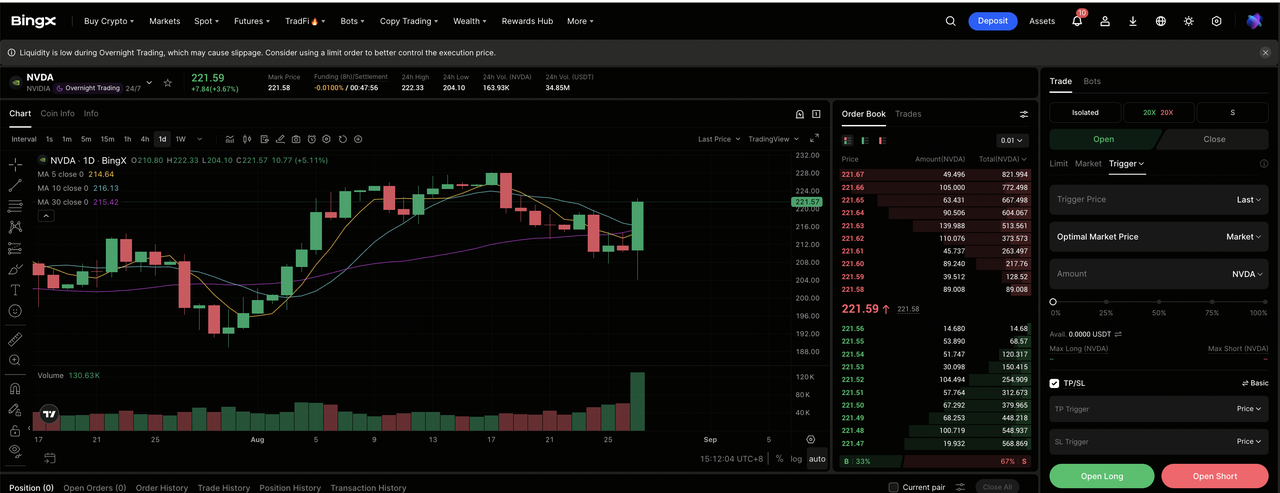
Step 1: Access BingX TradFi. Sign up and navigate to the specialized TradFi section on the main BingX exchange dashboard.
Step 2: Select your contract. Search for and select the NVDA-USDT or AMD-USDT perpetual futures contract, then confirm the displayed ticker and market type.
Step 3: Choose your direction. Select Open Long if you expect AI-compute demand and earnings momentum to remain intact. Select Open Short if you expect a valuation reset, a capex slowdown or a disappointing print to pressure the stock.
Step 4: Select leverage and margin mode. Choose Isolated or Cross-Margin based on risk tolerance. Because both stocks re-price sharply around earnings, and AMD fell ~8% even after a beat, conservative leverage and clear position sizing are important, especially into Nvidia's August 26 report.
Step 5: Execute strict risk protocols. Set Take-Profit and Stop-Loss (TP/SL) levels before or immediately after entry. Monitor earnings, guidance, data-center revenue trends, AI-capex signals and custom-silicon developments.
Top 5 Risks to Watch for Nvidia and AMD Investors in 2026
Nvidia and AMD benefit from the same AI infrastructure cycle, but both remain exposed to competition, valuation pressure, policy risk, and execution.
- Custom AI chips could reduce demand for merchant GPUs. Google’s TPU, AWS Trainium, and other hyperscaler-designed accelerators could shift more AI workloads away from Nvidia and AMD. Nvidia has more existing share to defend, while AMD may find it harder to gain the share investors expect.
- Valuation leaves little room for disappointment. Both stocks price in strong future growth, especially AMD at roughly 66x forward earnings. Softer guidance, weaker margins, or slower data-center growth could trigger sharp corrections even if headline results remain solid.
- AI spending could slow. Nvidia and AMD both depend heavily on hyperscalers continuing to expand GPU, server, and data-center budgets. Any pause or reprioritization of AI capex could pressure revenue growth and sentiment across both stocks.
- China export restrictions remain a major uncertainty. U.S. controls can limit which AI products Nvidia and AMD sell into China, affecting revenue, product strategy, and future estimates. Policy changes in either direction could materially shift expectations.
- Execution risks differ between the two companies. AMD must keep gaining AI accelerator share and improve ROCm adoption, while Nvidia must sustain rapid growth from a much larger base and defend its lead against AMD and custom silicon.
This becomes a much better place for the custom silicon discussion, so I would delete it completely from the
Final Thoughts: Should You Invest in Nvidia or AMD in 2026?
Nvidia and AMD offer two different ways to invest in the AI buildout. Nvidia provides stronger market leadership, higher margins, and the CUDA ecosystem, while AMD offers faster growth potential through AI GPU share gains and its broader CPU business.
The main question is whether Nvidia can maintain its lead as AI spending scales, and whether AMD can grow fast enough to justify its higher valuation. Investors should focus on data-center growth, margins, guidance, and competition from custom AI chips.
Risk Reminder: NVDA and AMD remain exposed to AI-capex cycles, valuation volatility, export restrictions, and execution risk. Derivatives based on either stock can also involve leverage and liquidation risk.
Related Reading
- Nvidia (NVDA) Stock Price Outlook for 2026: Can Blackwell and Vera Rubin Take NVDA Back to $300?
- AMD Price Prediction 2026: $525 AI Sovereignty or $300 Valuation Trap?
- Top AI Compute and GPU Stocks to Buy in 2026: The Shift to Inference and Custom Silicon
- Top AI Server Stocks to Buy in 2026: Rack-Scale Systems, GPU Servers, and AI Servers Infrastructure
- Top 10 AI Infrastructure Stocks to Buy in 2026: Chip Manufacturing and Design Leaders
- Top 10 AI Hardware Stocks to Watch in 2026: The Architecture Driving Next-Gen Intelligence
