

AMC Entertainment Holdings (AMC) is the world's largest theatrical exhibitor, operating roughly 850 theatres and 9,600 screens across the United States and Europe. Ticket sales remain its main demand engine, with food and beverage, premium-format surcharges, loyalty memberships and advertising adding revenue per visit. A stronger film slate gives AMC meaningful recovery potential, though high fixed costs, debt service and repeated equity issuance make the stock unusually sensitive to attendance and financing conditions.
Its latest quarter supplied the strongest operating evidence in years. AMC Q2 2026 revenue reached a record $1.60 billion, up 14.2% year over year and about $130 million above the $1.47 billion LSEG consensus. Adjusted EPS of $0.14 beat expectations for a $0.06 loss, adjusted EBITDA rose 70% to $321.4 million and free cash flow reached $190.1 million. The central question is how much of that improvement can accrue to each share after AMC sold another 105.3 million shares in June.
The AMC stock forecast for 2026 now centers on two competing views:
- The box-office recovery case: A broader release calendar, premium large formats and higher spending per guest could keep EBITDA and free cash flow positive, reduce refinancing pressure and support a move toward $4.50.
- The balance-sheet constraint case: Debt, interest expense, fixed theatre costs and a much larger share count could absorb the operating recovery, limiting per-share value even when attendance improves.
This guide breaks down the AMC stock forecast, 2026 price scenarios, key risks and analyst outlooks, drawing on AMC Entertainment's July 20 Q2 2026 results, investor filings and market data through September 9, plus how to trade AMC stock futures on BingX TradFi with USDT collateral.
Top 5 Things for AMC Investors to Know in September 2026
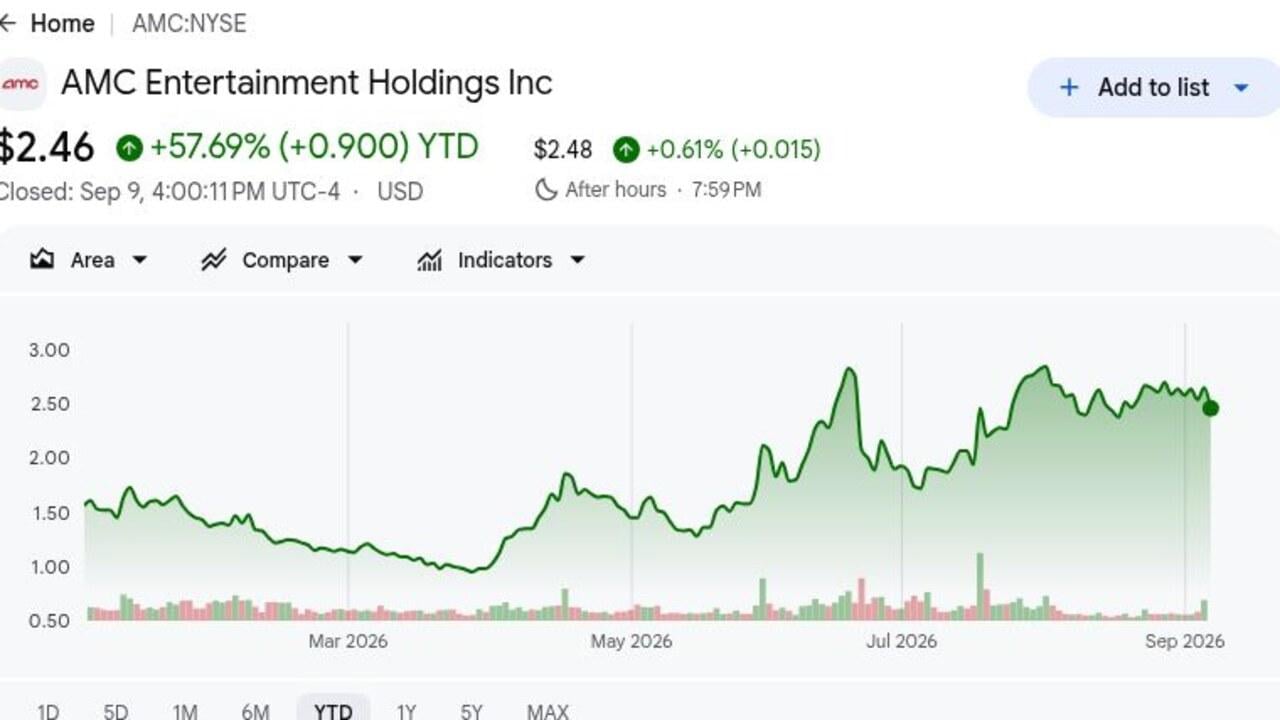
- AMC closed at $2.46 on September 9 after rising 57.69% year to date: The stock advanced from near $1 early in the year to almost $3 during the summer. The close sits near B. Riley's $2.50 target and below Wedbush's $4 target, showing how the market discounts part of the recovery.
- Q2 revenue of $1.60 billion rose 14.2% and beat consensus by about $130 million: Six films produced domestic opening weekends above $75 million. AMC called it the strongest box-office quarter in seven years, supporting better theatre utilization across its circuit.
- Adjusted EPS of $0.14 beat an expected $0.06 loss by $0.20: Adjusted EBITDA increased 70% to $321.4 million. The result shows the earnings sensitivity of a fixed-cost network when attendance rises, though it does not remove interest expense.
- Free cash flow reached $190.1 million as attendance grew nearly 14%: U.S. attendance increased 12% and international attendance rose about 18%. Internally generated cash can fund theatre upgrades and interest payments without another immediate capital raise or debt exchange.
- AMC raised $150 million by selling 105.3 million shares in June: Gross proceeds averaged roughly $1.42 per share before fees. The capital improved liquidity, yet enterprise gains must now be divided across a larger ownership base for investors.
What Is AMC Entertainment Holdings (AMC)?
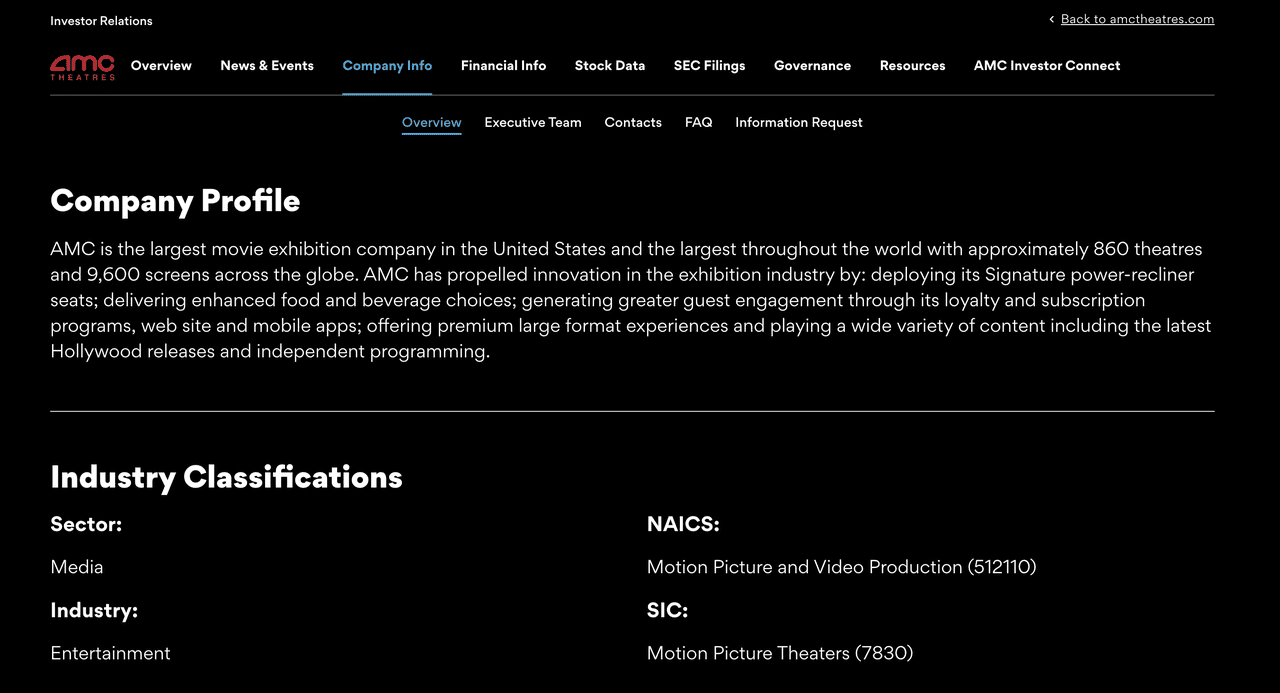
AMC Entertainment is a theatrical exhibition company that sells movie tickets and food and beverages through a global theatre circuit. Its roughly 850 theatres and 9,600 screens include locations in the United States as well as European markets operated under Odeon and other regional brands. Admissions revenue depends on film availability, attendance and ticket pricing, while concessions, advertising and premium experiences raise revenue per guest. AMC also uses AMC Stubs, A-List subscriptions, mobile ticketing and direct customer data to improve frequency and retention across a business with substantial rent, labor and technology costs.
AMC's long-term direction centers on making theatres more differentiated and productive rather than simply adding conventional screens. The Go Plan expands IMAX, Dolby Cinema, Laser at AMC and AMC-branded premium or extra-large formats, supported by upgraded projection, recliners and broader food choices. Major studios including Disney and Universal have maintained exclusive theatrical windows for important releases, sustaining cinemas as the first paid destination for tentpole films. AMC also launched Leawood Films in 2026 to distribute independent and filmmaker-financed releases, a longer-term attempt to improve screen utilization and participate in economics beyond exhibition alone.
AMC Entertainment (AMC) Q2 2026 Earnings Overview: Record Revenue, Cash Flow and Attendance Growth
AMC delivered record Q2 revenue of $1.60 billion versus the $1.47 billion LSEG estimate, adjusted EPS of $0.14 versus a $0.06 loss expected, and adjusted EBITDA of $321.4 million, up 70%. Total attendance increased nearly 14%, including 12% growth in the United States and about 18% internationally, while free cash flow reached $190.1 million. The print demonstrated powerful operating leverage, though the $150 million ATM raise and 105.3 million new shares show why liquidity improvement and per-share value can move in different directions.
Read More: AMC (AMC) Q2 2026 Earnings News: Record Operations Offset a Still-Heavy Balance Sheet
|
Financial Metric |
Guidance / Consensus |
Reported / Actual |
Surprise |
|
Q2 2026 revenue |
$1.47B LSEG consensus |
$1.60B |
Beat. About $130M above consensus; up 14.2% YoY. |
|
Q2 adjusted EPS |
-$0.06 LSEG consensus |
$0.14 |
Beat. A $0.20 positive surprise versus an expected loss. |
|
Q2 adjusted EBITDA |
— |
$321.4M |
Improved. Increased 70% YoY to a quarterly record. |
|
Q2 free cash flow |
— |
$190.1M |
Positive. Converted the box-office rebound into liquidity. |
|
Total attendance |
— |
Nearly +14% YoY |
Accelerated. U.S. attendance rose 12% and international attendance about 18%. |
|
Opening weekends above $75M |
— |
6 films |
Broadened. Multiple releases supported the quarter. |
|
June ATM equity offering |
— |
$150M from 105.3M shares |
Dilutive. Added liquidity near a $1.42 average gross price. |
- Revenue of $1.60 billion exceeded consensus by about $130 million: The 14.2% increase reflected the strongest box-office quarter in seven years. Six domestic openings above $75 million reduced dependence on one hit and increased theatre utilization across the circuit.
- Adjusted EPS of $0.14 beat the expected loss by $0.20: Ticket and concession growth reached the bottom line. The profit improves the recovery case, though debt service, leases and capital spending still require substantial cash from theatre operations.
- Attendance increased nearly 14%, led by about 18% international growth: U.S. attendance rose 12%, making the rebound geographically broad. More guests drive admissions and create another opportunity to sell concessions, memberships, advertising and premium seats during each theatre visit.
- Adjusted EBITDA climbed 70% to $321.4 million: EBITDA grew far faster than revenue's 14.2% gain, illustrating operating leverage. Sustaining that relationship would strengthen refinancing capacity, while weaker film supply could quickly reverse it and pressure quarterly cash flow.
- Free cash flow of $190.1 million improved AMC's financing options: Cash can support the Go Plan and reduce reliance on capital markets. The $150 million equity raise means investors still need several internally funded periods before assuming dilution has ended.
AMC Entertainment (AMC) 2026 Investment Outlook: $4.50 Bull Case vs. $1.20 Bear Case
AMC's 2026 outlook depends on whether the Q2 operating rebound becomes a durable source of free cash flow before debt costs or additional shares absorb the improvement. The following ranges are editorial scenarios based on operating assumptions, not Wall Street promises.
The Bull Case: Strong Box Office and Premium Formats Push AMC Toward $4.50
The Bull Case assumes 2026 becomes the strongest year for cinemas since the pandemic, with major releases supporting attendance after a record second quarter. Premium screens, recliner upgrades and higher food and beverage spending increase revenue per guest. AMC’s $321.4 million in quarterly adjusted EBITDA also shows how higher attendance can lift earnings faster than revenue.
A move toward $4.50 would require free cash flow to remain positive after reaching $190.1 million in Q2. Stronger interest coverage, fewer new share issuances, consistent studio release schedules and further debt extensions would support this scenario. Renewed dilution would weaken the case even if company revenue continued to grow.
The Base Case: A Gradual Recovery Keeps AMC Between $2.50 and $3.25
The Base Case assumes attendance and premium-format demand remain stronger than in 2025, though quarterly results continue to depend on the film release calendar. Revenue and EBITDA improve over the full year, but AMC’s debt, interest expense and the 105.3 million shares sold in June limit how much of that progress reaches each existing share.
Under this scenario, AMC could trade mainly between $2.50 and $3.25, near the price targets from B. Riley, Benchmark and Macquarie. Positive free cash flow and stable liquidity would support the lower end of the range. Moving above $3.25 would require clearer debt reduction without further dilution, and a return to negative free cash flow would weaken the central case.
The Bear Case: Weaker Film Supply and Further Dilution Pull AMC Toward $1.20
The Bear Case assumes the release slate weakens after the summer, causing attendance to decline against stronger comparisons. Fixed rent, labor and technology costs would pressure EBITDA as attendance falls. Lower operating cash flow could also increase AMC’s reliance on refinancing, debt exchanges or additional equity issuance.
A move toward $1.20 would become more likely if free cash flow turned negative, debt discounts widened or management launched another large at-the-market offering. Citigroup’s $1.20 target reflects this downside view. AMC could still generate full-year revenue growth, but a rising share count and high financing costs could continue reducing value per share.
AMC Stock Price Forecasts for 2026 By Wall Street Analysts
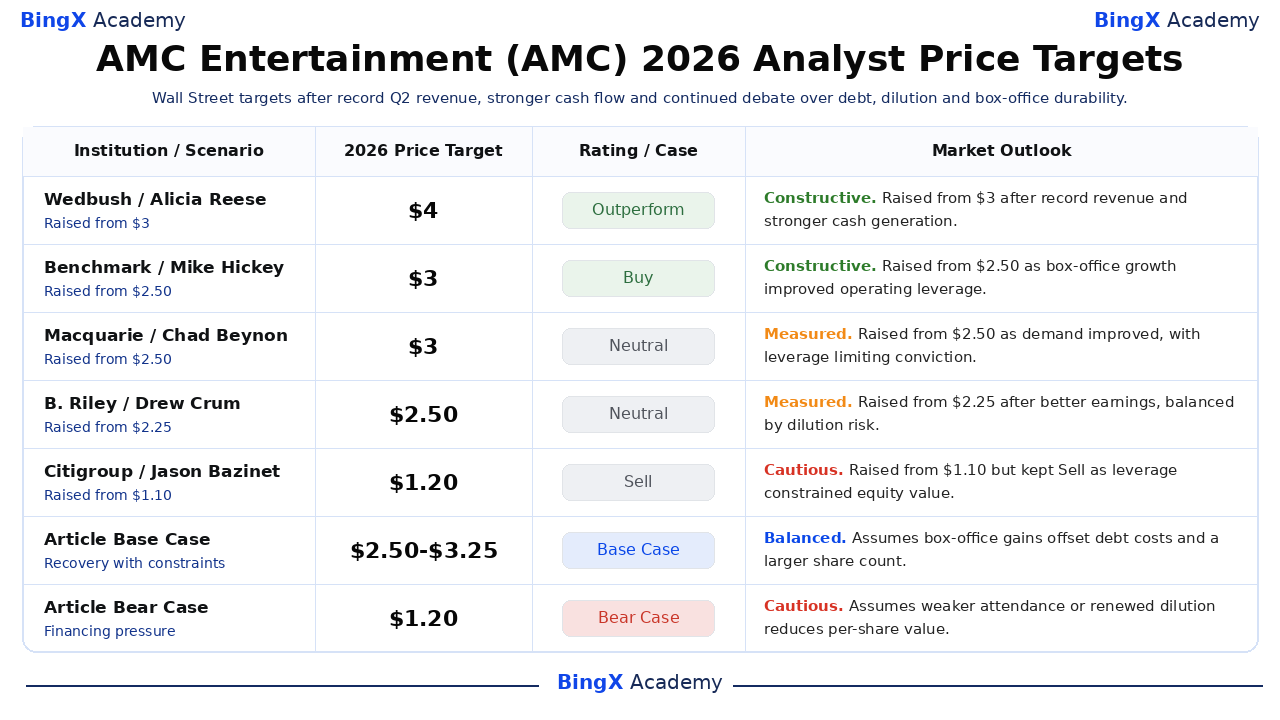
Wall Street remains divided after AMC's record quarter. Five selected analyst actions range from Wedbush's $4 Outperform target to Citigroup's $1.20 Sell target, reflecting disagreement over whether stronger box-office operating leverage can outrun financing costs and dilution across AMC's larger share base.
|
Institution |
2026 Price Target |
Rating |
Market Outlook |
|
Wedbush |
$4.00 |
Outperform |
Constructive. July 21: raised from $3 after record Q2 revenue and stronger cash generation. |
|
Benchmark |
$3.00 |
Buy |
Constructive. July 21: raised from $2.50 as box-office recovery improved confidence in operating leverage. |
|
Macquarie |
$3.00 |
Neutral |
Measured. September 2: raised from $2.50 as demand improved, with leverage and dilution limiting conviction. |
|
B. Riley |
$2.50 |
Neutral |
Measured. July 22: raised from $2.25 after better Q2 earnings, balanced by debt and dilution risk. |
|
Citigroup |
$1.20 |
Sell |
Cautious. May 7: raised from $1.10 but retained Sell as leverage constrained per-share value. |
|
Article Base Case |
$2.50-$3.25 |
Base Case |
Balanced. Assumes box-office gains offset debt costs and a larger share count. |
|
Article Bear Case |
$1.20 |
Bear Case |
Cautious. Assumes weaker attendance or renewed dilution reduces per-share value. |
How to Trade AMC Entertainment (AMC) Stock on BingX
Trade AMC's box-office recovery, cash-flow outlook and dilution risk using BingX TradFi and BingX AI tools. Because AMC can react sharply to opening-weekend results, earnings and financing announcements, traders should define the catalyst and risk limits before entering a position.
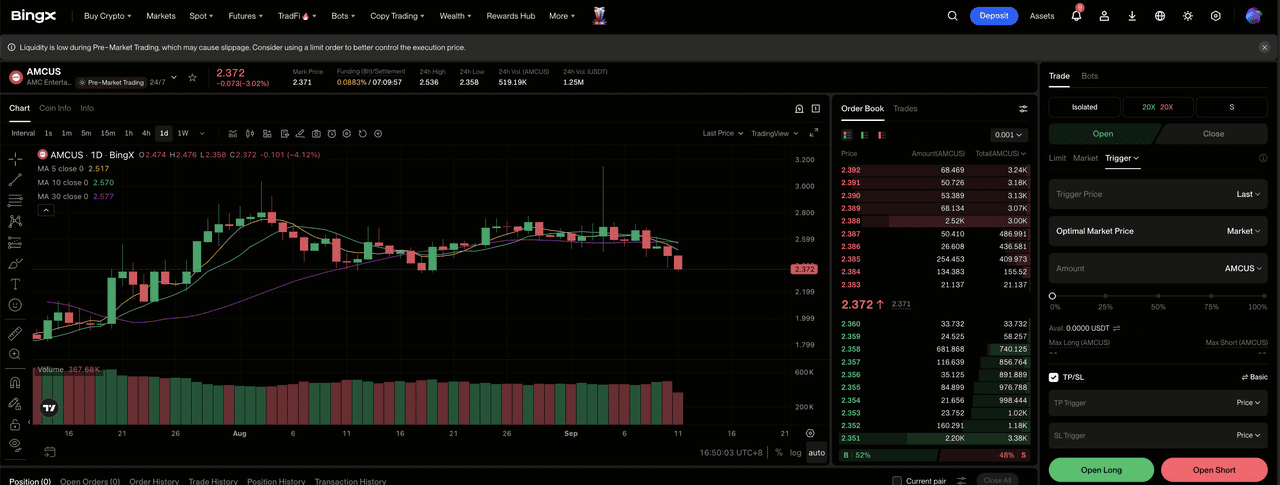
Step 1: Access BingX TradFi. Sign up and navigate to the specialized TradFi section on the BingX exchange dashboard.
Step 2: Select AMC Entertainment (AMC). Search for and select the AMC-USDT perpetual futures contract.
Step 3: Choose your direction. Select Open Long if attendance growth and premium formats sustain positive free cash flow. Select Open Short if a weaker release slate, refinancing pressure or new equity issuance reduces per-share value.
Step 4: Select leverage and margin mode. Choose Isolated or Cross-Margin based on your risk tolerance. AMC rose 24% after Q2 earnings and has gained 57.69% year to date, showing why conservative leverage and clear position sizing are important.
Step 5: Execute strict risk protocols. Set Take-Profit and Stop-Loss (TP/SL) levels before or immediately after entering the trade. AMC can react quickly to film openings, studio schedule changes, quarterly cash flow, debt exchanges and ATM disclosures.
Top 5 Risks to Watch for AMC Entertainment Investors in 2026
AMC’s operating recovery still carries substantial equity risk because its results remain highly sensitive to film supply, fixed costs, debt obligations and further share issuance.
- A weaker film slate could reverse AMC’s 14.2% revenue growth: Studios control release schedules, and delays can reduce attendance without producing an immediate decline in rent or labor costs. Even a few underperforming weekends could therefore have an outsized effect on EBITDA.
- Debt payments compete with theatre upgrades: Cash spent on interest and refinancing cannot be used for premium screens, recliners, projection systems or food and beverage improvements. Higher borrowing costs could reduce the value created by AMC’s operating recovery and leave less cash available to keep its theatres competitive.
- Further equity issuance could dilute per-share gains: AMC raised $150 million by selling 105.3 million shares through its June at-the-market program. Additional issuance at low share prices would spread any improvement in revenue, EBITDA and cash flow across a larger number of shares.
- Streaming could reduce attendance and weaken pricing power: Exclusive theatrical windows from Disney, Universal and other studios help cinemas attract audiences before films reach streaming platforms. Shorter windows or more direct-to-streaming releases could reduce attendance opportunities and make AMC’s fixed theatre costs harder to cover.
- AMC’s fixed costs can magnify a downturn: Adjusted EBITDA increased 70% when revenue grew 14.2%, showing the benefits of operating leverage during a recovery. The same cost structure could work in reverse if attendance declines, placing renewed pressure on EBITDA and free cash flow.
Final Thoughts: Should You Invest in AMC Entertainment in 2026?
AMC enters the rest of 2026 with its best operating evidence in years. Record revenue of $1.60 billion beat consensus, adjusted EPS turned an expected loss into a profit, adjusted EBITDA reached $321.4 million and free cash flow totaled $190.1 million. A broader slate and premium formats support recovery. The deciding constraint is whether liquidity can strengthen without adding another 105.3 million shares.
The bull case toward $4.50 needs several periods of positive cash flow without major dilution. The base case keeps AMC between $2.50 and $3.25, while the $1.20 bear case grows more credible if film supply weakens or financing needs return. Conservative traders may wait for confirmation through attendance, EBITDA conversion, interest coverage and AMC's ability to fund upgrades without another large equity issue.
Risk Reminder: Trading and investing in equities like AMC involves a high risk of capital loss. AMC is exposed to film-slate volatility, debt and refinancing costs, dilution, fixed operating expenses and changing consumer behavior. Conduct independent research before allocating capital.
Related Reading
- Netflix (NFLX) Price Prediction 2026: Can NFLX Stock Rebound to $125 on Ads and Live Sports?
- GameStop (GME) Stock Prediction 2026: Retail Survivor or Holding Co. Juggernaut?
- Meta (META) Price Prediction 2026: Can AI Monetization Push META Toward $1,000?
- Alphabet (GOOGL) Price Prediction 2026: Can 82% Cloud Growth and AI Push GOOGL Stock to $430?
- Reddit (RDDT) Price Prediction 2026: Can AI Data Opportunities Push RDDT Toward $300?
