
Cardano remains one of the most decentralized and liquid staking ecosystems in the blockchain space. Unlike other networks that require slashing or long lock-up periods, Cardano’s Ouroboros consensus protocol allows users to earn rewards while keeping their ADA fully accessible. As of early 2026, over 63% of the total ADA supply is staked across thousands of independent stake pools, securing a network valued at billions. The average annual percentage yield (APY) currently ranges between 2.8% and 4.5%, depending on pool performance and saturation.
For ADA holders, staking is not just a technical contribution to the network but is also a non-custodial way to grow your holdings without ever giving up control of your private keys. This guide covers everything from the 2025 Chang hard fork governance updates to practical steps for staking on BingX Earn and via self-custody wallets.
What Is Cardano PoS Layer-1 Blockchain?
Cardano is a third-generation, open-source layer-1 blockchain platform built on the Ouroboros Proof-of-Stake (PoS) consensus protocol. It was founded by Charles Hoskinson, a co-founder of Ethereum, who sought to address the scalability and sustainability limitations he observed in early blockchain designs. Developed through a research-driven, peer-reviewed methodology, Cardano provides a highly secure and scalable infrastructure for decentralized applications (dApps). As of February 2026, the network maintains a robust degree of decentralization, with over 3,000 active stake pools globally and more than 63% of its total supply participating in the staking ecosystem.
What Is the Role of the ADA Token in the Cardano Ecosystem?
ADA is the native utility token of the Cardano network, facilitating both transaction settlement and ecosystem security. It features a hard-capped maximum supply of 45 billion tokens, with a current circulating supply of approximately 36.07 billion ADA. Within the Ouroboros protocol, ADA functions as voting power for the network's decentralized governance; holders can delegate their tokens to stake pools to earn an average network reward rate of ~2.28% to 3.5%, while simultaneously participating in the Project Catalyst governance treasury. This treasury is currently funded by 20% of epoch emissions, ensuring long-term self-sustainability for the blockchain’s development.
What Is Cardano Staking and How Does It Work?
Cardano staking is the process of delegating your ADA to a Stake Pool. In Cardano’s Proof-of-Stake (PoS) system, the network doesn't require miners to solve complex puzzles. Instead, it uses Slot Leaders, stake pools selected to add the next block based on the amount of ADA delegated to them.
Think of it like a democratic election: your ADA acts as your voting power. By delegating to a pool, you increase that pool's chances of winning the right to produce a block. When the pool succeeds, the network generates rewards, which are automatically distributed to you and the pool operator.
Key Terms to Know Before Getting Started with Staking Cardano
• Epoch: A 5-day period in which blocks are produced and rewards are calculated.
• Saturation: A mechanism to prevent centralization. If a pool grows too large, rewards decrease, encouraging users to move to smaller pools.
• Liquid Staking: Your ADA is never locked. You can send, spend, or sell your staked ADA at any time.
Why Stake Cardano (ADA) in 2026?
The 2025 Chang Hard Fork and subsequent Plomin updates have transformed Cardano into a fully community-governed blockchain. Staking now carries more weight than ever, as delegators can also participate in governance actions via DReps (Delegated Representatives).
With the rise of Cardano-based DeFi and stablecoins, holding ADA provides a triple yield potential: price appreciation, staking rewards, and participation in the growing Web3 ecosystem. Furthermore, Cardano’s no-slashing policy makes it one of the safest PoS networks for beginners, as your principal ADA is never at risk of being taken by the network for validator errors.
How Much ADA Do You Need to Start Staking?
• Self-Custody Wallets: You need a minimum of 5 ADA to delegate. Note that the protocol requires a one-time 2 ADA deposit to register your staking key (fully refundable when you stop staking).
• Centralized Exchanges (CEXs): On platforms like BingX, you can often start with as little as 1 ADA through flexible Earn products.
What Are the Top 3 Ways to Stake ADA in 2026?
As Cardano’s ecosystem continues to mature, staking ADA in 2026 offers multiple flexible ways to earn passive rewards while supporting the network’s security and decentralization.
1. Stake Cardano (ADA) on BingX Earn: Best for Beginners
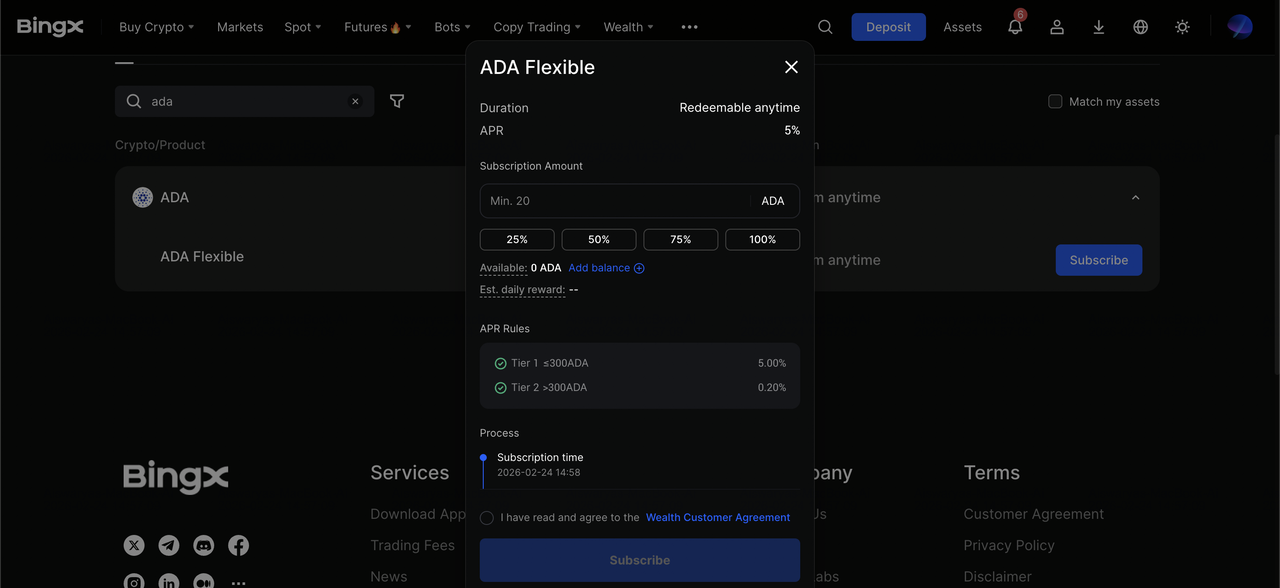
Earn passive income on Cardano (ADA) holdings via BingX Earn
If you want the simplest experience without managing staking keys or epoch cycles, BingX Earn is the ideal entry point. BingX manages the technical side of stake pool selection and uptime for you.
How to Start Staking ADA on BingX Earn and Earn 5% APR on ADA Holdings
In 2026, BingX offers a competitive 5% APR on ADA holdings through its Flexible Term products. This rate often outperforms native network averages because BingX optimizes delegation across high-performance pools.
1. Log in to your BingX account and complete KYC.
2. Deposit or Buy ADA on the BingX Spot Market.
3. Navigate to Wealth → Earn on the app or website.
4. Search for ADA and select the Flexible or Fixed product.
5. Enter the amount, review the 5% APR offer, and click Subscribe.
Note: BingX Flexible products allow you to redeem your ADA at any time, making it as liquid as keeping it in your spot wallet but far more profitable.
2. Native ADA Staking via Self-Custody Cardano Wallets
For users who want full control and the ability to participate in Cardano governance, using a dedicated wallet is the gold standard.
• Lace and Yoroi: Popular light wallets (browser/mobile) that allow you to browse a list of stake pools and delegate in three clicks.
• Daedalus: A full-node wallet for advanced users that provides the highest level of security and decentralization.
How to Stake ADA by Delegation
1. Download a compatible Cardano wallet, e.g., Lace.io.
2. Buy Cardano (ADA) on BingX and transfer your tokens to your wallet address.
3. Go to the Staking/Delegation tab.
4. Search for an ADA staking pool, e.g., based on performance, margin fees, or mission-driven goals.
5. Confirm the transaction. Your first rewards will arrive after a 15–20 day warm-up period (roughly 3–4 epochs).
3. Stake ADA Using Hardware Wallets Like Ledger and Trezor
For maximum security, you can connect your Ledger or Trezor device to a software interface like Yoroi or Eternl. This allows you to stake your ADA while your private keys remain offline and cold. This is highly recommended for users holding large amounts of ADA.
How to Stake Cardano with Trezor via Trezor Suite
Trezor offers a seamless, native experience through the Trezor Suite app, though it also supports third-party apps like Daedalus.
1. Initialize: Connect your Trezor, such as Model T, Safe 3, or Safe 5, and open the Trezor Suite desktop or web app.
2. Enable Account: Select Add Account and choose Cardano (ADA) from the asset list.
3. Transfer Assets: Buy Cardano on BingX and send your ADA to the Receive address shown in Trezor Suite, verifying the address on the device screen.
4. Stake Natively: Click on the Staking tab. Trezor Suite provides a simplified interface to delegate to high-performance, vetted pools.
5. Finalize: Review the delegation transaction and the 2 ADA deposit on your Trezor device. Confirm the action physically to begin earning rewards.
Expert Tip: Even when using a hardware wallet, you still enjoy Liquid Staking. You can move your ADA at any time; the network simply takes a snapshot of your balance at the end of every 5-day epoch to calculate your next reward.
How to Buy Cardano (ADA) on BingX
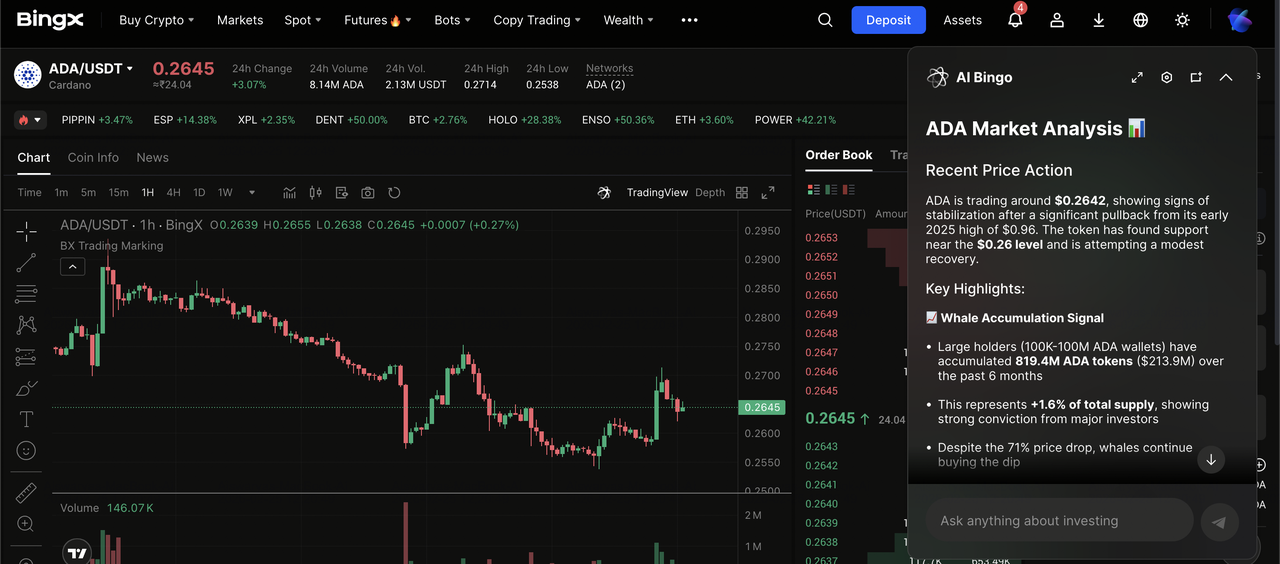
ADA/USDT trading pair on the spot market featuring BingX AI analysis
Before you can begin earning rewards, you can utilize BingX AI, the platform’s intelligent trading assistant, to analyze real-time ADA market trends and identify the most optimal entry points for your purchase. Follow these steps to secure your ADA tokens and prepare for staking:
1. Fund Your Account: Navigate to the Buy Crypto section to purchase USDT using a credit/debit card, Apple Pay, or bank transfer.
2. Access the Spot Market: Go to the Spot tab and search for the ADA/USDT trading pair.
3. Execute Your Trade: Select Market Order for an instant purchase at the current price, enter the amount of ADA you wish to buy, and click Buy ADA.
4. Confirm Holdings: Once the trade is complete, your tokens will appear in your Spot Account, ready to be moved into BingX Earn for high-yield rewards.
How to Manage Risks and Maximize Rewards When Staking ADA Tokens
While Cardano is inherently safer than other PoS chains due to the absence of slashing, you should still manage these factors:
• Pool Performance: Use tools like PoolTool.io or ADAPools.org to ensure your chosen pool is consistently producing blocks. If performance drops below 90%, it may be time to switch.
• Saturation Risk: If your pool's saturation exceeds 100%, your rewards will decrease. Monitor your wallet notifications; most modern wallets will warn you if a pool is over-saturated.
• Custodial Risk: When staking on an exchange, you rely on the platform’s security. BingX mitigates this with its Shield Fund and cold-storage protocols, but users seeking pure decentralization should consider a hardware wallet.
Final Word: Should You Stake Cardano (ADA) in 2026?
Deciding to stake ADA in 2026 involves balancing the high-yield convenience of centralized platforms with the sovereign security of self-custody. Utilizing BingX Earn offers a streamlined, one-click entry point with a competitive 5% APR, making it ideal for those prioritizing immediate returns and ease of use. Conversely, native staking through hardware wallets like Ledger or Trezor remains the preferred path for long-term holders seeking maximum independence and direct participation in Cardano’s decentralized governance.
However, all staking activities carry inherent risks that participants must manage. While Cardano does not utilize slashing at the protocol level, custodial staking on exchanges involves platform risk, and self-custody requires diligent private key management to prevent loss of funds. Furthermore, the market value of ADA is subject to high volatility; price fluctuations can offset the gains made from staking rewards. It is essential to conduct thorough research, evaluate your risk tolerance, and diversify your staking methods to align with your financial objectives.
Related Reading
FAQs on Cardano (ADA) Staking
1. Is my ADA locked when I stake?
No. Cardano uses liquid staking, meaning your ADA never leaves your wallet and is never locked. You can spend it at any time.
2. Can I lose my ADA through staking?
No. Unlike Ethereum, Cardano does not have slashing. If a pool fails or acts maliciously, you simply earn zero rewards for that epoch, but your principal balance remains safe.
3. How often are ADA staking rewards paid?
Rewards are distributed at the end of every 5-day Epoch. Once you clear the initial warm-up period, you will receive rewards every five days.
4. Why is the BingX Earn rate higher than the Cardano network average?
BingX often runs promotional yield programs or utilizes institutional-grade staking strategies to offer higher returns like 5% APR compared to the standard 3% network rate.
5. How do I choose the best Cardano stake pool?
Look for pools with a Margin below 5%, a Fixed Fee of 340 ADA (the protocol minimum), and a Saturation level between 30% and 80%.