
Eesee (ESE) is a first-of-its-kind 'win-win' marketplace designed to eliminate the liquidity friction often found in the NFT and RWA markets. By merging traditional trading with a transparent, on-chain raffle system, Eesee allows sellers to dispose of assets quickly at their desired total valuation while providing buyers an affordable gateway to own premium assets.
In April 2026, the ecosystem continues its expansion following a successful migration of the $ESE token to the BNB Chain to enhance scalability and lower transaction costs. Eesee serves as more than just a marketplace; it is an engagement hub that has already attracted a community of over 1 million members, integrating advanced features like Gelato VRF for verifiable randomness and Account Abstraction for a seamless user experience.
This article examines how Eesee gamifies the digital asset landscape, the mechanics of its IRO Launchpad, the utility of the $ESE token, and how to participate in this high-velocity ecosystem by trading Eesee (ESE) on BingX.
What Is the Eesee (ESE) Marketplace and Launchpad?
Source: Eesee docs
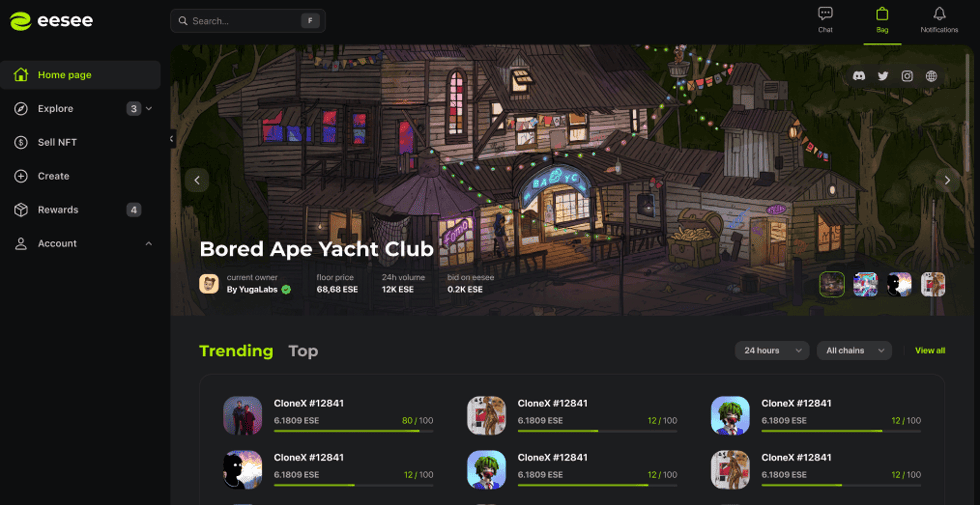
Eesee is a multi-chain digital asset hub that acts as a liquidity aggregator and a gamified sales platform. While traditional marketplaces like OpenSea or Blur rely on a 1-to-1 buyer-seller match, which can lead to long wait times for unique assets, Eesee utilizes a ticketed sales model. Backed by industry veterans and audited by Hacken with a near-perfect 9.9/10 score, Eesee targets both retail hunters and institutional sellers.
The platform's core thesis is to democratize access to high-value assets. To achieve this, Eesee has moved beyond simple NFT listing to include:
- Ticketed Raffles: Sellers set a total price and divide it into affordable tickets, ensuring they receive their full asking price once all tickets are sold.
- Asset Aggregation: A unified interface that pulls listings from multiple marketplaces, allowing users to discover and purchase diverse assets from various sources.
- Initial Raffle Offering (IRO): A proprietary launchpad model where users can gain early-stage token allocations through a fun, randomized tier system.
How Does the Eesee Ecosystem Work?
How to purchase tickets for token sale on Eesee | Source: Eesee docs
At its core, Eesee is an application layer that optimizes liquidity through gamification:
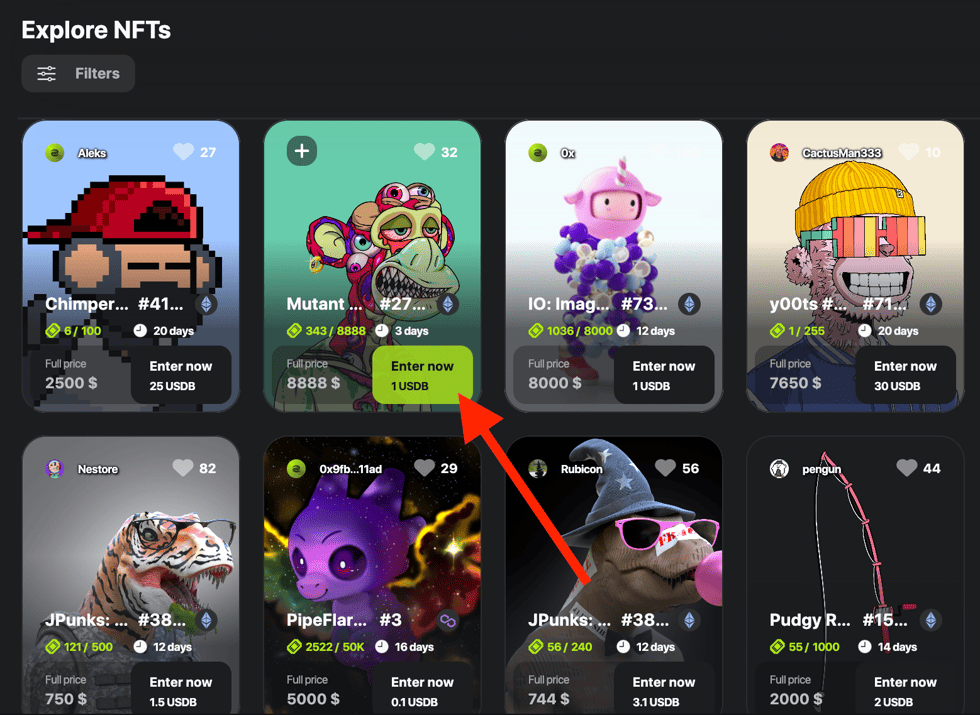
- The Ticketed Sales Mechanism: A seller lists an asset, e.g., a Bored Ape NFT or a Token Lot, for $50,000. They might issue 1,000 tickets at $50 each. Once all tickets are sold, a winner is selected.
- Gelato VRF Integration: To ensure absolute fairness, Eesee uses Gelato Verifiable Random Function (VRF). This provides cryptographic, on-chain proof that the winner was selected impartially, preventing platform manipulation.
- Account Abstraction (ERC-4337): Eesee features a built-in wallet that simplifies blockchain interactions. This allows for gas-efficient transactions and one-click experiences that feel like a standard Web2 app.
- Marketplace Mining: Even if a buyer doesn't win the raffle, they aren't left empty-handed. Every ticket purchase contributes to the user’s points, which translate into $ESE rewards and higher leaderboard rankings.
What Is the $ESE Token Used For?
The $ESE token is the native utility and governance engine of the Eesee ecosystem. Its primary functions include:
- Platform Payments: Used to purchase tickets for raffles, participate in IROs, and settle marketplace fees.
- Staking Tiers: Staking $ESE unlocks higher tiers from Metal to Platinum, which provide larger allocations in IROs and exclusive access to premium drops.
- Governance: Token holders can influence platform parameters and treasury allocations.
- Rewards & Incentives: $ESE is distributed to active users through the Marketplace Mining Pool, rewarding volume and platform engagement.
What Is $ESE Tokenomics?
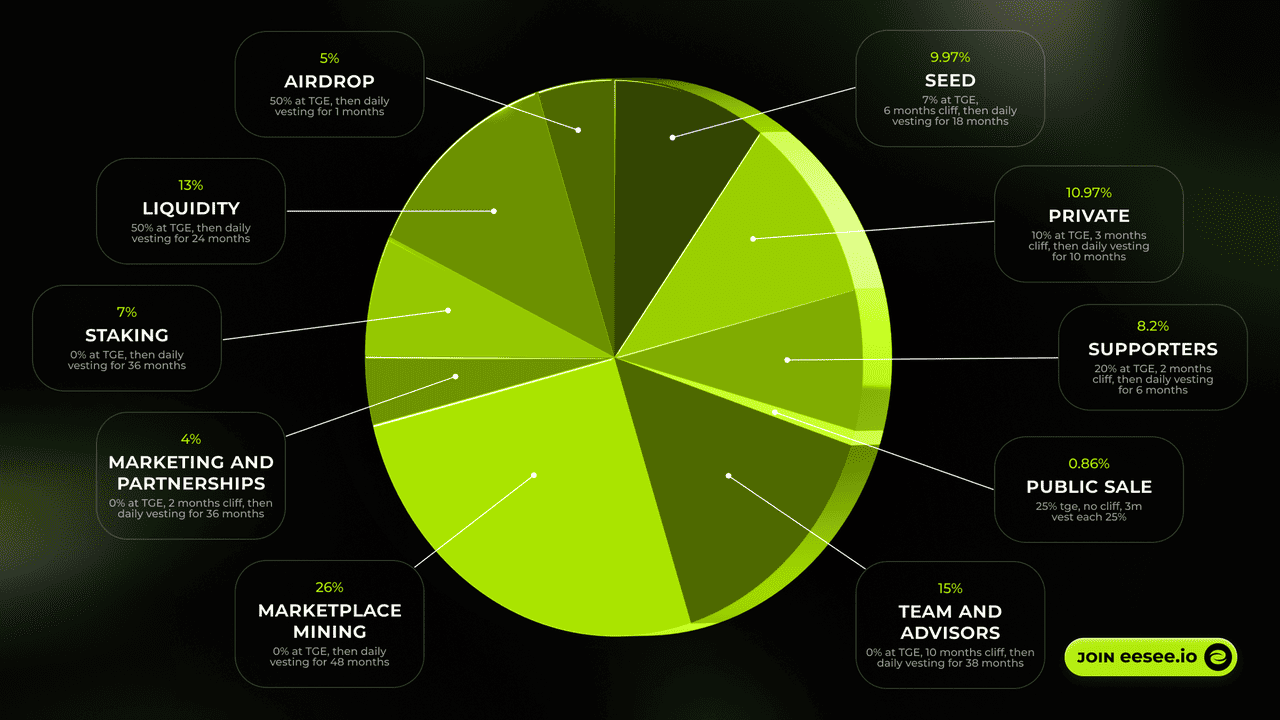
The $ESE token has a fixed total supply of 1,000,000,000 (1 billion) tokens. The distribution is balanced to incentivize community participation while maintaining a sustainable treasury for growth.
ESE token allocation | Source: Eesee docs
ESE Token Distribution Breakdown
- Marketplace Mining (26%): The largest share, reserved for rewarding users based on their trading volume and platform activity. This pool continuously replenishes tokens to keep the ecosystem liquid.
- Team & Shareholders (22.5%): Allocated to the core contributors and early backers. These tokens are typically subject to strict vesting schedules, e.g., a 12-month cliff and 24-month linear unlock, to ensure long-term alignment.
- Company Treasury (18%): Managed by the foundation to fund operational expenses, strategic partnerships, and future development of the eesee protocol.
- Community Airdrop (12.8%): Dedicated to rewarding early adopters and active participants across different seasons of platform growth.
- Private Round (10.97%): Tokens sold to institutional investors at a valuation of $15 million at $0.015/ESE, following a 3-month cliff and 10-month linear vesting.
- Seed Round (9.97%): Allocated to the earliest investors at an $11 million valuation at $0.011/ESE, with a 6-month cliff and 18-month linear vesting.
- KOLs Round (8.2%): Reserved for key opinion leaders and influencers who helped bootstrap the initial community, featuring a 2-month cliff and 6-month linear vesting.
How to Trade Eesee (ESE) on BingX
Utilize BingX AI to analyze real-time liquidity depth and historical price action for $ESE, ensuring you enter the market with data-backed precision during its current contract upgrade and migration phase.
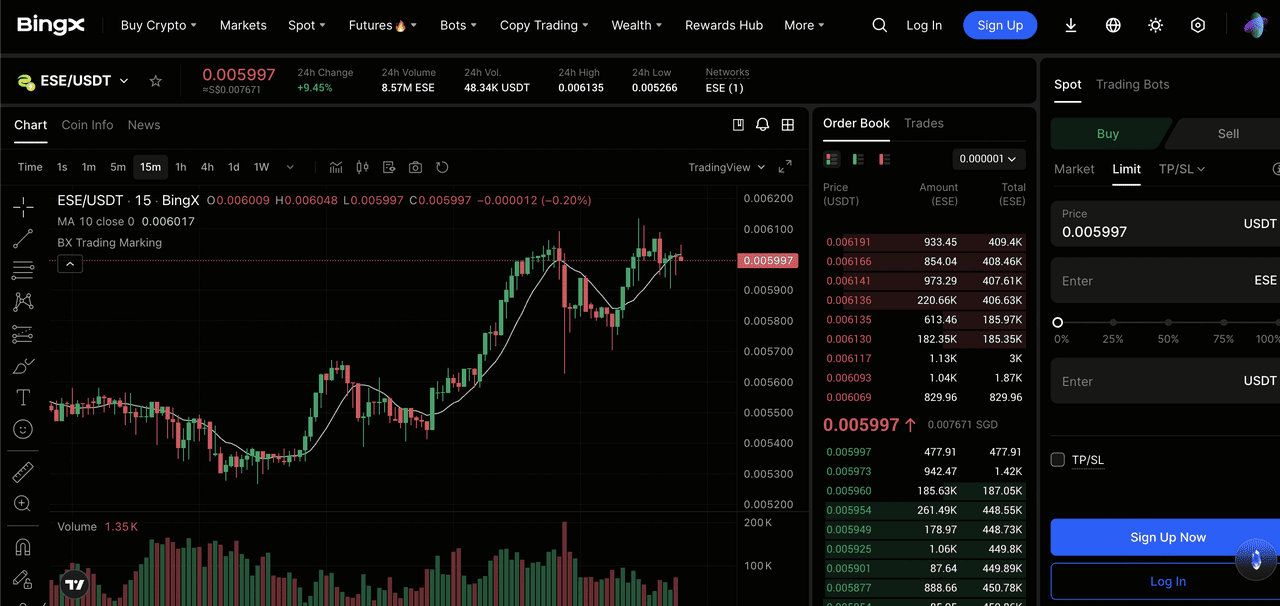
ESE/USDT trading pair on the BingX spot market
Buy, Sell, or HODL ESE Tokens on the Spot Market
- Access the Spot Market: Log in to your BingX account, navigate to the Market or Spot tab, and search for the ESE/USDT trading pair.
- Analyze with BingX AI: Use the integrated BingX AI Assistant to get a quick summary of current sentiment and key support/resistance levels before placing your order.
- Choose Your Order Type: Select a Market Order for immediate execution at the current price, or a Limit Order" to specify the exact price at which you wish to buy $ESE.
- Enter Amount: Input the amount of USDT you want to spend or the total number of ESE tokens you wish to acquire.
- Confirm and Secure: Review the transaction details and click Buy ESE; once the order is filled, your tokens will appear in your Fund Account, where you can hold them or transfer them to the Staking section to earn rewards.
Eesee vs. Traditional Launchpads: Key Differences
|
Feature |
Eesee IRO Launchpad |
Traditional Launchpads |
|
Participation Model |
Gamified Raffle (IRO): Low-cost tickets for everyone. |
Stake-to-Allocate: Tiered system based on high capital lock-up. |
|
Entry Barrier |
Ultra-Low: Buy a single ticket (often < $10) after KYC. |
High: Often requires thousands in native tokens for a "chance." |
|
Allocation Size |
Variable & Transparent: 50% to 1,000% of ticket price via Gelato VRF. |
Fixed/Static: Based strictly on the tier/amount staked. |
|
Selection Logic |
On-Chain Randomness: Verified by Gelato VRF (No bots). |
Centralized/FCFS: Often results in "gas wars" or bot manipulation. |
|
User Experience |
Account Abstraction: 1-click buy, gasless-feel transactions. |
Standard DeFi: Manual bridging, gas management, and multiple approvals. |
|
Community Scaling |
Viral/Retail-Focused: Reached 1M+ members via quests and raffles. |
Whale-Heavy: Often results in a concentrated, low-engagement holder base. |
Traditional launchpads like DAO Maker or Polkastarter typically operate on a capital-intensive Stake-to-Allocate model, where users must lock up thousands of dollars in native tokens to secure a guaranteed allocation. This creates a high barrier to entry, often favoring whales and leading to stagnant community growth. In contrast, Eesee’s Initial Raffle Offering (IRO) democratizes access by using a ticket-based system. Participants can secure potential allocations of 50% to 1,000% of their ticket price for as little as a few dollars, shifting the focus from net worth to active engagement and allowing projects to build a more diverse, high-velocity holder base.
From a technical and ROI perspective, Eesee differentiates itself through on-chain transparency and gamified risk-mitigation. While traditional platforms rely on centralized or opaque First Come First Served (FCFS) mechanics that are often exploited by bots, Eesee utilizes Gelato VRF to impartially determine allocation sizes. This ensures that even the smallest retail participant has a verifiable chance at superprofits through platinum-tier allocations. Furthermore, Eesee’s integration of Account Abstraction (ERC-4337) significantly reduces the gas friction common on legacy launchpads, enabling a 1-click participation flow that has successfully scaled the ecosystem to over 1 million members while maintaining a high 9.9 Hacken security rating.
5 Key Considerations Before Investing in Eesee (ESE)
Before allocating capital to the $ESE ecosystem, it is vital to assess the unique mechanics of its gamified liquidity model and the regulatory complexities associated with its global raffle-based marketplace.
- Liquidity Model Success: Eesee depends on filling the lot. If all tickets aren't sold by the deadline, the asset returns to the seller and the pool is raffled among participants.
- Audit Security: While Eesee holds a high Hacken score, always verify smart contract addresses, especially following the recent BNB Chain migration.
- Tier Competition: High-tier benefits require significant $ESE staking; monitor the Cost to Participate as the token price fluctuates.
- RWA Expansion: Eesee’s long-term value rests on its ability to move beyond NFTs into Real-World Assets (RWAs) like real estate or gold.
- Market Sentiment: As a gamified platform, Eesee thrives in bullish retail environments but may see lower volume during market consolidations.
Final Thoughts: Should You Invest in Eesee (ESE)?
As of April 2026, Eesee has successfully carved out a niche by turning the boring process of asset listing into an engaging, community-driven event. By bridging the gap between high-ticket digital assets and the average retail investor, Eesee provides a unique solution to the NFT liquidity problem. Its move to the BNB Chain and the introduction of AI-driven analysis tools signal a project that is maturing from a simple raffle site into a robust DeFi infrastructure layer.
For the strategic investor, $ESE represents a play on the SocialFi and GambleFi narratives. Success will depend on the platform's ability to maintain its 1 million+ user base and continue attracting high-quality IRO projects that offer real value to $ESE stakers.
Risk Reminder: Digital asset investments carry high market risk. The gamified nature of Eesee can lead to high volatility. Always perform your own research and only trade capital you can afford to lose. BingX is not responsible for any trading losses.