

In April 2026, State Street's Energy Select Sector SPDR ETF (XLE) has become the primary battleground for global macro strategists. After surging over 24% year-to-date, the fund is caught between two powerful narratives: a fundamental supercycle driven by massive earnings growth and a tactical hedge exit as geopolitical tensions in the Middle East show signs of diplomatic cooling. While XLE hit local peaks in late March, a significant divergence has emerged between technical Strong Buy signals and macroeconomic warnings that the energy insurance trade has already peaked.
As the energy sector transitions from a defensive inflation hedge to an aggressive growth engine, investors are weighing record-breaking Q1 earnings forecasts against the opportunity cost of missing out on a recovering Asian tech sector.
This guide breaks down the XLE ETF price prediction for 2026 using data from State Street Global Advisors, Zacks Equity Research, and BingX market analysis, and how to trade XLE ETF futures with Tether (USDT) on BingX TradFi.
Top 5 Things for Energy Select Sector SPDR ETF (XLE) Investors to Know in 2026
As the energy sector navigates a high-stakes environment of Hormuz Diplomacy and institutional re-weighting, investors must monitor these five factors:
- The $39 Billion Goliath: XLE remains the largest and cheapest vehicle for energy exposure with a 0.08% expense ratio, making it the first in, first out choice for institutional capital.
- Earnings Acceleration: The consensus for full-year 2026 energy sector earnings growth has topped 25%, a massive upward revision since the start of the year.
- The Hedge Fatigue: Strategists are calling for an exit from the Hormuz Hedge, suggesting that holding XLE further is paying for insurance you no longer need as diplomatic channels open.
- Extreme Concentration: Just two stocks, Exxon Mobil (XOM) and Chevron (CVX), account for over 40% of the fund, making the ETF hyper-sensitive to the quarterly reports of these two titans.
- Technical Divergence: While a Dark Cloud Cover candle in early April signaled a potential peak, the long-term monthly chart reflects a Bullish Harami, suggesting the pullback is merely a buying opportunity.
What Is the State Street Energy Select Sector SPDR ETF (XLE)?
The Energy Select Sector SPDR ETF (XLE) by State Street is a passively managed fund that seeks to provide precise exposure to companies in the oil, gas, and consumable fuel industries, as well as energy equipment and services. Unlike broad market indices, the XLE ETF only includes energy companies from the S&P 500, ensuring that every holding is a high-cap, institutional-grade leader.
The fund is currently anchored by the Big Three of Western energy: Exxon Mobil (XOM), Chevron (CVX), and ConocoPhillips (COP). In 2026, these firms represent the backbone of global energy security, benefiting from high margins and an aggressive return of capital through dividends and buybacks.
A Review of the Global Energy Sector's Performance in 2025-2026
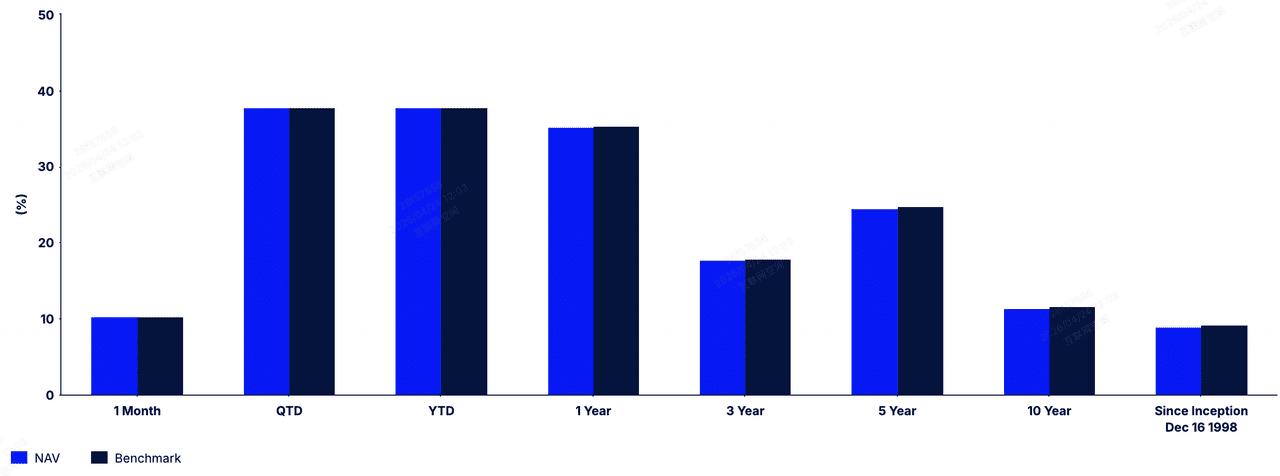
XLE State Street Energy Select Sector SPDR ETF fund performance | Source: State Street
In 2025, the energy sector provided steady returns, but 2026 has seen an explosion in volatility. The initial weeks of 2026 were defined by the Hormuz Disruption, which sent Brent crude prices surging and saw XLE gain 24.8% in the first four months alone. This rally set the stage for XLE to hit a 52-week high of $63.46, driven by a combination of geopolitical fear and a fundamental shift toward energy-intensive AI data center requirements.
XLE ETF 2026 Investment Outlook: $65 Bull Run vs. $40 Bear Case
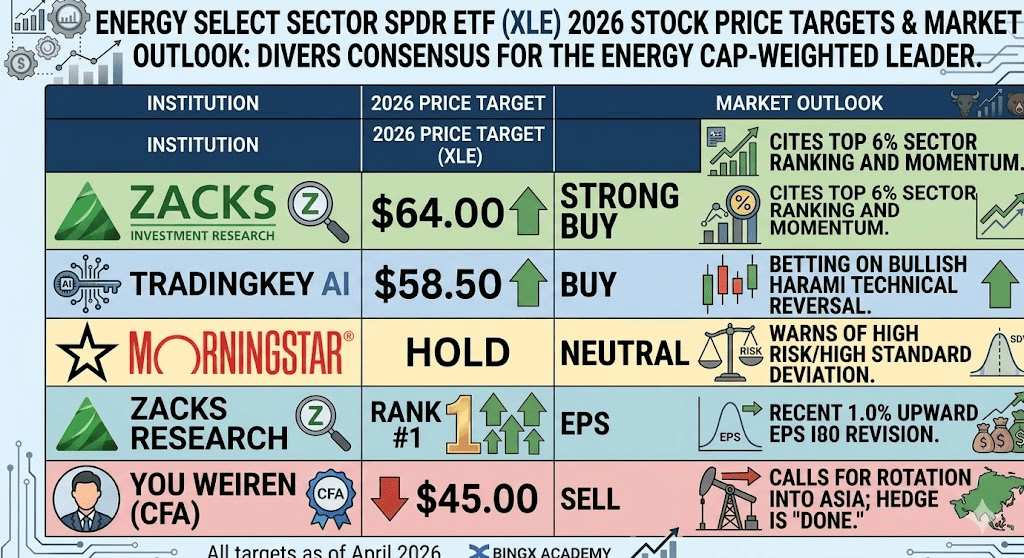
XLE energy sector ETF forecasts for 2026 by Wall Street analysts
Navigate the high-stakes volatility of the energy markets by weighing these three probability-weighted scenarios for the State Street Energy Select Sector SPDR (XLE) ETF through the remainder of 2026.
The Bull Case: The $65 Earnings Supercycle for XLE ETF
The bullish narrative is anchored in a massive 2,200 basis point upward revision in full-year earnings expectations since January. With the energy sector currently ranked in the top 6% of the Zacks Industry classification, the 2026 energy supercycle is driven by superior operating leverage. Even if crude prices stabilize, the structural damage to Middle Eastern collection and processing sites ensures a higher-for-longer margin environment for U.S. refiners and producers, who are capturing wider crack spreads and increasing capital returns through $60 billion in planned buybacks from the fund's top three holdings.
To capitalize on this, traders should monitor the $63.46 psychological resistance. A decisive breakout on high volume would signal a shift from a geopolitical trade to a fundamental growth play. Investors can look for entry points near the $56.53 NAV, targeting a $68 year-end finish, a projection supported by a 12.91% estimated 3-5 year EPS growth rate. In this scenario, XLE functions not just as a hedge, but as a core alpha generator with a high 0.50 beta, outperforming broader tech benchmarks.
The Base Case: The $52 - $58 Range-Bound Grind for Energy Select Sector SDPR ETF
In this scenario, XLE enters a distribution phase, where the initial 24% year-to-date surge is digested by the market. The exit of tactical war speculators is offset by aggressive institutional accumulation, as large-scale funds seek the safety of XLE’s 2.71% trailing dividend yield. With institutions already owning 65% of Exxon (XOM) and Chevron (CVX), the fund finds a valuation floor at $52, supported by a modest 14.56 P/E ratio for the current fiscal year. This creates a mean-reverting environment where price action is dictated by quarterly dividend distributions rather than headline volatility.
Practically, this requires a grid trading approach. Investors should focus on the $52 support and $58 resistance zones, utilizing the fund's high liquidity of over 8 million shares daily volume to execute tactical entries. The strategy here is to harvest the quarterly distributions while the 10-year Treasury yield acts as a valuation ceiling near 4.5%. Look for XLE to oscillate as capital rotates systematically between Magnificent Seven tech giants and high-cash-flow energy leaders to balance sector concentration.
The Bear Case: XLE's $40 Hedge Exit Trap
The bear case is triggered by the Hormuz Normalization as Iran's acute financial pressure, losing $435 million per day, forces a diplomatic pivot. If the Strait is declared fully open, the war premium estimated at $10–$15 per barrel will evaporate instantly. This de-escalation would likely catalyze a Great Rotation into Asian structural winners like Korea and Taiwan, which proved their resilience during the blockade. As the opportunity cost of holding insurance rises, the $39 billion in AUM could see rapid outflows as the tactical reason for the trade disappears.
Traders must watch for a decisive break below the $48 support level, which would likely trigger systematic trend-following sell programs. Such a breach would expose XLE to a rapid de-rating toward its $40.25 52-week low, effectively wiping out all 2026 gains. For risk management, a drop below the 60-day Moving Average should be viewed as a signal to liquidate tactical hedges and rotate proceeds into undervalued midstream operators or short-duration fixed income to protect against the inflation hump passing through the economy.
XLE ETF Analyst Forecasts and Price Targets for 2026
|
Institution |
2026 Price Target (XLE) |
Market Outlook |
|
Zacks Investment Research |
$64.00 |
Strong Buy: Cites top 6% sector ranking and momentum. |
|
TradingKey AI |
$58.50 |
Buy: Betting on Bullish Harami technical reversal. |
|
Morningstar |
Hold |
Neutral: Warns of high risk/high standard deviation. |
|
You Weiren (CFA) |
$45.00 |
Sell: Calls for rotation into Asia; hedge is "done." |
How to Trade Energy Select Sector SPDR ETF (XLE) on BingX TradFi
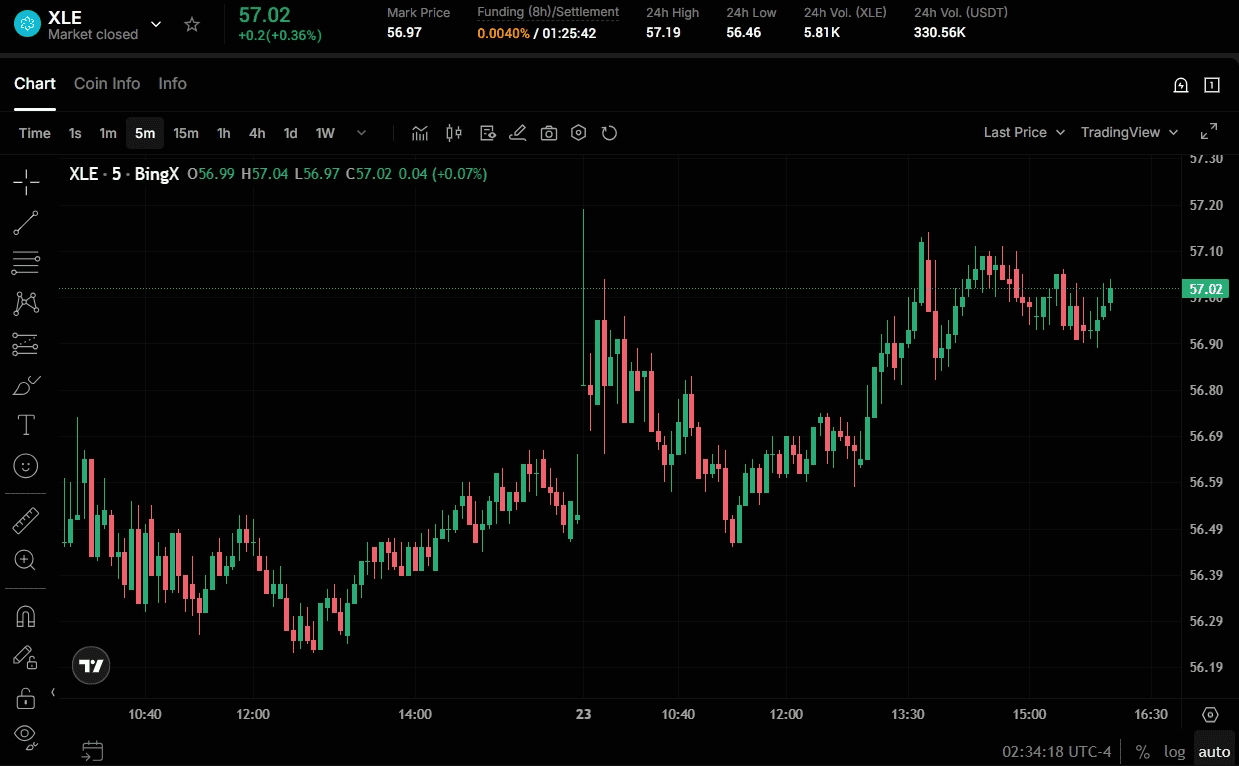
XLE/USDT perpetual contract on BingX futures market
Maximize your precision in the energy market by leveraging BingX AI integrations to identify optimal entry points during the 2026 energy shift.
- Access TradFi: Log in to your BingX account, navigate to the TradFi section, and select Stocks.
- Locate XLE: Search for the XLE/USDT perpetual contract on the BingX futures market.
- Configure Leverage: Set your preferred leverage, e.g., 2x–5x, to amplify exposure to the energy sector's volatility.
- Execute Strategy: Select Open Long if you anticipate an earnings-led breakout, or Open Short to hedge against a diplomatic resolution in the Middle East.
- Manage Risk: Define your Take-Profit (TP) and Stop-Loss (SL) levels, paying close attention to the $56.53 NAV as a baseline.
Top 5 Risks to Watch for XLE Energy Sector ETF Investors in 2026
As the energy sector transitions from a high-stakes geopolitical hedge to a fundamental growth play, investors must remain vigilant of these five structural and macroeconomic threats that could derail XLE’s 2026 trajectory.
- Diplomatic De-escalation: A successful round of talks in Islamabad could wipe out the war premium on oil overnight.
- Demand Destruction: High energy costs are starting to impact US CPI; if growth uncertainty hits the consumer, energy demand could crater.
- Concentration Risk: Because XLE only holds 22-25 stocks, a single earnings miss from Exxon or Chevron can move the entire ETF by 2-3%.
- Interest Rate Pressure: Energy-driven inflation may force the Fed to remain hawkish, which is historically a headwind for high-yield equities.
- The Asia Rotation: As Asian structural winners like TSMC and Samsung hit record profits, global capital may flee the expensive US energy sector.
Final Thoughts: Should You Invest in XLE Energy Select Sector ETF in 2026?
XLE remains a high-conviction play for investors betting on the physical reality of a supply-constrained market and a 25% earnings growth supercycle. For tactical traders, the $56.53 NAV serves as the ultimate line in the sand: maintaining price action above this level confirms institutional support for a run toward the $65 resistance. However, for those focused on macroeconomic cycles, the emergence of active diplomacy in the Middle East suggests that the most profitable leg of the war hedge has been captured, making a phased rotation into Asian structural winners a prudent move to manage opportunity cost.
For a practical execution strategy, investors should utilize a tiered entry/exit approach centered on the current technical divergence. If XLE sustains its Bullish Harami pattern on the monthly chart, accumulating on pullbacks near the 60-day SMA offers a favorable risk-reward ratio for a fundamental breakout. Conversely, a failure to hold the $52 support level should be viewed as a signal that the Hormuz premium is fully unwinding, necessitating a rapid shift to defensive, short-duration fixed income or undervalued midstream assets to protect capital.
Risk Reminder: Trading sector-specific ETFs like XLE involves significant concentration risk, as nearly half of the fund is tied to just two companies. The energy sector is historically cyclical and hyper-sensitive to unpredictable geopolitical headlines. Always employ strict stop-losses and ensure this satellite position does not exceed 5-10% of your total portfolio to mitigate potential downside volatility.
Related Reading
- Crude Oil Price Forecast 2026: $140 War Premium or $60 Surplus Baseline?
- Occidental Petroleum (OXY) Price Prediction 2026: $115 Net-Zero Alpha or $55 Commodity Trap?
- Exxon Mobil (XOM) Price Prediction 2026: $180 Energy Alpha or Geopolitical Value Trap?
- Cheniere Energy (LNG) Price Prediction 2026: $330 Sovereign Boom or $210 Infrastructure Trap?
- Roundhill Memory ETF (DRAM) Forecast 2026: $1.5B AI Supercycle or 'RAMmageddon' Trap?
- XOP S&P Oil & Gas ETF Prediction 2026: $210 Geopolitical Moonshot or $130 Hedge Trap?