

Apple Inc. (AAPL) entered March 2026 at a historic crossroads, reporting record Q1 revenue of $143.8 billion as it moves beyond its premium niche. With the launch of the $599 MacBook Neo and the integration of Apple Intelligence via Google Gemini, the company is aggressively pursuing entry-level markets and AI-driven upgrade cycles.
By March 2026, Apple had successfully shifted 25% of iPhone production to India, dodging geopolitical headwinds while launching its most disruptive hardware in years. While the stock has surged nearly 70% over the last few years, the market remains divided. Institutional heavyweights like Wedbush and Goldman Sachs are doubling down on $330+ price targets, while technical analysts warn of a sideways trap as the stock struggles to break the $267 resistance level.
The Apple stock forecast for 2026 is defined by two competing narratives:
• The Ecosystem Expansion: The MacBook Neo opens the door to the 27% of PC users who spend under $1,000, potentially supercharging a Mac segment that currently only represents 10% of sales.
• The Margin Squeeze: Significant increases in global memory prices and the massive costs of AI integration are threatening to eat into Apple’s legendary gross margins.
For traders, AAPL in 2026 offers a lower beta than high-flying chip stocks but provides a unique high-liquidity play on the intersection of AI software and consumer hardware. This guide breaks down the AAPL price prediction for 2026 using data from Wedbush, Rosenblatt, and Zacks, and how to trade Apple (AAPL) stock on BingX.
5 Key Highlights for Apple Investors in March 2026
1. The $599 Catalyst: The new MacBook Neo targets the Chromebook and entry-level Windows market, effectively doubling Apple's addressable PC market.
2. AI Monetization: Apple Intelligence, supported by a partnership with Alphabet, is driving a staggering iPhone 17 upgrade cycle without the heavy CapEx of building proprietary data centers.
3. Production Pivot: With 55 million iPhones assembled in India in 2025, Apple has significantly de-risked its supply chain from China-related volatility.
4. The $350 Bull Target: Top-tier analysts at Wedbush view the recent 8% dip from all-time highs as a generational buying opportunity ahead of the iPhone 18 cycle.
5. Capital Returns: A massive $24.7 billion share buyback program and a dividend increase to $0.26 per share continue to provide a floor for the stock price.
What Is Apple (AAPL)?
Apple is a Cupertino-based technology titan that has evolved from a hardware manufacturer into a global digital services ecosystem. Its business model relies on high-margin hardware like iPhone, Mac, iPad serving as the gateway to recurring services revenue, including App Store, iCloud, Apple Music, and AI subscriptions.
In 2026, Apple’s value proposition is its AI Privacy Moat. By processing most AI tasks on-device rather than in the cloud, Apple is positioning itself as the Secure AI alternative to competitors, driving hardware upgrades through software necessity.
Read more: How to Buy Apple Stock in 2026: A Guide for TradFi and Crypto Investors
Apple vs. Microsoft: Which Big Tech Stock Should You Trade in 2026?
While both Apple and Microsoft are AI leaders, their 2026 profiles differ significantly. On BingX, your choice depends on whether you want exposure to Enterprise Cloud or Consumer Ecosystems:
| Feature | Apple (AAPL) | Microsoft (MSFT) |
| Business Model | Consumer Ecosystem (B2C) | Enterprise Cloud & AI (B2B) |
| 2026 Context | Hardware-led AI upgrade cycle | Azure AI scaling & Co-Pilot margins |
| Primary Driver | MacBook Neo & iPhone 18 yields | Data Center CapEx & Office 365 AI |
| Volatility Profile | Moderate; tied to consumer spending | High; tied to Enterprise IT budgets |
Practical Tip: In 2026, AAPL is the preferred instrument for trading the AI in every pocket narrative. Microsoft remains the bet for those tracking the global backend infrastructure of the AI revolution.
Read more: Top AI Tokenized Stocks to Watch in 2026
Apple (AAPL) 2026 Investment Outlook: The Services Ramp vs. Component Costs
The 2026 forecast is a tug-of-war between Apple's pricing power and the rising cost of silicon.
• The Bullish Pivot: Services revenue now exceeds $30 billion per quarter. As Apple integrates paid AI Pro features into Siri, services margins are expected to expand toward 75%.
• The Bearish Baseline: Rising memory and storage costs are significant, according to CEO Tim Cook. If gross margins dip below 47%, the current 33x P/E multiple may face a downward correction.
Apple Stock Price Forecasts for 2026: Bull vs. Bear Outlook
| Source/Institution | 2026 Price Target | Market Outlook |
| Wedbush | $350.00 | Super-Bullish: AI-driven Super Cycle in full swing. |
| Oppenheimer | $340.00 | Bullish: Significant earnings upside from AI services. |
| TIKR Model | $337.00 | Bullish: Fair value based on 33% operating margins. |
| Goldman Sachs | $330.00 | Constructive: Buy rating based on App Store strength. |
| Rosenblatt | $268.00 | Neutral: Admirable execution but valuation is full. |
| Financhill | $205.00 | Bearish: Technical trend is currently Strongly Bearish. |
The Bull Case: The $350 AI Super Cycle
The bull narrative is anchored by a massive AI-driven hardware refresh and the disruption of the entry-level market. According to Wedbush analyst Dan Ives, the integration of Apple Intelligence into a record installed base of 2.5 billion active devices is creating an unprecedented upgrade cycle. The launch of the MacBook Neo at $599 is the primary growth engine for the Mac segment, which currently represents only 10% of hardware sales.
If the Neo captures just 5% of the global budget PC market, a segment where 27% of units sell for under $1,000, per Computer Intelligence, it could add over $15 billion in high-margin revenue. Combined with iPhone revenue growing 23% year-over-year as of Q1 2026, analysts at Oppenheimer project double-digit EPS growth through 2027, justifying a move toward a $350 price target.
The Bear Case: The Valuation Trap to $230
The bearish perspective highlights a valuation disconnect fueled by rising operational headwinds and cooling sentiment. Despite record sales, CEO Tim Cook warned in early 2026 that market pricing for memory is increasing significantly, a factor that threatens to squeeze gross margins. Analysts at Rosenblatt argue that at a 33x P/E ratio, the stock trades at a meaningful premium compared to its historical average, leaving the company with zero room for execution errors in a high-stakes hardware market.
Furthermore, there is growing skepticism regarding the pace of AI monetization. UBS and other cautious firms point out that while the MacBook Neo and AI features are promising, their contribution to the bottom line may be slower than the market currently prices in. If consumer spending on high-end electronics softens or if the AI Pro subscription model faces adoption hurdles, Apple's high valuation could be at risk of a correction. Analysts warn that a failure to meet aggressive growth targets could trigger a rotation out of the stock, potentially dragging the price down to the $230 range to align with more conservative cash-flow estimates.
How to Trade Apple (AAPL) Stock on BingX
Maximize your market timing by utilizing BingX AI to analyze real-time institutional liquidity zones and sentiment shifts surrounding Apple's 2026 product milestones.
Long or Short Apple (AAPL) Stock Futures on BingX TradFi
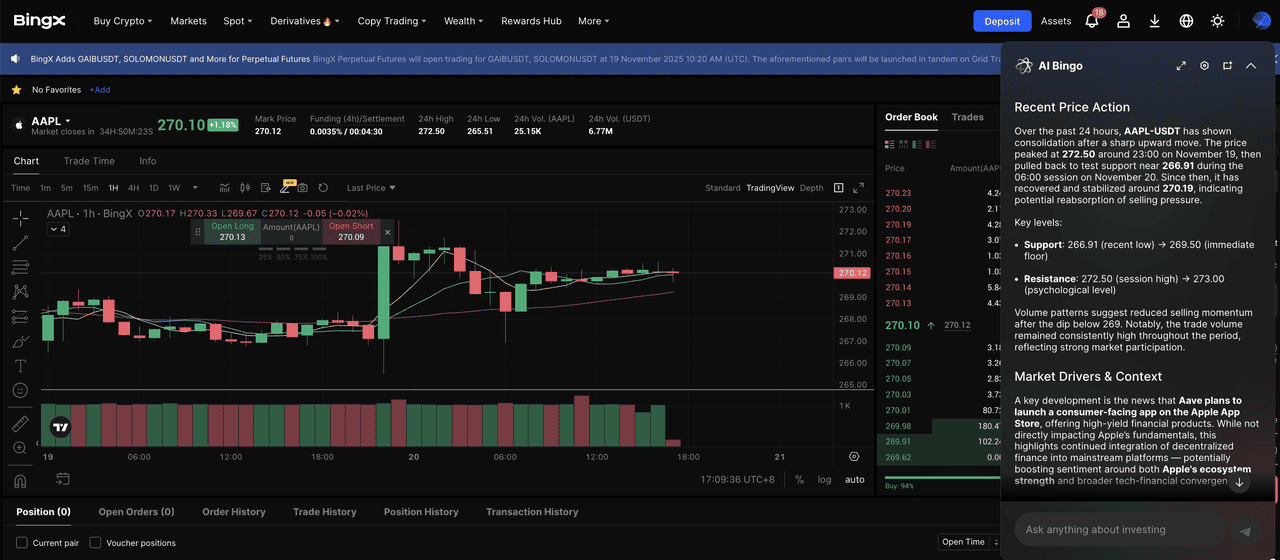
BingX TradFi allows traders to access Apple stock through USDT-margined perpetual contracts, offering a seamless bridge between crypto liquidity and equity markets. By trading AAPL/USDT perpetuals, you can utilize leverage, typically ranging from 5x to 10x, to amplify price movements without needing to own the underlying shares.
1. Transfer Funds: Move USDT to your Futures Account within the BingX app or web portal.
2. Select Market: Navigate to the TradFi tab under the Markets section and search for AAPL.
3. Analyze and Set Leverage: Use BingX’s built-in TradingView charts to identify entries; select your leverage, e.g., 5x, and choose between Isolated or Cross Margin.
4. Execute Order: Input your position size and set your Take-Profit (TP) and Stop-Loss (SL) levels, highly recommended for 2026's volatile tech landscape.
5. Confirm and Monitor: Click Open Long or Open Short to open your position and track real-time PnL (profit and loss) in the Positions tab.
Trading Tokenized Apple Stocks (AAPLx and AAPLON) on BingX Spot
For investors seeking direct exposure without the complexities of traditional brokerage accounts, BingX offers tokenized versions of Apple stock on the spot market. AAPLx represents a 1:1 tokenized version of the standard Apple share, while AAPLON captures Overnight price action, allowing you to react to news breaking in Asian supply chains before the US market opens.
1. Deposit USDT: Ensure your BingX Account is topped up with USDT.
2. Find the Pair: Go to the Spot Market and search for AAPLx/USDT for standard exposure or AAPLON/USDT for overnight trading.
3. Choose Order Type: Select a Limit Order to specify your entry price or a Market Order for instant execution at the current rate.
4. Buy Apple's Tokenized Stock: Enter the amount of USDT you wish to spend and click Buy AAPLx or Buy AAPLON.
5. Manage Assets: Your tokenized shares will appear in your Assets tab, where they can be held long-term or swapped back to USDT at any time.
Read more: What Is Apple Tokenized Stock (AAPLX and AAPLON) and How to Buy
5 Key Risks for Apple Traders to Monitor in 2026
Successful trading in the 2026 tech landscape requires a balanced understanding of the structural and macroeconomic hazards that could derail Apple’s growth trajectory.
1. Memory Price Inflation: As CEO Tim Cook highlighted in early 2026, soaring market pricing for NAND and DRAM components represents a direct hit to gross margins, potentially forcing Apple to choose between price hikes or lower profitability.
2. AI Performance Gap: Apple’s commitment to on-device processing via Apple Intelligence prioritizes privacy, but if its localized models suffer from higher latency or lower accuracy compared to cloud-dominant rivals, the consumer incentive to upgrade hardware may vanish.
3. Regulatory and Antitrust Headwinds: Ongoing legal battles with the U.S. Department of Justice (DOJ) and the European Union over App Store exclusivity and walled garden practices pose a multi-billion dollar threat to Apple’s high-margin Services revenue.
4. Ecosystem Saturation: With an installed base exceeding 2.5 billion active devices, Apple faces the law of large numbers; if hardware unit growth stalls in mature markets, the stock's valuation will depend entirely on the company’s ability to extract more value per user.
5. Smart Home Execution Risks: As reported in March 2026, Apple has faced repeated roadblocks and delays in launching its smart home display, suggesting that moving beyond mobile and computing into the home ecosystem remains a difficult hurdle for the company to clear.
Conclusion: Should You Invest in Apple (AAPL) in 2026?
Apple’s 2026 trajectory represents a fundamental shift from a luxury hardware vendor to a diversified AI and mass-market infrastructure provider. The successful launch of the MacBook Neo suggests a viable path for capturing the massive entry-level PC segment, while the Apple Intelligence roadmap offers a high-margin services tailwind. For long-term investors, the company’s record-breaking free cash flow and de-risked supply chain in India provide a stable foundation, positioning the stock as a primary vehicle for exposure to consumer AI adoption.
However, the investment thesis is currently balanced against a rich valuation and near-term margin headwinds. With the stock trading at a premium P/E ratio and facing significant memory cost inflation, the margin of safety is narrower than in previous cycles. For active traders, the 2026 outlook favors an agile approach, prioritizing technical confirmations at key resistance levels and monitoring the success of the new AI Pro subscription models. Decisions should weigh the potential for a $350 Super Cycle against the risk of a sideways correction if earnings growth fails to outpace rising component costs.
Risk Reminder: Even Mega-Cap stocks can be volatile. Always use stop-losses and stay updated on quarterly earnings dates which often trigger massive liquidity shifts.
Related Reading
1. Alphabet (GOOGL) Stock Outlook 2026: Can Gemini and Google Cloud AI Drive GOOGL Cross $420?
2. Palantir (PLTR) Stock Outlook for 2026: Can AI-Driven Enterprise Supercycle Take PLTR to $235+?
3. Intel (INTC) Stock Forecast 2026: Foundry Breakthrough to $89 or Value Trap?
4. Oracle (ORCL) Stock Price Outlook for 2026: Can AI Cloud Infrastructure Take ORCL Back to Its Highs?
5. How to Buy Apple Stock in 2026: A Guide for TradFi and Crypto Investors
6. Apple (AAPL) Stock Outlook for 2026: MacBook Neo Growth or AI Valuation Trap?