In early May 2026, Zinc (XZN) stands at a high-stakes crossroads. After hitting a local peak of $3,532 in late April, prices have experienced a sharp correction toward the $3,340 level. While the International Lead and Zinc Study Group (ILZSG) confirms a 19,000-metric ton deficit for the year, investors are currently grappling with a demand vacuum caused by the May Day holiday and persistent weakness in China's real estate sector.
The narrative for 2026 is dominated by a massive supply-side squeeze. The triple shock of the Middle East conflict has sent Brent crude toward $86/bbl and urea prices up by 60%, drastically raising the cost of smelting and logistics. With major zinc mines like Lady Loretta reaching their end-of-life, the market is balancing structural scarcity against a high-interest-rate environment that threatens industrial expansion. This guide breaks down the Zinc price prediction for 2026 using data from the World Bank, BMI (Fitch Solutions), and LME market analysis.
You will also discover how to trade Zinc futures with USDT through BingX TradFi.
Top 5 Things for Zinc Traders to Know in 2026
As Zinc navigates a volatile landscape of geopolitical disruptions and energy spikes, traders must monitor these five market-moving factors:
- The Structural Deficit: The ILZSG forecasts a refined zinc deficit of 19,000 metric tons for 2026, even as global output is expected to rise by 1.4%.
- Input Cost Pressures: A 24% surge in global energy prices and a scarcity of sulfuric acid, exacerbated by Chinese and Russian export bans, are creating a high floor for production costs.
- The China Property Pivot: Investment in China's real estate sector is projected to decline by 12.8% in 2026, removing a massive traditional pillar of galvanized steel demand.
- The Green Offset: While construction slows, demand from the Renewables and EV sectors like solar frames and EV batteries is forecast to rise, partially offsetting the property slump.
- Zinc-Ion Battery Momentum: Aqueous Zinc-Ion battery research is surging as a lithium alternative. With 32% of research activity focused on ZnSO4 systems, zinc is evolving from a construction metal to a core energy-storage RWA (real-world assets).
What Is Zinc (XZN)?
Zinc is a versatile industrial metal primarily used for galvanizing steel to prevent corrosion. In 2026, it has transitioned from a simple construction commodity into a strategic RWA essential for the energy transition. Beyond infrastructure, zinc is increasingly critical for zinc-ion battery storage and large-scale solar installations.
As of May 2026, the zinc market is defined by inelastic supply. Smelters in the Middle East and Europe are facing record electricity costs, leading to output curtailments. On the BingX TradFi platform, traders can speculate on these price movements through Zinc (XZN) CFDs, allowing for seamless long and short positions using a unified crypto-collateralized interface.
Trading zinc in 2026 involves tracking the LME Cash-Settlement price and SHFE futures. BingX TradFi integrates these global benchmarks, allowing users to trade tokenized commodities alongside their Bitcoin holdings. As the metal trades near $3,350/tonne, these instruments serve as vital vehicles for navigating the commodity coiling effect.
An Overview of Zinc's Performance in 2025
In 2025, Zinc delivered a steady 10% return, significantly trailing the explosive growth of gold. The year was characterized by a 'wait-and-see' approach from institutional investors as mine grades in Australia and Kazakhstan fluctuated.
However, by Q4 2025, the narrative shifted when Glencore announced the planned closure of the Lady Loretta mine. This removal of high-grade feedstock set the stage for the Q1 2026 rally, where prices climbed from $2,867 to over $3,500 following the escalation of the Middle East conflict.
Zinc’s 2026 Strategy: How to Navigate Volatility
- The $3,300 Support: Technical analysts identify the $3,300–$3,340 zone as a critical support band. Holding this level is essential to maintain the structural bull trend.
- The Sulfuric Acid Bottleneck: Monitor export policies from China and Russia. A continued ban on sulfuric acid exports could force a supply-side breakout regardless of demand.
- The Mark-Price Shield: In volatile RWA markets, utilize BingX’s risk management tools. Ensure your liquidation triggers are set appropriately for the current high-volatility environment.
Zinc 2026 Investment Outlook: $3,500 Breakout vs. $2,900 Correction
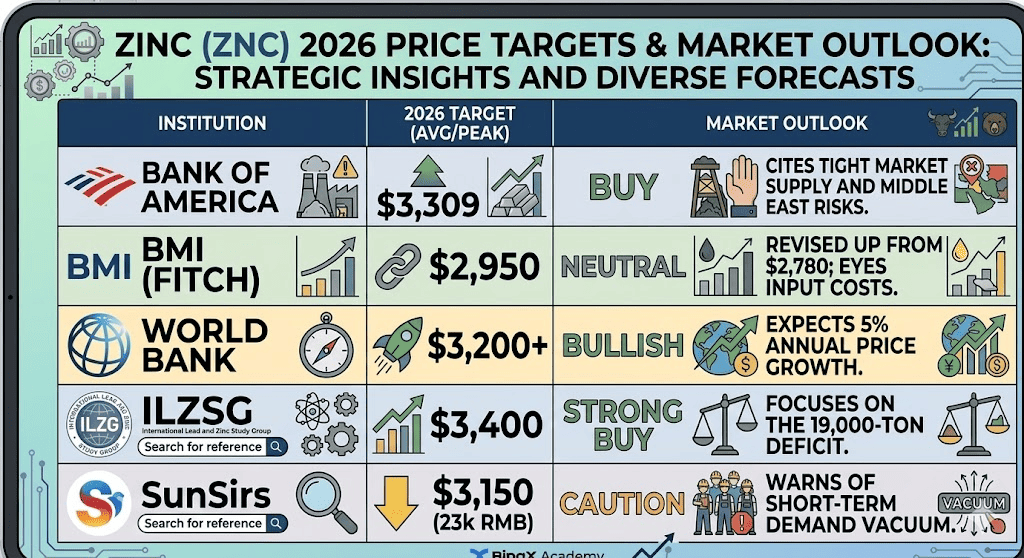
Zinc price forecasts for 2026 by various leading analysts
Navigating the Zinc market in 2026 requires understanding three probability-weighted outcomes:
The Bull Case for Zinc Prices in 2026: The $3,500 Structural Breakout
The bullish narrative centers on a Supply-Side Fracture driven by the compounding effects of the Middle East conflict and critical feedstock scarcity. As the Strait of Hormuz closure extends toward October, the World Bank’s forecast of a 24% surge in energy prices becomes the primary market driver. Brent crude averaging $115/bbl would likely force marginal European and Asian smelters into a second wave of curtailments, transforming the current 19,000-ton deficit into a severe structural shortfall. This is further exacerbated by the Sulphuric Acid Squeeze, as export bans from China and Russia remove a key processing input, effectively capping refined output regardless of price.
For traders, this scenario triggers a high-velocity short squeeze as industrial consumers scramble to secure physical metal amid record-low inventories. A decisive break above the $3,532 April peak would likely shift the market from a technical trade to a scarcity premium phase, targeting the $3,500–$3,600 zone. In this environment, the most effective strategy involves monitoring LME inventory drawdowns below the 200,000 mt mark and utilizing long perpetual positions with tight trailing stops to capture the upward volatility driven by inelastic mine supply.
The Base Case: Zinc's $2,950 – $3,300 Consolidation
The base case envision a Distribution Phase where persistent supply-side risks are neutralized by a Demand Vacuum in traditional sectors. While BMI has revised the 2026 price floor upward to $2,950 to account for rising input costs like diesel and urea, the 12.8% decline in Chinese real estate investment acts as a heavy anchor. In this scenario, the market digests the explosive gains of Q1, balancing the 31% increase in fertilizer costs and energy spikes against a cooling global manufacturing PMI. Prices become pinned between the cost of production and the reality of slowing galvanized steel consumption.
Practically, this results in a high-volatility, range-bound environment defined by the $2,950 support and $3,300 resistance levels. Investors should focus on the Green Growth offset, where incremental demand from EV battery housing and solar infrastructure provides a steady floor, preventing a total price collapse. The tactical play here is Range-Trading the Extremes - buying near the marginal cost of production at around $2,950/tonne and taking profits as prices approach the psychological $3,300 ceiling, while using BingX’s AI-driven sentiment tools to gauge the duration of each swing.
The Bear Case: The $2,700 Demand Destruction Trap for Zinc Price
The bearish scenario is triggered by a Macro-Skunk event where the Triple Shock of war, energy, and food inflation finally fractures global consumer discretionary spending. If inflation in developing economies sustainedly exceeds 5.8%, the resulting aggressive monetary tightening would likely lead to a hard landing for global manufacturing. In this environment, the automotive sector, a key zinc consumer, would face a sharp contraction, and the Green Energy pivot would be delayed by prohibitive capital costs, leaving the market in a 49,600-ton monthly surplus similar to the spikes seen in early February.
Technically, the bear case is confirmed by a decisive daily close below the $3,200 line in the sand. Such a breach would likely activate systematic trend-following sell programs, liquidating the speculative length built up during the Q1 rally. As social inventories climb back toward 260,000 mt, the War Premium would be rapidly erased. Traders should look to hedge long-term exposure by opening short positions on BingX if the 21-day moving average is lost, targeting a mean-reversion toward the $2,700–$2,800 support zone where 2025's pre-conflict price levels sit.
Zinc Price Forecasts for 2026 by Leading Analysts
|
Institution |
2026 Target (Avg/Peak) |
Market Outlook |
|
Bank of America |
$3,309 |
Buy: Cites tight market supply and Middle East risks. |
|
BMI (Fitch) |
$2,950 |
Neutral: Revised up from $2,780; eyes input costs. |
|
World Bank |
$3,200+ |
Bullish: Expects 5% annual price growth. |
|
ILZSG |
$3,400 |
Strong Buy: Focuses on the 19,000-ton deficit. |
|
SunSirs |
$3,150 (23k RMB) |
Caution: Warns of short-term demand vacuum. |
How to Trade Zinc (XZN) Futures on BingX TradFi
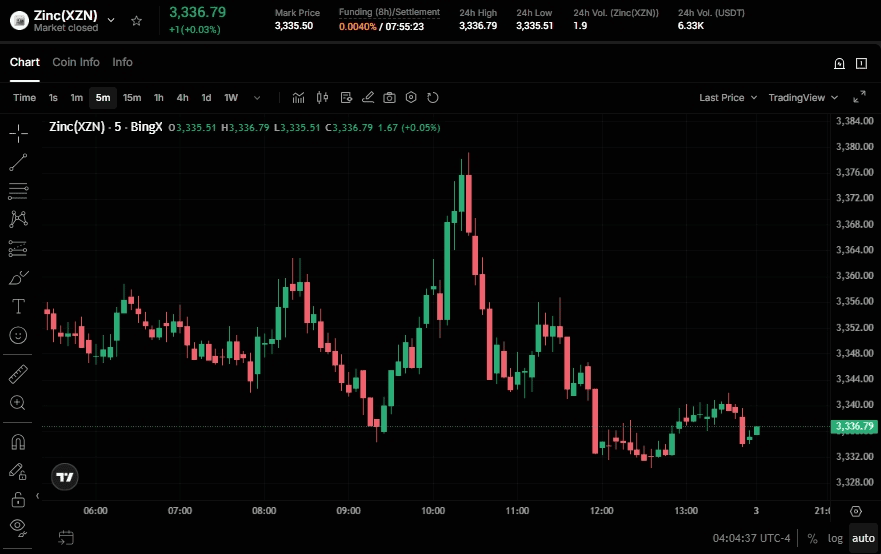
Zinc perpetuals on BingX futures market
Capitalize on Zinc’s volatility using BingX TradFi and BingX AI's AI-driven market analysis.
- Access BingX TradFi: Navigate to the Commodities sub-section on BingX TradFi markets.
- Select Zinc (XZN): Choose the ZINC(XZN)-USDT perpetual or CFD contract.
- Adjust Leverage and Settings: Set your preferred leverage ratio and configure Take-Profit (TP) and Stop-Loss (SL) orders immediately to manage risk against volatility.
Top 5 Risks to Watch for Zinc Traders in 2026
Navigating the high-stakes zinc market in 2026 requires a sharp eye on the shifting macroeconomic and geopolitical currents that could disrupt even the strongest technical trends.
- Macroeconomic Pivot: If the Fed maintains rates longer than expected, the USD strength will pressure all LME-denominated metals.
- The May Day Hangover: If Chinese demand doesn't rebound after the holiday, the short-term correction could turn into a bear trend.
- Energy Price Easing: A sudden ceasefire in the Middle East would deflate the energy premium overnight, hitting zinc smelter support.
- Substitution: High zinc prices could drive automakers toward alternative anti-corrosion coatings.
- Inventory Surges: Watch for unexpected LME warehouse delivery dumps that can trigger sharp liquidations.
Final Thoughts: Is Zinc a Buy at $3,350 in 2026?
As of May 2026, Zinc has moved from a boring industrial metal to a high-volatility safe-haven. At $3,350, the metal is pricing in a significant supply-side risk. For long-term investors, the structural deficit and the shift toward Zinc-Ion battery technology provide a compelling floor.
However, tactical traders must remain disciplined. The immediate correction suggests the market is waiting for a demand catalyst from the East. Monitoring the $3,300 support and AI trade alerts on BingX will be critical for timing your entries in this high-tension market.
Risk Reminder: Trading commodities involves significant capital risk. Zinc's high sensitivity to energy prices and geopolitical shifts can lead to rapid price swings. Always implement strict stop-loss orders.
Related Reading
- Platinum (PL) Price Prediction 2026: $2,500 Industrial Breakout or Speculative Retrace?
- Is Gold a Good Investment in 2026? Risks & Returns Explained
- Silver Price Prediction for 2026: Can XAG Surge Above $200 or Face a Correction?
- Is Copper (XCU) a Good Investment in 2026?
- Crude Oil Price Forecast 2026: $140 War Premium or $60 Surplus Baseline?
- Palladium Price Prediction 2026: $2,900 Tariff Squeeze or Structural Bear Trap?
