
XDC Price Prediction Summary: Analyst consensus for 2026 puts XDC in the $0.034-$0.06 range in base-case scenarios, with a bull case of up to $0.15 if institutional RWA adoption accelerates. For 2030, base-case targets range from $0.15 to $0.20, with optimistic scenarios reaching $0.40 to $0.57, driven by XDC's expanding role in trade finance tokenization and ISO 20022-aligned settlement infrastructure.
XDC Network is one of the few crypto assets whose price narrative is driven primarily by institutional adoption milestones rather than retail trading cycles. While most altcoins track Bitcoin's mood, XDC's structural tailwinds come from a specific, high-stakes market: the tokenization of global trade finance, a sector measured in the tens of trillions of dollars.
This guide provides a year-by-year price analysis from 2026 to 2030, grounded in XDC's actual utility metrics, RWA TVL growth, on-chain signals, and the competitive landscape for enterprise blockchain. The numbers are analyst consensus ranges, not guarantees. The reasoning behind them is where the real investment thesis lives.
XDC Network: Current Market Snapshot (Q2 2026)
|
Metric |
Value |
|
Current Price (approx.) |
$0.028 to $0.036 (verify before publish) |
|
Market Cap |
~$600M to $700M |
|
Circulating Supply |
~37.8 billion XDC |
|
All-Time High |
~$0.16 (2021) |
|
Consensus Mechanism |
XDPoS 2.0 (Chained HotStuff BFT) |
|
Block Finality |
6 seconds |
|
TPS Capacity |
2,000+ transactions per second |
|
RWA TVL / Processed Volume |
$700M+ TVL; $1B+ tokenized RWA processed |
|
Key 2026 On-Chain Signal |
10.38M XDC left exchanges in one day (May 27, 2026) |
The RWA Utility Factor: Why $700M in TVL Changes the Price Narrative
Most crypto price predictions are built on market sentiment, technical patterns, and Bitcoin correlation. XDC's price narrative has a structural layer that most altcoins lack: actual on-chain utility tied to a measurable and growing market. As of Q2 2026, the XDC ecosystem has processed over $1 billion in tokenized real-world assets, with RWA TVL on the network exceeding $700 million.
These are not paper metrics. They represent trade finance instruments, debt issuances, and treasury products that real institutions are settling on the XDC blockchain.
The significance of this for price is direct. XDC is required as both a settlement asset and a staking collateral for masternode validators. As more trade finance volume flows through the network, demand for XDC as a functional asset grows independent of speculative retail interest. This is the property that differentiates XDC from most top-100 assets: rising TVL creates structural demand for XDC, not just narrative.
The $28 Trillion Market Opportunity Behind XDC's Valuation
Global trade finance is a $28 trillion annual market. The trade finance gap, the difference between the financing that SMEs need and what banks can currently provide, is estimated at $2.5 trillion to $5 trillion per year. XDC was the first and, as of 2026, only blockchain invited to join the Trade Finance Distribution Initiative (TFDi), a consortium that includes the world's leading banks and non-bank financial institutions.
The math behind XDC's long-term price ceiling runs as follows. If blockchain-enabled trade finance reaches even 5% market penetration by 2030 and XDC captures 25% of that blockchain market share, the on-chain TVL attributable to XDC would reach approximately $350 billion. Infrastructure blockchains have historically traded at 2 to 5 times their TVL in market-cap terms. That scenario produces a market cap of $700 billion to $1.75 trillion, which at XDC's current circulating supply of 37.8 billion tokens implies a token price range of $18 to $46. That is the theoretical long-term bull case; it is not a 2030 forecast. It represents what the market would need to believe about adoption to justify such prices.
The base case is far more modest. Market penetration of 0.5% to 1% with XDC capturing 15% to 20% of that market produces TVL of $20 billion to $56 billion and, at a 2x to 4x TVL multiple, a market cap of $40 billion to $224 billion. At 37.8 billion circulating XDC, that still implies a price range of $1.06 to $5.92 in the base case over a 5- to 10-year horizon. The $1.00 price level is achievable in this framework, but it requires a sustained, multi-year adoption trajectory rather than a single crypto bull run.
|
Adoption Scenario |
On-Chain XDC TVL |
Est. Market Cap (3x TVL) |
Implied XDC Price |
|
Conservative (0.2% penetration, 10% share) |
$5.6B |
$16.8B |
~$0.44 |
|
Base Case (0.5% penetration, 20% share) |
$28B |
$84B |
~$2.22 |
|
Bull Case (1% penetration, 25% share) |
$70B |
$210B |
~$5.56 |
XDC Price Prediction 2026: Market Trends and Catalyst Analysis
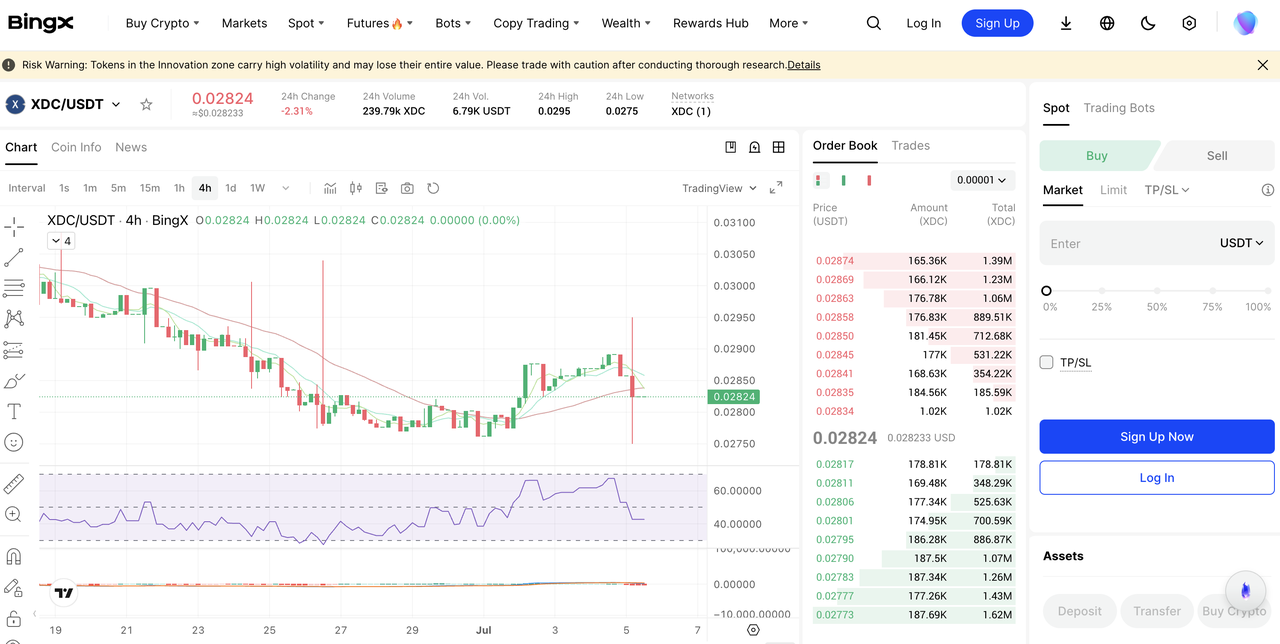
XDC entered 2026 in a consolidation phase, trading between $0.045 and $0.055 in January before pulling back to the $0.028-$0.036 range by Q2 2026 as broader market risk aversion increased. The Relative Strength Index for XDC sat near neutral levels in Q2, reflecting accumulation-phase conditions rather than active buying pressure.
The most significant on-chain signal in 2026 came on May 27, when 10.38 million XDC tokens left exchange wallets in a single day, marking the largest single-day exchange outflow of the year. Large exchange outflows typically indicate whale accumulation and reduce immediate sell pressure. This is consistent with the patient, fundamentals-driven holding pattern typical of XDC's institutional investor base.
2026 Price Prediction: Range and Key Catalysts
|
Scenario |
2026 Price Range |
Implied Market Cap |
Key Condition |
|
Conservative |
$0.020 to $0.034 |
$756M to $1.3B |
Broad market weakness; adoption delays |
|
Base Case |
$0.034 to $0.060 |
$1.3B to $2.3B |
Steady RWA growth; no macro shock |
|
Bull Case |
$0.060 to $0.150 |
$2.3B to $5.7B |
Tier-1 exchange listing; major institutional announcement |
The 2026 catalyst list for the bull case includes: a Tier-1 exchange listing (Binance or Coinbase have not yet listed XDC), further large-scale RWA issuances following the $500M Brazilian agricultural debt deal, and continued institutional validator additions following Deutsche Telekom and Clearpool. The bear-case risk is primarily macro: a broad crypto market sell-off or delayed adoption timelines for blockchain-based trade finance.
XDC Technical Analysis: Key Levels to Watch in 2026
- Support zone: $0.0282 to $0.0308, identified by multiple technical analysts as the primary short-term support as of Q2 2026.
- EMA200 resistance: $0.0414, representing the 200-day exponential moving average. A sustained break above this level, accompanied by volume, would be the first technical signal of a trend reversal.
- Break target: $0.037-$0.040 on confirmed volume. A hold above $0.040 targets the EMA200.
- RSI context: RSI in the 45-55 range through Q2 2026, consistent with neutral-to-accumulation conditions. RSI above 60 on a weekly close would confirm bullish momentum shift.
XDC Price Prediction 2026 to 2030: Year-by-Year Forecast Table
|
Year |
Conservative |
Base Case |
Bull Case |
Primary Catalyst |
Key Risk |
|
2026 |
$0.020 to $0.034 |
$0.034 to $0.060 |
$0.060 to $0.150 |
Tier-1 exchange listing; $500M+ RWA issuances; ISO 20022 adoption |
Macro selloff; adoption delay |
|
2027 |
$0.040 to $0.070 |
$0.080 to $0.130 |
$0.130 to $0.250 |
RWA tokenization moves from pilot to production scale; subnet expansion |
Competition from Stellar, XRP, Ethereum L2s |
|
2028 |
$0.060 to $0.100 |
$0.100 to $0.200 |
$0.200 to $0.400 |
Sharding and L2 rollout; MLETR regulatory framework adoption across jurisdictions |
Regulatory clampdown on tokenized trade assets |
|
2029 |
$0.080 to $0.140 |
$0.140 to $0.280 |
$0.300 to $0.500 |
Cross-chain AI credit scoring (XDC-AI); bridge expansion via LayerZero |
Crypto supercycle fails to materialize |
|
2030 |
$0.042 to $0.100 |
$0.150 to $0.200 |
$0.400 to $0.570 |
$16T+ RWA market on-chain; XDC established as backbone infrastructure for tokenized trade |
Competing chains capture majority of RWA market |
Detailed Year-by-Year XDC Price Analysis
XDC Price Prediction 2026: Building the Foundation
2026 is a foundation year for XDC. The ISO 20022 migration across major financial institutions was completed in 2025, placing XDC in direct competition for cross-border settlement infrastructure. The acquisition of Contour Network (which connects HSBC, Citi, and 100+ financial institutions) gives XDC access to institutional rails that most blockchains cannot replicate.
The base case of $0.034 to $0.060 reflects a scenario in which institutional adoption grows steadily, while retail interest remains subdued amid post-bull-run consolidation.
A Tier-1 exchange listing would be the single largest catalyst for a push toward the upper end of the range or beyond it. Analysts at Digitalcoinprice and TokenMetrics estimate 2026 targets of $0.08 to $0.21 in optimistic cases, while conservative models target $0.034 to $0.040 in the stability range.
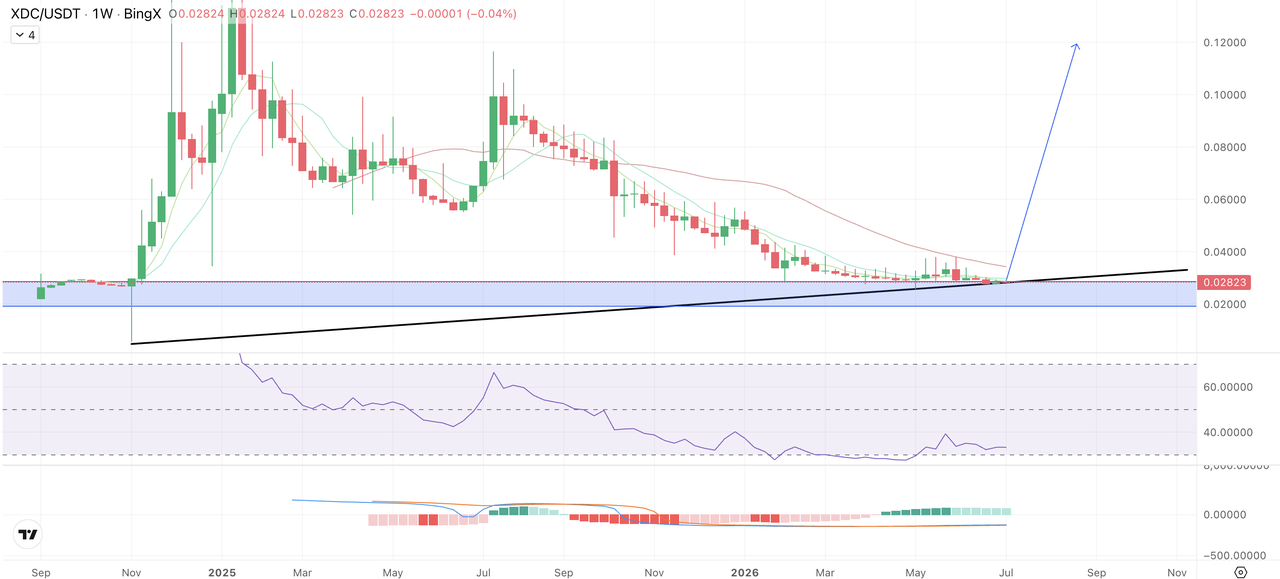
XDC Price Chart - Source: BingX
XDC Price Prediction 2027: The Scale Year
2027 is the year that analysts expect RWA tokenization to transition from pilot programs to production-scale deployment. If XDC's trade finance infrastructure delivers on the Contour Network integration and additional large-scale issuances follow the $500M Brazilian agricultural debt deal, the base case of $0.080 to $0.130 becomes achievable.
Digitalcoinprice's data model, the most-cited third-party forecast for XDC, projects a 2027 target of approximately $0.10. The bull case of $0.13 to $0.25 requires both a favorable macro environment and a meaningful increase in XDC's share of the RWA market versus competing chains.
XDC Price Prediction 2028 to 2029: Infrastructure Maturity
The 2028 to 2029 window is when XDC's sharding and Layer 2 upgrades are projected to become operational, significantly increasing throughput for enterprise applications. Quantum-resistant cryptography research begins integration in this timeframe. Cross-chain interoperability via LayerZero bridges expands the addressable market for XDC-settled assets.
The base case for 2028 ($0.10 to $0.20) reflects a scenario in which XDC has successfully demonstrated institutional scale, and the RWA market has grown to a measurable size. The 2029 base case ($0.14 to $0.28) assumes continued compounding of institutional adoption without macro disruption.
XDC Price Prediction 2030: The Long-Term Thesis
By 2030, the RWA market on blockchain is projected by multiple analysts to exceed $16 trillion in total value. The XDC thesis, articulated by community analysts, positions XDC as a bridge between permissioned DLT networks (such as R3 Corda, used by the DTCC) and the public blockchain ecosystem. If that positioning holds, XDC captures a structural role in the flow of institutional assets onto public blockchains.
The base case for 2030 ($0.15 to $0.20) requires steady adoption without a supercycle. The bull case ($0.40 to $0.57) requires a new crypto supercycle alongside XDC becoming recognized as core RWA infrastructure. A $1.00 XDC in 2030 is a very low-probability outcome (estimated at 5% to 10%) that would require XDC to capture approximately 25% of blockchain-enabled trade finance, with a 3x TVL-to-market-cap multiple.
The market cap required at that price, approximately $37.8 billion, is theoretically achievable but would rank XDC alongside Solana and BNB at their respective cycle peaks.
What Drives XDC's Price: The 5 Key Factors
- RWA TVL growth on XDC: This is the primary fundamental driver. Every billion dollars in new on-chain RWA settled via XDC represents a measurable increase in structural demand for XDC as settlement and staking collateral. Monitor XDC's TVL on DeFiLlama as the most reliable leading indicator.
- Institutional validator additions: When institutions such as Deutsche Telekom, Clearpool, and Republic join as validators, they stake large XDC positions, thereby reducing liquid supply. A pattern of consistent validator growth correlates with accumulation-phase price behavior.
- Exchange listing momentum: XDC is available on several exchanges but has not yet secured listings on Binance or Coinbase as of mid-2026. Either listing would be a material price catalyst, as it would expose XDC to the largest retail trading audiences in crypto.
- EIP-1559 fee burn mechanics: XDC's Cancun upgrade introduced EIP-1559-style fee mechanics, meaning a portion of transaction fees is permanently burned. As transaction volume grows with enterprise adoption, the burn rate increases, reducing XDC supply over time and improving scarcity dynamics.
- Bitcoin and macro correlation: Despite its utility fundamentals, XDC remains positively correlated with Bitcoin during broad market moves. A Bitcoin bear market suppresses XDC even as its fundamentals improve. Understanding this correlation is essential for timing both entry and exit.
Key 2026 Institutional Milestones Supporting the XDC Thesis
These are confirmed, verifiable developments that underpin the utility case for XDC. They are not price predictions; they are the foundation from which price predictions are built.
|
Milestone |
Who is Involved |
Price Relevance |
|
Contour Network acquisition |
HSBC, Citi, and 100+ financial institutions |
Gives XDC access to established institutional trade finance infrastructure |
|
$500M Brazilian agricultural debt issuance |
VERT Capital and institutional partners |
Largest single RWA deal on XDC; validates production-scale capability |
|
Deutsche Telekom joins as validator |
Deutsche Telekom (Fortune Global 500) |
Largest European infrastructure company staking XDC; reduces liquid supply |
|
$12.7B USDC processed via XDC |
Clearpool integration |
Demonstrates payment-layer capacity at institutional scale |
|
Commodities Trading Club membership |
S&P Global, CME Group, LSEG |
Positions XDC as the only public blockchain for RWA tokenization in commodity finance |
|
TFDi membership (only blockchain member) |
World's leading banks and NBFIs |
Structural industry endorsement with no competing blockchain |
|
XDC 2.0 (Chained HotStuff BFT) |
Princeton University protocol team |
6-second finality makes XDC viable for real-time settlement; not a marketing claim |
|
10.38M XDC exchange outflow (May 27, 2026) |
On-chain data (Santiment) |
Largest single-day accumulation signal of 2026; bullish on-chain indicator |
Bull Case vs. Bear Case: The Complete Scenario Framework
Bull Case: XDC Becomes Core RWA Infrastructure
- Binance and/or Coinbase listing in 2026 to 2027: A top-tier listing would expose XDC to hundreds of millions of retail users, dramatically increase daily trading volume, narrow the bid-ask spread, and attract momentum traders.
- RWA market reaches $5 trillion on-chain by 2030: If the institutional narrative shifts from 'experimental' to 'standard,' XDC's first-mover status in trade finance gives it structural advantages that later entrants cannot replicate quickly.
- MLETR adoption accelerates: The Model Law on Electronic Transferable Records provides the legal framework for digitized trade documents. As more jurisdictions adopt MLETR, the legal barrier to on-chain trade finance settlement falls, directly expanding the addressable market for XDC.
- XDC-AI and cross-chain interoperability deliver: The planned XDC-AI on-chain credit scoring system and LayerZero bridge expansion could create an entirely new demand surface for XDC beyond trade finance.
Bear Case: Adoption Timelines Slip and Competition Intensifies
- Stellar and Ripple capture the institutional RWA market: XLM and XRP compete directly for the same institutional settlement market. Both have deeper banking relationships in certain regions. If they dominate the RWA narrative in the next bull cycle, XDC's market-share ceiling will compress significantly.
- Ethereum Layer 2 ecosystems absorb institutional DeFi: Base, Arbitrum, and Polygon are all building institutional RWA offerings. If large institutional capital flows to Ethereum-ecosystem chains rather than XDC's specialized infrastructure, XDC's TVL advantage shrinks.
- Token unlock pressure: XDC's total supply significantly exceeds its circulating supply. Scheduled token unlocks create ongoing sell pressure that can overwhelm institutional buying during bear markets.
- Adoption remains in pilot phase through 2028: If trade finance tokenization moves slower than expected and production-scale deals remain rare, XDC may remain a sub-$0.05 asset through the mid-2020s regardless of its technical merits.
How to Buy and Trade XDC on BingX
XDC is available on BingX's spot market. Visit BingX to get started.
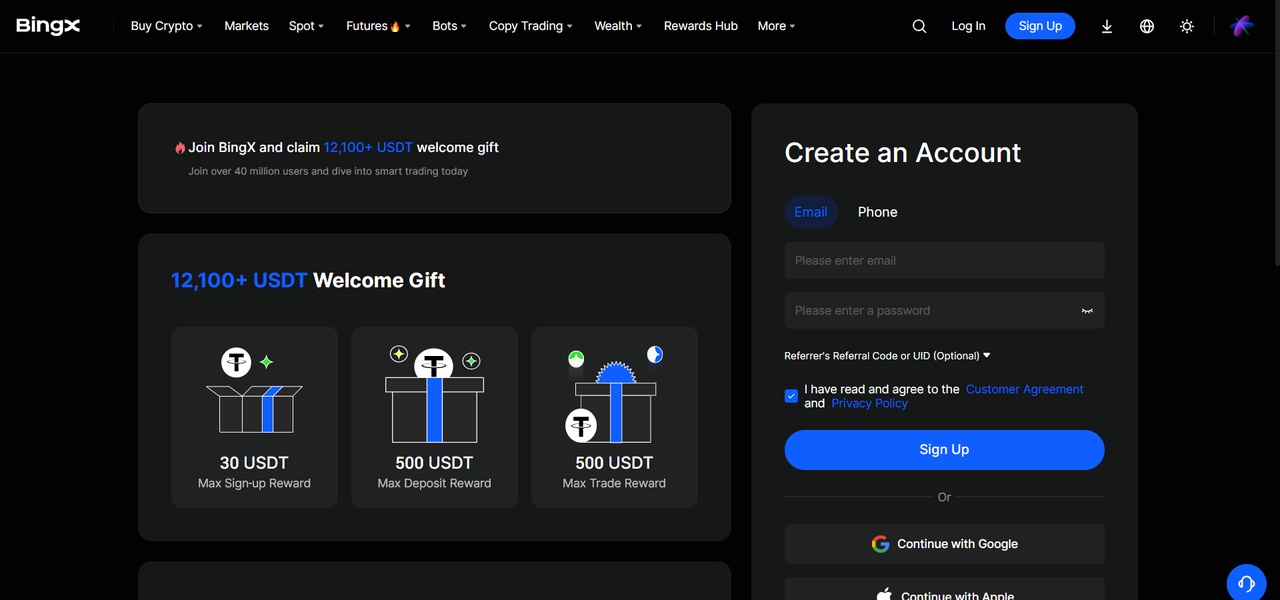
1. Create or Log Into Your Account
Register with your email or phone number, then complete identity verification (KYC) to access the full spot market and futures trading.
2. Deposit USDT
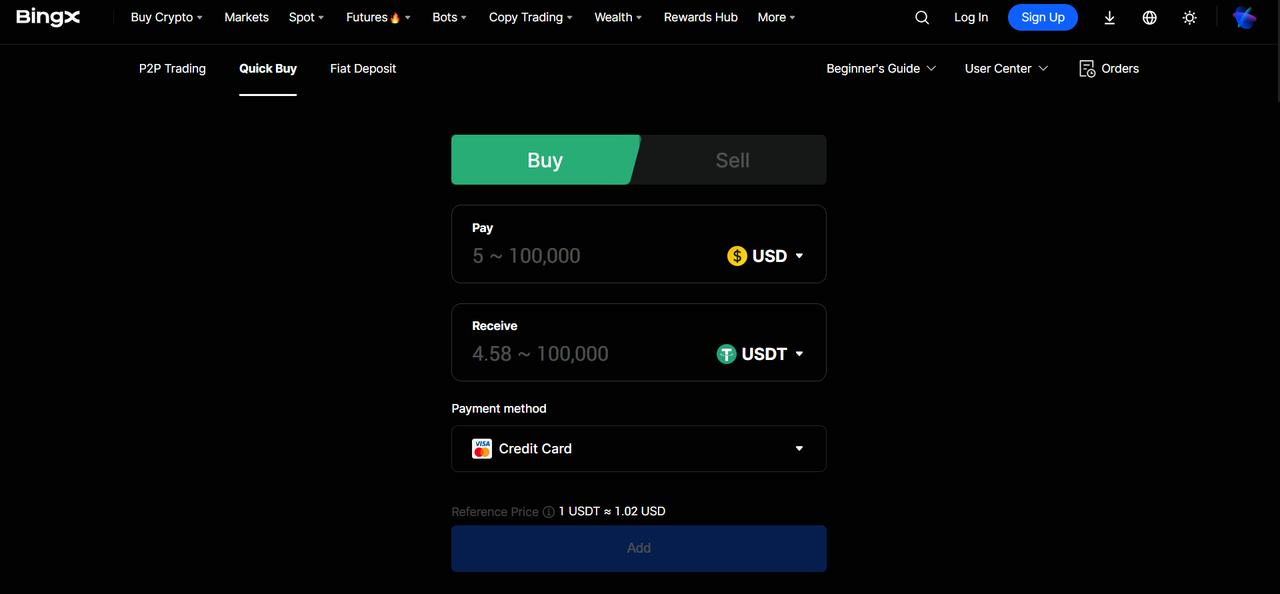
Transfer USDT from an external wallet to your BingX Spot account, or use Quick Buy to convert fiat via credit or debit card (Visa/Mastercard, supported regions). USDT is the standard base currency for the XDC/USDT pair.
3. Search XDC/USDT
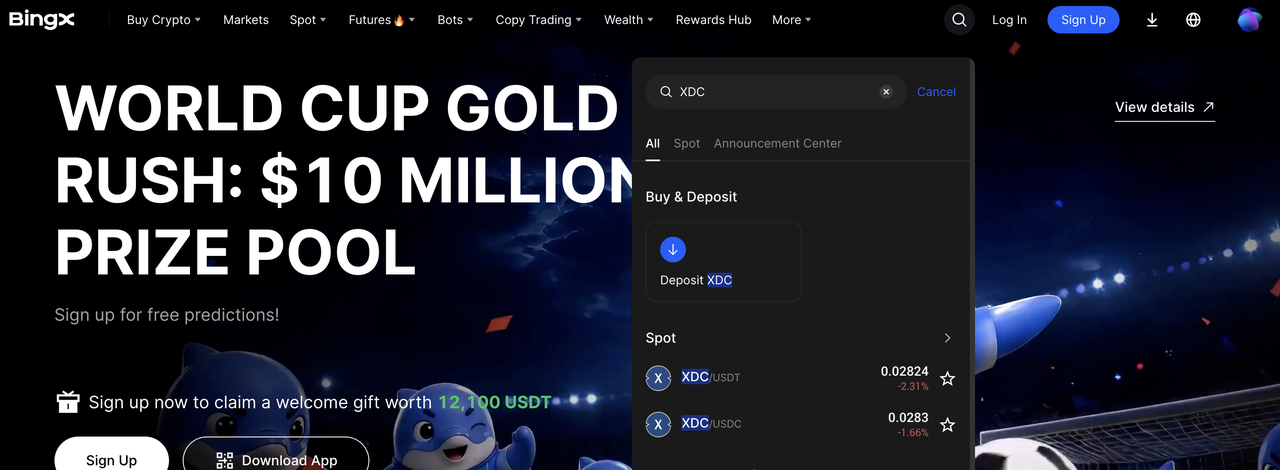
Use the search bar to open the XDC/USDT spot pair. XDC is an infrastructure asset with moderate daily volume relative to its market cap, so avoid navigating away mid-session during fast-moving institutional news events.
4. Place a Limit Order
XDC's order book is thinner than major-cap assets. A Limit order lets you set your exact entry price rather than accepting market execution.
5. Set Stop-Loss and Take-Profit at Order Entry
Configure your Stop-Loss and Take-Profit levels before confirming the order. XDC moves sharply on specific catalysts: exchange listing announcements, large RWA deal confirmations, and institutional validator additions. Pre-set your exits before those events, not after the price has already moved.
Conclusion: XDC's Price Will Follow Its Utility Curve
XDC is not a token you buy because of a narrative. It is a token you buy because the institutions settling real trade finance instruments on its blockchain create structural demand that most altcoins simply do not have.
The price has not yet caught up with the fundamentals. $700M in RWA TVL, a $500M agricultural debt issuance, Deutsche Telekom staking on the network, and TFDi membership with no competing blockchain none of that is reflected in a $0.028 to $0.036 token price. The gap closes when one of two things happens: a Tier-1 exchange listing puts XDC in front of a retail audience, or a large enough institutional deal forces the market to pay attention.
Until then, XDC rewards patience over momentum. Track the TVL on DeFiLlama, monitor exchange outflows on Santiment, and monitor validator additions. Those are the signals that move before the price does. When you are ready to act on them, XDC/USDT is available on BingX.
Related Articles
- Buy XDC Network (XDC) on BingX in Minutes
- Making Every Trade Efficient: A Guide to Stable Spot Portfolio Growth
- Risk Management in Crypto Trading: 7 Rules Every Trader Must Know
- How to Keep a Trading Journal: A Complete Guide for Crypto Traders
- Implied Volatility in Crypto: What It Means and How to Trade It
- Altcoin Season: What It Is, How to Spot It, and How to Trade It
FAQs on XDC Price Prediction
1. What is the XDC price prediction for 2026?
Analyst consensus for XDC in 2026 ranges from $0.034 to $0.060 in the base case, with a bull scenario reaching $0.060 to $0.150 if a Tier-1 exchange listing or major RWA issuance announcement occurs. The conservative range is $0.020 to $0.034 if broader market conditions deteriorate.
2. What is the XDC price prediction for 2030?
For 2030, analyst consensus centers on $0.15 to $0.20 in the base case, driven by steady institutional adoption of XDC's trade finance tokenization infrastructure. The bull case of $0.40 to $0.57 requires a crypto supercycle and XDC establishing itself as recognized core RWA infrastructure. A $1.00 price in 2030 is a very low-probability outcome (estimated at 5% to 10%) that requires approximately $37.8 billion in market capitalization.
3. What drives XDC's price?
XDC's price is primarily driven by on-chain RWA TVL growth, institutional validator additions (which stake XDC and reduce liquid supply), exchange listing momentum, EIP-1559 fee burn from transaction volume, and Bitcoin/macro correlation during broad market moves. Rising RWA TVL is the single most important leading indicator.
4. How much XDC is there?
XDC has a circulating supply of approximately 37.8 billion tokens as of Q2 2026. Total supply is higher, with ongoing unlock schedules creating gradual sell pressure. The EIP-1559 fee burn introduced in the Cancun upgrade partially offsets this over time as transaction volume grows.
5. Is XDC a good long-term investment?
XDC has structural utility that most speculative altcoins lack: it is the only blockchain member of the Trade Finance Distribution Initiative, processes real institutional volume, and has partnerships with HSBC, Citi, Deutsche Telekom, and others. The bear case risks are competition from Stellar, Ripple, and Ethereum L2s, plus adoption timelines that may extend beyond market cycles. This article does not constitute financial advice. Conduct your own research before making any investment decision.
6. What is XDC Network used for?
XDC Network is an enterprise-grade blockchain used for real-world asset tokenization and trade finance. Primary use cases include tokenizing trade finance instruments (invoices, letters of credit, debt securities), cross-border settlement, and hosting institutional DeFi applications. XDC was the first blockchain invited to join the Trade Finance Distribution Initiative and processed over $1 billion in tokenized RWA as of 2026.
7. Can XDC reach $1?
Mathematically, $1.00 XDC requires a market capitalization of approximately $37.8 billion at the current circulating supply. This would rank XDC alongside top-10 to top-15 cryptocurrencies globally. Analysts consider this achievable only if XDC captures a significant share of a multi-trillion-dollar RWA market over a 5 to 10 year horizon. Most credible 2030 forecasts do not put $1.00 in their base or bull cases.
