

Unstable Coin (USDUC) is an omnichain memecoin built to monetize the inherent volatility of the digital asset market. While traditional stablecoins strive for a 1:1 peg with the US Dollar, USDUC explicitly rejects stability, embracing extreme price swings as its core utility.
As of May 2026, the USDUC ecosystem has reached a market capitalization of approximately $16.75 million, fueled by a high-octane community that views volatility as a feature, not a bug. With recent major listings on BingX Spot and Binance.US, the project has evolved from a Solana-native joke into a cross-chain speculative powerhouse, challenging the boring $322 billion stablecoin market.
This article explores the mechanics of USDUC’s Stablecoin Conquest, the utility of the $USDUC token, and how to navigate the high-risk, high-reward landscape of Unstable Finance.
What Is Unstable Coin (USDUC) Anti-Stablecoin?
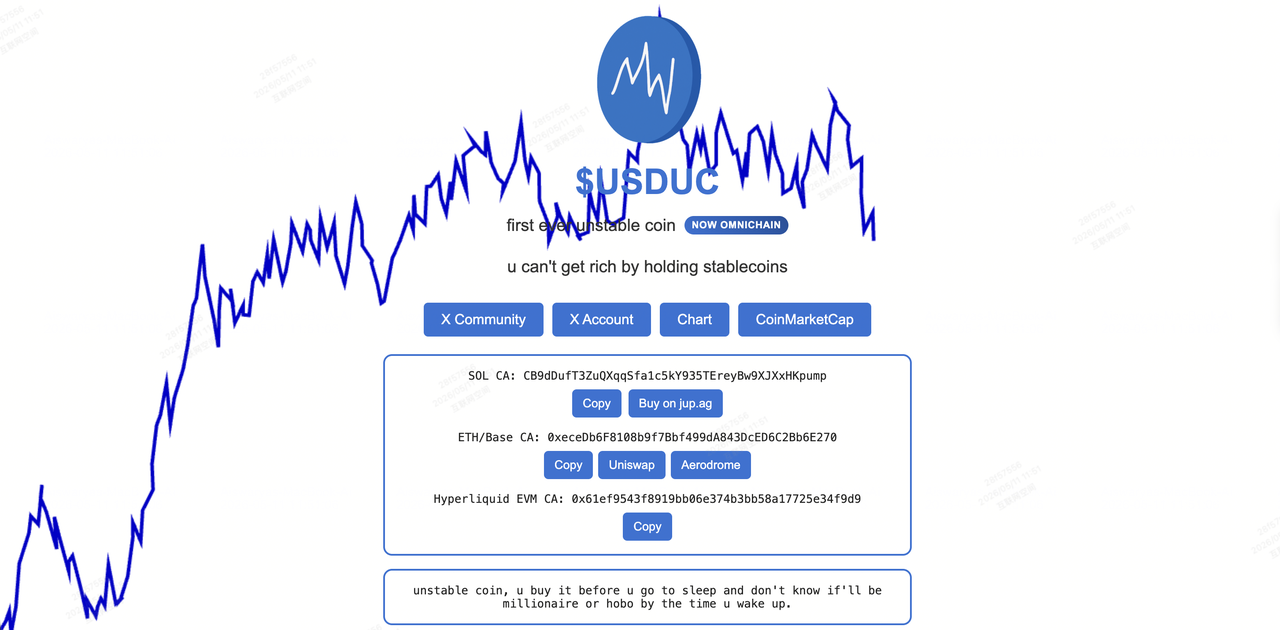
Source: USDUC
USDUC is a specialized memecoin designed to parody the predictability of centralized finance (CeFi). Unlike algorithmic or collateralized assets, USDUC has no reserves, no peg, and no stability mechanisms. It is marketed as the perfect hedge against market boredom, targeting traders who prefer the possibility of massive gains over capital preservation.
The protocol functions as a cultural jab at tightening global regulations, such as the 2025 GENIUS Act, positioning itself as a decentralized tool for unstable people. Key pillars of the project include:
- Anti-Stablecoin Narrative: A Stablecoin Conquest roadmap that tracks milestones as USDUC flips the market caps of assets like BUSD, DAI, and USDC.
- Omnichain Interoperability: Originally launched on Solana, USDUC now operates across Ethereum, Base, and Hyperliquid EVM via Chainlink CCIP.
- The Millionaire or Hobo Philosophy: A transparent high-risk model where price is driven purely by community sentiment and viral hype.
How Does the USDUC Ecosystem Work?
USDUC operates as a fair launch protocol, ensuring that 100% of the supply is community-held from day one. It utilizes a lean technical architecture to facilitate rapid price discovery:
1. The Fair Launch Model
Launched via the Solana-based Pump.fun, USDUC avoided private sales, pre-mines, and team allocations. This structure mitigates the risk of insider dumping, placing the token's fate entirely in the hands of market participants.
2. The Chaos Level Metric
The project tracks its own performance through a gamified Chaos Level, a real-time sentiment gauge ranging from Stable to Rising. This helps traders visualize the token's current volatility relative to its Conquest targets.
3. Cross-Chain Liquidity
By leveraging Chainlink's Cross-Chain Interoperability Protocol (CCIP), USDUC tokens are not siloed. A trader can buy USDUC on Solana and bridge it to Ethereum or Base to tap into different liquidity pools or DeFi yield opportunities, such as Volatility Vaults.
What Is the $USDUC Token Used For?
The $USDUC token is the primary speculative vehicle and governance engine for the project, with a fixed supply of 1,000,000,000 (1 billion) tokens.
- Volatility Staking: Users can stake $USDUC in Volatility Vaults to earn rewards, often paid out in native assets like SOL or ETH, funded by trading fees.
- Chaos Governance: Holders participate in Chaos Proposals, voting on future chain integrations, marketing stunts, and community-led burn challenges.
- Universal Speculation: Serving as a cross-chain meme asset that can be used across multiple DEX and CEX platforms.
What Is Unstable Coin (USDUC) Tokenomics?
Unstable Coin (USDUC) features a fair launch tokenomic model designed for maximum transparency and market volatility, with a total supply hard-capped at 1 billion tokens. Launched on Solana via Pump.fun, the project has no team allocations or pre-mines, and the mint function has been renounced to ensure a fixed supply that can never be inflated. With a 0% transaction tax and nearly 100% of tokens already in circulation, USDUC is engineered to facilitate rapid price discovery and high-frequency trading across its omnichain ecosystem.
USDUC vs. Traditional Stablecoins: Key Differences
|
Feature |
Unstable Coin (USDUC) |
Traditional Stablecoins (USDC/USDT) |
|
Target Price |
$0.00 to ∞ based on pure volatility |
$1.00 strict peg |
|
Backing |
Community Sentiment and hype |
Cash, Treasuries, or crypto collateral |
|
Purpose |
Entertainment and Speculation |
Capital preservation and medium of exchange |
|
Founders |
Pseudonymous collective |
Centralized entities like Circle and Tether |
The fundamental difference between Unstable Coin (USDUC) and traditional stablecoins lies in their mathematical objective and reserve structure. Traditional stablecoins like USDT and USDC are pegged assets, maintaining a 1:1 value with the US dollar through massive reserve holdings, as of May 2026, the combined market cap of the top three stablecoins exceeds $270 billion, backed by liquid cash and US Treasury bills. In contrast, USDUC is an uncollateralized anti-stablecoin with a hard-capped supply of 1 billion tokens and a market cap of approximately $10.8 million. While USDC utilizes monthly Deloitte audits to prove its stability, USDUC utilizes a Chaos Level metric to track its volatility, intentionally fluctuating by as much as 750% in a single day as seen on May 5, 2026 to provide a speculative alternative to the stagnant $1.00 price point.
Practically, these assets serve opposite roles in a digital portfolio. Traditional stablecoins act as Safe Havens and settlement layers, allowing traders on BingX to lock in profits and bypass the volatility of assets like Bitcoin. USDUC, however, functions as a Volatility-as-a-Service tool; it is a high-velocity speculative asset that traders use to bet on narrative shifts and social media hype cycles. While a depeg event is a systemic failure for USDT or USDC, extreme price movement is the intended utility of USDUC. From a functional standpoint, traditional stablecoins are institutional tools for payroll and DeFi lending, whereas USDUC is a community-driven memecoin designed for unstable market conditions where the primary goal is rapid price discovery rather than capital preservation.
How to Trade Unstable Coin (USDUC) on BingX
You can leverage BingX AI to analyze USDUC’s Chaos Level in real-time, helping you identify high-probability entry points across both spot and derivatives markets.
Buy, Sell, or HODL USDUC on the Spot Market
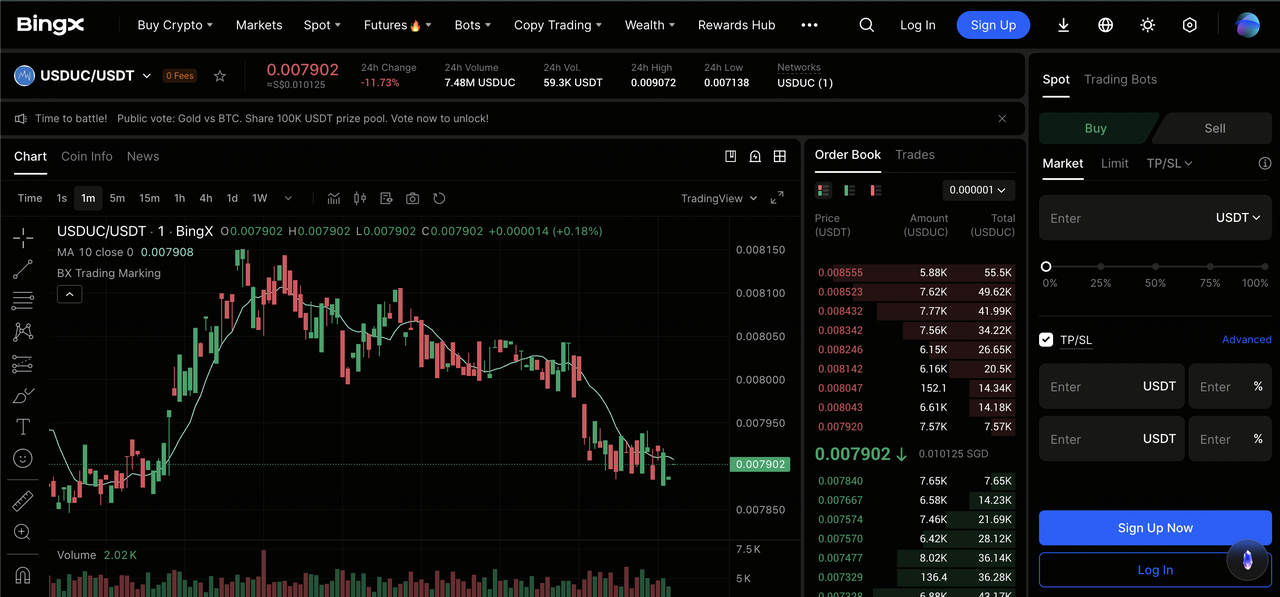
USDUC/USDT trading pair on BingX spot market
BingX recently migrated USDUC to its core Spot Market, providing a high-liquidity environment for the USDUC/USDT pair with a limited-time Zero Fee promotion ending May 15, 2026.
- Search: Navigate to the Spot market and search for the USDUCPUMP/USDT trading pair.
- Analyze: Use the integrated AI Bingo tool to scan for RSI divergences or volume spikes common in unstable assets.
- Execute: Choose a Market Order for instant participation in a pump, or a Limit Order to buy the hobo dip. Once confirmed, your tokens will appear in your Fund Account.
Long or Short USDUC Perpetuals on the Futures Market
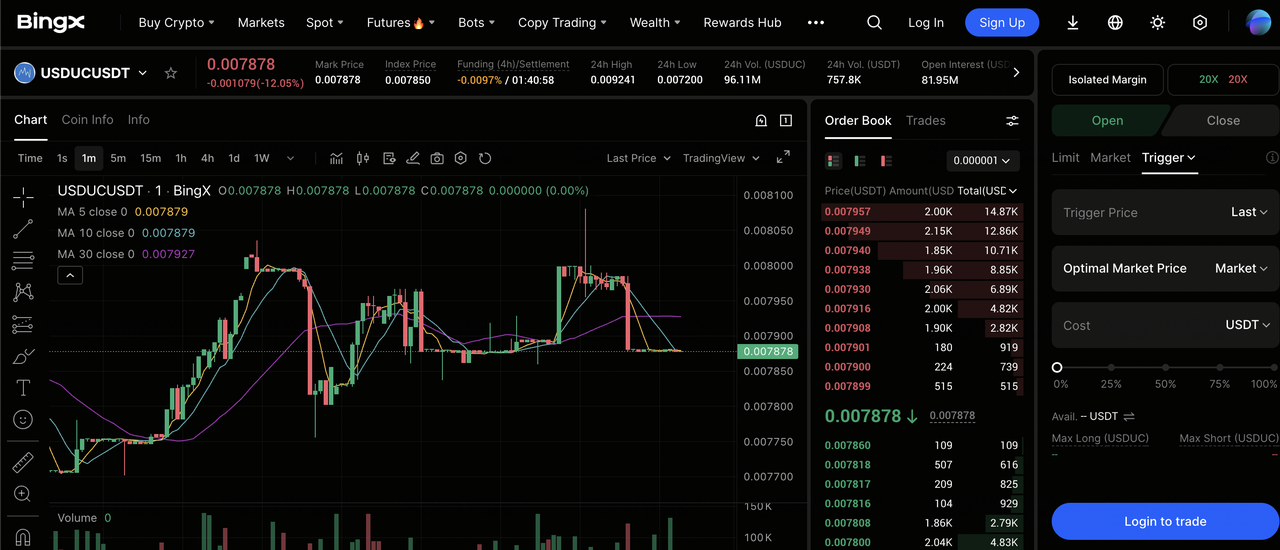
USDUC/USDT perpetual contract on BingX futures market
For advanced traders, BingX offers the USDUC/USDT Perpetual Futures pair, allowing you to go Long or Short with up to 50x leverage.
- Transfer: Move USDT from your Fund Account to your Futures Account to use as margin.
- Setup: Select the USDUCPUMP/USDT perpetual contract. Due to extreme volatility, BingX has adjusted the funding settlement frequency to every 1 hour to ensure market stability.
- Risk Management: Toggle the TP/SL (Take Profit/Stop Loss) switch before opening your position. Given USDUC’s unstable nature, using Isolated Margin mode is highly recommended to protect your total balance from liquidations during sudden swings.
5 Key Considerations Before Investing in USDUC
Investing in the unstabl requires a specific risk appetite. Before trading, consider these factors:
- Extreme Volatility: Intraday swings of 50-100% are common. Never invest more than you can afford to lose.
- Satirical Nature: The project has no intrinsic value or official roadmap beyond the meme.
- Contract Security: Always verify the official contract address before trading USDUC tokens.
- Listing Hype: Prices often surge during new exchange listings and may correct sharply afterward.
- Community-Driven: The token's survival depends on the continued engagement and humor of its unstable community.
Final Thoughts: Should You Buy Unstable Coin (USDUC) and Embrace the Chaos?
As of May 2026, Unstable Coin (USDUC) has transitioned from a satirical Solana-based experiment into a functional cross-chain asset that challenges the traditional concept of value preservation. By intentionally decoupling from the US Dollar and utilizing an omnichain framework via Chainlink CCIP, the project provides a specialized tool for traders to hedge against the lack of price action in the broader stablecoin market. For participants on BingX, the practical utility of USDUC lies in its volatility-as-a-service model, where the objective is to capture rapid intraday price movements rather than seeking a long-term store of value or predictable yield.
The long-term viability of USDUC depends on its ability to sustain community engagement as it pursues its Stablecoin Conquest milestones. While its fair-launch tokenomics and renounced mint function provide a level of structural transparency, the token remains an entirely narrative-driven asset. Strategic users should view USDUC as a high-risk speculative vehicle, focusing on the Chaos Level metrics and liquidity depth across networks like Base and Hyperliquid. Ultimately, USDUC serves as a case study in how memecoin culture can institutionalize market volatility, transforming unstable price action into a tradeable financial product.
Risk Reminder: Memecoins are highly speculative. USDUC is designed to be unstable; its value can go to zero as easily as it can reach the moon. Always DYOR.
Related Reading
- What Is BELIEF (BELIEF) Coin, the Solana-Based Motivational Faith Memecoin?
- What is Bull (BULLSOL) Memecoin and How to Trade It on BingX?
- What Is Burnie Senders (BURNIE) PolitiFi Memecoin and How to Trade It on BingX?
- USDC vs. USDT: Key Differences and Which Stablecoin to Choose in 2026?
- What Are the Best Stablecoins to Have in Your Portfolio in 2026?
