
Following the successful rollout of the Fusaka upgrade in December 2025, Glamsterdam is Ethereum’s next major hard fork, targeted for the first half of 2026. This upgrade represents a significant shift back to Layer 1 (L1) structural improvements. By introducing Enshrined Proposer-Builder Separation (ePBS) and Block-Level Access Lists (BALs), Glamsterdam aims to eliminate long-standing bottlenecks in how blocks are constructed and executed. These changes pave the way for true parallel execution, potentially boosting Ethereum’s throughput toward 10,000 TPS while making the network more decentralized and MEV-fair.
By the end of this guide, you’ll understand what the Ethereum Glamsterdam hard fork is, how it enables parallel processing, the expected timeline, what this L1-first evolution means for the broader crypto market, and how to trade Ethereum upgrade events on BingX.
What Is the Ethereum Glamsterdam Upgrade?
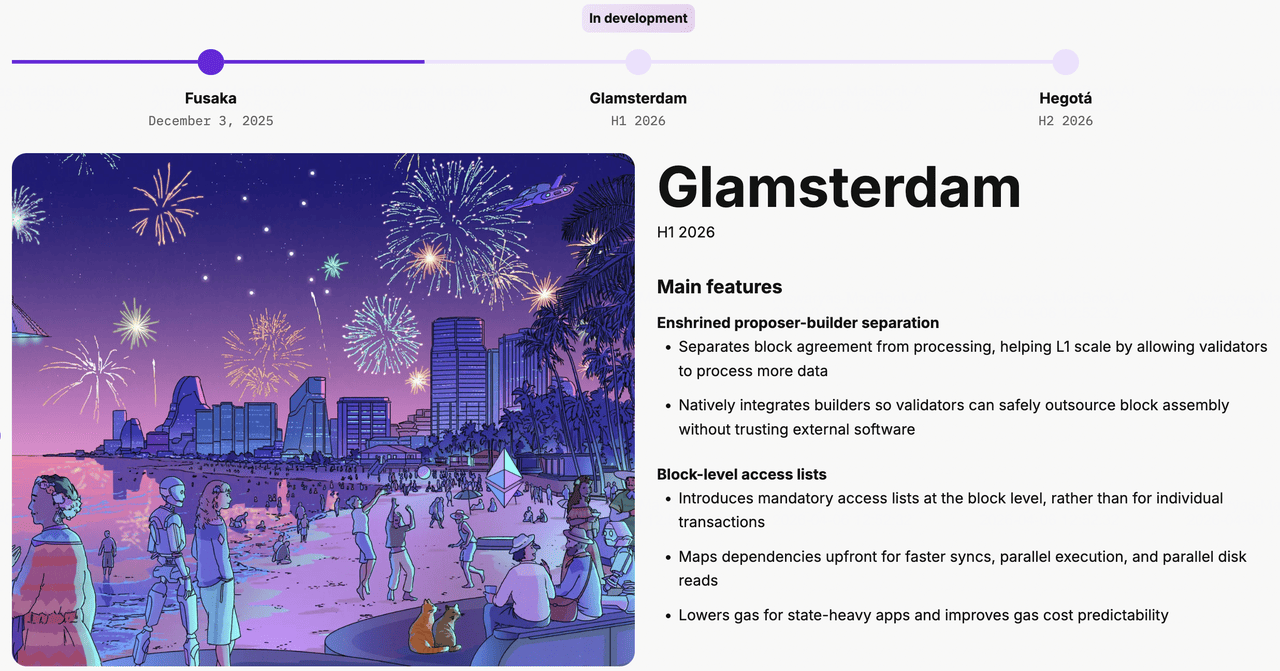
Key highlights of Ethereum Glamsterdam (Gloas + Amsterdam) upgrade | Source: Ethereum roadmap
Glamsterdam is a coordinated network upgrade that simultaneously updates Ethereum’s two core layers. Its name is a portmanteau of the two layer-specific code names: Amsterdam (the Execution Layer) and Gloas (the Consensus Layer). Unlike recent upgrades that focused primarily on lowering costs for Layer 2 rollups like Dencun and Fusaka, Glamsterdam is designed to overhaul the engine of the Ethereum base layer.
At its heart, the upgrade addresses two trust-based blind spots in Ethereum’s current architecture. First, it moves the relationship between block builders and validators directly into the protocol (ePBS). Second, it requires blocks to declare their data dependencies upfront (BALs), allowing the network to process multiple transactions at once rather than one by one.
Read more: What Are the Top Ethereum Layer-2 Projects of 2026?
When Is the Glamsterdam Upgrade Expected to Roll Out?
pectra, fusaka, glamsterdam 🪩 pic.twitter.com/l2bJXd0lA3
— timbeiko.eth (@TimBeiko) January 9, 2025
The Ethereum Glamsterdam upgrade is currently targeted for H1 2026, the first half of the year. As of April 2026, development is moving through rigorous testing phases to ensure the structural changes to block production do not compromise network stability.
- Devnet Phase (Early 2026): Early developer networks (Devnet-0 through Devnet-5) have been utilized to test the core logic of ePBS and BALs in a controlled environment.
- Public Testnets (Spring 2026): Activation on major testnets like Holesky and Sepolia is expected in the coming months. These rehearsals allow node operators to test client compatibility.
- Mainnet Activation (Target H1 2026): While a specific block height hasn't been locked in as of writing, developers are aiming for a mid-2026 release.
The upgrade timeline is L1-first, meaning the focus is on protocol-level stability over rapid deployment. Following Glamsterdam, the network is expected to move toward the Hegotá upgrade in H2 2026.
What Are the Key EIPs in Glamsterdam Update: The Pillars of Parallelism
The Glamsterdam upgrade is defined by two headline Ethereum Improvement Proposals (EIPs) that change how the network functions at a fundamental level.
1. EIP-7732: Enshrined Proposer-Builder Separation (ePBS)
Today, 80-90% of Ethereum blocks are produced using external relays (like MEV-Boost). This introduces a centralization risk because validators must trust these third-party services. ePBS integrates this separation directly into the Ethereum protocol code.
It makes the network more resilient by removing middlemen. It also addresses MEV (Maximal Extractable Value) fairness, ensuring that block building is transparent and that proposers cannot be easily manipulated.
2. EIP-7928: Block-Level Access Lists (BALs)
Currently, Ethereum executes transactions sequentially because it doesn't know which transactions might overlap or conflict until they are run. BALs require a block to carry a map of all accounts and storage slots it will touch before execution begins.
This is the key to parallel execution. If the network knows that Transaction A and Transaction B touch completely different accounts, it can process them simultaneously across multiple CPU cores, drastically increasing speed.
What Changes in the Ethereum Network After the Glamsterdam Upgrade Rollout?
The impact of Glamsterdam will be felt across the entire stack, from infrastructure providers to the end-user experience:
- Massive Throughput Boost: By enabling parallel EVM processing, Ethereum aims to jump from its current double-digit TPS to a target of 10,000 TPS.
- Gas Cost Predictability: With BALs allowing for pre-fetching of state data, gas costs become more stable and predictable, especially for complex, state-heavy smart contracts.
- Enhanced Decentralization: By enshrining block production rules, Glamsterdam reduces the power of centralized relay operators, making it safer and easier for smaller validators to participate.
- Higher Gas Limits: The upgrade lays the groundwork to safely increase the block gas limit from 60 million toward 200 million, providing more block space for everyone.
How Does Glamsterdam Impact Different Ethereum Ecosystem Stakeholders?
The Glamsterdam upgrade introduces structural changes to Ethereum's core architecture that will fundamentally reshape the experience for everyone from everyday users and decentralized application (dApp) developers to the validators and node operators who secure the network.
- For Users: While no manual action is required, the invisible benefits are substantial, particularly during high-traffic events. The implementation of Block-Level Access Lists (BALs) and a projected gas limit increase to 200 million are expected to slash L1 gas fees by up to 78% for complex smart contract interactions. This means swapping tokens or minting NFTs during a gas war will become significantly more affordable and predictable, as parallel execution prevents a single popular mint from clogging the entire network's pipeline.
- For Developers: Builders gain a vastly more powerful execution environment where parallelism allows for high-frequency DeFi protocols and complex gaming logic to run on L1 without the latency bottlenecks of the current sequential EVM. Practical upgrades like the PAY opcode (EIP-5920) allow for simpler, gas-efficient ETH transfers within contracts, while the declaration of state dependencies upfront via BALs enables developers to optimize their code for pre-fetching. This shift effectively turns Ethereum execution into a dependency graph, allowing decentralized applications to scale horizontally across multiple threads.
- For Node Operators and Validators: This is a high-stakes operational shift that requires upgrading both Execution and Consensus clients well ahead of the H1 2026 deadline. Validators will take on the critical new duty of joining the Payload Timeliness Committee (PTC) to verify that builders reveal block contents on time, moving the network away from its 80-90% dependency on external, trust-based relays. While hardware requirements may see a slight uptick to handle parallel disk reads, the move to ePBS (EIP-7732) ensures that even smaller, home-staked nodes can compete fairly with professional builders, reinforcing the network’s censorship resistance.
- For ETH Investors and Stakers: Glamsterdam marks the transition from an L2-centric scaling narrative back to a High-Performance L1 value proposition, potentially re-establishing Ethereum as the premier World Computer. By targeting 10,000 TPS and integrating MEV fairness directly into the protocol, the upgrade reduces the centralization discount often applied to Ethereum's valuation. Stakers, in particular, should monitor the shift to ePBS, as the removal of third-party relays could lead to more transparent and equitably distributed MEV rewards directly through the protocol.
How to Prepare for the Ethereum Glamsterdam Upgrade in H1 2026
Preparation for Glamsterdam is straightforward but varies by your role. For everyday users and ETH holders, no manual action is required; your funds remain safe in your existing wallets, and the protocol transition happens automatically. Simply stay alert for upgrade scams or fake migration links; official Ethereum upgrades never require you to move your funds or share private keys.
For node operators and validators, this is a critical maintenance event. You must update both your Execution Layer (EL) and Consensus Layer (CL) clients to the specific releases supporting the Glamsterdam hard fork. Because ePBS introduces the Payload Timeliness Committee (PTC), operators should also audit their network latency and hardware performance to handle the new timing sensitivities and parallel disk reads required by BALs (EIP-7928).
How to Trade Ethereum Upgrades with BingX
Leveraging the advanced insights of BingX AI, traders can navigate the volatility of major network upgrades like Glamsterdam with data-driven precision and automated efficiency.
1. Spot Trading to Buy and Sell ETH for Long-Term Value
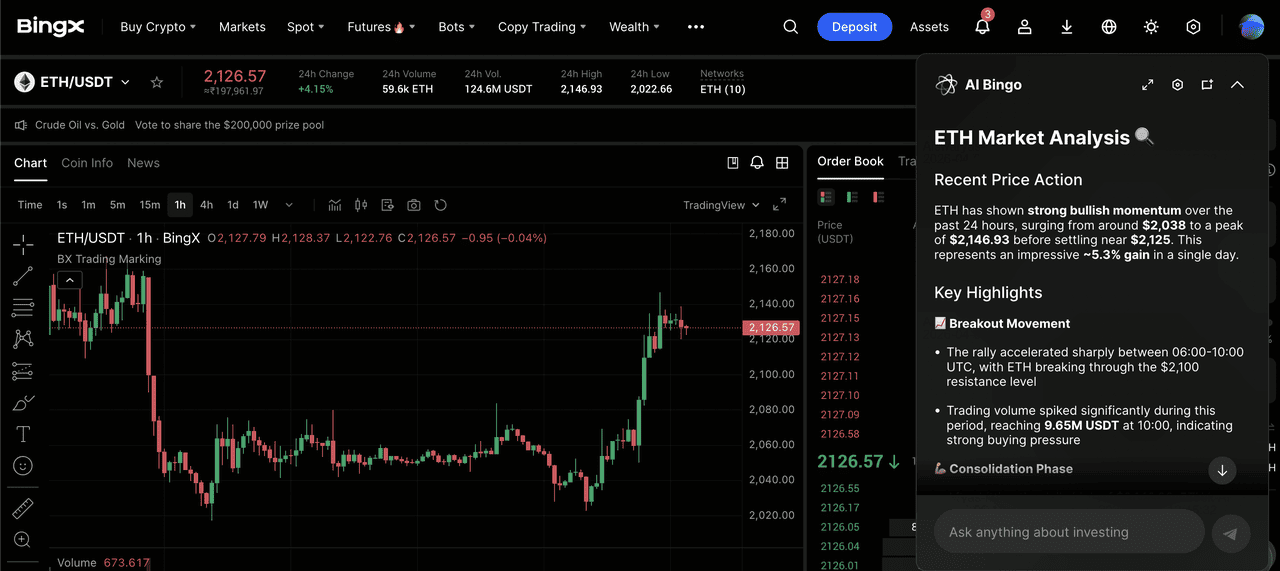
ETH/USDT trading pair on the spot market featuring BingX AI analysis
As Ethereum shifts toward an L1-first scaling model, investors can use the BingX Spot Market to accumulate ETH or ecosystem tokens like LDO and OP. Spot trading allows you to capitalize on the long-term fundamental strength of the network without the risks of liquidation or funding fees during the pre-upgrade build-up.
2. Long or Short ETH on Futures Trading for Volatility
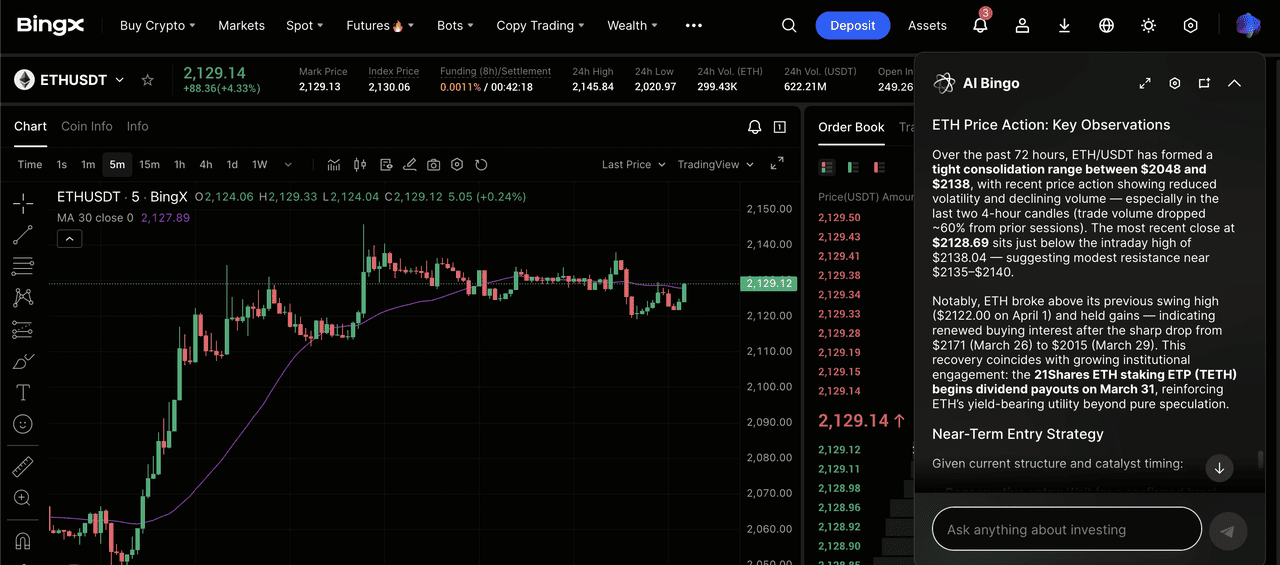
ETH/USDT perpetual contract on the futures market with BingX AI insights
Significant hard forks often trigger 'buy the rumor, sell the news' price action, which savvy traders can navigate using BingX Perpetual Futures. By utilizing long or short positions with flexible leverage, you can hedge your existing ETH holdings or speculate on short-term price swings as the H1 2026 activation date approaches.
3. DCA Ethereum with BingX Recurring Buy
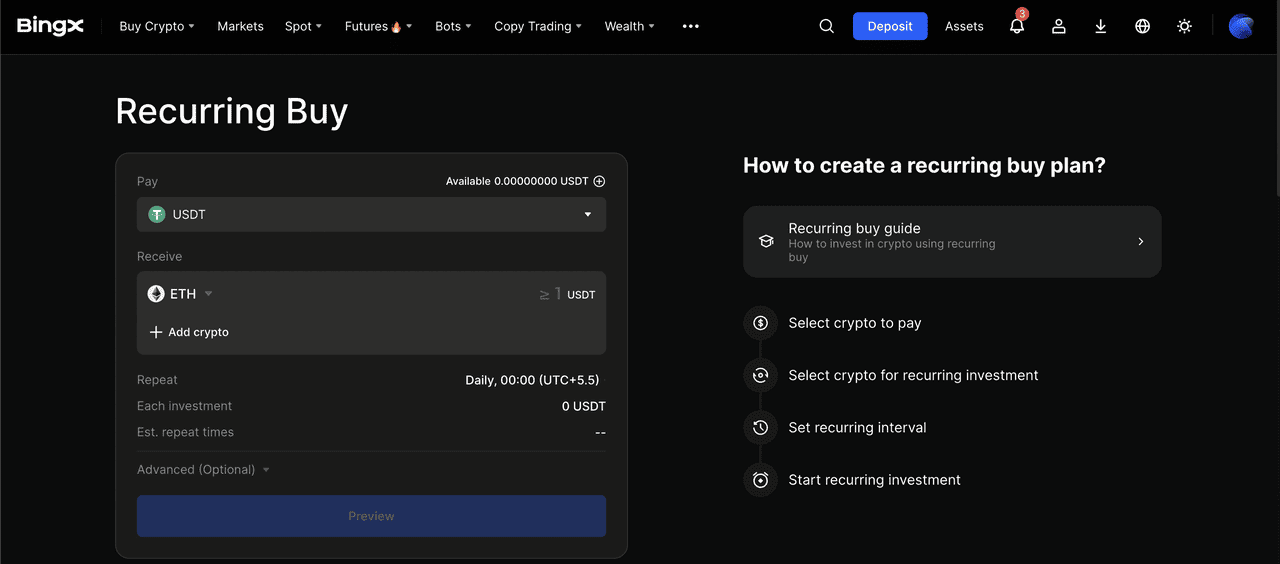
How to DCA Ethereum with BingX Recurring Buy
To mitigate the risks of market timing, the BingX Recurring Buy tool allows you to automate a Dollar-Cost Averaging (DCA) strategy. By setting up a daily or weekly purchase of ETH, you can build a position at an average price throughout the Glamsterdam development cycle, ensuring you are positioned for the post-upgrade efficiency gains regardless of temporary market dips.
What’s Next After Glamsterdam: Ethereum's Hegotá Upgrade in H2 2026
Once Glamsterdam establishes the framework for parallel execution and trustless block building, the network will look toward Hegotá (H2 2026).
The primary goal following Glamsterdam is Statelessness. Hegotá is expected to introduce Verkle Trees (or similar state-expiry solutions), which will allow nodes to verify the network without storing the entire massive history of Ethereum. This will lower the hardware requirements for running a node, ensuring that Ethereum remains decentralized even as it scales to handle millions of daily users.
Conclusion: What to Expect From Ethereum's Glamsterdam Update
The Glamsterdam upgrade represents a fundamental shift in Ethereum’s architecture, moving away from the trust-based and sequential models that have historically limited Layer 1 throughput. By enshrining block production into the protocol and enabling parallel execution through Block-Level Access Lists, Glamsterdam addresses the core bottlenecks of MEV centralization and state-access latency. This structural redesign ensures Ethereum remains a high-performance, decentralized foundation capable of supporting the next generation of high-frequency DeFi and enterprise-grade applications.
As the network approaches the H1 2026 activation, participants should prioritize staying informed through official developer calls and the BingX Academy’s real-time market analysis. While Glamsterdam aims to significantly lower fees and boost efficiency, users are reminded that major hard forks involve inherent technical risks, including potential software bugs, network synchronization delays, or short-term price volatility. Always conduct thorough research and ensure your node software or exchange accounts are prepared well in advance of the milestone.
Related Reading
- Ethereum Fusaka Upgrade on December 3, 2025: What You Need to Know
- What Is the Ethereum Pectra Upgrade That Went Live on May 7, 2025?
- Looking at the Ethereum Roadmap
- What is Ethereum 2.0? A Beginner’s Guide to the Future of Ethereum
- What is Data Availability?
FAQs About the Ethereum Glamsterdam Upgrade
1. What is the Ethereum Glamsterdam update?
The Glamsterdam upgrade is a major Ethereum network hard fork scheduled for the first half of 2026. It simultaneously updates the Execution Layer (Amsterdam) and the Consensus Layer (Gloas) to introduce Enshrined Proposer-Builder Separation (ePBS) and Block-Level Access Lists (BALs). These technical shifts move block production rules directly into the protocol and enable parallel transaction processing.
2. When is the Ethereum Glamsterdam upgrade date?
While an exact mainnet block height has not yet been finalized by core developers, the upgrade is targeted for H1 2026. Testing is currently underway across various devnets, with public testnet activations (Holesky and Sepolia) expected in the months leading up to the mid-2026 launch.
3. How will Glamsterdam hard fork lower Ethereum gas fees?
Glamsterdam introduces EIP-7928 (BALs), which allows the network to pre-fetch data and execute transactions in parallel. By increasing efficiency and potentially raising the gas limit to 200 million, the upgrade is projected to reduce Layer 1 gas costs by up to 78%, making the base layer more affordable during periods of high network demand.
4. What is ePBS and why does it matter in the Ethereum 2.0 roadmap?
Enshrined Proposer-Builder Separation (ePBS) is a feature of EIP-7732 that integrates the block-building process directly into the Ethereum protocol. This removes the current 80-90% reliance on third-party relays (like MEV-Boost), reducing centralization risks and ensuring a fairer, more transparent distribution of Maximal Extractable Value (MEV).
5. How does parallel execution work in Glamsterdam?
Currently, Ethereum processes transactions one by one (sequentially). With Block-Level Access Lists (BALs), each block declares which accounts it will touch upfront. This allows nodes to identify independent transactions and process them simultaneously across multiple CPU cores, effectively turning Ethereum's execution into a high-speed dependency graph.
6. Does the Ethereum Glamsterdam hard fork impact my my ETH holdings?
If you are an everyday user or ETH holder, no action is required. Your funds will remain safe in your current wallet or exchange account. If you run an Ethereum node or validator, you must update your client software, e.g., Geth, Nethermind, Prysm, to the compatible version before the hard fork activation slot.
7. What is the next Ethereum update after Glamsterdam upgrade?
Following Glamsterdam, the Ethereum roadmap moves toward the Hegotá upgrade (H2 2026). Hegotá is expected to focus on 'The Verge' and 'The Purge' initiatives, potentially introducing Verkle Trees to achieve statelessness, which would significantly lower the hardware requirements for running an Ethereum node.
