
Tezos (XTZ) is one of the most technologically unique and structurally resilient infrastructure platforms in the digital asset market celebrated for its revolutionary approach to protocol governance and forkless development. Conceived in 2014 by Arthur Breitman (writing under a pseudonym) and launched via a historic initial coin offering (ICO) in 2017, Tezos was engineered to act as a secure, decentralized ledger capable of updating its own code seamlessly. This design effectively eliminates the community fragmentation, political gridlock, and disruptive hard forks that traditionally threaten mainstream public networks.
As of 2026, Tezos (XTZ) stands out as a highly efficient layer 1 ecosystem asset widely respected for its institutional-grade security framework, lightning-fast execution speeds, and environmental sustainability. It continues to serve as an essential infrastructure pillar for high-value asset tokenization, decentralized finance (DeFi), gaming backends, digital art marketplaces, and decentralized applications (dApps). Powered by its community-centric architecture, Tezos ensures a secure, user-governed environment making it a premier choice for the global expansion of the Web3 economy.
Read more: What Are the Top Layer-1 (L1) Blockchains to Know in 2026?
Key Takeaways
- Self-Amending Ledger: Tezos relies on a unique on-chain governance system that permits the network to upgrade its protocol automatically without relying on contentious hard forks.
- Liquid Proof-of-Stake: The consensus framework operates using an energy-efficient liquid delegation model, enabling token holders to secure the network via "baking" or risk-free delegation without asset lockup periods.
- Institutional-Grade Security: The protocol utilizes functional programming environments (OCaml and Michelson) that support formal verification, providing the mathematical code correctness demanded by high-value corporate applications.
- Rapid Scale and Evolution: In 2026 updates like the Tallinn protocol have optimized Layer 1 performance to short 6-second block times and massive storage efficiencies for dApps.
- Top Trading Venue: BingX stands as the premier choice for trading Tezos (XTZ) with deep market liquidity, low trading fees and robust security features.
Read more: What Is Algorand (ALGO) in 2026? Complete Beginner's Guide to the Carbon-Negative Layer-1
What Is Tezos (XTZ)?
Tezos (XTZ) is an open-source decentralized blockchain network designed to act as a flexible smart contract platform, enabling friction-free peer-to-peer value transfer and secure decentralized application deployment. Engineered to help Web3 protocols overcome code vulnerability and governance deadlocks, Tezos removes structural innovation barriers by implementing a formal upgrade mechanism built right into the ledger's base rules.
In 2026 Tezos (XTZ) continues to serve as an indispensable, highly adaptive infrastructure environment within the global crypto space. The platform has distinguished itself by continually onboarding advanced technical capabilities, such as dedicated Data Availability Layers (DAL) and modular "Tezos X" scalability upgrades, without ever breaking application backward-compatibility or dividing its ecosystem. Backed by an active international network of builders, researchers, and validators, Tezos bridges the gap between secure enterprise software design and user-centric network control.
How Tezos Network Works
Tezos achieves its rapid transaction speeds and structural finality by utilizing a specialized Liquid Proof of stake (LPoS) consensus mechanism and a native on-chain amendment framework. Instead of exposing users to unstable network fee models or sudden consensus splits, Tezos organizes its operations through an automated, multi-phase on-chain upgrade process:
- Proposal and Exploration Phases: Bakers submit technical protocol amendments directly to the network. Token holders review and vote on these choices, with successful proposals advancing to a native testnet workspace.
- Testing and Promotion Phases: The upgrade undergoes rigorous evaluations to ensure code safety. If a final super-majority vote is achieved, the network automatically swaps its old consensus engine for the new code at the start of a designated cycle.
Beyond this unique amendment loop, Tezos utilizes its "Tenderbake" consensus updates to enable deterministic transaction finality. Under modern protocol standards like Tallinn, block production times operate at an ultra-low 6 seconds, and data indexing is optimized up to 100x for complex smart contracts. Because developers leverage formal mathematical verification to prove contract code correctness before deployment, there is zero risk of systemic smart contract bugs or external software vulnerabilities compromising network operations.
Tezos Blockchain's Key Trends and Utility in 2026
Tezos (XTZ) exhibits impressive technological evolution and structural adoption in 2026. The network has successfully rolled out its "Tezos X" roadmap, introducing a highly optimized modular architecture that functions like a scalable, cloud-based backend for heavy enterprise data pipelines and consumer dApps. This system relies on protocol-native multisig setups and native Layer 2 scaling resources to handle thousands of concurrent interactions per second without inflating gas expenses.
Tezos has also carved out a dominant niche in digital art platforms, web3 gaming, and institutional tokenization projects where mathematical certainty is paramount. The native token, Tez (XTZ), remains heavily utilized across the entire ecosystem. It serves as the primary accounting unit for network transaction fees, the required asset needed to deploy secure dApps, and the economic fuel that powers staking rewards and on-chain voting metrics across thousands of active global nodes.
Benefits and Advantages of Tezos Network (XTZ)
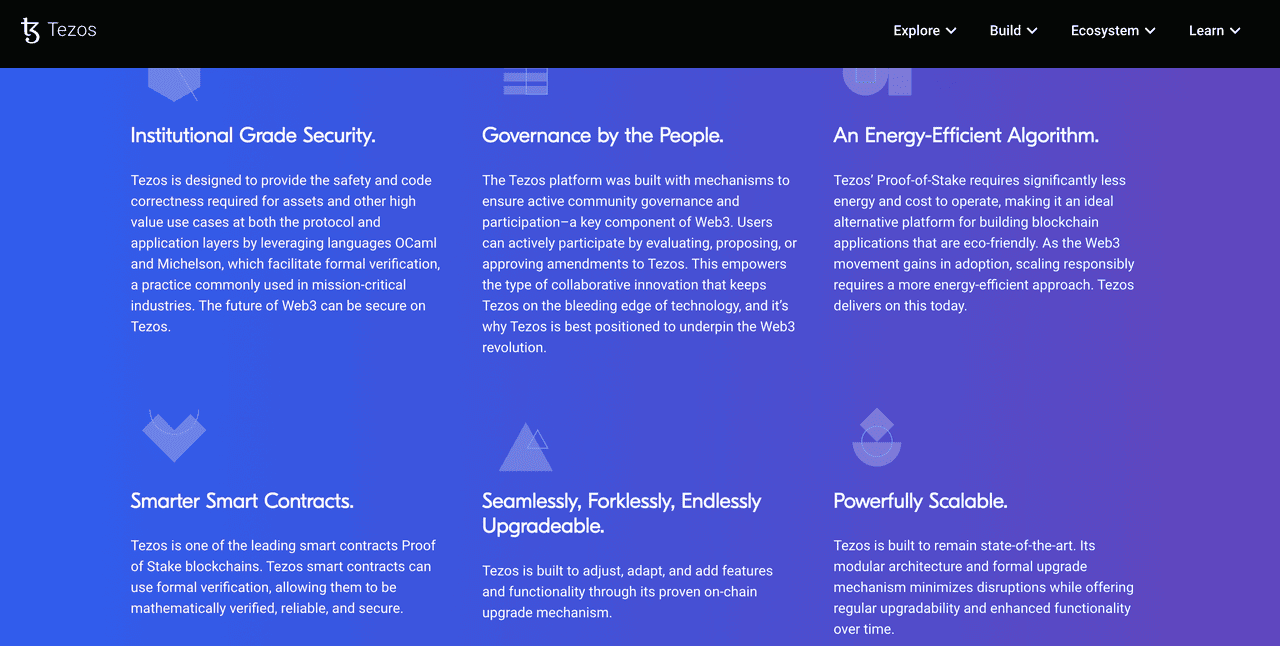
Tezos (XTZ) presents several core operational advantages that keep it at the forefront of the smart contract and decentralized application sector:
- Forkless Upgradability: Built-in amendment systems ensure that technical updates occur smoothly on-chain, preserving chain unity and eliminating split-network risks.
- Liquid Delegation Flexibility: Token holders can delegate their validation power to active network bakers instantly, earning yield without giving up custody or dealing with artificial asset lockups.
- Formal Verification Safety: Mathematical proof systems verify smart contract logic at the protocol layer, preventing code exploits and protecting institutional capital.
- Highly Predictable Staking: Advanced Adaptive Issuance features automatically balance network staking ratios with market demands, generating predictable yield structures for ecosystem stakers.
- Extreme Energy Efficiency: The proof-of-stake framework utilizes a fraction of the computational power demanded by legacy networks, delivering a thoroughly green, eco-friendly dApp environment.
- Dynamic Developer Invoices: Upgrades allow builders to attach native funding requests directly to protocol proposals, rewarding developers out of network inflation upon community approval.
Tezos vs. Cardano
Tezos (XTZ) is frequently contrasted against platforms like Cardano when evaluating highly secure, peer-reviewed public ledger frameworks designed for long-term survival. While Cardano relies on a strictly academic, multi-layered Haskell architecture that uses hard fork combinators to transition between development eras, Tezos functions as an integrated, self-amending layer 1 platform built to systematically absorb, vote on, and deploy new blockchain tech entirely on-chain.
Tezos handles complex governance decisions directly at the protocol level, allowing individual delegators to override their validators' choices to ensure fair community outcomes. Furthermore, while Cardano's ecosystem updates depend on a multi-tier off-chain foundation roadmap, Tezos executes its architectural advancements, such as adjusting block latency and tightening validator thresholds, through automated, on-chain cycles, providing the agile development speed and structural predictability that modern Web3 businesses demand.
What Are the Tokenomics of XTZ?
Tezos (XTZ) uses an inflationary, self-upgrading Proof of stake (PoS) model. It features no maximum supply, relying instead on network inflation to continuously fund staking yields, network security, and on-chain governance.
Key Supply and Tokenomics Data
- Circulating Supply: ~1.09 billion XTZ
- Maximum Supply: None
- Annual Inflation Rate: ~4.87%
- Staking Reward Rate: Typically ranges from 5% to 6% annually
- Initial Allocation: 79.59% allocated to early ICO participants, with 10% each distributed to the Tezos Foundation and Dynamic Ledger Solutions (DLS)
How the Economics Work
- Liquid Proof-of-Stake (LPoS): Holders can delegate their tokens to a validator (or "baker") to secure the network and vote on upgrades. Tezos's liquid delegation feature allows token holders to change their delegation at any time without lockup periods, providing greater flexibility compared with other PoS systems.
- Staking and Validation: Delegators earn between 5% and 6% annualized returns, while "bakers" (validators) require a minimum threshold of tokens to run nodes and process blocks.
- Deflationary Mechanisms: While new XTZ is minted for block rewards, small amounts of XTZ are actively "burned" when processing smart contract transactions to offset the inflation.
- Dynamic Upgrades: The network’s tokenomics (like staking requirements and inflation rates) are not static; they are upgraded directly through on-chain governance as the community approves new protocols (such as the Quebec or Tallinn upgrades).
Understanding Tezos' Utility Token, XTZ
As the primary native coin inherent to the Tezos network, Tez (XTZ) serves as the absolute backbone of blockchain's economic architecture. It functions simultaneously as a Medium of Exchange for decentralized app services, a long-term Store of Value, an indispensable Utility Token for smart contract execution, and the primary Governance Mechanism giving users proportional voting weights during protocol amendments.
Protection from Dilution
The inflation rate isn't fixed but adjusts based on network participation through the network's Adaptive Issuance mechanism. As new tokens are created, they are distributed proportionally to bakers and delegators who actively participate in network validation and governance. This means that active participants maintain their relative ownership percentage in the network, protecting them from inflationary dilution.
Read more: What Are the Top Spot Ethereum ETFs to Buy in 2026?
How to Trade Tezos (XTZ) on BingX
Traders can capitalize on Tezos' unique self-amending governance updates and LPoS market trends with precision by leveraging BingX AI, which offers real-time machine-learning indicators and automated grid strategies to optimize your entries on the XTZ/USDT pair.
Buy or Sell XTZ on the Spot Market
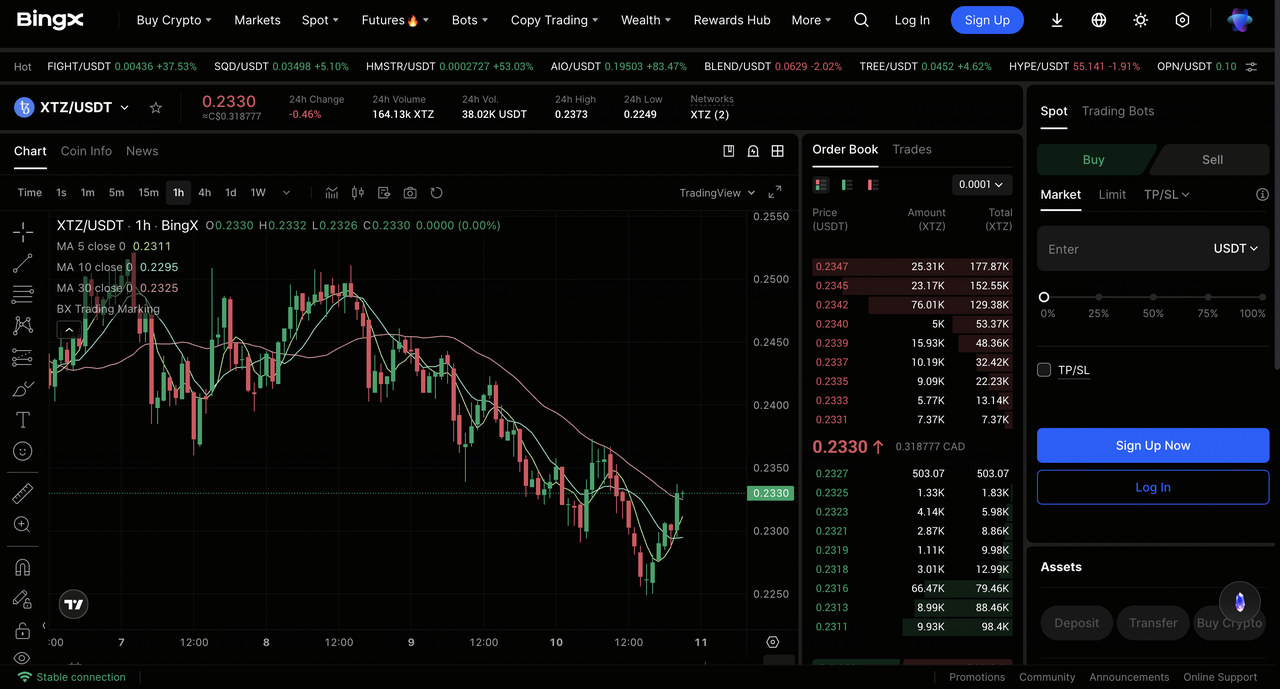
The XTZ/USDT trading pair is on the spot market. Spot trading is ideal for long-term holders looking to build a diamond hands position.
- Create and verify your account on BingX.
- Navigate to Spot Trading and search for XTZ/USDT.
- Use BingX AI driven insights to find optimal entry points.
- Securely store your XTZ in the BingX wallet.
Conclusion: Why You Should Trade Tezos on BingX
Tezos (XTZ) continues to prove its immense structural value in 2026 through its strict mathematical privacy, forkless predictability, adaptive token issuance, and community-driven development. As global developers and financial institutions transition away from legacy systems and TradFi setups to demand smart contract environments that combine rigorous code security with rapid, undisrupted technology updates, Tezos remains an exceptionally reliable choice for modern digital infrastructure.
BingX stands out as the ultimate exchange hub for trading Tezos (XTZ), providing excellent liquidity depth, minimal trading fee tiers, and rapid execution speeds for both basic spot holdings and sophisticated futures traders. Whether you are trading XTZ to exploit short-term market movements, accumulating assets for long-term network baking utility, or interacting with institutional-grade DeFi applications, BingX lets you process and manage your Tezos holdings safely and effectively.
As public and developer demand for automated contract verification and forkless scaling frameworks continues to accelerate, trading Tezos (XTZ) on a platform like BingX ensures users have the tools and structural reliability needed to confidently navigate the Web3 landscape.
