

The blockchain landscape in 2026 demands a complete reassessment of legacy scaling solutions. For years, crypto native users defined Polygon simply as a convenient, low-cost Ethereum sidechain. However, following structural core upgrades, that classification is officially obsolete. Polygon (POL) has systematically evolved from a isolated scaling layer into an end-to-end institutional payments infrastructure and cross-chain ecosystem.
Driven by the launch of the Open Money Stack (OMS) and the cryptographic unification of the AggLayer, the network is capturing trillions of dollars in real-world asset (RWA) transfers, stablecoin orchestration, and agentic microtransactions. Powered by $POL, its hyperproductive native token, the ecosystem now manages institutional flows from global fintech leaders like Stripe, Revolut, and Flutterwave.
This technical guide breaks down the structural reality of the Polygon network in 2026, examining its new multi-layer architecture, its performance upgrades, and why building on Polygon today means tapping into a deeply liquid, aggregated settlement matrix.
What Is Polygon (POL): From Matic Network to the AggLayer
Polygon’s journey is one of structural metamorphosis. To understand the network's 2026 capabilities, it is essential to trace how its underlying technology has expanded over the last decade.
The Early Phases: Scaling a Fragmented Ethereum
Founded in 2017 as the Matic Network, the project initially focused on basic Layer 2 Plasma scaling to relieve Ethereum’s early congestion bottlenecks. By 2020, this architecture matured into the standalone Polygon Proof-of-Stake (PoS) sidechain. While the PoS chain successfully processed billions of transactions and onboarded major consumer applications, it operated as an independent ecosystem. It relied on traditional, asynchronous bridges to move assets, which locked liquidity into isolated pools and created operational fragmentation.
The 2026 Reality: Cryptographic Containment and Unified State
In 2026, the paradigm shifted completely with the full maturity of the AggLayer (Aggregation Layer). The AggLayer is not a bridge; it is a decentralized interoperability protocol powered by zero-knowledge (ZK) cryptography. By linking diverse EVM and non-EVM blockchains through a unified state and liquidity layer, it allows assets to move instantly across network boundaries without wrapping or intermediary security degradation.
The core architectural breakthrough of the AggLayer is cryptographic containment. Utilizing a pessimistic proof system, the network ensures that if a single connected chain suffers an exploit or consensus failure, the damage is completely contained within that specific chain's deposits. It prevents catastrophic propagation across the rest of the unified ecosystem, allowing private enterprise instances and public networks to settle securely against the same pool of deep liquidity.
How Polygon Network Works: The Three Pillars of PoS, zkEVM, and Miden
The network no longer relies on a single chain design. Instead, it utilizes a modular portfolio of execution environments engineered for distinct industrial and decentralized applications.
Pillar 1: The Upgraded Polygon PoS Chain, the High-Volume Settlement Rail
The flagship PoS chain remains the primary destination for high-frequency retail applications and global stablecoin volume. In mid-2026, the execution layer underwent massive protocol upgrades via the Bhilai upgrade and PIP-86, optimizing the network specifically for payments infrastructure:
- Block Time Reduction: Average block generation times were shortened from 2.0 seconds to 1.75 seconds, expanding structural finality and throughput by 14%.
- Gas Limit Expansion: The maximum computational gas per block was expanded to 140 million, elevating native capacity to over 3,800 Transactions Per Second (TPS) while keeping average transaction costs clamped at an ultra-low $0.002.
- The Lisovo Hard Fork: Integrated native gas subsidies and optimized contract calls to facilitate seamless automated machine-to-machine transactions.
Pillar 2: Polygon zkEVM Institutional Security Standard
For high-value decentralized finance (DeFi) primitives and corporate asset tokenization, Polygon zkEVM provides bytecode-equivalent EVM compatibility backed by the mathematical certainty of zero-knowledge rollups. Instead of relying on honest-validator assumptions, every transaction execution on the zkEVM is compressed and proven back to the Ethereum mainnet via ZK validity proofs. This ensures inherited base-layer security, making it the preferred standard for enterprise clearinghouses and tokenized bond issuances.
Pillar 3: Polygon Miden Advanced ZK-Client Architecture
Polygon Miden introduces a radical departure from traditional, transparent blockchain architectures. Operating as a ZK-centric rollup based on the Miden Virtual Machine (Miden VM), it utilizes client-side smart contract execution.
Instead of forcing the entire network to process and view transaction data publicly, users execute transactions locally on their own devices and merely submit a cryptographic proof of validity to the network. This architecture unlocks two critical 2026 primitives:
- Strict On-Chain Privacy: Sensitive state transitions remain encrypted, satisfying stringent corporate confidentiality requirements.
- Massive Parallel Execution: By offloading computation from the global validator set, Miden bypasses standard sequential block bottlenecks, opening the door for complex web3 gaming states and high-throughput AI agent architectures.
Why Sidechain Is No Longer the Correct Term for Polygon Blockchain in 2026
Describing Polygon as a simple sidechain in 2026 is a fundamental technical error. The structural evolution of its consensus models, token design, and integration layers has permanently shifted the network into a core multi-chain settlement matrix.
Dual-Layer Consensus Architecture
The Polygon PoS chain has outgrown traditional sidechain mechanics by operating a highly advanced Dual-Layer Architecture split cleanly between transaction execution and finality verification:
- Bor Execution Layer: A specialized Go-Ethereum (Geth) derived engine optimized exclusively for lightning-fast EVM transaction processing.
- Heimdall v2 Consensus Layer: Built on CometBFT and the Cosmos SDK, this layer stands completely independent of Bor execution. Heimdall coordinates validator staking, monitors core contracts on Ethereum, and processes deterministic finality through milestones.
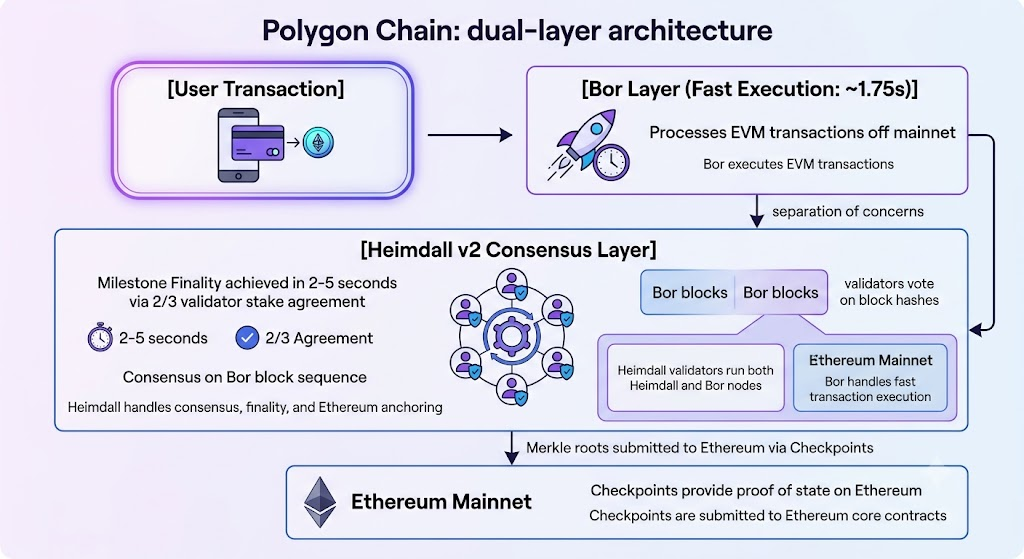
With Heimdall v2 consensus, true finality is achieved within 2 to 5 seconds via vote extensions. Validators agree on the sequence of Bor blocks, cementing them into local milestones. Checkpoints (Merkle roots of the block data) are then systematically pushed to the Ethereum mainnet at governed intervals. While checkpoints secure global state history on Ethereum for mainnet withdrawals, cross-L2 asset routing relies strictly on milestone finality, eliminating the latency penalties inherent to legacy sidechain environments.
Why Did Polygon Migrate Its Native Token From MATIC to POL?
The deprecation of the MATIC token in favor of POL marks a major shift in the network's tokenomics. Unlike MATIC, which functioned strictly as a single-chain utility and gas token, $POL is designed as a hyperproductive native token.
Validators can stake $POL to simultaneously validate multiple chains across the entire AggLayer matrix, securing diverse rollups, validiums, and data availability networks from a unified capital base. Furthermore, the token possesses a fundamental deflationary mechanism: high transaction throughput across the Open Money Stack results in approximately 1 million POL burned daily, balancing out the token's ecosystem staking emission rates.
Polygon Open Money Stack (OMS): From Standalone Chain to Vertically Integrated Payments Stack
A traditional sidechain merely hosts applications; it does not provide native infrastructure. In 2026, Polygon operates as a comprehensive financial orchestration layer via the Open Money Stack (OMS).
Through the strategic acquisitions and integration of fiat-to-crypto networks (Coinme) and non-custodial account infrastructure (Sequence), the Open Money Stack delivers an all-in-one payment suite behind a single HTTP API. Enterprises can deploy smart contract wallets via passkeys, execute real-time cross-border fiat swaps, e.g., USD to MXN settlement in 5 seconds, and route automated token flows via Trails, Polygon's intent-based routing system, without managing gas, bridges, or fractional liquidity pools manually.
Polygon Sidechain vs. Polygon AggLayer: Technical Comparison
|
Feature / Primitive |
2020 Polygon PoS (Sidechain Era) |
2026 Polygon Network (AggLayer Era) |
|
Primary Token Core |
$MATIC (Single-chain utility) |
$POL (Hyperproductive multi-chain staking) |
|
Consensus Engine |
Basic Proof-of-Stake (Tendermint) |
Heimdall v2 (CometBFT) + Milestone Finality |
|
Interoperability |
Asynchronous, fragmented bridges |
AggLayer (Atomic, ZK Pessimistic Proofs) |
|
Average Block Time |
2.0 Seconds |
1.75 Seconds (PIP-86) |
|
Target Throughput |
~1,500 TPS |
3,800+ TPS (PoS) / 20,000+ TPS (CDK Optimized) |
|
Core Value Prop |
Cheap, isolated dApp hosting |
Open Money Stack & Global Payment Settlement |
Autonomous Commerce with Agentic Payments on Polygon
A definitive pillar of Polygon's 2026 value proposition is its native optimization for autonomous AI-driven commerce. With the emergence of decentralized AI agents capable of executing background financial transactions without manual human confirmation, Polygon has standardized the underlying protocols necessary for machine-to-machine economies.
The x402 Protocol
The network natively implements the x402 standard, an HTTP-based payment infrastructure that maps the traditional 402 Payment Required status code directly onto on-chain stablecoin rails. This enables autonomous systems to instantly pay for API consumption, compute power, or data streams on a strict pay-per-use basis, eliminating the need for complex software-as-a-service (SaaS) credit card subscriptions.
ERC-8004 Trust Registries
To ensure security within multi-agent environments, Polygon utilizes ERC-8004, establishing an on-chain trust framework for autonomous software. Through specialized identity and validation registries, independent AI agents can verify each other's credentials, evaluate transaction histories, and execute high-speed micro-invoices safely on-chain. Backed by the sub-two-second block times of the PoS chain, Polygon has established itself as the baseline layer for frictionless, autonomous economy routing.
How to Trade Polygon (POL) on BingX
Trading Polygon’s migrated native token, $POL, is optimized by the BingX AI suite, featuring the conversational AI Skills Hub and the real-time AI Claw analyst tool, which allows users to formulate data-driven execution strategies using natural language queries.
Buy, Sell, or HODL POL on the Spot Market
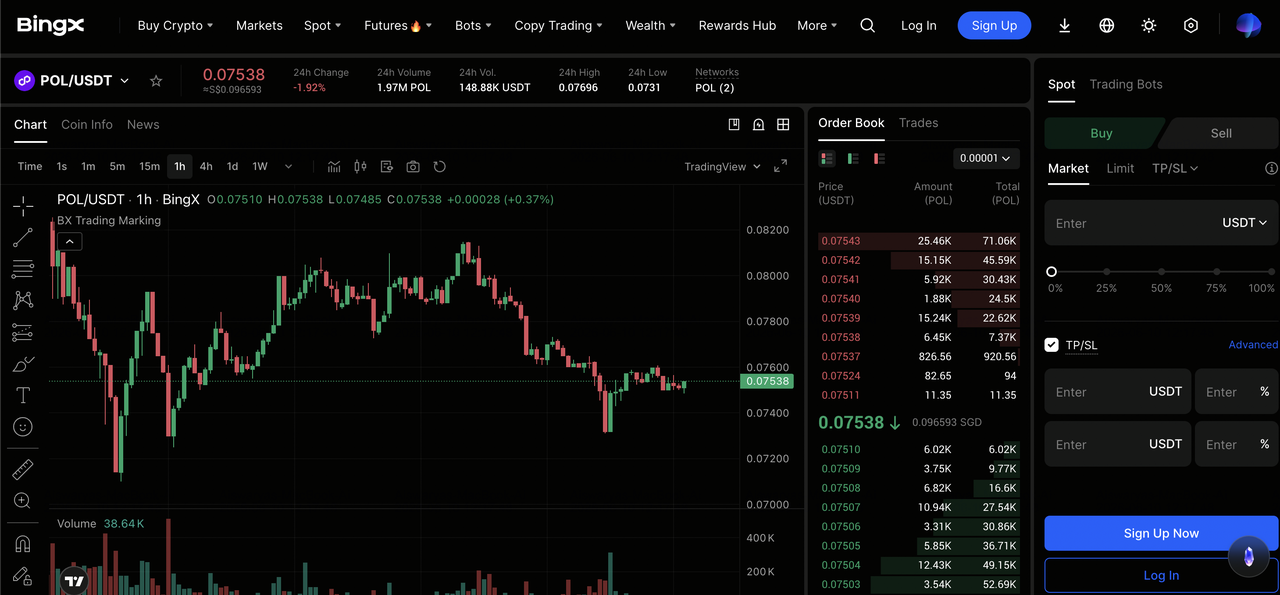
POL/USDT trading pair on BingX spot market
- Log In and Fund Your Wallet: Access your BingX mobile app or desktop dashboard, navigate to Assets, and ensure you have deposited USDT into your Fund Account.
- Access the Spot Market: Hover over Spot on the top navigation bar, select Spot, and use the search field to locate the POL/USDT trading pair.
- Select Order Type: Choose your preferred execution method, Market Order for instant execution at the prevailing global spot price, or Limit Order to specify a precise entry target.
- Execute Order: Input the amount of USDT you wish to allocate and click Buy POL to secure the tokens into your spot wallet.
Long or Short POL Futures with Leverage
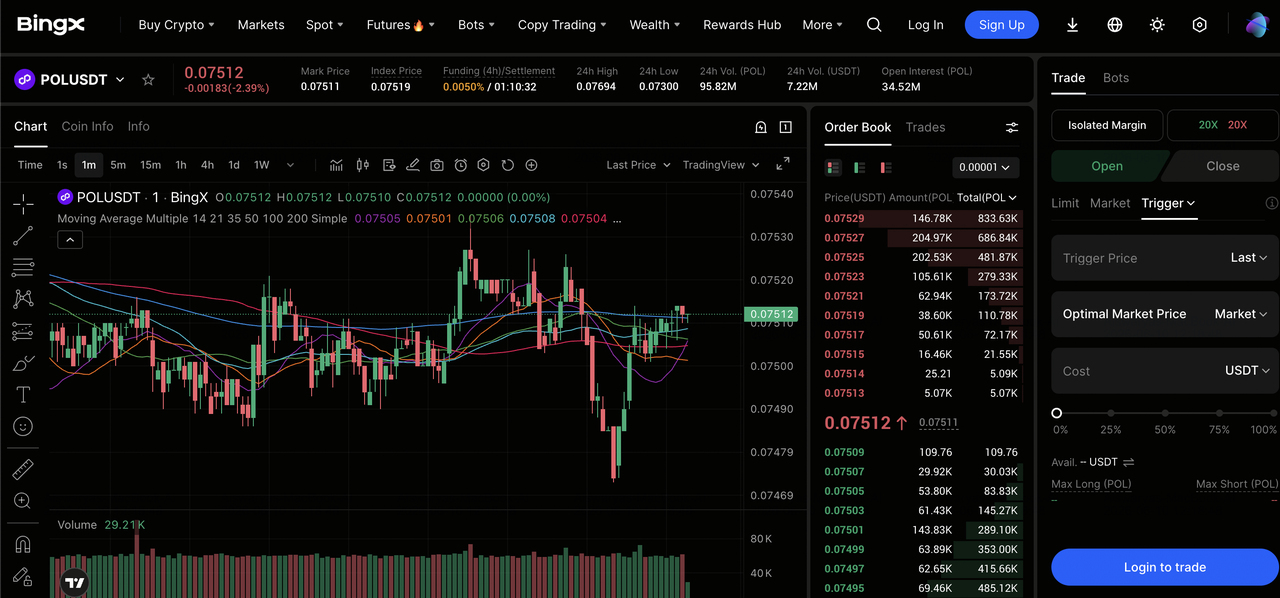
POL/USDT perpetuals on BingX futures market
- Transfer Capital: Move your USDT from your Fund Account to your Futures Account via the internal transfer window with zero fees.
- Navigate to Perpetuals: Select Futures and click on Perpetual Futures, then open the contract menu to select POL/USDT Perpetual contract or POL/USDC perpetuals.
- Configure Leverage & Margin Mode: Choose between Isolated Margin, limiting risk to a single position, or Cross Margin using your total account balance to avoid liquidation, and select your leverage multiplier.
- Set Risk Controls and Confirm: Input your position sizing, dictate clear Take-Profit (TP) and Stop-Loss (SL) boundary parameters, and click Buy/Long if you anticipate an ecosystem recovery, or Sell/Short if you are trading a continuation of macro technical resistance.
Key Considerations Before Investing in Polygon (POL)
Investing in Polygon in 2026 requires balancing the network’s monumental shift toward institutional payment rails against structural market head-winds:
- Evolving Tokenomics and Deflationary Pressures: The 1:1 migration from MATIC to POL successfully unlocked multi-chain utility, allowing validators to secure a wider web of custom CDK rollups and validiums simultaneously. This utility is supported by automated protocol tokenomics that burn roughly 1 million POL daily during periods of high network usage, acting as an aggressive long-term supply sink against the token's baseline staking emissions.
- Intense Layer 2 and Interoperability Competition: While Polygon's AggLayer provides mathematically superior cryptographic containment using zero-knowledge pessimistic proofs, it operates in a highly competitive execution landscape. Standalone scaling frameworks, alternative modular rollups, and monolithic chains are actively competing for developer mindshare and total value locked (TVL), meaning Polygon’s success hinges directly on the broad enterprise adoption of its Open Money Stack (OMS).
- Concentration of Network Activity: On-chain diagnostics indicate that a significant portion of the network's transactional volume and underlying gas fees historically remain concentrated within a handful of hyper-successful decentralized applications, such as the prediction platform Polymarket. For $POL demand to grow sustainably, the ecosystem must continuously diversify its active dApp pool and capture long-term retail volumes across alternative web3 consumer verticals.
- Regulatory Landscape & Compliance Hurdles: Because Polygon is explicitly positioning its infrastructure to settle global corporate money movements via partnerships with traditional fintech networks, it faces rigorous compliance scrutiny. Regulatory bodies, including the U.S. SEC, maintain a strict posture toward digital asset classifications, making the integration of localized compliance modules like the incoming OMS KYC Hub absolutely mandatory to protect institutional capital pools from unexpected enforcement pauses.
Final Thoughts: Can Polygon Become the Payment Layer of the Internet?
Polygon’s transition from a fast Ethereum alternative to a foundational multi-chain liquidity layer is complete. By moving away from the isolated architecture of traditional sidechains and deploying a unified, ZK-proven environment via the AggLayer, the network has solved the core issue of liquidity fragmentation.
Whether you are a retail user executing low-cost stablecoin transfers, an AI agent paying per API request via the x402 protocol, or a major financial institution deploying a private validium using the Polygon Chain Development Kit (CDK), the 2026 Polygon network provides a fast, resilient, and enterprise-ready settlement stack built to move value at the speed of the internet.
Risk Reminder: Digital asset markets are subject to structural volatility, regulatory shifts, and smart contract execution risks. Always conduct exhaustive research and ensure proper security configurations when interacting with on-chain protocols.
Related Reading
- What Are the Top Ethereum Layer-2 Projects of 2026?
- How to Add Polygon (POL) to MetaMask Wallet
- Connect MetaMask to BNB, Polygon & Supported Blockchains: A Step-by-Step Guide
- Is Base Network Preparing to Launch a Native Token? All You Need to Know
FAQs on Polygon (POL)
1. Is the old MATIC token still usable in 2026?
No, the migration from MATIC to POL is virtually 100% complete. POL has fully replaced MATIC as the universal gas, validation, and ecosystem staking token across the entire Polygon landscape.
2. How does the AggLayer differ from traditional cross-chain bridges?
Traditional bridges lock assets on a source chain to mint wrapped copies on a destination chain, introducing massive smart contract risks and liquidity fragmentation. The AggLayer uses zero-knowledge pessimistic proofs to securely unify liquidity state across independent chains, enabling native, atomic transactions without asset wrapping.
3. What is the minimum POL required to run a validator node in 2026?
Following the execution of the governance proposal PIP-4, the minimum staking requirement to participate directly in network validation and checkpoint consensus is 10,000 POL.
