

Hashflow (HFT) is a DeFi liquidity infrastructure protocol that uses request-for-quote, or RFQ, trading to connect users and integrators with professional market makers. Instead of relying only on automated liquidity pools, Hashflow uses signed market-maker quotes and off-chain pricing functions, positioning itself around execution quality and configurable liquidity. It sits in the DeFi trading, cross-chain liquidity, and on-chain market-structure narratives.
As of August 2026, Hashflow’s homepage reported more than $25 billion in RFQ volume and more than 30 integrations, both project-reported scale indicators rather than independently audited activity metrics. The ecosystem has four key parts: HFT is the governance token, the RFQ layer manages quote discovery and execution, the taker API supports integrations, and the Hashverse connects staking and governance experiences. This guide explains what Hashflow is, how the protocol works, how HFT tokenomics function, the main risks to consider, and how to buy HFT on BingX.
What Is Hashflow (HFT)?
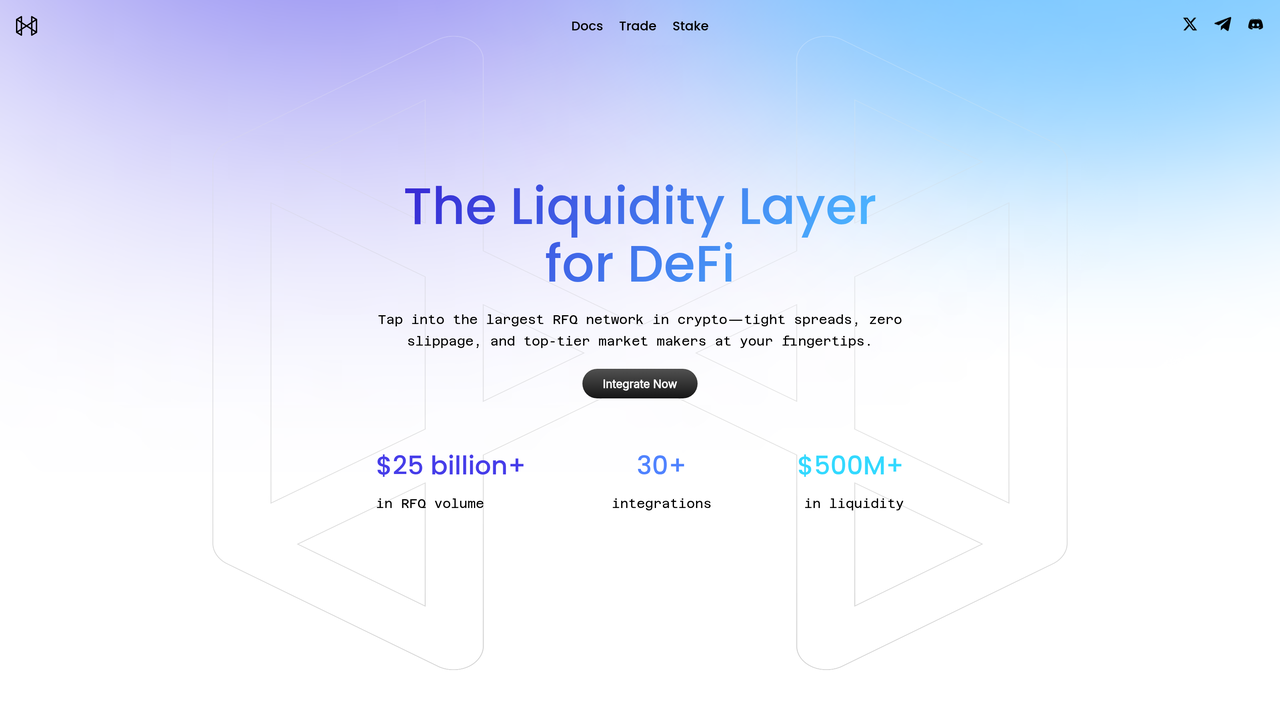
Hashflow is an RFQ-based liquidity protocol with HFT issued as an ERC-20 token on Ethereum. A trader or integrating application requests a quote, market makers provide prices, and the selected quote is signed for execution. The protocol documentation contrasts this model with constant-product automated market makers because market makers can price with off-chain inputs such as historic prices and volatility.
HFT is the governance token for Hashflow and its Hashverse governance environment. It is used for vote-escrow governance, staking-related participation, and a share of protocol-fee rewards under the documented fee model. Hashflow’s official homepage names Dragonfly, Electric Capital, Wintermute, Coinbase, and Balaji Srinivasan under “Backed by,” but this is a historical project disclosure and not an endorsement or investment recommendation.
The core idea behind Hashflow is simple: market makers can compete to provide signed prices while users and integrators receive an executable quote rather than relying solely on an automated pool curve.
Key components of the Hashflow ecosystem include:
- RFQ liquidity: Market makers respond to trade requests with quotes rather than contributing liquidity only through an automated pricing pool.
- Off-chain pricing: Makers can incorporate market data and risk inputs when forming a quote before it is signed.
- Taker API V3: Integrators can query available market makers and price levels before requesting an executable RFQ.
- HFT governance: Staked HFT and lock duration determine vote-escrow governance weight.
How Does Hashflow Work?
Hashflow works as an Ethereum-originated RFQ liquidity protocol whose quote discovery, signed execution, governance, and incentives are coordinated by market makers, the taker API, and the HFT token.
- Quote requests reach market makers: Rather than starting with a constant-product pool curve, Hashflow sends a request for a price to market makers that can provide liquidity for the requested trade.
- Makers price with external inputs: The documentation says makers can source liquidity from anywhere and use off-chain pricing functions that incorporate data such as historic asset prices and volatility.
- Quotes are signed for execution: A market maker cryptographically signs a quote. Hashflow states that the price remains unchanged for the duration of that trade, which is its documented protection design rather than a guarantee against every execution or market-risk outcome.
- Integrators discover liquidity first: The Taker API V3 lets an application query available makers and price levels for a network, then request a signed executable RFQ when it has selected a route.
- Cross-chain routes can be specified: The API supports base- and quote-chain parameters. Its documentation describes Wormhole-based cross-chain execution and an estimated cross-chain fee, while supported networks and route availability can change.
Hashflow vs. Uniswap and PancakeSwap: Key Differences
Hashflow, Uniswap, and PancakeSwap all support decentralized token trading, but they use different approaches to pricing, liquidity, and execution. Hashflow relies on professional market makers and signed RFQ quotes, while Uniswap and PancakeSwap primarily use liquidity pools and automated market maker models.
|
Comparison |
Hashflow |
Uniswap |
PancakeSwap |
|
Core model |
RFQ-based trading |
Automated market maker (AMM) |
Automated market maker (AMM) |
|
Price formation |
Quotes from professional market makers |
Prices determined through liquidity pools |
Prices determined through liquidity pools |
|
Liquidity source |
Market makers and external liquidity |
Liquidity providers deposit assets into pools |
Liquidity providers deposit assets into pools |
|
Trade execution |
Signed executable quote |
Swap against on-chain pool liquidity |
Swap against on-chain pool liquidity |
|
Price impact |
Quote is fixed for the specified trade |
Depends on pool liquidity and trade size |
Depends on pool liquidity and trade size |
|
Main advantage |
Market makers can use external pricing and risk inputs |
Permissionless trading with broad on-chain liquidity |
Permissionless swaps across a large DeFi ecosystem |
|
Main tradeoff |
Depends on market-maker and route availability |
Trades can face price impact and slippage |
Trades can face price impact and slippage |
The main difference is RFQ-based execution versus AMM-based execution. Hashflow asks market makers to provide an executable price for each trade, while Uniswap and PancakeSwap execute swaps against on-chain liquidity pools. This makes Hashflow more focused on quote-based execution, while Uniswap and PancakeSwap emphasize permissionless pool-based trading.
Read More: Uniswap vs. PancakeSwap vs. SushiSwap: Which one is the Better DEX in 2026?
What Are the Hashflow (HFT) Tokenomics?
HFT tokenomics center on a one-billion-token genesis supply, category-specific allocation and vesting schedules, and governance-linked fee participation. Ecosystem Development is the largest initial allocation at 53.18%, while HFT should not be framed as permanently fixed supply because the official release schedule describes 4% annual steady-state issuance after four years.
HFT Token Utility and Supply Mechanisms
- Vote-escrow governance: Voting weight is designed to depend on the amount of HFT staked and the length of the lock.
- Protocol decisions: Documentation identifies protocol fees, marketing, and code development as areas subject to governance.
- Staker fee rewards: The fee-model page states that 50% of monthly protocol-fee revenue is allocated to HFT staker rewards, subject to governance changes.
- Community treasury: The stated fee allocation sends 30% to a community treasury for future HFT buybacks, which should not be treated as a guaranteed automatic burn program.
- Ecosystem incentives: Initial Ecosystem Development allocation includes partner, community, market-maker, service-provider, treasury, and Hashverse-reward categories.
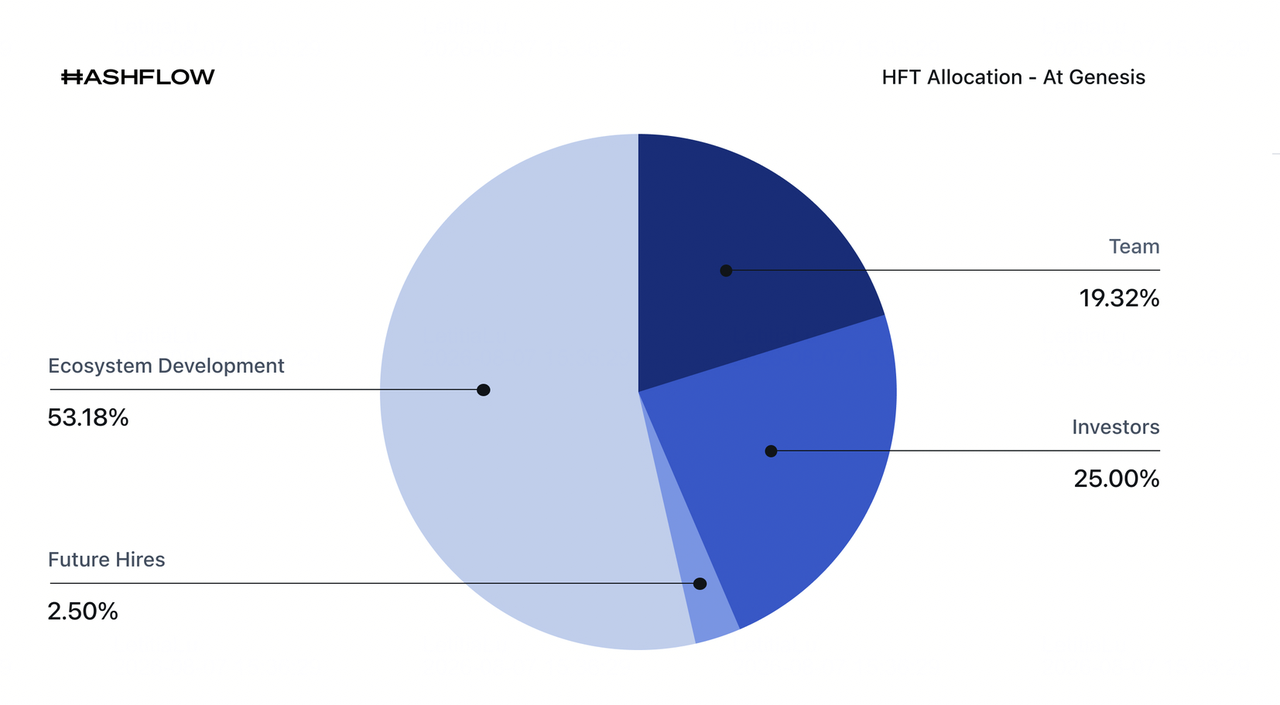
Source: HashFlow Docs
HFT Token allocation
- Ecosystem Development: 53.18%, or 531.8M HFT. This umbrella allocation includes ecosystem partners, community rewards, designated market-maker loans, integration partners, future community rewards, vendors, the community treasury, and Hashverse rewards.
- Early Investors: 25.00%, or 250M HFT. The official schedule describes a 25% one-year post-TGE cliff followed by 75% linear daily vesting over the subsequent three years.
- Core Team: 19.32%, or 193.2M HFT. The official schedule describes a 25% one-year post-TGE cliff followed by 75% linear daily vesting over the subsequent three to five years.
- Future Hires: 2.50%, or 25M HFT. This category is part of the stated one-billion-token genesis allocation.
By 2026, HFT’s supply dynamics depend on the balance between governance and staking demand, vesting-related supply, and the documented issuance design. Because allocation categories follow different schedules, investors should monitor governance changes, token-unlock information, and any verifiable issuance data when evaluating supply pressure.
How to Buy Hashflow (HFT) on BingX
BingX offers HFT through its spot market, letting users buy and hold HFT directly. Spot trading suits users who want direct ownership of the token.
Spot Trading: Buy and Own HFT Directly
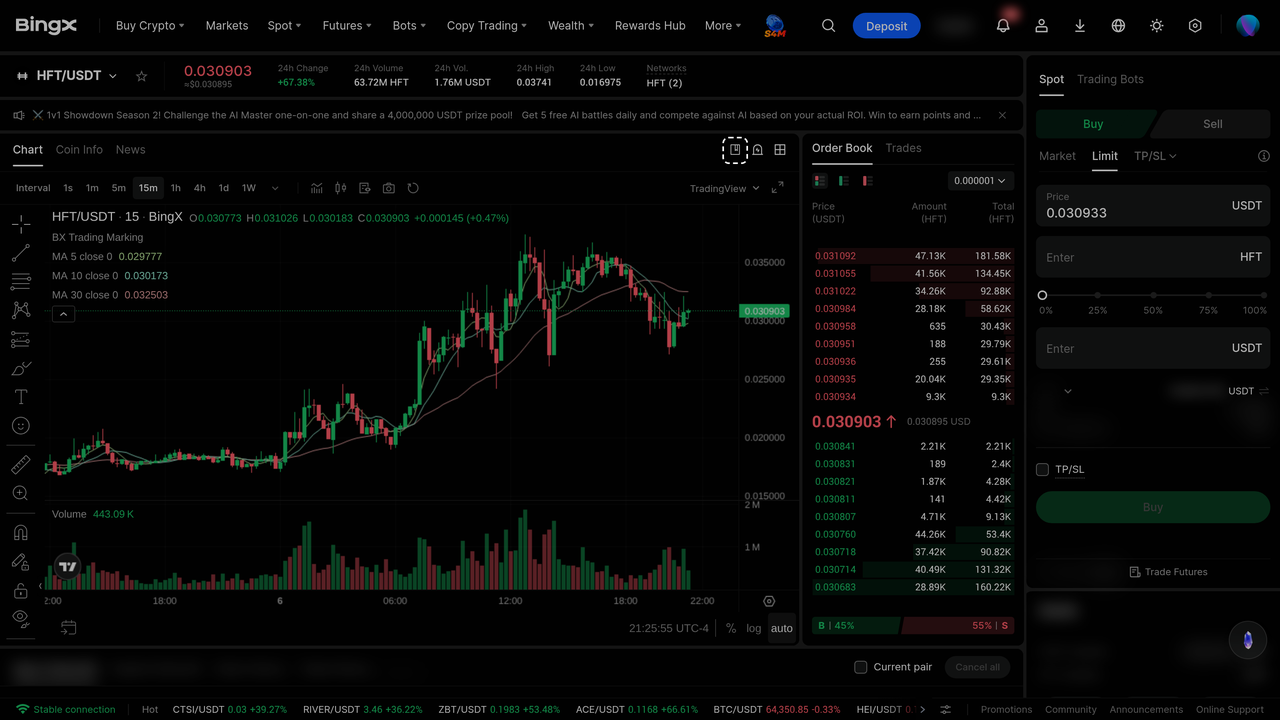
- Step 1: Account setup and security. Sign up and log into your BingX account, complete the identity verification required in your region, and enable two-factor authentication.
- Step 2: Fund your spot account. Deposit USDT or another supported asset into your BingX spot account. Where available, users can also use supported fiat on-ramp options.
- Step 3: Navigate to the spot market. Search for the HFT/USDT trading pair.
- Step 4: Place your order. Choose a market order to buy HFT at the displayed market price when the order is placed, or use a limit order to set the price you want to pay.
- Step 5: Manage your HFT. Once filled, your HFT appears in your spot account. You can keep it on BingX for convenience or withdraw it to an Ethereum-compatible self-custody wallet.
Risks and Considerations Before Investing in Hashflow (HFT)
Hashflow has a differentiated RFQ design, maker-oriented pricing, and governance-linked fee participation. However, HFT still carries significant risks tied to maker availability, token supply dynamics, governance changes, and market volatility.
- Market-maker dependency: Quote quality and route availability depend on participating makers and the liquidity they choose to make available for a pair or network.
- Execution and cross-chain risk: Signed-quote design does not remove smart-contract risk, bridge risk, network congestion, or the possibility that a desired route is unavailable.
- Governance variability: Fee allocation, treasury use, and incentive design can change through governance, so documented distributions should not be treated as permanent economic terms.
- Supply and unlock risk: Team, investor, ecosystem, and future-hire allocations follow different release structures, while the release schedule also describes post-genesis annual issuance.
- Price volatility: HFT can experience sharp price moves. Past performance does not guarantee future results, and token price movements do not prove protocol adoption or fee generation.
Final Thoughts: Should You Invest in Hashflow (HFT) in 2026?
Hashflow is an RFQ-based DeFi liquidity protocol whose distinguishing feature is signed market-maker pricing rather than reliance only on an automated pool curve. Its 2026 story is anchored by its RFQ execution design, integration infrastructure, and HFT’s governance and fee-participation framework.
The key question for 2026 is whether Hashflow can convert quote-based execution and integrations into durable usage and governance demand. Its maker-oriented pricing and signed-quote architecture set it apart from automated-pool-only approaches, but HFT remains exposed to supply, governance, liquidity, and market risks. For investors and traders, the most important metrics to watch are verifiable protocol usage, active integration and maker coverage, governance proposals, token-unlock and issuance data, and fee-revenue distribution changes.
Related Reading
- What Is DeFi (Decentralized Finance)? 8 Types of DeFi Protocols to Know
- What Is Ethereum Restaking?
- 7 Best Crypto Liquidity Mining Platforms to Watch in 2026
- What Is USDT? A Comprehensive Guide to the World's Leading Stablecoin
- What Is Aave (AAVE) Crypto Lending: All You Need to Know in 2026
FAQs About Hashflow (HFT)
1. What makes Hashflow different from other DeFi trading protocols?
Hashflow uses an RFQ model in which professional market makers provide cryptographically signed quotes for execution. This allows makers to use off-chain pricing and risk inputs rather than relying only on an automated constant-product pool curve.
2. What blockchain is HFT on?
HFT is an ERC-20 token issued on Ethereum. Users should verify the official contract address and supported network before depositing, withdrawing, or transferring HFT.
3. Is HFT supply fixed?
No. Hashflow documents a genesis supply of 1 billion HFT, together with allocation and vesting schedules. Its release schedule also describes 4% annual steady-state issuance after four years, so HFT should not be treated as a permanently fixed-supply token.
4. Which wallets support HFT?
HFT can be stored in Ethereum-compatible wallets such as MetaMask and other wallets that support ERC-20 tokens. Users should confirm the correct network and token contract before transferring funds.
