
Cronos sits at the intersection of crypto exchanges and blockchain infrastructure, but its identity is broader than a typical exchange token. Rather than serving only as a trading fee discount token, CRO powers a multi-chain blockchain ecosystem that includes a Cosmos-based Layer 1, an Ethereum-compatible smart contract chain, and an Ethereum Layer 2. Built and supported by Crypto.com, one of the world’s largest centralized exchanges, Cronos is designed to connect a large exchange user base with on-chain DeFi, NFTs, payments, and tokenized real-world assets through a single native asset.
It is important to distinguish Cronos, CRO, and Crypto.com. Cronos refers to the blockchain ecosystem. CRO is the native cryptocurrency used for gas fees, staking, governance, and settlement across Cronos POS, Cronos EVM, and Cronos zkEVM. Crypto.com is the centralized exchange and financial services company that built and continues to support the ecosystem. This guide explains what Cronos is, how its three chains work, how CRO is used, how its tokenomics function, the main risks to consider, including the 2025 supply re-mint controversy, and how to trade CRO on BingX.
What Is Cronos (CRO)?
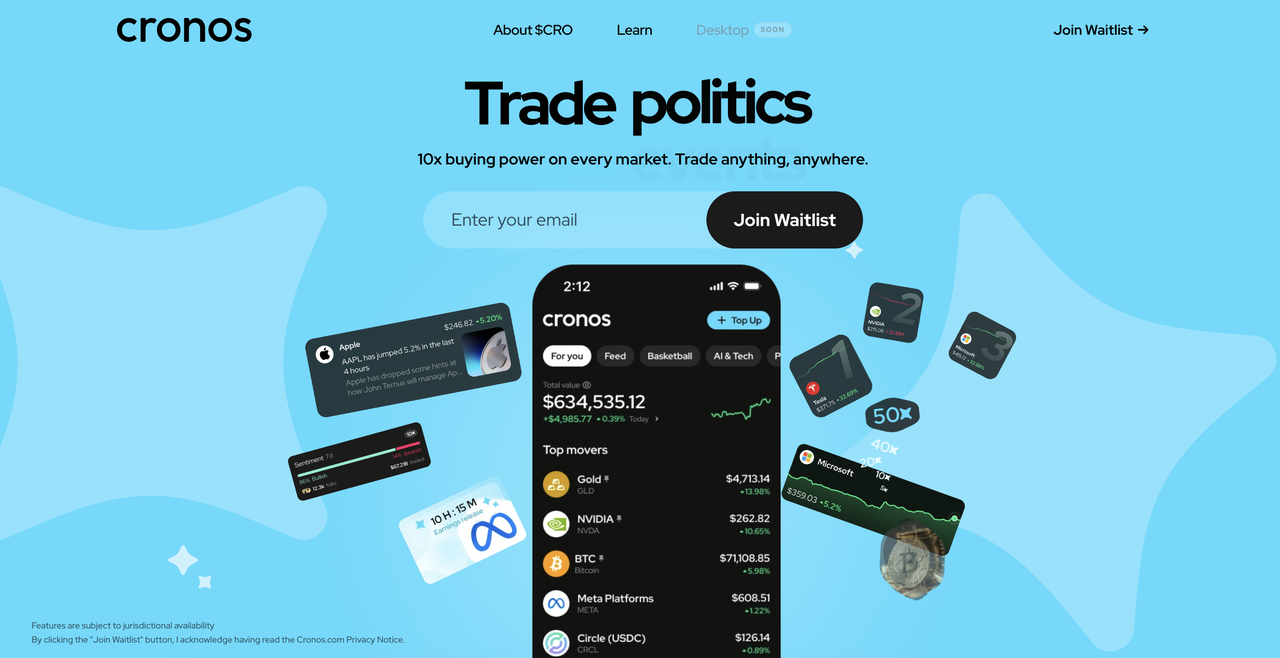
Cronos (CRO) is the native token of a multi-chain blockchain ecosystem developed in close partnership with Crypto.com, one of the largest centralized exchanges in the world. Unlike a typical exchange token used mainly for trading fee discounts, CRO is designed to support a broader on-chain ecosystem that includes DeFi, NFTs, payments, gaming, and tokenized real-world assets (RWA).
Cronos is built around three connected networks: Cronos POS, Cronos EVM, and Cronos zkEVM. This structure gives users access to both Cosmos-based infrastructure and Ethereum-compatible smart contracts, while helping Crypto.com connect its retail user base with open Web3 applications.
This gives CRO a broader role than a trading-related platform token. It connects exchange users, developers, and blockchain applications across the Cronos ecosystem.
CRO Coin vs. Cronos Network vs. Crypto.com: What Are the Differences?
- CRO coin: CRO is the native cryptocurrency of the Cronos ecosystem. It is used for gas fees, staking, governance, zkCRO on Cronos zkEVM, and selected Crypto.com benefits such as card rewards and exchange fee tiers.
- Cronos network: Cronos is the blockchain ecosystem powered by CRO. It includes Cronos POS for payments and consumer use cases, Cronos EVM for Ethereum-compatible apps, and Cronos zkEVM as an Ethereum Layer 2 built on ZKsync’s Elastic Chain.
- Crypto.com: Crypto.com is the centralized exchange and financial services company behind Cronos. It supports the ecosystem through funding, distribution, and product integration, while Cronos itself runs through validators and on-chain governance.
Read More: BingX vs Crypto.com 2026: Which Is Better for Spot and Futures Trading? Pros, Cons and Fees Compared
How Does Cronos Work?
At its core, Cronos is a multi-chain ecosystem unified by the CRO token. Instead of relying on one chain for every use case, Cronos uses three connected networks for payments, smart contracts, and Ethereum Layer 2 scaling. These chains connect through IBC, LayerZero, and Ethereum-based bridges.
Source: Cronos Website
- Cronos POS Chain: Cronos POS is the original Cosmos SDK chain in the ecosystem. It uses Tendermint Byzantine Fault Tolerant consensus and is secured by validators staking CRO. The chain is mainly used for payments, NFTs, consumer applications, and on-chain governance, with very low transaction fees.
- Cronos EVM Chain: Cronos EVM is the main application chain for DeFi, NFTs, gaming, and consumer apps. Built with Ethermint and the Cosmos SDK, it supports Ethereum-compatible smart contracts, which means developers can bring Ethereum apps to Cronos with minimal changes.
- Cronos zkEVM Layer 2: Cronos zkEVM is an Ethereum Layer 2 built with ZKsync’s Elastic Chain technology. It uses zero-knowledge proofs to batch transactions and settle them back to Ethereum, helping reduce fees while benefiting from Ethereum’s security. Its gas token is zkCRO, a liquid-staked version of CRO.
- Cross-chain interoperability: Cronos connects to other blockchain ecosystems through IBC, LayerZero, and Ethereum bridges. IBC links Cronos with Cosmos-based networks, while LayerZero expands connectivity to major EVM chains, Solana, and other ecosystems. This multi-chain setup allows users and assets to move across networks more flexibly.
Major Cronos Developments: From Crypto.org Chain to Trump Media and Beyond
Cronos has grown from Crypto.com’s early token ecosystem into a multi-chain network spanning payments, EVM applications, Ethereum Layer 2 scaling, and institutional treasury use cases. Its history also includes major governance events that continue to shape how investors view CRO’s supply, decentralization, and long-term trust.
|
Milestone |
Date |
Main Purpose |
|
MCO Token ICO |
2018 |
Crypto.com launched its initial token as MCO |
|
Rebrand to CRO |
2020 |
MCO swapped to CRO ahead of native chain launch |
|
Crypto.org Chain Mainnet |
March 2021 |
First native Cronos chain (now Cronos POS) launched |
|
Cronos EVM Mainnet |
November 2021 |
EVM-compatible Layer 1 brought Ethereum dApps onto Cronos |
|
70 Billion CRO Burn |
2021 |
Largest token burn in crypto history at the time |
|
Cronos zkEVM Mainnet |
August 2024 |
Ethereum Layer 2 launched on ZKsync Elastic Chain |
|
70 Billion CRO Re-mint |
March 2025 |
Controversial governance vote reversed the 2021 burn |
|
Trump Media Partnership |
August 2025 |
$6.4 billion CRO treasury announced with Trump Media |
|
Governance Proposal #33 |
May 2026 |
Emissions decay model that caps supply below 100 billion |
- From MCO to CRO (2018): Crypto.com, originally Monaco, first raised funds through the MCO token. The ecosystem later transitioned to CRO, making it the unified token for Crypto.com products and the Cronos blockchain ecosystem.
- Cronos POS and Cronos EVM Launch (2021): Crypto.org Chain, now Cronos POS, launched as a Cosmos SDK proof-of-stake chain for payments and consumer use cases. Cronos EVM later expanded the ecosystem with Ethereum-compatible DeFi, NFT, gaming, and consumer applications.
- 70 Billion CRO Burn (2021): Crypto.com burned 70 billion CRO from the original 100 billion supply, reducing total supply to roughly 30 billion. The burn was positioned as a long-term supply reduction for CRO holders.
- Cronos zkEVM Mainnet (August 2024): Cronos zkEVM launched as an Ethereum Layer 2 built with Matter Labs on the ZKsync Elastic Chain. It introduced zkCRO as a liquid-staked gas token and connected Cronos more closely to Ethereum scaling.
- 70 Billion CRO Re-mint (March 2025): A controversial governance proposal re-minted 70 billion CRO and reversed the earlier burn. The tokens were placed into a Cronos Strategic Reserve to support ecosystem development, potential ETF products, and treasury initiatives.
- Trump Media Partnership (August 2025): Trump Media, Yorkville Acquisition Corp, and Crypto.com announced a CRO-focused treasury partnership. The deal brought major attention to CRO, but also added volatility as the treasury position later declined after CRO retraced.
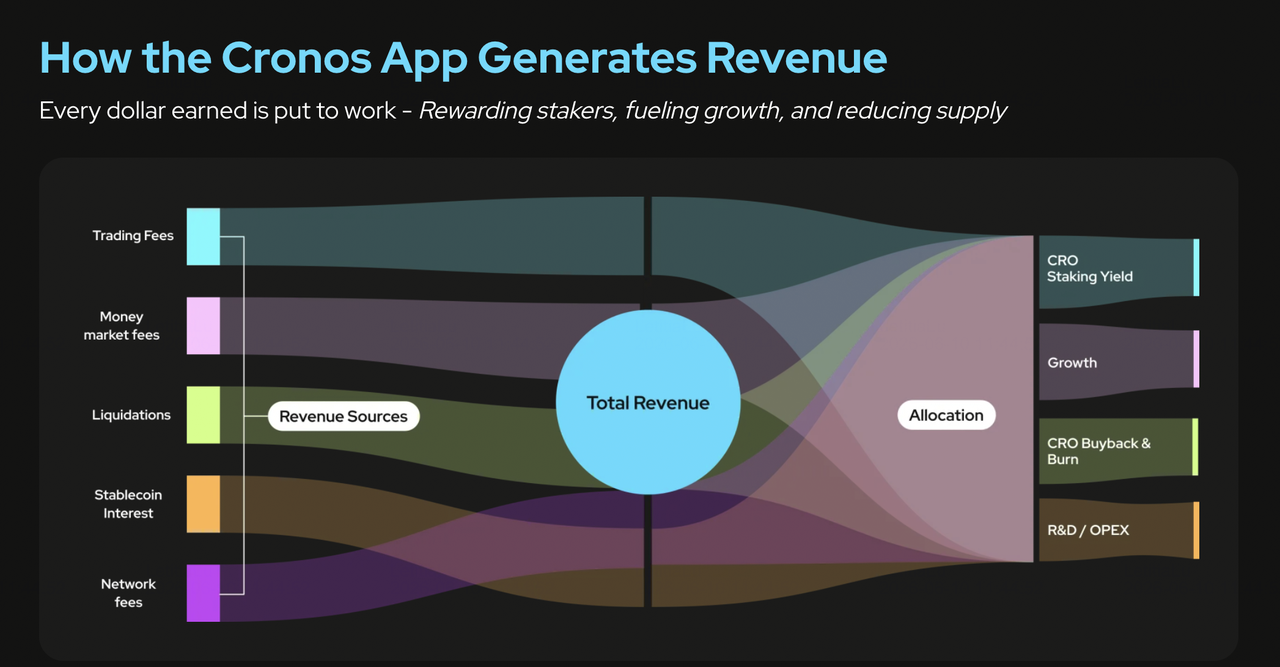
- Governance Proposal #33 (May 2026): CRO holders approved a monthly emissions decay schedule designed to keep total CRO supply below 100 billion. The proposal also began shifting staking rewards from pure inflation toward ecosystem revenue from the Cronos App and network fees.
Read More: Trump Media CRO Treasury via SPAC Sparks 30% CRO Rally, Price Prediction in Focus
Cronos Ecosystem and Adoption: Crypto.com Integration, DeFi, and Institutional Catalysts
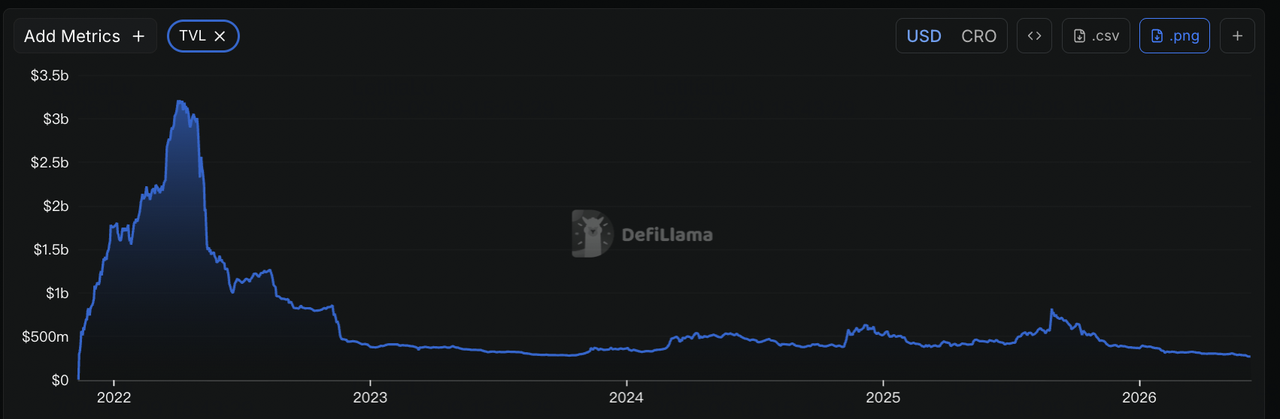
Cronos adoption is driven by two forces: its connection to Crypto.com’s user base and the on-chain activity across its multi-chain ecosystem. Cronos supports DeFi, NFTs, gaming, payments, and tokenized real-world assets, while also benefiting from institutional catalysts such as the Trump Media treasury partnership, the Canary CRO Trust filing, and Crypto.com’s broader RWA roadmap.
Source: DefiLlama
1. Cronos as the On-Chain Layer for Crypto.com
Cronos’s biggest advantage is its direct connection to Crypto.com. The exchange has a large global retail user base, a Visa card program, derivatives products, and payment services, giving Cronos a built-in distribution channel that most Layer 1 ecosystems do not have.
This creates multiple demand channels for CRO. Users can access CRO through Crypto.com products such as card rewards, fee tiers, and staking, while also using CRO on-chain for gas, DeFi, and governance. The trade-off is that CRO remains highly tied to Crypto.com’s growth, regulatory position, and ability to move exchange users into on-chain activity.
2. DeFi, Stablecoins, and Real Application Activity on Cronos
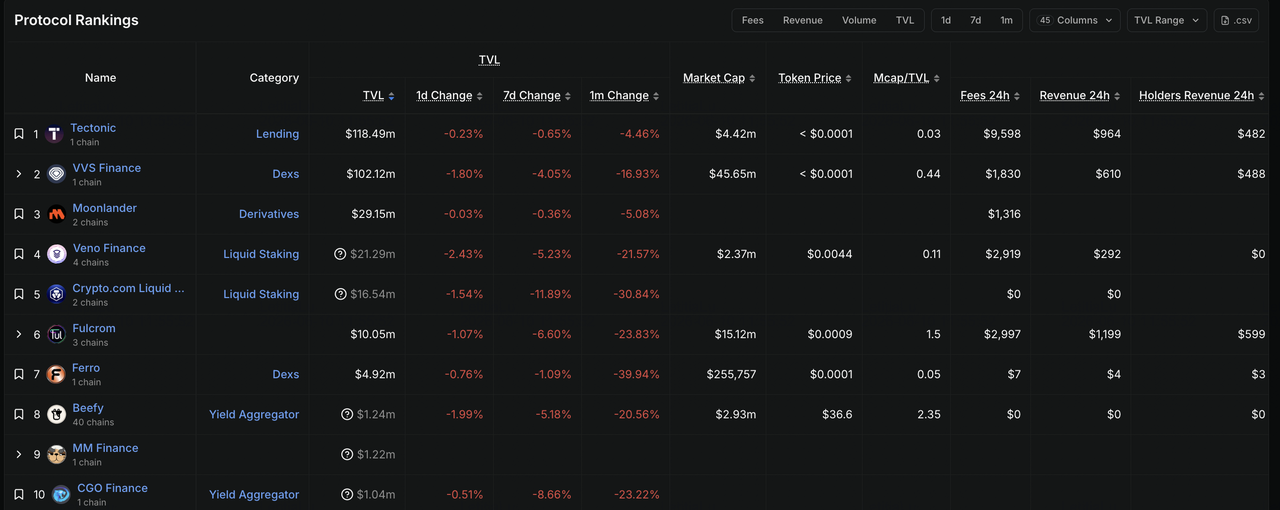
Most Cronos application activity is concentrated on Cronos EVM, where Ethereum-compatible smart contracts support DeFi, gaming, NFTs, and consumer apps. Key categories include:
Source: DefiLlame
- Decentralized exchanges: VVS Finance and other DEXs provide liquidity for CRO and major trading pairs.
- Liquid staking and yield: Veno Finance, H2 Finance, and related protocols support staking and yield strategies, including zkCRO.
- Derivatives and lending: Tectonic, Fulcrom Finance and other DeFi protocols support perpetual futures, lending, and structured products.
- NFTs, gaming, and consumer apps: Cronos Play, Crypto.com’s NFT marketplace, and games like Loaded Lions: Mane City support consumer-facing activity.
- Tokenized real-world assets (RWA): Cronos has outlined an RWA roadmap, with early examples such as UEFA Champions League match coin tokenization.
The key adoption signal is whether Cronos can attract users beyond Crypto.com’s existing customer base. External DeFi liquidity, gaming users, and NFT activity will show whether Cronos is becoming a more independent Web3 ecosystem.
3. Trump Media Partnership and Institutional Catalysts
Cronos’s institutional narrative has been shaped by the Trump Media partnership, which introduced a CRO-focused treasury vehicle and planned integrations with Truth Social and Truth+.
Crypto.com has also pursued regulated access through the Canary CRO Trust filing and potential staked CRO ETF products. These catalysts can expand CRO’s investor base, but they also create concentration risk if large treasury holders later reduce exposure.
Cronos vs. BNB Chain vs. X Layer: Exchange-Backed Blockchains Compared
Cronos, BNB Chain, and X Layer are all connected to major centralized exchanges, but they target different roles. BNB Chain is the most mature exchange-backed ecosystem, Cronos focuses on Crypto.com-linked multi-chain adoption, and X Layer is OKX’s Ethereum Layer 2 strategy.
Read More: What Is X Layer: OKB's New Layer 2 Blockchain Explained
|
Network |
Exchange Link |
Structure |
Native Token |
Main Strength |
Main Risk |
|
Cronos |
Crypto.com |
POS + EVM + zkEVM |
CRO |
Crypto.com distribution, multi-chain design, RWA and institutional catalysts |
Crypto.com dependency and 2025 re-mint trust gap |
|
BNB Chain |
Binance |
BNB Smart Chain + opBNB |
BNB |
Deep liquidity, large user base, mature DeFi ecosystem |
Binance regulatory exposure and Ethereum L2 competition |
|
X Layer |
OKX |
Ethereum Layer 2 |
OKB |
OKX backing, Ethereum alignment, low-cost app layer |
Newer ecosystem with less proven liquidity and network effects |
What Are the Cronos (CRO) Tokenomics?
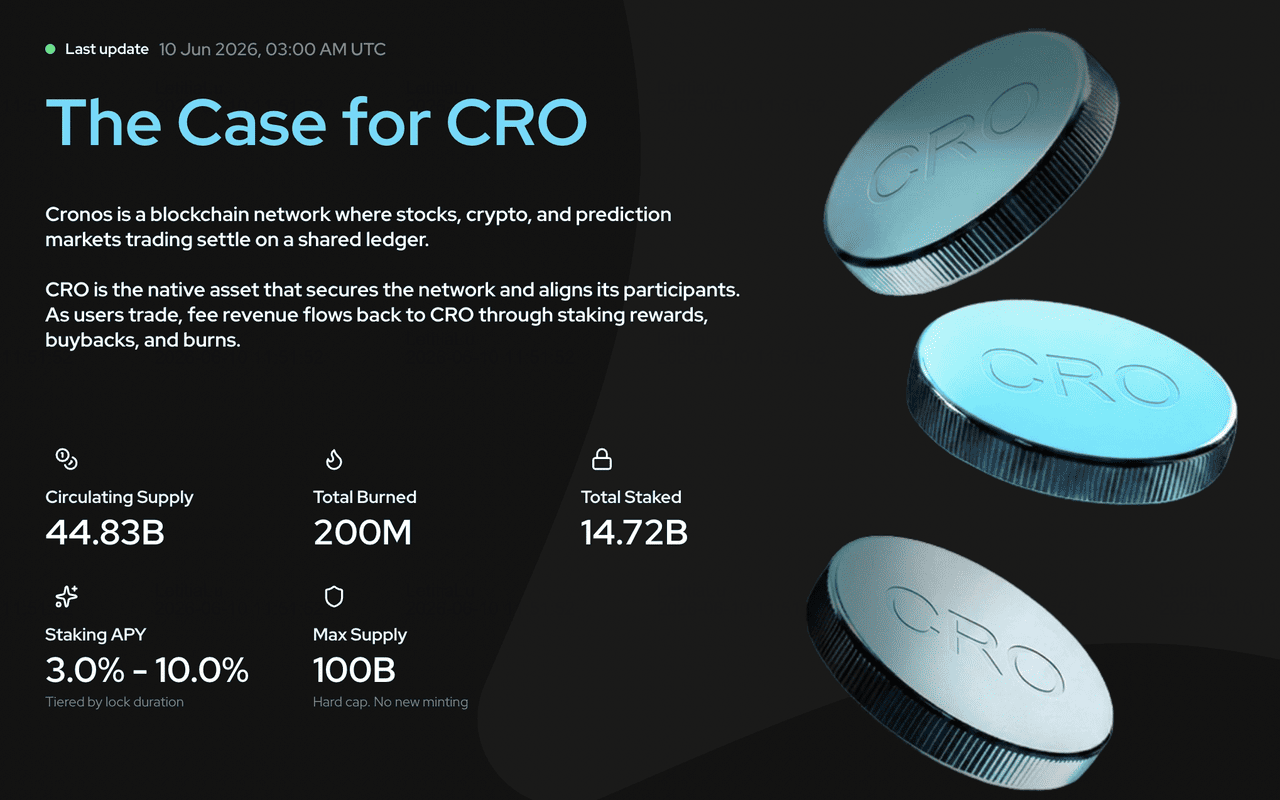
Cronos tokenomics are closely watched because CRO’s supply structure has changed several times. CRO originally had a maximum supply of 100 billion tokens. In 2021, Crypto.com burned 70 billion CRO, reducing supply to roughly 30 billion. In 2025, a controversial governance proposal re-minted 70 billion CRO into the Cronos Strategic Reserve, restoring the long-term supply ceiling toward 100 billion. As of the current tokenomics model, CRO emissions follow a 6.8% monthly decay schedule designed to reduce future inflation and keep total supply below 100 billion CRO.
CRO Token Utilities and Supply Mechanisms
CRO is the main economic asset across the Cronos ecosystem. It is used for gas, staking, governance, and selected Crypto.com product benefits.
- Gas across Cronos chains: CRO is used as gas on Cronos POS and Cronos EVM. On Cronos zkEVM, zkCRO, a liquid-staked version of CRO, is used as the gas token.
- Staking and validator rewards: CRO holders can stake tokens to help secure the network and earn rewards funded by emissions and network fees.
- Governance voting: Staked CRO holders can vote on governance proposals, including major supply-related decisions such as the 2025 re-mint and 2026 emissions decay model.
- Crypto.com product utility: CRO is connected to Crypto.com products such as Visa card rewards, exchange fee tiers, staking products, and other platform benefits.
- Emissions decay model: Governance Proposal #33 introduced a 6.8% monthly emissions decay schedule, designed to reduce future inflation and keep total CRO supply below 100 billion.
CRO Supply Structure and Strategic Reserve
CRO does not have a clean fixed-supply model or a simple token allocation table. Its supply structure is better understood through several key components:
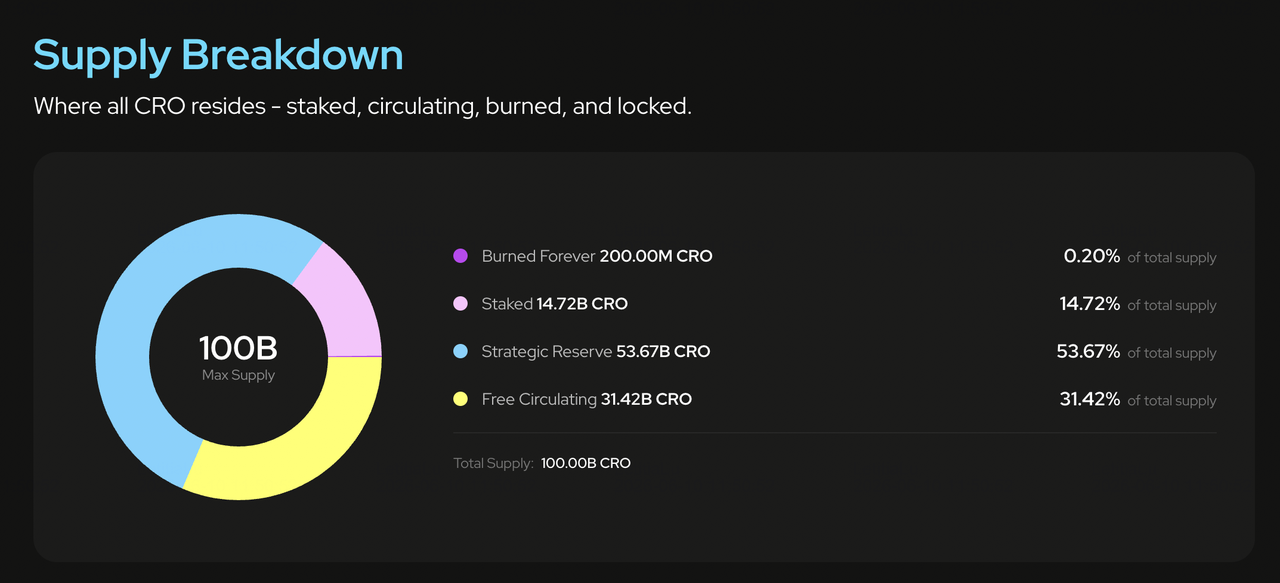
- Maximum supply: CRO originally had a total supply of 100 billion tokens. After the 2025 re-mint and 2026 emissions decay model, the supply ceiling is designed to stay below 100 billion CRO.
- 2021 burn: Crypto.com burned 70 billion CRO, reducing supply to roughly 30 billion CRO.
- 2025 controversial re-mint: A governance proposal re-minted 70 billion CRO, reversing the earlier burn and placing the tokens into the Cronos Strategic Reserve. This was controversial because many holders had viewed the 2021 burn as permanent.
- Strategic Reserve: The reserve is intended to fund ecosystem growth, ETF seeding, partnerships, and treasury initiatives, with tokens released through a vesting schedule.
For investors, the key is to watch circulating supply, Strategic Reserve vesting, future emissions, and whether reserve tokens create long-term ecosystem value or dilution pressure.
Controversial 2025 CRO Re-mint
The 2025 CRO re-mint is one of the most debated parts of Cronos tokenomics. The controversy comes from several issues:
- Reversal of the 2021 burn: Crypto.com burned 70 billion CRO in 2021, which many holders viewed as a permanent supply reduction. The 2025 re-mint effectively reversed that decision.
- Future dilution risk: The re-minted tokens were placed into the Cronos Strategic Reserve, but investors may still worry that future token releases could increase selling pressure over time.
- Trust in supply policy: Changing CRO’s supply structure after a major burn raised questions about how predictable Cronos tokenomics really are.
- Governance concerns: The re-mint passed through governance, but the process drew criticism from some community members who felt the outcome did not fully reflect holder expectations.
- Unclear value trade-off: Supporters argue the reserve can fund ecosystem growth, ETF seeding, and partnerships. Critics argue that these benefits must be strong enough to justify the supply expansion.
How to Trade Cronos (CRO) on BingX
BingX offers two practical ways to gain exposure to Cronos, depending on whether the goal is direct ownership or short-term trading. Spot trading is better suited for users who want to buy and hold CRO directly, and futures trading is designed for active traders who want long or short exposure to CRO price movements.
Spot Trading: Buy and Own CRO Directly
Spot trading is the most straightforward way to buy Cronos on BingX. When users buy CRO on the spot market, they own the asset directly and can hold it in the BingX spot account, transfer it, or withdraw it to a self-custody wallet.
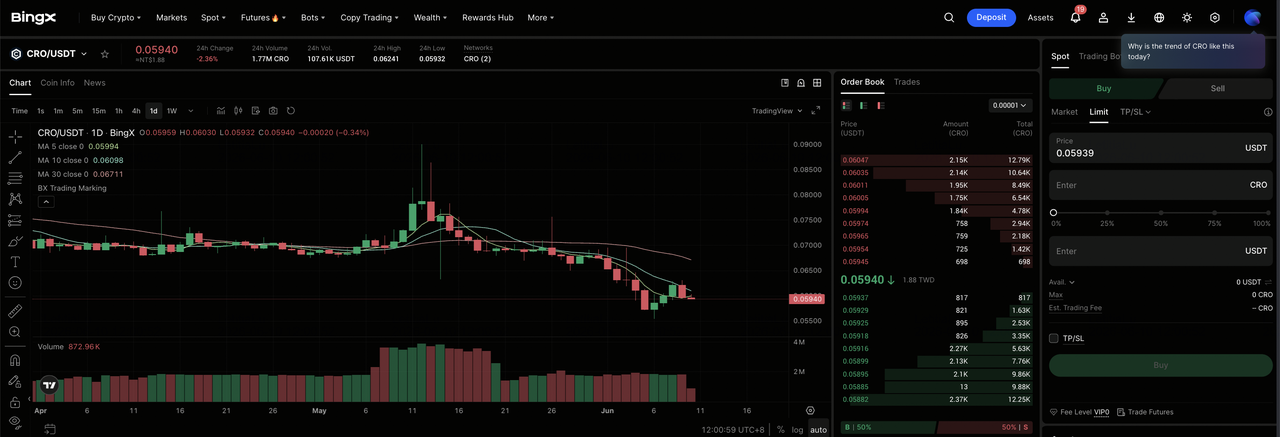
Step 1: Account setup and security. Sign up and log into your BingX account, complete the identity verification (KYC) required in your region, and enable two-factor authentication.
Step 2: Fund your spot account. Deposit USDT or another supported asset into your BingX spot account. Where available, users can also use supported fiat on-ramp options.
Step 3: Navigate to the spot market. Search for the CRO/USDT trading pair.
Step 4: Place your order. Choose a market order to buy CRO immediately at the current price, or use a limit order to set the price you want to pay.
Step 5: Manage your CRO. Once filled, your CRO appears in your spot account. You can keep it on BingX for convenience or withdraw it to a personal wallet for self-custody.
Futures Trading: Trade CRO Price Movements with Leverage
For active traders, BingX offers USDT-margined CRO perpetual futures. Futures allow users to trade CRO price movements without holding the underlying asset, with the flexibility to open long positions if they expect CRO to rise or short positions if they expect CRO to fall.
Because futures involve leverage, they can amplify both gains and losses. This approach is more suitable for traders who already have a clear risk plan and understand liquidation risk, particularly for a token like CRO that moves sharply on Crypto.com news, partnership announcements, and broader exchange-token sentiment.
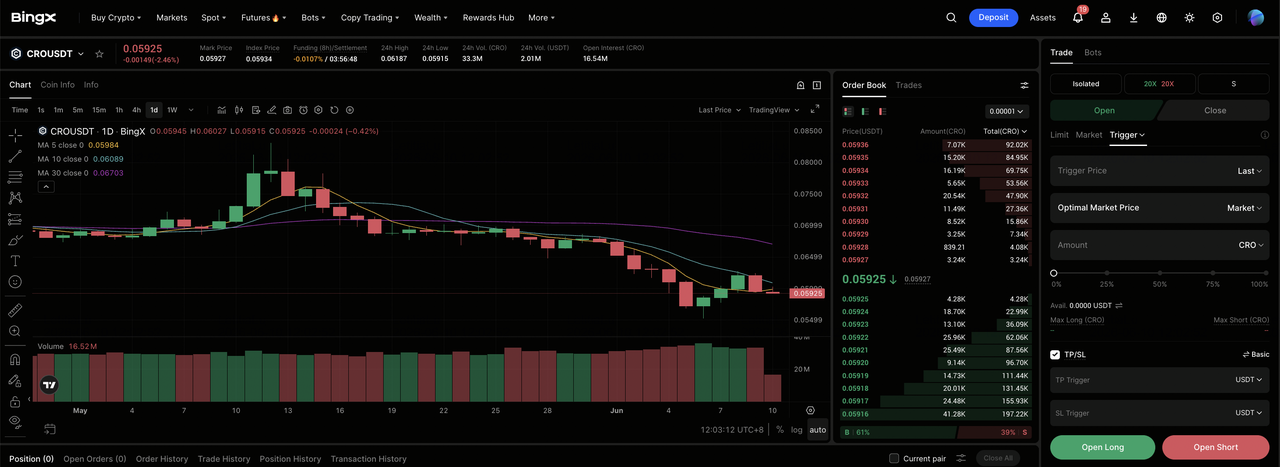
Step 1: Transfer collateral. Move USDT from your spot account into your futures account, where it will serve as margin.
Step 2: Select the contract. Search for the CRO-USDT perpetual contract.
Step 3: Set direction and leverage. Open long if you expect CRO to rise, or open short if you expect CRO to decline. Choose leverage based on your risk tolerance and position size.
Step 4: Execute the trade. Enter the order amount and choose a market or limit order depending on your trading plan.
Step 5: Manage risk. Set stop-loss and take-profit orders before or immediately after entering the position. Profit and loss settle dynamically in USDT.
Risks and Considerations Before Investing in Cronos (CRO)
Cronos benefits from Crypto.com’s distribution and a real multi-chain ecosystem, but CRO also carries risks around supply, governance, competition, and regulation.
- 2025 re-mint trust gap: The re-mint of 70 billion CRO reversed the 2021 burn and raised concerns about supply predictability and governance trust.
- Crypto.com dependency: CRO’s value is closely tied to Crypto.com’s growth, regulation, and ability to move exchange users on-chain.
- Governance concentration: Crypto.com-associated validators have historically held meaningful voting power, creating concerns around governance independence.
- Trump Media overhang: Trump Media’s large CRO position supports the institutional narrative, but any major exit could create selling pressure.
- Competitive pressure: Cronos competes with BNB Chain, X Layer, Ethereum Layer 2s, and other EVM ecosystems with deeper liquidity.
- Regulatory and leverage risk: Exchange-backed tokens face regulatory uncertainty, while CRO futures traders need to manage volatility, leverage, and liquidation risk carefully.
Final Thoughts: Should You Invest in Cronos (CRO) in 2026?
Cronos is one of the clearest examples of an exchange-backed blockchain ecosystem. With Cronos POS, Cronos EVM, and Cronos zkEVM, the project connects Crypto.com’s user base to DeFi, NFTs, payments, gaming, and tokenized real-world assets. Its 2025 and 2026 catalysts, including the Trump Media treasury partnership, Canary CRO Trust filing, and Governance Proposal #33 emissions decay model, have also strengthened its institutional narrative.
For anyone evaluating CRO in 2026, the key question is whether Cronos can turn Crypto.com distribution and institutional attention into sustainable on-chain demand. The multi-chain architecture works, and the Crypto.com connection is a real advantage. However, CRO still carries risks from the 2025 re-mint controversy, validator concentration, Crypto.com dependency, and the Trump Media supply overhang. Whether users buy CRO through spot or trade futures, understanding both the ecosystem and the governance history behind the token is essential.
Related Reading
- BingX vs Crypto.com 2026: Which Is Better for Spot and Futures Trading? Pros, Cons and Fees Compared
- Trump Media CRO Treasury via SPAC Sparks 30% CRO Rally, Price Prediction in Focus
- What Is X Layer: OKB's New Layer 2 Blockchain Explained
- Top 7 DeFi Projects to Watch on BNB Ecosystem in 2026
