

Bittensor sits at the intersection of crypto and artificial intelligence, but its goal is different from most AI tokens. Instead of simply adding a token to an AI product, Bittensor tries to create an open market for machine intelligence. The network is made up of specialized AI marketplaces called subnets, where miners produce machine learning outputs, validators judge their quality, and TAO rewards flow to the participants delivering the most useful work. In simple terms, Bittensor turns AI performance into something that can be measured, rewarded, and traded on an open network.
It is also important to separate Bittensor, TAO, and the Opentensor Foundation. Bittensor is the decentralized AI network. TAO is the native cryptocurrency used to reward miners and validators, support staking, and serve as the settlement asset across subnets. The Opentensor Foundation is the non-profit organization that helped build and support the network, but Bittensor itself is open-source and permissionless. This guide explains what Bittensor is, how it works, how subnets operate, how TAO tokenomics function, the main risks to consider, and how to trade TAO on BingX.
What Is Bittensor (TAO)?
Bittensor (TAO) is a decentralized, open-source Layer 1 blockchain built specifically for artificial intelligence (AI). It was founded by Jacob Steeves, also known as “Const,” and Ala Shaabana through the Opentensor Foundation. The project’s roots go back to 2016, with its first whitepaper published in 2019 and its first network version, “Kusanagi,” launched in January 2021. Bittensor launched as a fair-launch network with no pre-mine, no presale, and no founder allocation.
The core idea behind Bittensor is to create an open marketplace for machine intelligence. Instead of relying only on closed AI platforms run by large companies, Bittensor allows independent participants to produce, evaluate, and earn from AI-related work. Miners provide machine learning outputs, validators judge their quality, and TAO rewards flow to the participants that deliver the most useful results.
The easiest way to understand Bittensor is to compare it with Bitcoin, Ethereum, and centralized AI platforms:
- Bitcoin: Bitcoin is designed as digital money and a store of value. Its purpose is monetary, not computational.
- Ethereum: Ethereum is a general-purpose smart contract platform. It can support many types of applications, but it is not built specifically for AI workloads.
- Centralized AI platforms: Companies like OpenAI, Anthropic, and Google operate closed AI systems where users pay for access but usually cannot participate directly in model production or rewards.
- Bittensor: Bittensor is built as a decentralized AI network where participants compete to produce and validate machine intelligence through specialized subnets.
This focus gives Bittensor its identity. It is not trying to become another general-purpose blockchain or another closed AI platform. It is trying to become the settlement and incentive layer for an open AI economy.
TAO Coin vs. Bittensor Network vs. Opentensor Foundation: What Are the Differences?
- TAO the coin: TAO is the native cryptocurrency of Bittensor. It is used to reward miners and validators, distribute emissions across subnets, support staking, and serve as the settlement asset that connects the network’s AI marketplaces.
- Bittensor the network: Bittensor is the decentralized Layer 1 blockchain built for artificial intelligence. It hosts the subnet marketplace, uses Yuma Consensus to score contributions, and coordinates the shared TAO economy across all subnets.
- The Opentensor Foundation: The Opentensor Foundation is the non-profit organization founded by Jacob Steeves and Ala Shaabana that helped build and support the Bittensor protocol. Similar to the Ethereum Foundation, it helps coordinate development, but Bittensor itself is open-source and permissionless.
How Does Bittensor Work?
At its core, Bittensor is a network of specialized AI marketplaces called subnets. Each subnet has its own task, participants, and scoring rules, but all of them share the same native token, TAO. Instead of using Proof of Work or traditional Proof of Stake, Bittensor rewards participants based on the usefulness of the machine intelligence they provide.
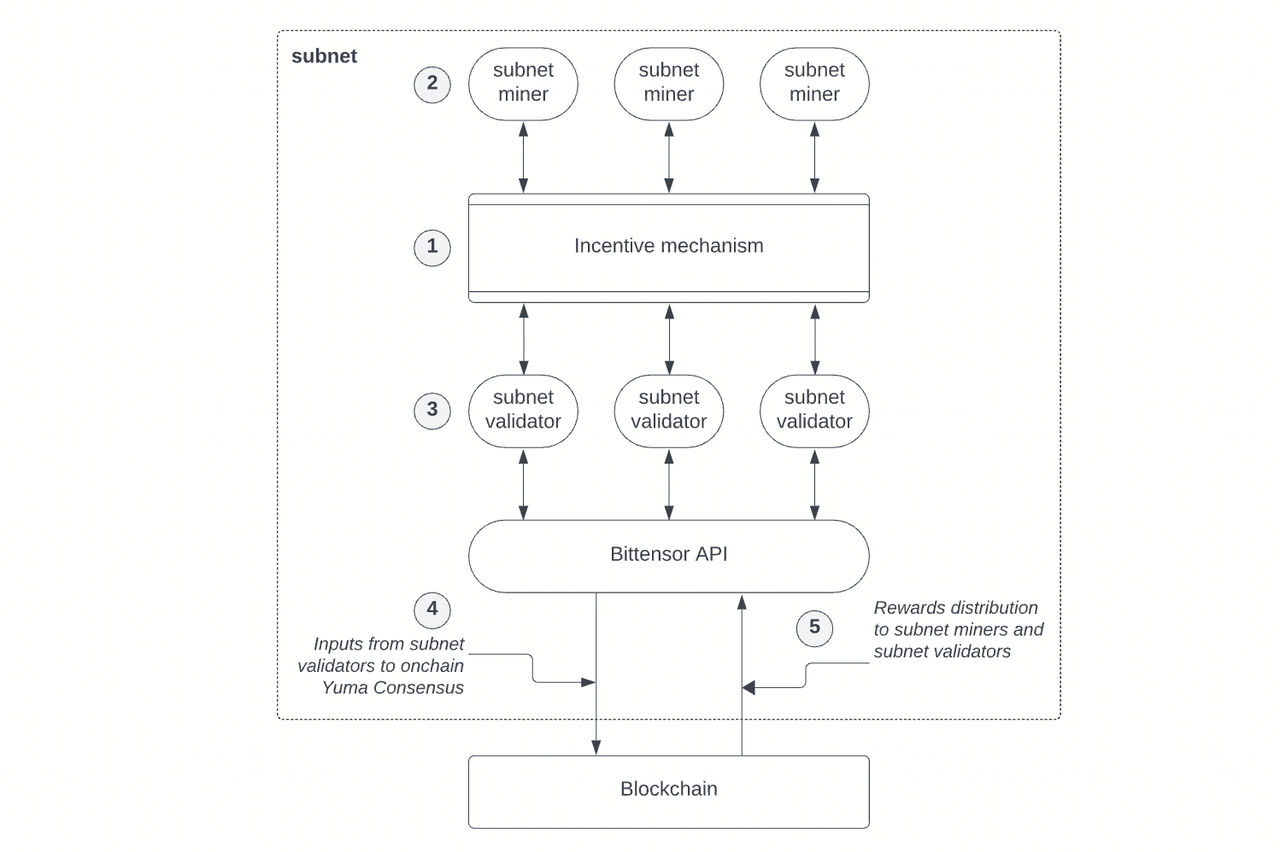
Source: Bittensor.com
- Subnets: A subnet is an independent AI marketplace inside Bittensor. Each one focuses on a specific task, such as text generation, image generation, web scraping, or compute provisioning. Each subnet has its own miners, validators, scoring rules, and economic logic.
- Miners: Miners produce the actual AI work. They run models, respond to prompts, generate outputs, scrape data, or provide compute depending on the subnet. Miners earn TAO when validators judge their outputs to be useful.
- Validators: Validators evaluate miner outputs and rank their quality. They stake TAO to participate and submit scores that help determine which miners deserve rewards. Good validators are rewarded for accurate evaluation, while poor scoring can reduce their rewards.
- Yuma Consensus: Yuma Consensus is Bittensor’s scoring mechanism, sometimes described as “Proof of Intelligence.” It combines validator scores into a shared ranking and distributes TAO emissions to miners and validators based on contribution quality. This creates a feedback loop where miners compete to produce better outputs and validators compete to judge them accurately.
Major Bittensor Developments: From Whitepaper to dTAO and the First Halving
Bittensor’s history has been shaped by major network upgrades that expanded the protocol from an early AI experiment into a modular marketplace of specialized AI subnets. The table below gives a quick overview, followed by a short walkthrough of each milestone.
|
Milestone |
Date |
Main Purpose |
|
Whitepaper Published |
2019 |
First Bittensor whitepaper outlined the decentralized AI vision |
|
Kusanagi Launch |
January 2021 |
First Bittensor mainnet went live with TAO emissions |
|
Nakamoto Fork |
November 2021 |
Hard fork addressing early consensus issues |
|
Finney Upgrade |
March 2023 |
Kernel performance improvements, paved the way for subnets |
|
Revolution Upgrade |
October 2023 |
Introduced the modular subnet architecture |
|
dTAO Upgrade |
2025 |
Subnet alpha tokens and market-driven emissions |
|
First Halving |
December 2025 |
Daily TAO emissions cut from 7,200 to 3,600 |
- Whitepaper Published (2019). The first Bittensor whitepaper, BitTensor: An Intermodel Intelligence Measure, introduced the idea of a decentralized market for machine intelligence. The project’s conceptual roots go back to 2016, when Jacob Steeves began exploring blockchain-based AI coordination.
- Kusanagi Launch (January 2021). Bittensor’s first mainnet version, Kusanagi, went live with miners and validators producing and evaluating early AI outputs. TAO emissions began through a fair launch, with no pre-mine, presale, or founder allocation.
- Nakamoto Fork (November 2021). After Kusanagi was halted to address early consensus issues, Bittensor relaunched as Nakamoto through a hard fork. A small portion of the Kusanagi-mined supply was migrated, and Nakamoto became the protocol’s first stable mainnet.
- Finney Upgrade (March 2023). Nakamoto was upgraded to Finney, improving core performance and laying the groundwork for delegated staking and subnets. Finney remains the live Subtensor blockchain that supports Bittensor today.
- Revolution Upgrade (October 2023). Revolution transformed Bittensor from a single AI network into a modular system of independent subnets. This was the turning point that made Bittensor a marketplace of specialized AI markets rather than one general intelligence network.
- dTAO Upgrade (2025). Dynamic TAO, or dTAO, changed how emissions flow across the network. Instead of relying on a centralized root validator model, each subnet now has its own alpha token, allowing market demand and subnet performance to influence how TAO rewards are allocated.
- First Halving (December 2025). Bittensor’s first halving was triggered when total emissions reached 10.5 million TAO, half of the 21 million cap. Daily issuance fell from 7,200 TAO to 3,600 TAO, reducing the rate of new TAO entering circulation.
Bittensor Ecosystem and Adoption: Subnet Growth, AI Use Cases, and Real Usage
Bittensor’s adoption is best measured through its subnet economy. By 2026, the network has grown to roughly 128 active subnets, with plans to expand toward 256. These subnets cover AI inference, text generation, image generation, data scraping, forecasting, compute, storage, and other machine intelligence markets. The launch of dTAO also made subnets directly investible through subnet-specific alpha tokens, turning subnet demand into a visible market signal. By March 2026, combined subnet alpha-token market value had reached roughly $1.1 billion to $1.4 billion, showing that Bittensor is no longer only a single-token AI narrative.
1. Subnet Growth Shows Bittensor Is Becoming a Multi-Market AI Network
The subnet system is the center of Bittensor’s ecosystem. Each subnet competes for TAO emissions by producing a specific AI or digital service, and dTAO changed how the market evaluates those subnets. Instead of relying only on root validators to allocate emissions, each subnet now has an alpha token whose market price reflects demand, confidence, and perceived quality.
This creates a more measurable adoption layer. Investors can now look at subnet count, alpha-token market cap, emissions, stake, and subnet-level demand instead of treating Bittensor as one undifferentiated AI token. The risk is that market price can also reward hype, not only real utility, which makes subnet-level quality more important than headline growth.
2. Real AI Demand Is Emerging Most Clearly in Inference Subnets
Bittensor subnets are no longer limited to text generation. The network now covers digital commodities such as AI inference, training, compute power, storage, data collection, and financial prediction.
Key subnet categories include:
- AI inference: Subnets that serve model outputs and compete with centralized inference providers.
- Text and image generation: Subnets focused on language, writing, summarization, and visual outputs.
- Data and web scraping: Subnets that collect and structure data for downstream AI workflows.
- Prediction and forecasting: Subnets focused on markets, weather, and measurable time-series outcomes.
- Compute and storage: Subnets that provide GPU resources, processing capacity, or storage.
The strongest adoption signal comes from subnets that serve external users, not just internal reward systems. Inference is currently the most important category to watch because it has clearer commercial demand and easier comparison with centralized AI providers.
3. The Main Adoption Risk Is Emission-Driven Activity Without Real Customers
The most important question is whether subnet activity reflects real AI demand or mainly incentive capture. Bittensor’s subnet growth is meaningful, but more subnets and higher alpha-token valuations do not automatically prove external adoption.
This is the real adoption test for Bittensor. If more subnets can attract external users, generate useful AI outputs, and justify emissions through demand, Bittensor becomes a credible open AI marketplace. If subnet activity remains mainly token-driven, the network risks becoming a circular incentive economy where TAO rewards participation more than actual machine intelligence.
What Are the Bittensor (TAO) Tokenomics?
Bittensor’s tokenomics combine Bitcoin-like scarcity with an AI marketplace emission model. TAO has a fixed maximum supply of 21 million tokens, with no pre-mine, no presale, and no founder allocation. New TAO enters circulation through block emissions and is distributed to participants who contribute useful work, validate outputs, create subnets, or stake into the network.
TAO Token Utility and Supply Mechanisms
TAO is the core economic asset of the Bittensor network. It is used to reward AI work, secure the network through staking, coordinate value across subnets, and determine how emissions flow through the ecosystem.
- Reward AI work: Miners earn TAO-linked rewards for producing useful AI outputs or digital services within subnets.
- Reward validation: Validators earn rewards for scoring miner outputs and helping the network decide which contributions are valuable.
- Support staking and delegation: TAO holders can stake or delegate TAO to validators, earning rewards while helping secure and influence subnet activity.
- Power subnet markets: After the dTAO upgrade, TAO flows into subnet-specific markets, where alpha-token signals help determine which subnets receive more emissions.
- Fixed supply and halving schedule: TAO has a maximum supply of 21 million. Emissions are reduced through halvings triggered by supply milestones. The first halving occurred when emissions reached 10.5 million TAO, cutting daily issuance from 7,200 TAO to 3,600 TAO.
TAO Token Allocation
TAO does not have a traditional team, investor, or treasury allocation. Instead, tokens are allocated through network emissions. The standard subnet emission split is:
|
Recipient |
Allocation |
Role |
|
Miners |
41% |
Produce AI outputs or digital services within a subnet |
|
Validators |
41% |
Evaluate miner outputs and assign quality scores |
|
Subnet owner |
18% |
Creates and maintains the subnet’s incentive mechanism |
After dTAO, emissions are first routed toward subnets based on subnet-level market demand and alpha-token signals, then distributed within each subnet using this standard split. The key point is that TAO’s supply is scarce, but its emissions are market-directed: rewards flow toward the subnets and participants the network believes are producing valuable AI work.
How to Trade Bittensor (TAO) on BingX
BingX offers two practical ways to gain exposure to Bittensor, depending on whether the goal is direct ownership or short-term trading. Spot trading is better suited for users who want to buy and hold TAO directly, and futures trading is designed for active traders who want long or short exposure to TAO price movements.
Spot Trading: Buy and Own TAO Directly
Spot trading is the most straightforward way to buy Bittensor on BingX. When users buy TAO on the spot market, they own the asset directly and can hold it in the BingX spot account, transfer it, or withdraw it to a self-custody wallet.
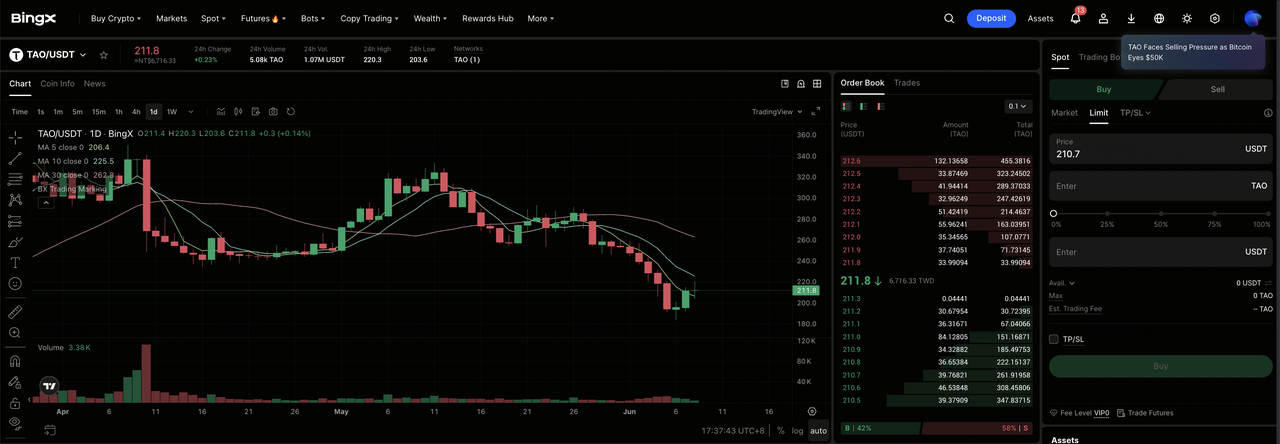
Step 1: Account setup and security. Sign up and log into your BingX account, complete the identity verification (KYC) required in your region, and enable two-factor authentication.
Step 2: Fund your spot account. Deposit USDT or another supported asset into your BingX spot account. Where available, users can also use supported fiat on-ramp options.
Step 3: Navigate to the spot market. Search for the TAO/USDT trading pair.
Step 4: Place your order. Choose a market order to buy TAO immediately at the current price, or use a limit order to set the price you want to pay.
Step 5: Manage your TAO. Once filled, your TAO appears in your spot account. You can keep it on BingX for convenience or withdraw it to a personal wallet for self-custody.
Futures Trading: Trade TAO Price Movements
For active traders, BingX offers USDT-margined TAO perpetual futures. Futures allow users to trade TAO price movements without holding the underlying asset, with the flexibility to open long positions if they expect TAO to rise or short positions if they expect TAO to fall.
Because futures involve leverage, they can amplify both gains and losses. This approach is more suitable for traders who already have a clear risk plan and understand liquidation risk, particularly for a higher-beta asset like TAO that moves with both AI sentiment and broader crypto cycles.
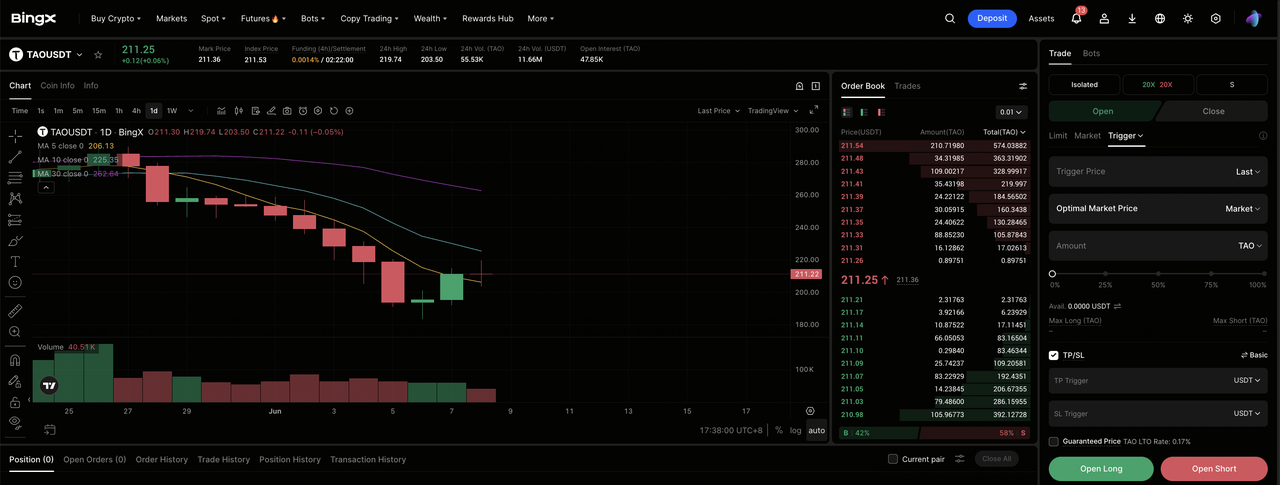
Step 1: Transfer collateral. Move USDT from your spot account into your futures account, where it will serve as margin.
Step 2: Select the contract. Search for the TAO-USDT perpetual contract.
Step 3: Set direction and leverage. Open long if you expect TAO to rise, or open short if you expect TAO to decline. Choose leverage based on your risk tolerance and position size.
Step 4: Execute the trade. Enter the order amount and choose a market or limit order depending on your trading plan.
Step 5: Manage risk. Set stop-loss and take-profit orders before or immediately after entering the position. Profit and loss settle dynamically in USDT.
Risks and Considerations Before Investing in Bittensor
Bittensor has a strong technical foundation and a novel approach to decentralized AI, but TAO also carries risks tied to real usage, emissions, governance, dilution, competition, and market access.
- Real-usage gap: The central question is whether subnet activity reflects genuine AI demand or mainly token-incentivized participation. Inference subnets like Chutes show real usage potential, but they remain a minority of total subnet activity.
- Zombie subnets and emission gaming: The Subnet 281 “LOL-subnet” incident showed that dTAO can be exploited when subnet alpha tokens attract capital without meaningful AI work. Bittensor must keep improving incentives so emissions reward usefulness, not just speculation.
- Validator and governance concentration: The top root validators still have meaningful influence over subnet emissions, and large stake concentrations can create governance concerns. dTAO reduced this issue but did not remove it entirely.
- Future dilution risk: TAO has a fixed 21 million supply cap, but just over half of the maximum supply is currently circulating. Even after the first halving, future emissions remain material and should be included in any valuation view.
- Competition and AI narrative risk: Bittensor leads the decentralized AI category, but it competes with Render, Akash, the ASI Alliance, Gensyn, and other AI infrastructure projects. TAO is also highly sensitive to broader AI market sentiment, which can drive sharp drawdowns even when network fundamentals improve.
- Liquidity, ETF, and leverage risk: TAO is not yet listed on every major U.S. retail exchange, and pending spot ETF filings remain uncertain. For users trading TAO futures, leverage can amplify losses quickly, so position sizing and stop-loss discipline are especially important.
Final Thoughts: Should You Invest in Bittensor in 2026?
Bittensor is one of crypto’s most ambitious attempts to build a decentralized marketplace for machine intelligence. With a 21 million TAO hard cap, the first halving completed, over 70% of supply staked, and dTAO making subnet emissions more market-driven, the project has moved beyond pure AI-token narrative into a functioning subnet economy.
For anyone evaluating TAO in 2026, the key question is whether Bittensor can turn subnet activity into sustained external AI demand. The technical architecture works, tokenomics are tight, and real production subnets exist, but not every subnet has proven meaningful real-world usage. Whether users buy TAO through spot, build a position with DCA, or trade futures, understanding the subnet marketplace and the gap between incentives and real adoption is essential.
Related Reading
- What Are the Top 10 AI Agent Crypto Projects of 2026?
- What Are the Top 10 AI Crypto Projects to Watch in 2026?
- What Are the Top 7 DeFAI (AI + DeFi) Projects to Watch in 2026?
- Top AI Data Center Stocks to Buy in 2026: Cloud, Servers, and AI Compute Infrastructure
- Top AI Compute and GPU Stocks to Buy in 2026: The Shift to Inference and Custom Silicon
