

Moving beyond the pure narrative hype of previous cycles, the Alliance has integrated Fetch.ai, SingularityNET, and CUDOS into a functional Layer-1 infrastructure layer. Armed with groundbreaking architectural milestones and upcoming mainnet deployments, FET is attempting to structurally break away from its multi-year macro bottom.
By late June 2026, the Alliance has completely re-engineered its relationship with the broader tech economy. While the altcoin market faces severe macro headwinds under Extreme Fear sentiment with the Crypto Fear and Greed Index sitting at 15, FET has registered highly volatile trading ranges, currently hovering around $0.1718 with a market cap of roughly $392 million. Recent reports that OpenAI may delay its blockbuster IPO to protect a potential $1 trillion valuation have triggered a sharp cooling phase, hitting AI equities and crypto-linked tokens alike. Despite this, steady 24-hour spot trading volumes of over $114 million highlight that nearly 30% of the asset's total valuation is shifting hands daily.
The FET price prediction for 2026 is sharply divided: macro structural bulls anticipate a dramatic supply squeeze driven by the network's upcoming custom BlockDAG mainnet launch and a $50 million "Earn & Burn" framework, while conservative technical analysts warn that lingering bearish derivatives positioning and the overhead 200-day Simple Moving Average (SMA) could limit near-term upside. For active traders, this infrastructure-driven window offers exceptional volatility backed by continuous on-chain agent deployments. This guide explores FET forecasts from CoinMarketCap data, technical analysis models, and structural indicators, alongside real-time developments. You will also learn how to trade these moves in the FET token on BingX.
Top 5 Things to Know About Artificial Superintelligence Alliance (FET)
- The OpenAI IPO Cool Down: Reports that OpenAI may push back its listing timeline have temporarily dampening risk appetite for the broader AI trade, subjecting high-beta proxies like FET to temporary sector-wide sell-offs.
- The Custom BlockDAG Mainnet: Set for a late 2026 production launch, the native ASI:Chain transitions the ecosystem away from generic Layer-1 networks toward a purpose-built home optimized for massive concurrent AI workloads.
- The $50 Million Earn & Burn: Programmed to systematically contract circulating supply, this deflationary protocol mechanism utilizes enterprise network revenues to buy back and permanently destroy FET tokens on the open market.
- Whale Accumulation Trends: Despite prevailing market fear, on-chain data shows prominent whale addresses holding 1 million to 10 million FET aggressively accumulating throughout Q2 2026, signaling strong institutional conviction in historical support zones.
- The Legacy Ticker Resolution: Due to backend contract complexities, major centralized exchanges like BingX opted to preserve the original Fetch.ai smart contract, meaning the unified asset continues to trade under the familiar FET ticker.
What Is Artificial Superintelligence Alliance (FET)?
Artificial Superintelligence Alliance is a highly specialized, decentralized initiative explicitly engineered to host and scale the global artificial intelligence economy. While general-purpose blockchains are unsuited for the rapid, high-concurrency needs demanded by machine-to-machine interactions, the Alliance has unified the core capabilities of three separate Web3 pillars. April 2024 marked the formal pooling of Fetch.ai (autonomous economic agents), SingularityNET (neural-symbolic AGI research), and CUDOS (decentralized cloud computing). This horizontal integration provides an all-in-one independent platform where developers can access data, rent compute, and launch complex autonomous applications.
The network achieved structural readiness in early 2026 through successive rollouts of its production-ready software stack. In February 2026, the alliance deployed its ASI:Create platform in a closed alpha to eliminate operational bottlenecks, quickly followed by the April release of the OmegaClaw framework, a framework capable of giving agents advanced memory retention and multi-step reasoning. With the subsequent launch of the Agent Launchpad on May 20, 2026, the network successfully moved past pure speculation, allowing developers to deploy fully autonomous agents that execute secure, on-chain smart contract operations globally.
Read more: What Is Artificial Superintelligence (FET), the Complete Guide to the ASI Alliance?
An Overview of FET Token Utility and Tokenomics
The FET token serves as the irreplaceable economic engine powering the Alliance ecosystem, aligning network validators, autonomous software agents, and enterprise clients within a single value-capture model.
- Network Settlement and Gas Layer: Operating as the primary medium of exchange across the network, FET is required to pay for autonomous AI services, smart contract executions, and data exchange.
- Decentralized Compute Access: Through the ASI:Cloud interface, developers utilize FET tokens to lease high-tier, distributed GPU clusters, including NVIDIA H100s, for model training and inference.
- Deflationary Value Accrual: To counter outstanding issuance, the alliance relies on its Earn & Burn protocol engine. As B2B platforms integrate these agents into supply chains and logistics workflows, real-world utility fees are algorithmically routed to buy back and burn FET, translating economic activity into token scarcity.
What Makes FET Different From Other Layer-1 Blockchains?
The Artificial Superintelligence Alliance distinguishes itself from traditional Layer-1 blockchains like Solana or Avalanche by focusing exclusively on a single vertical: decentralized AI infrastructure, agentic automation, and high-performance computing (HPC). Rather than competing for decentralized applications (dApps) or generic meme coin volumes, FET functions as an enterprise-grade gateway for automated workflows. While standard blockchains rely heavily on speculative retail transactions to generate gas fees, FET's network traffic is inherently linked to autonomous digital workers executing automated B2B workflows and rental yields on distributed hardware.
From a structural standpoint, the alliance is pioneering vertical integration across the AI lifecycle. In June 2026, the platform expanded its utility past standard consumer chat interfaces by offering decentralized compute scaling that runs up to 50% cheaper than legacy cloud providers like Amazon Web Services (AWS). This framework enables smaller machine learning enterprises to bypass restrictive centralized corporate contracts, turning raw distributed computing power into an accessible commodity asset.
FET vs. Traditional Layer-1 Blockchains: 3 Key Features
|
Feature |
Artificial Superintelligence Alliance (FET) |
Traditional Layer-1 (L1) |
|
Ecosystem Focus |
Dedicated AI Infrastructure & Autonomous Agents |
General-purpose smart contracts / DeFi |
|
Deflationary Driver |
$50M Revenue Earn & Burn + Compute Rental Burns |
Base Gas Fee Burns (EIP-1559 model) |
|
Infrastructure Moat |
Native distributed GPU clusters (CUDOS Integration) |
Third-party cloud providers or independent validators |
|
Target Audience |
B2B Enterprises, AI Developers, Autonomous Agents |
Crypto-native yield farmers and retail traders |
|
Circulating Supply |
~83% of Max Supply Circulating (Low dilution risk) |
Highly inflationary or heavily vesting unlock structures |
While general-purpose blockchains struggle to find repeatable enterprise adoption, the Alliance's specialized architecture provides three unique structural advantages:
- Neural-Symbolic AI Frameworks: Unlike generic EVM environments, the underlying codebase supports hybrid AI models that combine deep learning neural networks with the logical reasoning of symbolic AI, creating highly secure and predictable code execution.
- Censorship-Resistant Execution: Recent regulatory restrictions on centralized Web2 models have spotlighted the value of decentralized alternatives. The Alliance offers an un-stoppable repository for open-source AI deployment, insulating builders from sudden tech monopolies.
- Established Supply Profile: Unlike newly launched infrastructure protocols that face aggressive multi-year vesting dilutions, the vast majority of FET's supply is already circulating in the open market, heavily insulating spot buyers from sudden institutional unlock dumping.
FET 2026 Price Outlook: OpenAI IPO Premium vs. 'Sell the News' Reality
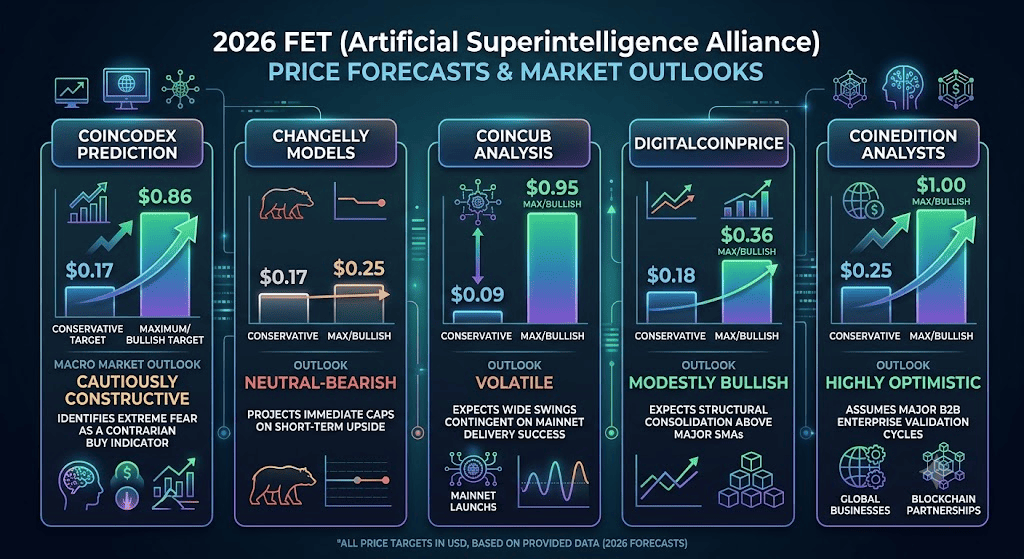
FET price prediction for 2026 by various analysts
The remainder of 2026 presents a defining test for the Artificial Superintelligence Alliance (FET), pitting a highly sophisticated agentic fundamental thesis against macro technical blockades. Traders are currently positioning across three primary price regimes, balanced against broader equity tech trends and upcoming mainnet integration milestones.
The Bull Case: Technical Breakout Beyond the $0.30 Neckline
The macro bull case hinges on a full technical reversal stemming from the massive multi-month accumulation bottom visible on the daily charts. Over the past few weeks, whale balances holding between 1 million and 10 million FET have steadily surged. Near-term technical structures are attempting to carve out a horizontal floor right above historical support levels at $0.16.
If spot accumulation forces a confirmed breakout above the immediate 50-day SMA ($0.2075), it opens a swift extension channel toward the 200-day SMA near $0.2105. The ultimate target for a structural bull run is the heavy macro resistance at the $0.25–$0.30 neckline, a level that has rejected FET multiple times during past market corrections. If the upcoming late 2026 ASI:Chain Mainnet launch successfully flips $0.30 into a long-term support floor, technical algorithms project an extended multi-month rally targeting a range between $0.64 and $0.95, fueled further by successful enterprise adoption.
The Base Case: Consolidation and Event Stabilization Between $0.22 and $0.35
The base case assumes that while the rolling launch of the Agent Launchpad provides a prominent trading floor, the current macro risk-off sentiment restricts FET from achieving immediate parabolic heights. In this scenario, the immediate tokenomics updates, the systematic GPU compute rentals and the gradual activation of Earn & Burn blocks, successfully absorb seasonal sell pressure.
FET effectively establishes a rock-solid trading equilibrium inside a broad horizontal channel. Price action stabilizes with a baseline average between $0.22 and $0.35 through the end of 2026. The token becomes priced not on speculative OpenAI hype cycles, but as a mature utility asset accumulating steady transaction value on-chain, neutralizing overall market fear.
The Bear Case for FET Price: Extended Capital Freeze Down to $0.090–$0.12
The bear case is grounded in macro equity precedent and the current heavy imbalance in traditional AI asset sentiment. If tech sector risk aversion deepens due to prolonged delays in the Web2 AI IPO pipeline, speculative capital may continue to flee high-beta assets.
Furthermore, the lingering psychological damage from the historic Ocean Protocol treasury exit in late 2025 continues to restrict order book depth on several key spot venues. A failure to hold the vital psychological support floor at $0.16 will likely invalidate the developing consolidation base. This would force a sharp downward capitulation, plunging FET back to its historical bearish macro support corridor between $0.090 and $0.12, trapping the asset in a prolonged sideways winter.
FET Price Prediction for 2026: Institutional and Analyst Outlook
Institutional forecasting platforms indicate a wide divergence in year-end expectations, heavily weighted by whether they prioritize short-term chart structures or fundamental programmatic burns.
|
Forecasting Entity |
2026 Conservative Target |
2026 Maximum/Bullish Target |
Macro Market Outlook |
|
CoinCodex Prediction |
$0.17 |
$0.86 |
Cautiously constructive; identifies Extreme Fear as a contrarian buy indicator. |
|
Changelly Models |
$0.17 |
$0.25 |
Neutral-Bearish; projects immediate caps on short-term upside. |
|
Coincub Analysis |
$0.09 |
$0.95 |
Volatile; expects wide swings contingent on mainnet delivery success. |
|
DigitalCoinPrice |
$0.18 |
$0.36 |
Modestly bullish; expects structural consolidation above major SMAs. |
|
CoinEdition Analysts |
$0.25 |
$1.00 |
Highly optimistic; assumes major B2B enterprise validation cycles. |
How to Trade Artificial Superintelligence Alliance (FET) on BingX
Navigate the high-velocity AI infrastructure market with precision by leveraging BingX's trading suite, which provides real-time trend analysis and automated order routing for both spot and derivatives traders looking to capitalize on FET volatility.
Buy, Sell, or HODL FET on the Spot Market
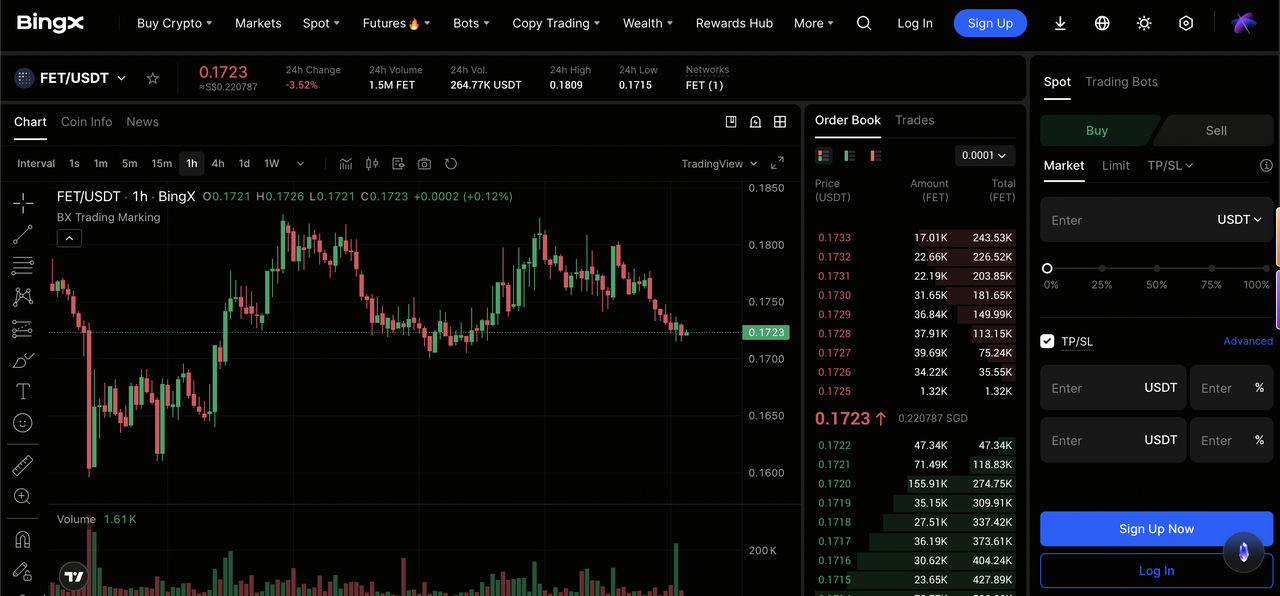
FET/USDT trading pair on BingX spot market
Spot trading is optimal for long-term investors aiming to gain exposure to the Alliance’s fundamental agent infrastructure growth while avoiding the risks of leverage-based liquidations during volatile macro tech shifts.
- Log in to your BingX account and navigate to the Spot Market.
- Type FET/USDT into the top-right asset search bar.
- Review the live order book. Select your preferred order type: a Limit Order to establish a specific entry threshold, or a Market Order to execute instantly at current market pricing.
- Input the desired amount of USDT you wish to allocate and click Buy FET. Your purchased tokens will reflect instantly in your Spot Account.
Long or Short FET Perpetuals with Leverage on the Futures Market
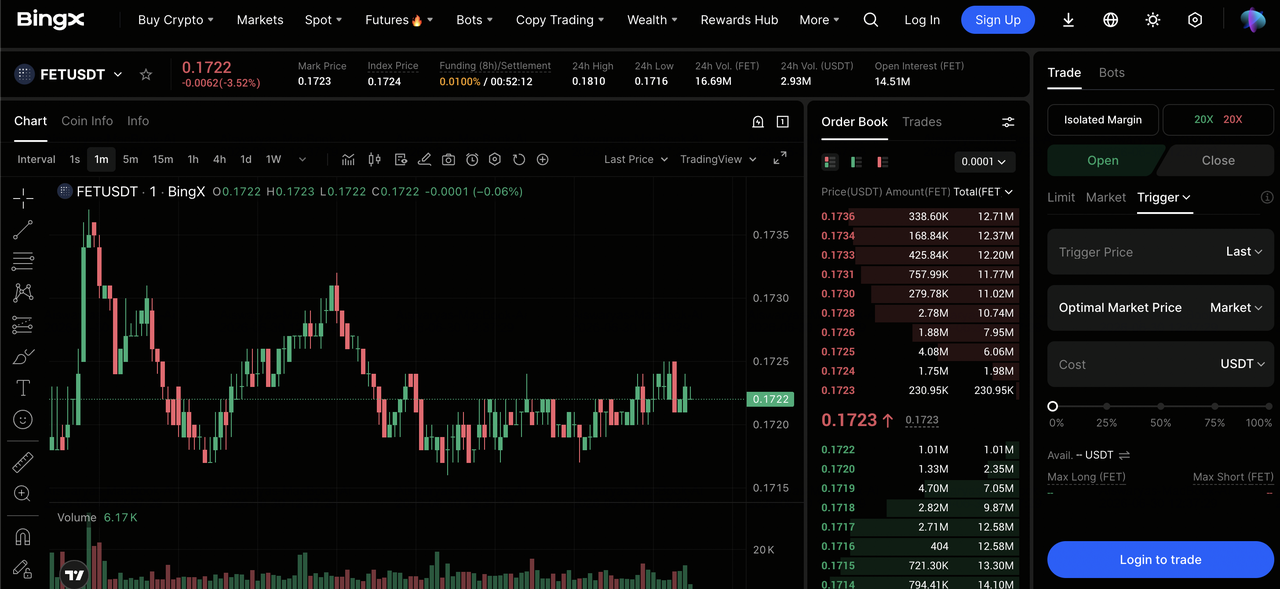
FET/USDT perpetual contract on BingX futures market
For active market participants seeking to capitalize on short-term trend reversals, short-squeezes, or to hedge spot allocations against macroeconomic tech listings, BingX offers liquidity-backed FET/USDT perpetual contracts.
- Select the Futures dropdown menu and click Perpetual Futures.
- Search and open the FET/USDT perpetual contract interface.
- Choose your preferred Margin Mode: Isolated Margin to insulate risk to an individual position, or Cross Margin to utilize your unified account balance as collateral.
- Set your target Leverage level. Due to rapid price swings triggered by global AI market news, strict risk parameters (2x–5x) are recommended for capital preservation.
- Define your execution criteria, ensuring clear Take-Profit (TP) and Stop-Loss (SL) trigger thresholds are established.
- Click Open Long if you anticipate a breakout through the moving average resistance, or Open Short to profit from an extended macro sector correction.
5 Key Risks for FET Traders to Watch in 2026
While the integration of decentralized computing power and autonomous software tools provides the Alliance with a unique technical edge, market participants must carefully monitor several hazards to insulate their trading capital:
- Slowing Web2 Momentum: The valuation of decentralized AI tokens remains highly correlated with traditional tech equity sentiment; structural cooling or delayed valuations in traditional AI spaces directly drag down FET's price action.
- Fierce Centralized Monopolies: Web2 tech conglomerates have unparalleled capital, distribution networks, and massive localized computing centers, which can capture major commercial contracts before decentralized options mature.
- Complex Governance Stability: Following the public fallout and treasury division caused by Ocean Protocol's exit from the Alliance, traders must monitor internal consensus among the remaining founding members (Fetch, SingularityNET, CUDOS).
- Hardening AI Regulations: Legal frameings such as the EU AI Act require deep audit histories and explicit human liability paths for autonomous systems, creating friction for networks that utilize anonymous global compute nodes.
- Delayed Mainnet Timelines: The transition to the native BlockDAG ASI:Chain layer must execute cleanly in late 2026; technical bugs or launch extensions risk losing momentum to agile, native competitor protocols.
Conclusion: Should You Buy FET Token in 2026?
Determining if FET represents a high-conviction buy in 2026 requires separating tactical, narrative-driven trading from structured fundamental investing. In the immediate horizon, FET behaves as a high-velocity momentum vehicle for tech sector sentiment. The $0.16–$0.17 zone remains a vital historical accumulation corridor; a clean daily close above the $0.21 resistance, verified by strong trading volume, would invalidate the local downtrend and initiate a technical leg up toward the mid-term targets. For derivatives traders, the current combination of Extreme Fear and whale buying patterns offers an attractive setup for capturing near-term relief rallies.
For structural, multi-year investors, the 2026 investment thesis depends on Utility Over Speculation. The Alliance is successfully decoupling its long-term network value from pure hype by integrating physical GPU rendering power and on-chain agent deployment tools. If the protocol successfully coordinates its BlockDAG mainnet to secure recurring B2B software workloads post-2026, the structural demand floor will establish a baseline value significantly higher than previous cycles. The most prudent approach for BingX users remains a strategy of disciplined accumulation near multi-year macro supports, while continuously monitoring active on-chain agent transactions as the primary indicator for long-term price appreciation.
Risk Reminder: Trading digital assets involves an exceptional degree of risk. The programmatic buy blocks generated by the alliance are completely dependent on transaction volumes; if platform activity slows down, the asset remains fully exposed to the same downward pressures as any traditional altcoin. Leverage must be managed conservatively, and stop-loss orders are absolutely mandatory to safeguard trading balances from sudden macroeconomic shocks.
Related Reading
- What Is Artificial Superintelligence (FET), the Complete Guide to the ASI Alliance?
- Top AI Compute and GPU Stocks to Buy in 2026: The Shift to Inference and Custom Silicon
- What Is OpenAI Pre-IPO and How to Trade It on BingX?
- What Are the Top 10 AI Agent Crypto Projects of 2026?
- What Are the Top 10 AI Crypto Projects to Watch in 2026?
