
The landscape of Solana (SOL) decentralized finance has reached its Alpenglow milestone in 2026. With the Firedancer validator client now fully operational, the network reliably sustains over 1 million transactions per second (TPS). This sub-second finality has transformed Solana DEXs from simple swap interfaces into sophisticated financial engines capable of competing with global stock exchanges.
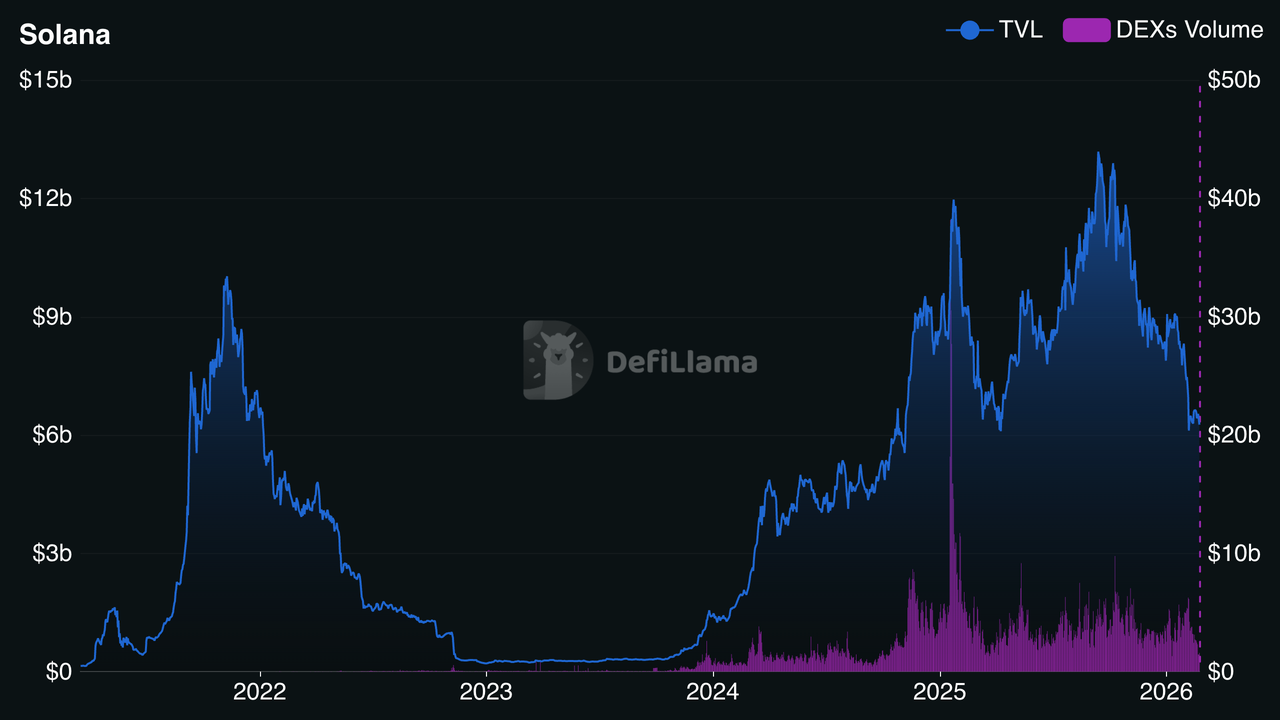
Solana DeFi TVL and DEX volume | Source: DefiLlama
As of February 2026, the Solana DeFi ecosystem boasts a Total Value Locked (TVL) of $6.264 billion, with daily app fees exceeding $5.67 million. The rise of Solana Blinks and Actions has further decentralized the experience, allowing users to execute complex trades directly from their social feeds or hardware-native wallets.
This guide provides an exhaustive review of the 7 best Solana DEXs in 2026, evaluating their liquidity depth, technical innovation, and role in the modern SVM (Solana Virtual Machine) economy.
An Overview of Solana’s High-Speed DeFi Ecosystem in 2026
The Solana DeFi ecosystem in 2026 has transitioned from an experimental playground to a high-performance financial layer. Leveraging its sub-second finality and the Firedancer upgrade, the network facilitates institutional-grade trading with a Total Value Locked (TVL) of $6.264 billion. The core benefit of Solana DEXs lies in their composability, the ability for multiple protocols to interact seamlessly. For instance, a user can swap assets on Jupiter, provide liquidity on Raydium, and instantly use those LP positions as collateral on lending platforms, all with transaction fees costing less than $0.01.
A major catalyst for this growth is the integration of Real-World Assets (RWAs), specifically through tokenized stocks (xStocks). Launched in mid-2025, xStocks brings U.S. equities like Nvidia (NVDAx) and Apple (AAPLx) on-chain, backed 1:1 by real shares. This allows non-U.S. investors 24/7 market access and T+0 (instant) settlement, bypassing traditional brokerage delays. As of early 2026, xStocks has recorded over $3 billion in total on-chain transaction volume, with Solana commanding a dominant 93% market share in the tokenized equity space.
The programmability of these assets, enabled by Solana Token Extensions, allows for automated corporate actions like dividend reinvestment and splits directly within a user's wallet. This convergence of $120 trillion global equity markets with Solana’s high-throughput blockchain provides a dual advantage: retail users gain fractional ownership and weekend trading, while crypto-native investors can utilize Wall Street assets within sophisticated DeFi yield strategies.
What Are the 7 Best Solana DEXs in 2026?
As Solana scales toward global adoption, these platforms have emerged as the leaders based on volume, security audits, and integration with the latest Agave 2.0 standards.
1. Jupiter (JUP)
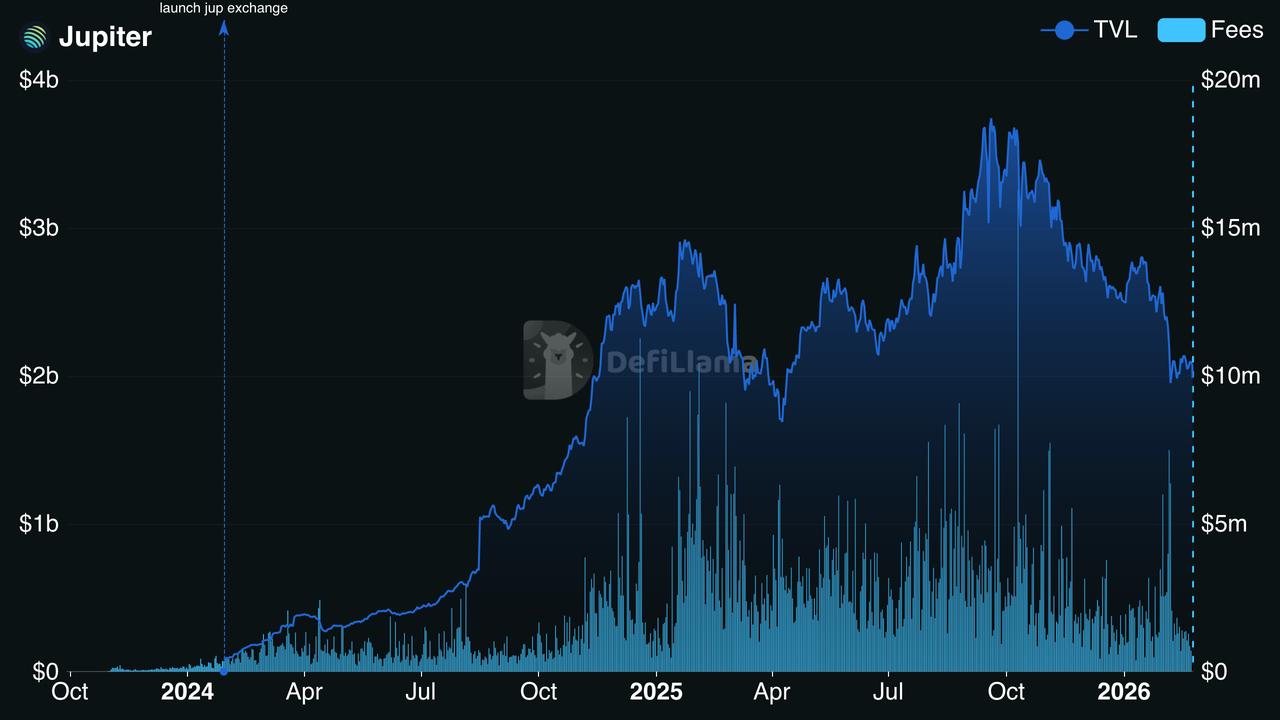
Jupiter TVL and fees | Source: DefiLlama
Jupiter (JUP) has evolved from a simple aggregator into the foundational operating system for Solana DeFi, commanding a Total Value Locked (TVL) of nearly $2 billion in February 2026. By routing trades across a directory of 10,000+ liquidity pairs, including Raydium, Orca, and Meteora, it utilizes advanced smart-routing algorithms to deliver the most efficient execution prices with minimal slippage. In the Firedancer era, Jupiter handles the majority of Solana’s retail volume, offering a CEX-like terminal experience that includes Limit Orders, Bridge Aggregation, and Perpetual trading with up to 250x leverage on major assets like SOL, BTC, and ETH.
The platform’s 2026 technical edge is driven by Ultra Mode, which introduces MEV-resistant routing and gasless swaps, allowing users to trade even when they lack SOL for transaction fees. For disciplined investors, Jupiter’s Dollar-Cost Averaging (DCA) tool has become the ecosystem standard, automating recurring buys with precise interval controls. Recent data highlights its growing utility as a credit hub, with the Jupiter Lend money market supporting a diversified borrowing environment where users can earn yields averaging 5% APY.
Best Suited For: Traders requiring high-precision execution, automated investment strategies, and a unified interface to access the entire Solana liquidity landscape.
Learn more about how Jupiter DEX works in our comprehensive explainer guide.
2. Raydium (RAY)
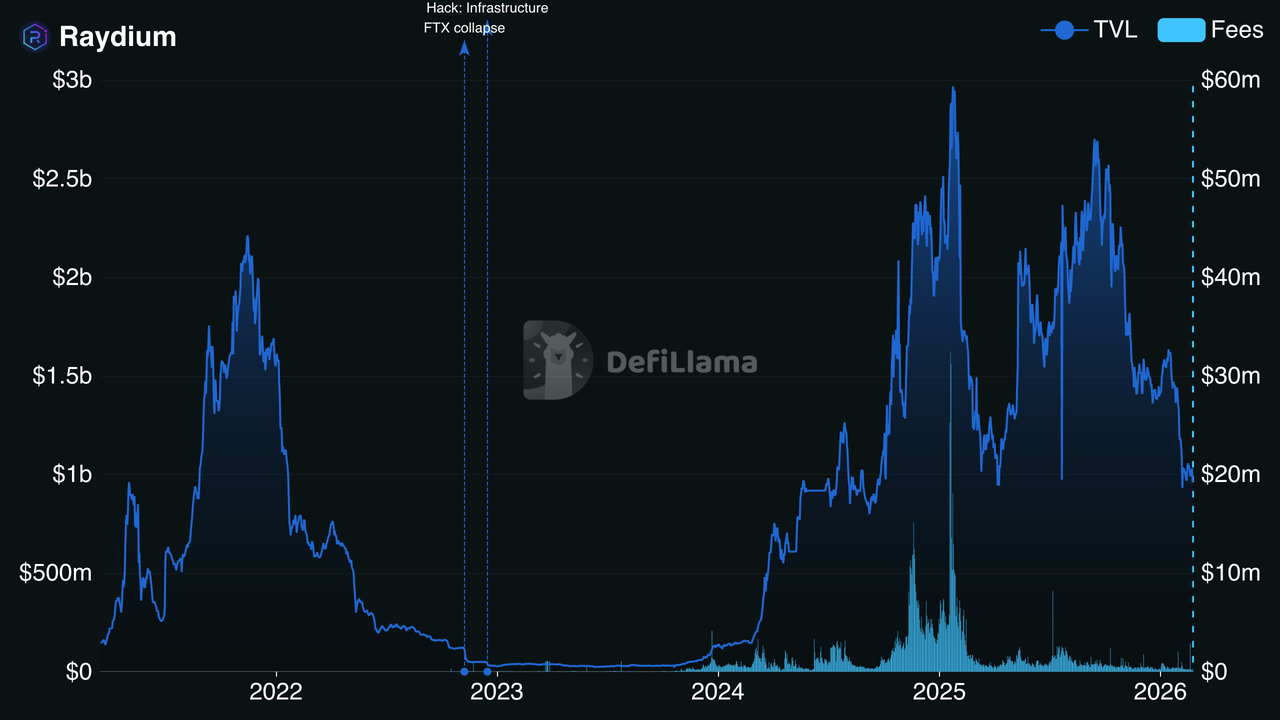
Raydium TVL and fees | Source: DefiLlama
Raydium serves as Solana’s primary liquidity infrastructure, commanding a TVL of $958.29 million as of February 2026. It functions as a versatile liquidity primitive, offering three distinct pool architectures: the battle-tested AMM v4 (legacy), high-efficiency CLMM (Concentrated Liquidity), and the modern CPMM (Constant Product) which fully supports Token-2022 standards and multiple fee tiers. This multi-layered approach allows Raydium to power over 14,000 trading pairs, making it the most integrated liquidity source for aggregators like Jupiter. Traders can execute lightning-fast swaps, trade perpetuals with leverage, or participate in Burn & Earn programs where liquidity is permanently locked to boost ecosystem trust while still accruing trading fees.
The platform’s 2026 growth is centered on LaunchLab, a sophisticated token launchpad utilizing bonding curves. Its JustSendit mode allows developers to deploy tokens in seconds, while the Custom mode offers granular control over vesting, fee-sharing, and curve types. Once a fundraising target is met, liquidity automatically migrates to a CPMM pool and the LP tokens are burned, ensuring a seamless transition from launch to active market trading. For investors, this creates a transparent graduation process for new assets, while Permissionless Farms allow any project to add custom token incentives to their pools to attract deep, stable liquidity.
Best Suited For: Liquidity providers seeking high capital efficiency via CLMM, and gem hunters looking for the highest-velocity token launches on Solana.
Learn more about how Raydium works in our detailed guide.
3. Drift Protocol (DRIFT)
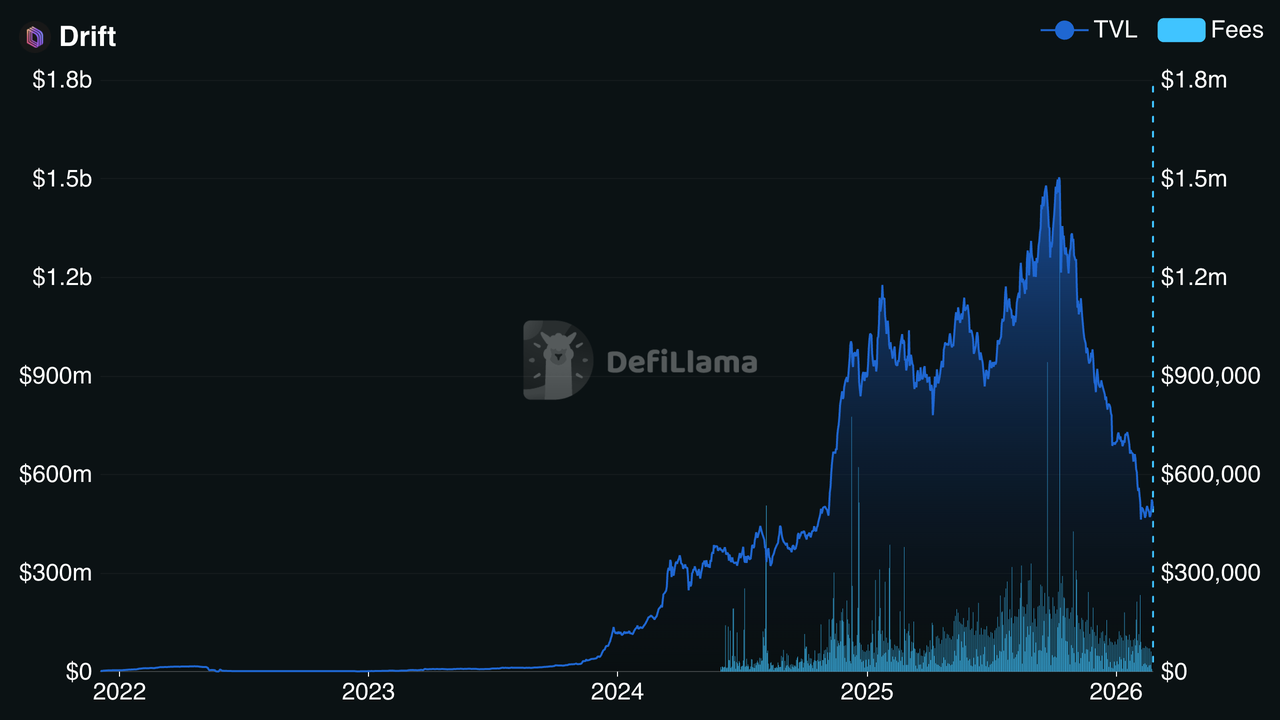
Drift Protocol TVL and fees | Source: DefiLlama
As of early 2026, Drift Protocol has cemented its status as Solana’s premier institutional-grade trading hub, managing a TVL of $494.3 million. It distinguishes itself through a Performance-First infrastructure that unifies spot margin trading, perpetuals, and a borrow-lend engine into a single cross-margined account. Drift's technical edge lies in its three-tier liquidity mechanism: it utilizes a Just-in-Time (JIT) Dutch Auction for top-of-block execution, a decentralized orderbook (DLOB) maintained by a network of Keeper Bots, and an automated market maker (vAMM) as a backstop. This hybrid approach has facilitated over 19.2 million total trades and a cumulative volume exceeding $145 billion, providing deep liquidity with minimal price impact even during extreme volatility.
Practicality and extreme capital efficiency define the 2026 Drift experience, offering up to 101x leverage on core assets like SOL, BTC, and ETH, and 20x leverage on a roster of over 40+ high-velocity perpetual markets. Advanced traders can use almost any major SPL token, including liquid staking derivatives like JitoSOL, as collateral, earning up to 16% yield via optimized lending strategies while simultaneously maintaining open leveraged positions. Security is a cornerstone of the platform, backed by a real-time risk engine with circuit breakers and rigorous audits from firms like Trail of Bits and OtterSec. For passive investors, Drift’s Backstop AMM Liquidity (BAL) vaults allow users to act as the protocol’s liquidity provider, capturing a share of trading fees and liquidations in a fully non-custodial environment.
Best Suited For: Professional traders and hedge funds requiring a high-leverage terminal with unified margin, and long-term holders looking to maximize capital efficiency by earning yield on collateral.
Learn more about the top liquid staking protocols in the crypto market.
4. Meteora
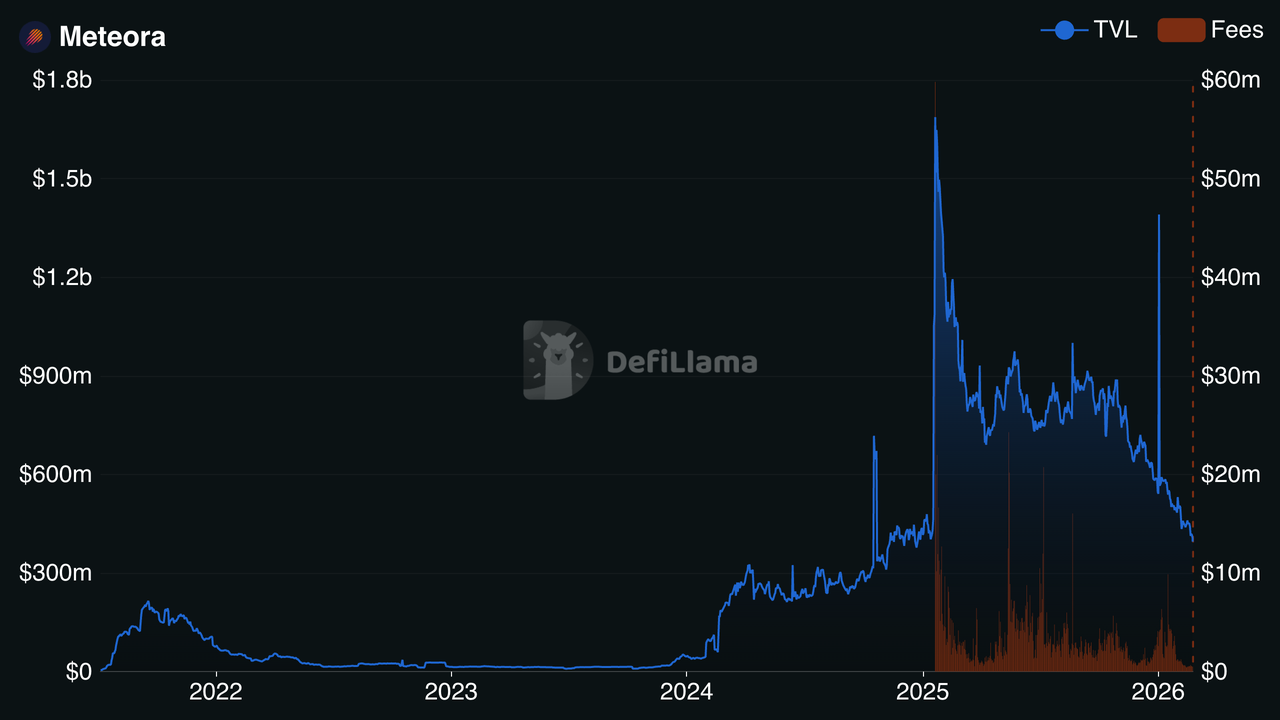
Meteora TVL and fees | Source: DefiLlama
As of early 2026, Meteora has established itself as the premier yield layer for the Solana ecosystem with a TVL of over $395 million, optimizing capital for a diverse Product Suite that includes DLMM (Dynamic Liquidity Market Maker) and DAMM (Dynamic AMM). Its flagship innovation, the DLMM, allows yield architects to bin liquidity into specific price points, creating custom liquidity shapes that can provide zero-slippage trading within a defined range. This granular control allows professional LPs to capture significantly higher fee volume during high-volatility events, while its Dynamic Vaults helper program automatically routes idle capital into lending protocols like Kamino or Solend to ensure no asset remains unproductive.
Beyond core liquidity, Meteora provides a critical Anti-Sniper Suite designed to protect token launches from malicious bot activity. This includes the Fee Time Scheduler, which imposes higher decayable fees during initial launch minutes, and the Alpha Vault, which allows genuine supporters to secure entry before public trading begins. For developers and retail users, the platform offers the Metsumi AI launch assistant, which simplifies the deployment of complex bonding curves and liquidity pools through a CLI-driven playground. By bridging the gap between professional-grade market-making tools and retail-accessible yield strategies, Meteora has become the go-to platform for the self-proclaimed LP Army looking to maximize on-chain returns.
Best Suited For: Advanced liquidity providers who want to build complex market-making strategies and token creators seeking robust anti-bot protection for new launches.
Learn how Meteora works in our detailed breakdown.
5. Orca
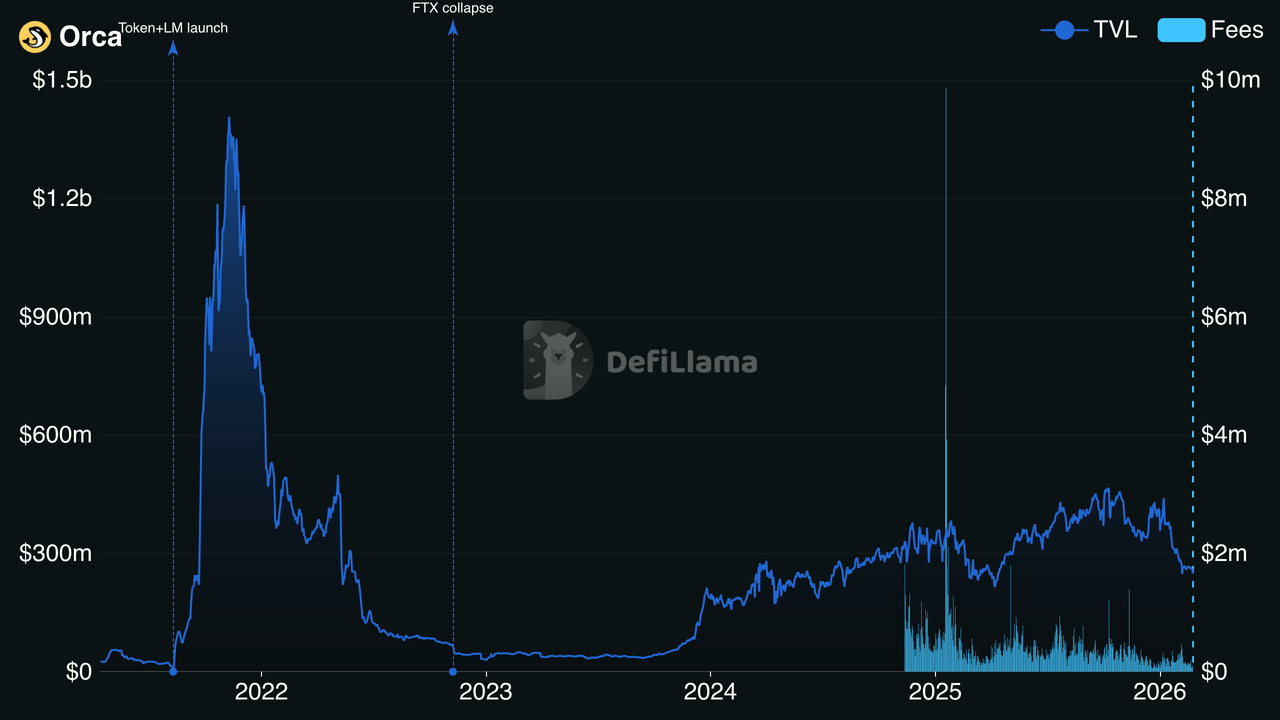
Orca TVL and fees | Source: DefiLlama
As of early 2026, Orca has matured into a cornerstone of Solana's human-centric DeFi, managing a TVL of over $247 million. Its core innovation, Whirlpools, utilizes a CLMM model that allows LPs to pin their capital to custom price ranges. This approach delivers institutional-grade capital efficiency, often requiring up to 4,000x less capital than traditional XYK pools to achieve the same depth. In 2026, Orca’s utility has expanded with Autoswap, a one-click deposit feature that automatically rebalances tokens during the LP process, and the launch of the Wavebreak launchpad, which successfully blocked over 25,000 sniper bots to ensure fair token distributions for retail users.
For traders, Orca’s hallmark is the Fair Price Indicator, which cross-references internal pool prices against external benchmarks like Jupiter to flag unfavorable rates before execution. This transparency, combined with a 2026 backend revamp that slashed latency, ensures swaps are finalized in under a second for an average fee of $0.00025. Practical tools like the Strategy Builder further simplify complex DeFi maneuvers, offering pre-built templates for yield strategies that help users navigate market volatility. With 30% of protocol fees now directed toward a DAO-led treasury buyback program, Orca seamlessly aligns its internal tokenomics with the growth of the broader Solana SVM ecosystem.
Best Suited For: Retail investors seeking a set-and-forget yield experience through automated LP tools and traders who prioritize price transparency and bot-resistant token launches.
6. PumpSwap
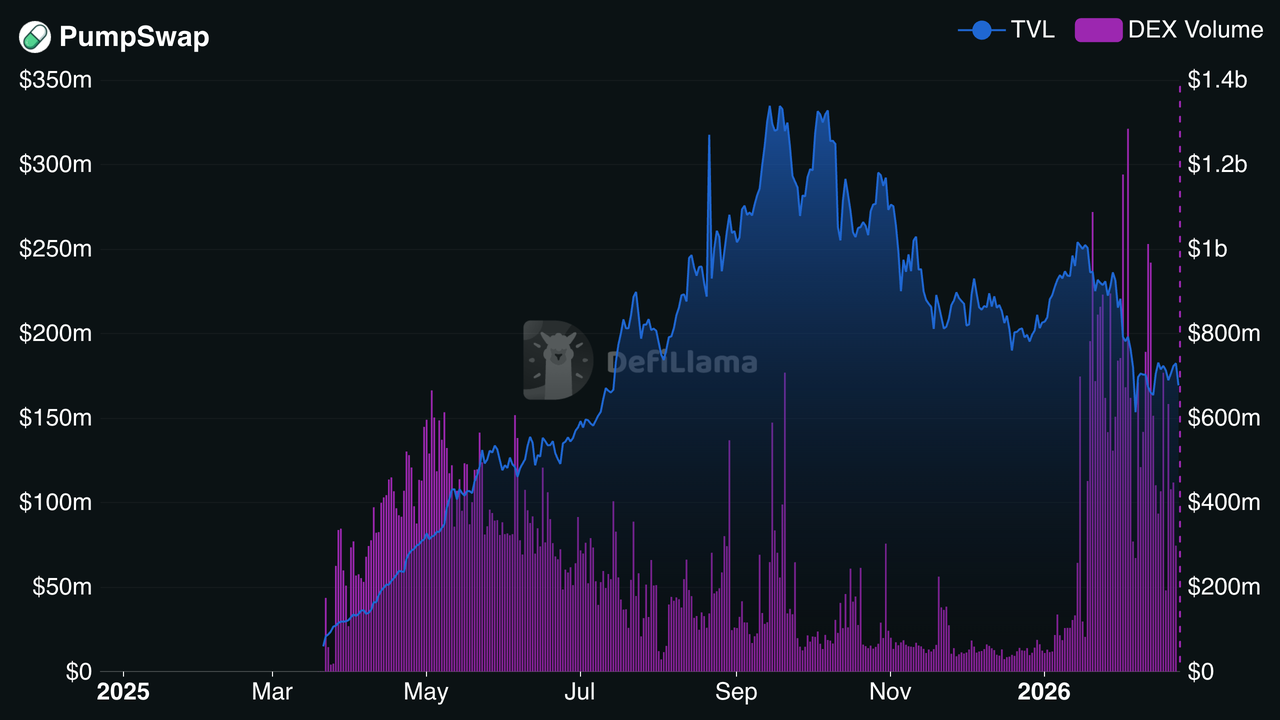
PumpSwap TVL and DEX volume | Source: DefiLlama
PumpSwap is the high-velocity execution engine for the Solana memecoin economy, commanding nearly $170 million in TVL and handling a staggering 74% of all Solana DEX volume during peak cycles. Born as the native DEX for Pump.fun, it eliminated the friction of the legacy graduation process by scrapping the 6 SOL migration fee in favor of a zero-cost, instant listing model. Once a token completes its bonding curve at approximately $69,000–$90,000 market cap, liquidity is automatically seeded into PumpSwap’s constant-product AMM. As of February 2026, the platform supports over 25,000 active trading pairs and regularly processes over $400 million in 24h volume, rivaling traditional heavyweights like Raydium in sheer transaction count.
The platform’s 2026 technical edge lies in its Trader-First incentive model, which includes a 0.3% Trader Cashback program that lets creators redirect rewards directly to active participants. Its integration with the Vyper Trading Terminal, acquired in early 2026, provides professional-grade tools like limit orders, stop losses, and real-time social sentiment overlays directly within the swap interface. With a streamlined 0.25% trading fee, 0.20% to LPs; 0.05% to protocol, PumpSwap has successfully gamified the Ape-in culture for the mobile-first Seeker phone era, making it the primary venue for community-driven investors who prioritize speed and social momentum over long-term fundamentals.
Best Suited For: High-risk retail traders and degen investors who require sub-second execution and professional-grade charting for low-cap, high-volatility tokens.
7. HumidiFi (WET)
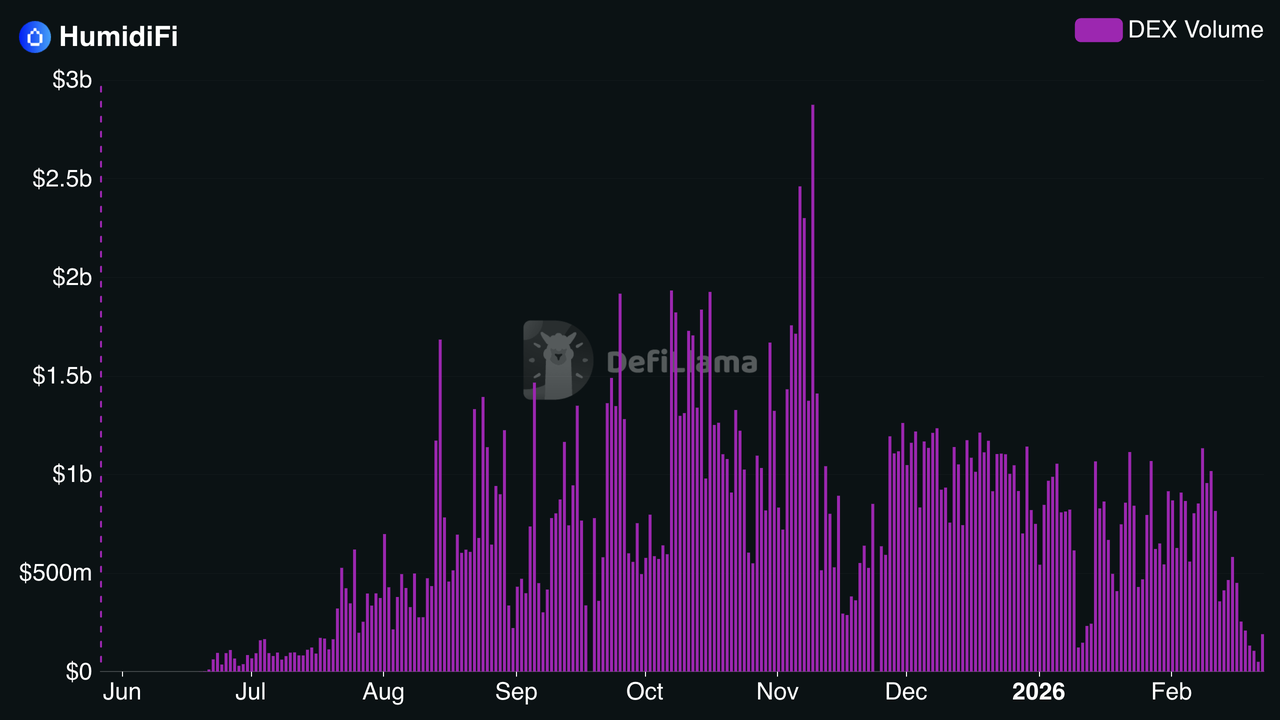
HumidiFi DEX trading volume | Source: DefiLlama
HumidiFi (WET) has emerged in 2026 as the vanguard of DeFi 2.0 on Solana, functioning as a Proprietary AMM (Prop AMM) that currently processes over $1 billion in daily volume. Accounting for roughly 35% of all spot DEX activity on the network, it replaces the static, inefficient curves of legacy models with institutional-grade market-making logic. HumidiFi’s technical edge lies in its active-liquidity framework, which separates off-chain high-frequency intelligence from on-chain settlement. This allows for predictive quoting, where quotes are generated based on real-time global market data and HFT models, ensuring tighter spreads and deeper liquidity that consistently outperforms both traditional DEXs and centralized exchanges (CEXs).
The platform’s 2026 breakthrough is its ability to treat retail users as first-class citizens. By using its predictive engine to differentiate between genuine retail flow and toxic arbitrage or informed bots, HumidiFi offers everyday traders significantly better execution and less slippage. This architecture maintains full composability, routing through major ecosystem hubs like Jupiter and DFlow, while ensuring that hundreds of liquidity pools can update their prices in milliseconds off a single oracle tick. For the hands-off investor, HumidiFi serves as a universal liquidity layer, providing the transparency of a blockchain with the execution quality and price discovery of a world-class trading desk.
Best Suited For: Retail traders seeking CEX-level execution without sacrificing self-custody, and institutional partners looking for a highly efficient, data-driven liquidity layer on Solana.
Learn more about how HumidiFi DEX works in our explainer article.
Beyond On-Chain Solutions: Trade Solana Tokens with Ease on BingX ChainSpot
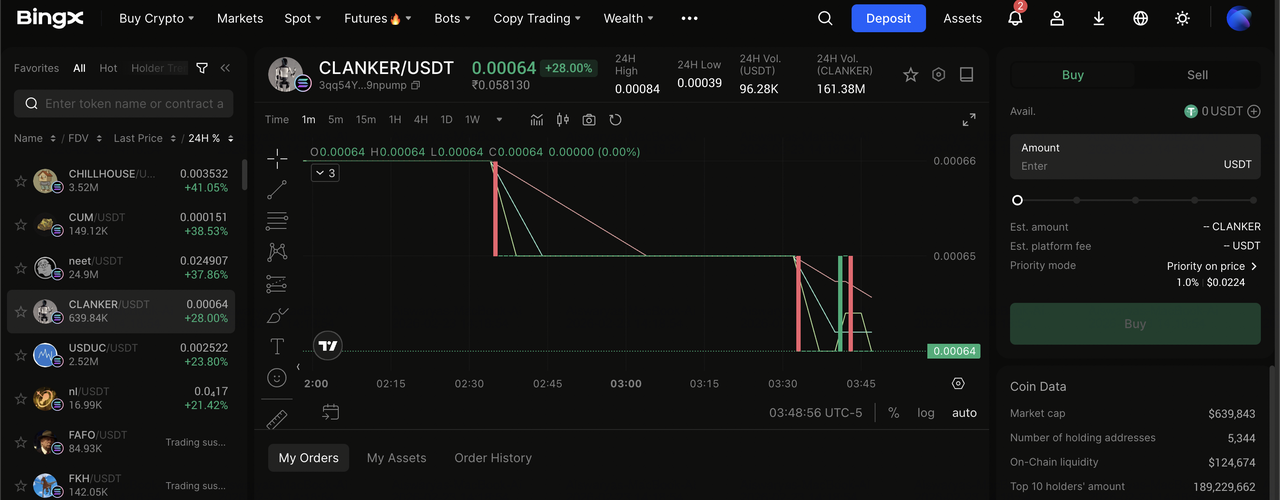
While decentralized exchanges offer autonomy, the technical barrier of gas fees, slippage, and wallet security can be daunting. For traders who want the exposure of Solana’s trending tokens with the security of a top-tier exchange, BingX ChainSpot offers a revolutionary alternative.
How to Trade Emerging Solana Tokens on ChainSpot
BingX ChainSpot is a CeDeFi (Centralized-Decentralized Finance) gateway that bridges the gap between on-chain innovation and exchange-grade convenience.
• Zero Gas Headaches: Trade trending Solana tokens directly with USDT. You don't need to hold native SOL for gas fees; BingX handles the technical execution on the back end.
• Instant Access: Get exposure to tokens listed on Raydium or PumpSwap minutes after they gain traction, all within your familiar BingX account.
• Unified Margin: Use your BingX balance to hedge your Solana positions with BingX TradFi, trading gold, crude oil, or global stocks alongside your crypto assets.
Best Suited For: Traders who want the alpha of on-chain Solana tokens without the complexity of manual bridging or managing seed phrases.
How to Trade Solana DEX Tokens on BingX
Powered by BingX AI, the platform helps you identify trends, manage risk, and execute trades more efficiently when trading fast-moving Solana DEX tokens.
Buy or Sell Solana DEX Tokens on the BingX Spot Market
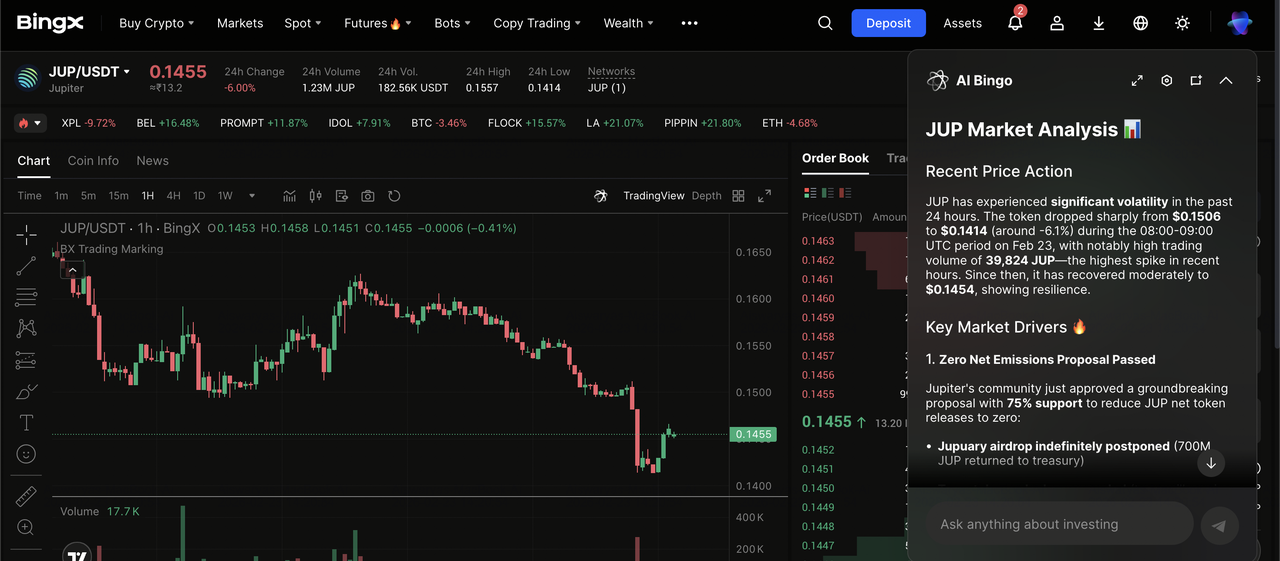
JUP/USDT trading pair on the spot market featuring BingX AI insights
On the BingX spot market, you can buy and sell supported Solana-based DEX tokens directly using pairs like USDT, making it easy to enter or exit positions at real market prices. Spot trading is ideal if you want full ownership of the tokens, simple order types, and straightforward exposure without leverage.
Long or Short Solana DEX Tokens on the BingX Futures Market
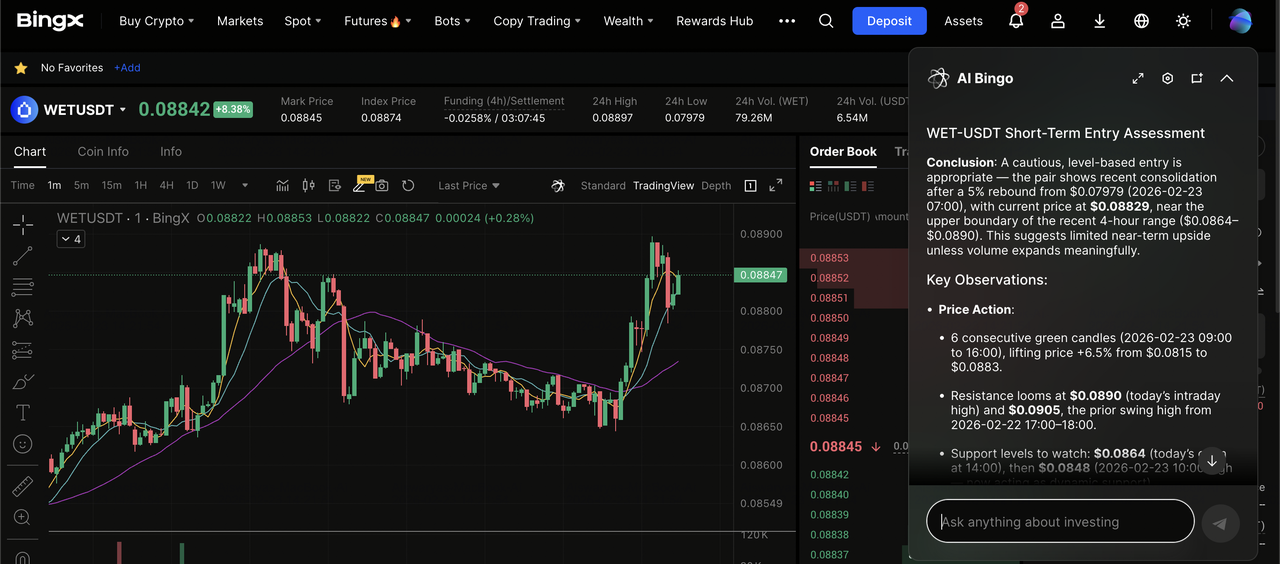
WET/USDT perpetual contract on the futures market featuring BingX AI insights
For more advanced strategies, BingX futures trading lets you trade Solana DEX tokens with leverage, enabling you to go long or short based on market direction. With tools such as adjustable leverage, stop-loss, take-profit, and BingX AI-powered insights, futures trading offers greater flexibility, but also comes with higher risk, making proper risk management essential.
How to Select the Best Solana DEX for Your Needs
Choosing the right platform in 2026 depends on aligning the protocol’s technical architecture with your specific trading frequency and risk profile.
• For Optimal Pricing: Jupiter functions as the primary routing layer for the ecosystem. Its aggregation engine scans over 10,000+ liquidity paths to minimize slippage, making it the standard for spot swaps and automated DCA.
• For Leveraged Trading: Drift Protocol is the established venue for perpetual futures, offering up to 101x leverage on core assets. Its v3 infrastructure features sub-400ms execution and a cross-margined risk engine designed for institutional-grade precision.
• For Yield Generation: Meteora and Orca provide advanced concentrated liquidity tools. Orca Whirlpools offers a streamlined interface for retail yield seekers, while Meteora DLMM allows for granular liquidity shaping to maximize fee capture during high-volatility events.
• For Centralized Efficiency: BingX ChainSpot serves as a CeDeFi gateway, allowing for the direct trade of trending on-chain tokens using USDT. This eliminates the requirement for external wallet management and manual gas estimation while maintaining direct access to on-chain liquidity.
Final Thoughts: The Future of Decentralized Trading on Solana
By early 2026, the Solana network has transitioned into a robust, institutional-grade infrastructure. The full integration of the Firedancer validator and the Alpenglow consensus protocol has effectively narrowed the gap between decentralized and centralized exchange performance, offering sub-200ms finality. Whether users are utilizing the advanced liquidity shapes of Meteora or the simplified CeDeFi efficiency of BingX, the ecosystem provides a high-velocity environment capable of supporting both retail memecoin markets and professional tokenized equities.
However, the rapid scaling of the Internet Capital Markets brings a more complex risk landscape. High-speed trading on Solana remains subject to Maximal Extractable Value (MEV) exploits, such as sandwich attacks, and the increased usage of Token-2022 extensions introduces new smart contract vulnerabilities like infinite recursion in transfer hooks. Traders should prioritize protocols with rigorous 2026-standard audits and utilize MEV-protected RPCs or aggregators like Jupiter to mitigate slippage. As always, the inherent volatility of digital assets means that technical performance does not guarantee financial returns; users should only allocate capital they are prepared to lose.
Remember, DeFi trading involves significant risks, including smart contract vulnerabilities and market volatility. Only invest capital you are prepared to lose and always verify URLs before connecting your wallet.
