


Western Digital Corporation (WDC) designs and manufactures data-storage infrastructure, with hard disk drives serving cloud, enterprise and consumer markets. Nearline capacity products sit at the center of its data-center exposure, while client and consumer drives broaden the revenue base. This focus gives Western Digital direct access to expanding AI data volumes, but it also leaves results sensitive to hyperscaler spending, industry capacity and storage pricing.
The latest quarter showed that the operating reset has moved from promise to reported results. Fiscal Q4 revenue increased 44% year over year, non-GAAP gross margin expanded by more than thirteen percentage points, and free cash flow strengthened. The investment case now depends on whether long-duration cloud demand and disciplined supply can preserve those economics after an exceptional re-rating.
The WDC stock forecast for 2026 centers on two competing views:
- The AI storage infrastructure case: Bulls expect rapid exabyte growth, multi-year hyperscaler planning and constrained nearline capacity to support pricing, margins and cash generation.
- The cyclical normalization case: Bears argue that a strong demand cycle and elevated margins can invite capacity, customer digestion and a lower valuation multiple before the operating business weakens materially.
This guide breaks down the WDC stock forecast, 2026 price scenarios, key risks and analyst outlooks, drawing on Western Digital's August 5 fiscal Q4 earnings release, annual disclosures and market data through September 2, 2026, plus how to trade WDC stock futures on BingX TradFi with USDT collateral.
Top 5 Things for WDC Investors to Know in September 2026
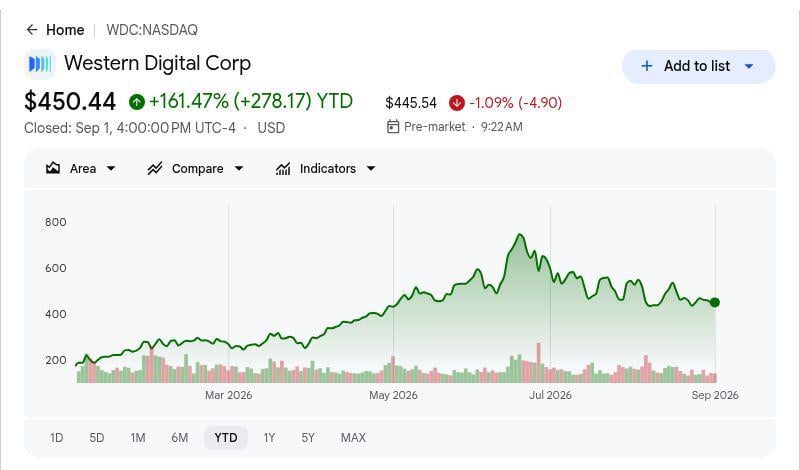
- A 161.47% YTD gain makes expectations the first valuation test: The September reference close followed a rapid re-rating, so further upside requires earnings revisions and durable demand rather than momentum alone.
- Revenue growth of 44% confirmed that the storage upcycle reached reported results: The quarter combined stronger cloud demand with improved pricing, separating the current cycle from a purely narrative-driven AI trade.
- Non-GAAP gross margin of 54.4% showed unusual operating leverage: A thirteen-point annual expansion indicates that product mix, pricing and disciplined supply translated demand into profitability.
- Free cash flow of $1.28 billion improved strategic flexibility: Stronger cash generation supports debt reduction, capital returns and selective capacity investment without weakening the balance sheet.
- Named analyst targets span a wide range: The dispersion reflects different assumptions about supply discipline, hyperscaler demand visibility and how much of the margin expansion should be treated as structural.
What Is Western Digital (WDC)?
Western Digital (WDC) is a San Jose-based data-storage company focused primarily on hard disk drives used across cloud, enterprise, client, and consumer markets. Its highest-capacity nearline HDDs are especially important for hyperscale data centers, where customers need large amounts of cost-efficient storage for AI training data, inference workloads, backups, and long-term data retention. This positions Western Digital behind the compute layer of AI infrastructure, supplying the persistent storage needed to support rapidly expanding datasets.
Western Digital is also shifting toward a more collaborative model with major hyperscale cloud and data-center customers, using multi-year agreements, joint capacity planning, and earlier visibility into future storage needs. WD says these customers increasingly rely on the company for long-term capacity planning, while new 40TB UltraSMR and HAMR drives are already qualified for hyperscale customers. Rather than adding supply aggressively during periods of strong demand, management is using customer commitments to guide production and technology transitions, helping reduce the inventory swings that have historically made the HDD cycle more volatile
Read More: Top AI Memory Stocks to Buy in 2026: DRAM, HBM, and AI Storage Demand Explained
Western Digital (WDC) Fiscal Q4 Earnings Overview: AI Storage Demand Converts Into Margin Expansion
- Quarterly revenue of $3.747 billion increased 44% year over year: The result also rose 12% sequentially, showing that demand and pricing improved through the fiscal year rather than peaking early.
- Non-GAAP diluted EPS of $3.56 increased 109% year over year: The result exceeded the tracked estimate and showed that gross-margin gains reached per-share earnings despite the capital intensity of the business.
- Non-GAAP gross margin of 54.4% expanded 1,310 basis points: The increase supports the view that tight supply, richer nearline mix and execution produced a material earnings reset.
- Operating cash flow of $1.39 billion supported $1.28 billion of free cash flow: Conversion at this level makes balance-sheet repair and capital allocation more credible than an earnings-only recovery.
- First-quarter guidance points to another large annual revenue increase: Management's midpoint also implies further margin and earnings progress, although guidance remains a roadmap rather than a booked result.
Western Digital Fiscal Q4 Financial and Consensus Profile: Revenue, EPS and Margins
Western Digital’s fiscal Q4 results showed a clear step-up in both earnings and cash generation. Revenue reached $3.747 billion, above the tracked $3.699 billion estimate, while non-GAAP diluted EPS of $3.56 also exceeded the $3.31 consensus. Profitability improved sharply, with non-GAAP gross margin at 54.4%, operating margin at 44.2%, and free cash flow reaching $1.28 billion.
|
Financial Metric |
Guidance / Consensus |
Reported / Actual |
Surprise |
|
Fiscal Q4 revenue |
$3.699 billion |
$3.747 billion |
Beat. Above the tracked estimate. |
|
Fiscal Q4 non-GAAP diluted EPS |
$3.31 |
$3.56 |
Beat. Profitability exceeded expectations. |
|
GAAP net income |
— |
$3.195 billion |
Improved. Earnings benefited from operating strength and tax items. |
|
GAAP diluted EPS |
— |
$8.21 |
Improved. Reported per-share income rose sharply. |
|
GAAP gross margin |
— |
54.10% |
Expanded. Up 1,310 basis points year over year. |
|
Non-GAAP gross margin |
— |
54.40% |
Expanded. Up 390 basis points sequentially. |
|
Non-GAAP operating margin |
— |
44.20% |
Strengthened. Mix and pricing lifted leverage. |
|
Operating cash flow |
— |
$1.39 billion |
Strong. Cash conversion supported deleveraging. |
|
Free cash flow |
— |
$1.28 billion |
Strong. Capital needs remained well covered. |
|
Fiscal Q1 2027 revenue midpoint |
— |
$4.1 billion |
Positive. Implies 42% to 49% annual growth. |
|
Fiscal Q1 2027 non-GAAP gross-margin midpoint |
— |
55.50% |
Higher. Guidance extends margin momentum. |
|
Fiscal Q1 2027 non-GAAP EPS midpoint |
— |
$4.00 |
Positive. Guidance points to further leverage. |
The most important takeaway is that the improvement was not limited to revenue. Western Digital also delivered stronger margins and cash flow, then guided fiscal Q1 2027 revenue to a $4.1 billion midpoint, non-GAAP gross margin to 55.5%, and non-GAAP EPS to $4.00. Because GAAP earnings were boosted by tax items, non-GAAP margins, operating leverage, and free cash flow provide a cleaner view of the underlying trend.
Western Digital (WDC) 2026 Investment Outlook: $900 Bull Case vs. $350 Bear Case
The central test is whether AI-driven data growth can keep storage demand ahead of disciplined industry supply long enough to make the margin reset durable.
The Bull Case: AI Storage Demand and Supply Discipline Push WDC Toward $900
The bullish case begins with persistent exabyte growth across training, inference and agentic workloads. Large cloud customers need more nearline capacity even when compute architectures change, and multi-year procurement visibility can help Western Digital plan supply without triggering the inventory excesses that damaged earlier cycles.
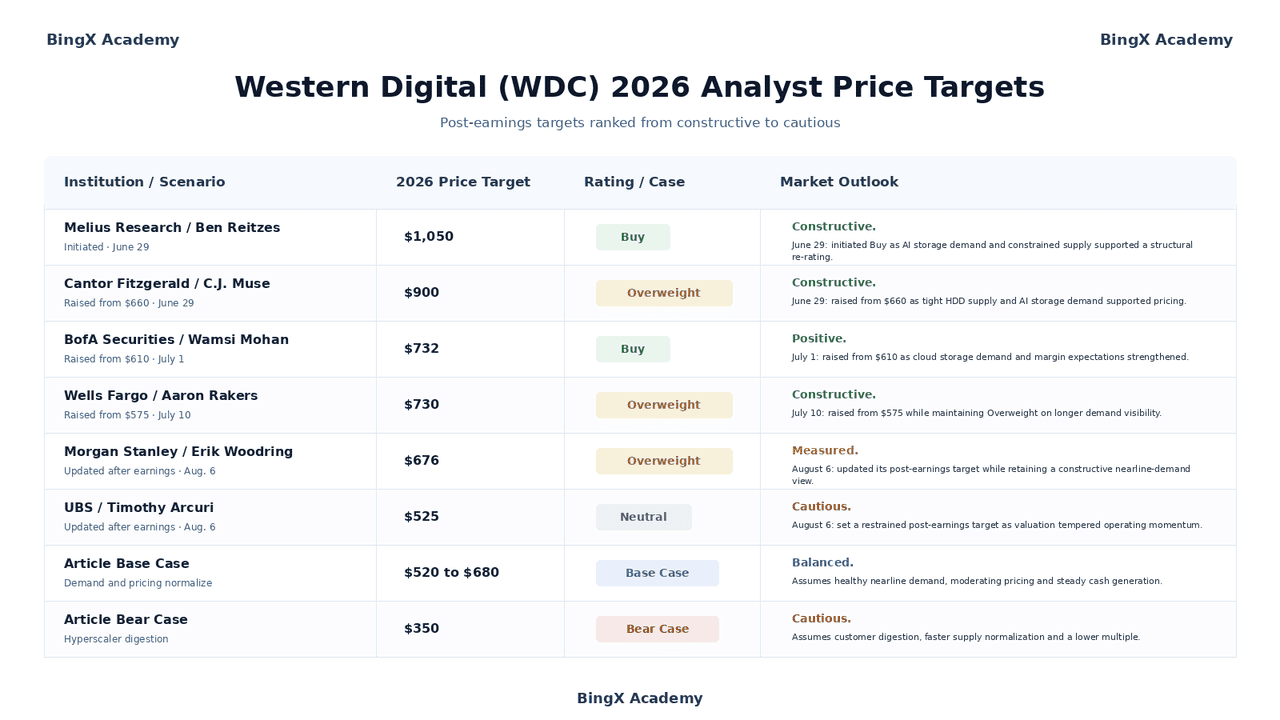
This editorial scenario requires strong execution on capacity, technology transitions and customer agreements. Cantor Fitzgerald's named target is the closest high reference in the selected set, while the scenario level remains an article-defined outcome rather than a Street consensus.
The Base Case: Durable Cloud Demand Keeps WDC Between $520 and $680
The base case assumes cloud demand remains healthy while pricing and margin expansion moderate after an unusually strong fiscal year. Revenue and cash flow can still grow, but the equity may spend more time consolidating as investors distinguish structural AI storage demand from cyclical scarcity.
The range aligns with the current cluster formed by UBS, Mizuho, Baird and Morgan Stanley. Confirmation would come from stable nearline demand, continued supply discipline and cash generation that remains strong even as annual comparisons become more demanding.
The Bear Case: Slower Orders and Margin Normalization Pull WDC Toward $350
The bear case does not require AI data growth to disappear. It requires major customers to digest capacity, supply availability to improve faster than demand, or pricing to normalize before operating costs adjust. A lower multiple could then amplify a modest earnings reset.
The clearest triggers would be shorter order visibility, weaker exabyte shipments, rising channel inventory or a rapid decline in gross margin. The bear reference is an editorial scenario, not a prediction or an analyst target.
WDC Stock Price Forecasts for 2026 By Wall Street Analysts
These rows are dated, named third-party actions, and their spread is evidence of uncertainty rather than one unified forecast. The final two rows are BingX Academy editorial scenarios, clearly separated from the real analyst actions while remaining in the same comparison table.
|
Institution / Scenario |
2026 Price Target |
Rating / Case |
Market Outlook |
|
Melius Research |
$1,050 |
Buy |
Constructive. June 29: set the selected Street-high reference as AI storage demand and constrained supply supported a structural re-rating. |
|
Cantor Fitzgerald |
$900 |
Overweight |
Constructive. June 29: raised from $660 as tight HDD supply and AI storage demand supported pricing. |
|
BofA Securities |
$732 |
Buy |
Positive revision. July 1: raised from $610 as cloud storage demand and margin expectations strengthened. |
|
Wells Fargo |
$730 |
Overweight |
Constructive. July 10: raised from $575 while maintaining Overweight on longer demand visibility. |
|
Morgan Stanley |
$676 |
Overweight |
Measured. August 6: updated its post-earnings target while retaining a constructive view on nearline demand. |
|
UBS |
$525 |
Neutral |
Cautious. August 6: set a more restrained post-earnings reference as valuation tempered operating momentum. |
|
Article Base Case |
$520 to $680 |
Base Case |
Balanced. Assumes healthy nearline demand, moderating pricing and continued cash generation after the re-rating. |
|
Article Bear Case |
$350 |
Bear Case |
Cautious. Assumes hyperscaler digestion, faster supply normalization and a lower earnings multiple. |
How to Trade Western Digital (WDC) Stock on BingX
Trade Western Digital's AI storage, pricing and margin outlook using BingX TradFi and BingX AI tools. Because WDC can react sharply to hyperscaler spending, capacity signals and earnings guidance, traders should define both the catalyst and risk limits before entering a position.
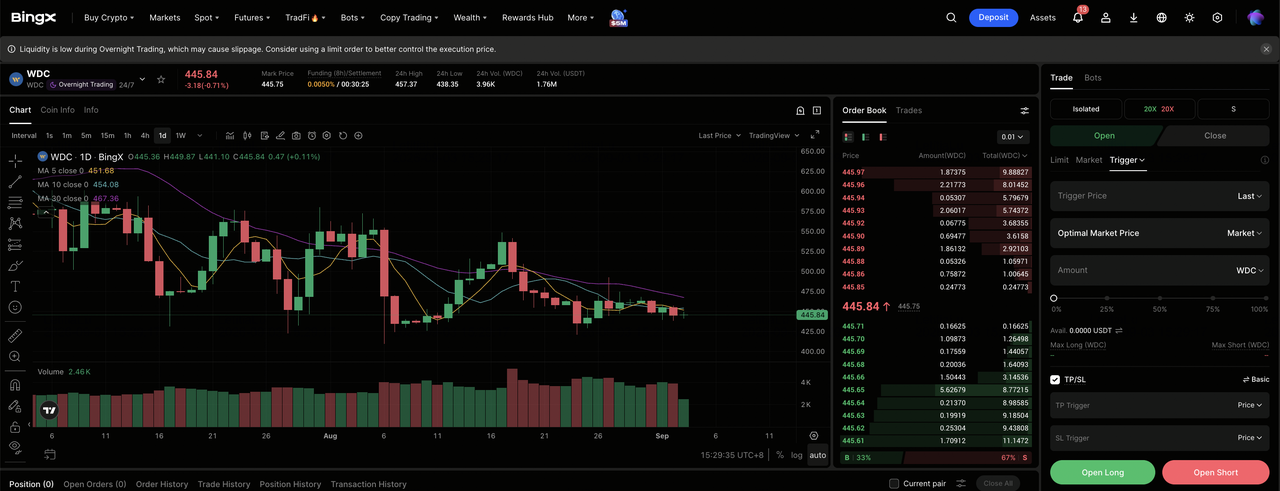
Step 1: Access BingX TradFi. Sign up and navigate to the specialized TradFi section on the BingX exchange dashboard.
Step 2: Select Western Digital (WDC). Search for and select the WDC-USDT perpetual futures contract.
Step 3: Choose your direction. Select Open Long if you expect sustained nearline demand, disciplined supply and stable margins. Select Open Short if you expect customer digestion, weaker pricing or a valuation reset.
Step 4: Select leverage and margin mode. Choose Isolated or Cross-Margin based on your risk tolerance. The scale of the YTD move shows why conservative leverage and clear position sizing are important.
Step 5: Execute strict risk protocols. Set Take-Profit and Stop-Loss (TP/SL) levels before or immediately after entering the trade. WDC can react quickly to earnings, gross-margin guidance, hyperscaler capex, capacity announcements and analyst revisions.
Top 5 Risks to Watch for Western Digital Investors in 2026
Western Digital's operating momentum is strong, yet five transmission channels could weaken earnings durability and per-share value.
- Hyperscaler digestion can interrupt nearline demand: Large cloud customers buy in substantial increments. A pause after rapid deployment can reduce shipments and pricing power even when long-term data creation remains healthy.
- Supply normalization can compress exceptional margins: Capacity additions, better yields or more aggressive competition can close the supply-demand gap. Gross margin may decline faster than revenue if pricing turns before costs adjust.
- Technology transitions carry execution and capital risk: Higher-capacity drives require complex product ramps and customer qualification. Delays can shift mix, raise costs and allow competitors to capture strategic deployments.
- Customer concentration magnifies planning errors: A small group of cloud customers influences demand visibility. Contract changes, internal architecture decisions or weaker capex can materially affect factory loading.
- The valuation now demands continued delivery: A large YTD re-rating reduces the cushion for guidance misses. Slower revisions or a lower market multiple can pressure the stock before absolute earnings contract.
Final Thoughts: Should You Invest in Western Digital in 2026?
Western Digital's operating improvement is not in dispute. Revenue, gross margin, earnings and cash flow all advanced sharply in fiscal Q4, while management's next-quarter outlook extended the demand and profitability trend. The business has become a direct way to express the view that AI infrastructure needs persistent storage as well as compute.
The bull case depends on multi-year hyperscaler planning and disciplined supply preserving strong economics. The bear case centers on customer digestion, margin normalization and a valuation that has already anticipated substantial progress. Conservative traders may wait for evidence that cash generation and order visibility remain durable through tougher comparisons.
Risk Reminder: Trading and investing in equities like WDC involves a high risk of capital loss. Western Digital is exposed to storage cycles, customer concentration, technology transitions, pricing volatility, capital intensity, leverage and valuation compression. Conduct independent research before allocating capital.
Related Reading
- Top AI Memory Stocks to Buy in 2026: DRAM, HBM, and AI Storage Demand Explained
- Top AI Data Center Stocks to Buy in 2026: Cloud, Servers, and AI Compute Infrastructure
- Micron Stock Price Prediction 2026: $1,500 AI Supercycle or Peak Margin Cyclical Trap?
- Sandisk (SNDK) Price Prediction 2026: Can AI Data Center Demand Push SNDK Toward $3,000?
- Seagate (STX) Price Prediction 2026: Can AI Storage Demand Drive STX Stock to $1,600?
- Roundhill Memory ETF (DRAM) Forecast 2026: $1.5B AI Supercycle or 'RAMmageddon' Trap?
