



The iShares Semiconductor ETF (SOXX) is a passively managed fund that tracks the NYSE Semiconductor Index, giving investors concentrated exposure to U.S.-listed semiconductor companies. It holds 30 stocks across the chip value chain, from designers and manufacturers to equipment makers, with results driven by the earnings, guidance, and sentiment of its underlying holdings rather than any single company. Because so much semiconductor demand now flows through artificial intelligence, SOXX has become one of the most direct ways to express a view on the AI infrastructure buildout.
The investment case now centers on whether the AI-driven chip cycle can sustain a rally that has already been compared to the dot-com era. SOXX has returned roughly 93% year to date and about 137% over the trailing year, lifting its portfolio price-to-earnings ratio near 76x, while its three-year beta of 2.0 means it tends to move about twice as much as the broad market in either direction. At the same time, the fund carries a low 0.34% expense ratio and roughly $47.8 billion in assets, and will begin trading on a split-adjusted basis on November 5, 2026. For investors, the key question is whether AI demand can keep earnings growing into an elevated valuation.
The SOXX forecast for 2026 now centers on two competing views:
- The AI supercycle case: Bulls expect AI data center buildouts, custom silicon, high-bandwidth memory demand, and broadening chip adoption to keep the sector's earnings compounding, supporting further gains from an already strong year.
- The valuation-and-cyclicality case: Bears see a 76x portfolio P/E, a beta of 2.0, heavy concentration in a handful of names, and the semiconductor industry's long history of boom-bust cycles as reasons the fund is exposed to a sharp drawdown.
This guide breaks down the SOXX forecast, 2026 price scenarios, key risks, and the sector backdrop, plus how to trade SOXX stock futures on BingX TradFi with USDT collateral.
Top 5 Things for SOXX ETF Investors to Know in 2026
SOXX traded near $553 in mid-2026 before its planned split, up roughly 93% year to date, with the fund remaining highly sensitive to AI chip demand, its largest holdings, and shifts in sector sentiment.
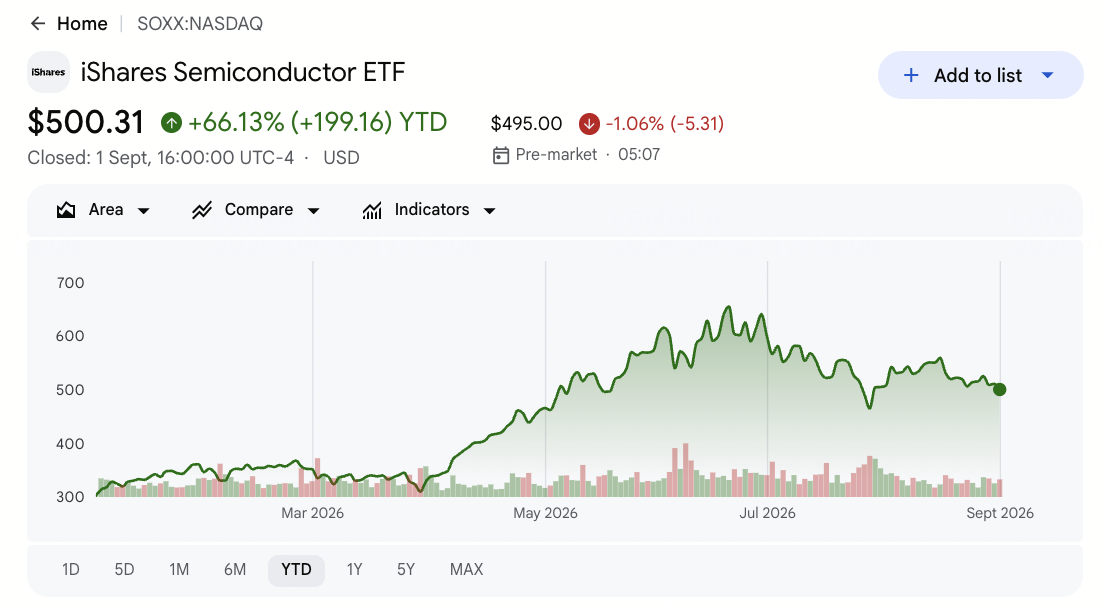
- AI infrastructure demand is the main driver of the rally. Spending on GPUs, accelerators, networking chips, and custom silicon has lifted many of SOXX’s holdings, helping the ETF gain roughly 93% year to date and about 137% over the trailing year.
- SOXX concentrates exposure across 30 semiconductor stocks. The fund tracks the NYSE Semiconductor Index and includes chip designers, memory companies, and equipment suppliers, with Micron at about 8.54% and AMD among the largest holdings. That concentration means a small group of companies can have a large impact on returns.
- Memory and custom silicon are broadening the AI trade. High-bandwidth memory demand has tightened supply and supported pricing, while hyperscaler custom chips and semiconductor-equipment spending have expanded the rally beyond the largest GPU names.
- Valuation and volatility have risen sharply. SOXX trades near 76x portfolio earnings with a price-to-book ratio around 13x, while its three-year beta is about 2.0. Strong earnings expectations support the premium, but weaker growth or a shift in sentiment could produce sharp corrections.
- A forward split changes the share price, not the investment value. SOXX is scheduled to begin trading on a split-adjusted basis on November 5, 2026. The split lowers the quoted price per share without changing the value of an existing position, while the fund’s 0.34% expense ratio and concentrated semiconductor exposure remain unchanged.
What Is the iShares Semiconductor ETF (SOXX)?
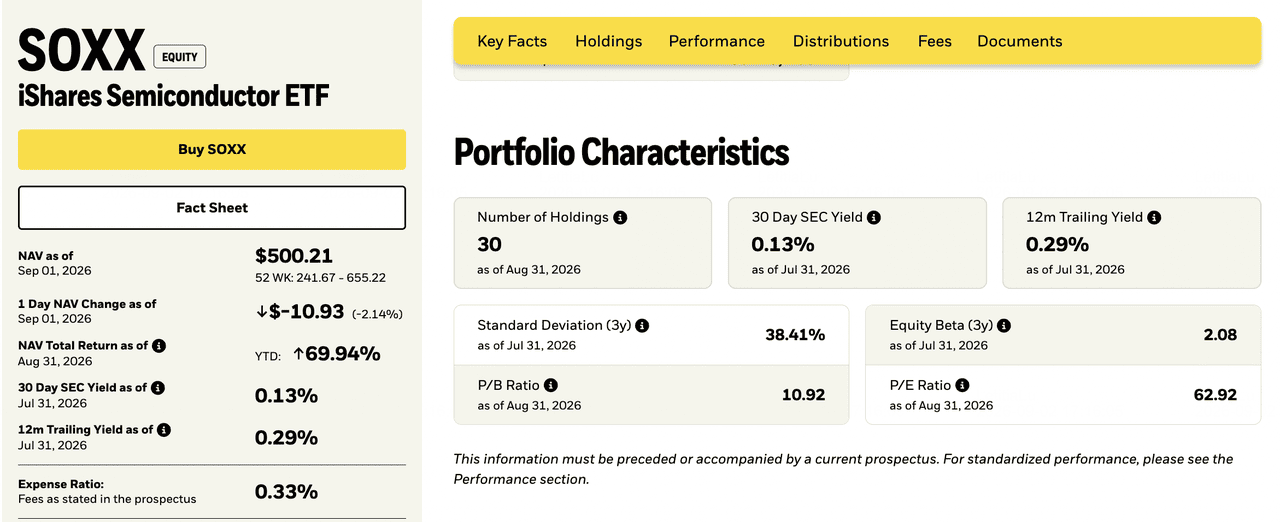
The iShares Semiconductor ETF (SOXX) is a passively managed fund launched in 2001 that tracks the NYSE Semiconductor Index. It holds companies across the semiconductor value chain, including chip designers, memory makers, foundries, and equipment suppliers, giving investors exposure to areas such as AI computing, data centers, advanced manufacturing, and digital infrastructure through a single ETF. Because the portfolio spans multiple parts of the chip industry, SOXX offers broader sector exposure than owning one semiconductor stock alone.
SOXX is still a concentrated sector fund, so its performance moves closely with the semiconductor cycle and the earnings of its largest holdings, including Nvidia, Micron, AMD, and Broadcom. Returns are influenced by AI and data-center spending, memory pricing, foundry utilization, equipment demand, and broader technology sentiment. That gives SOXX strong upside when semiconductor earnings accelerate, but also makes it more volatile when valuations compress, inventories rise, or capital spending slows. In practice, SOXX is a way to invest in the broader semiconductor growth story while accepting much higher sector concentration and cyclicality than a diversified market ETF.
SOXX ETF Top Holdings 2026: Nvidia, Micron, AMD, Broadcom, and More
SOXX holds 30 semiconductor stocks across chip design, memory, foundries, and equipment. Its largest positions remain concentrated in Nvidia, Micron, AMD, and Broadcom, which together account for about 34% of the fund, making AI accelerators, high-bandwidth memory, and custom silicon major performance drivers. Beyond those names, SOXX also includes Intel, Marvell, TSMC, Applied Materials, Lam Research, and KLA, giving the fund exposure to CPUs, networking, advanced chip manufacturing, and semiconductor equipment.
- Net assets: ~$41.7 billion
- Expense ratio: 0.33%
- Portfolio P/E: ~62.9x
- 3-year beta: 2.08
|
Company |
Ticker |
Weight |
Market Value (USD) |
Main Exposure |
|
Nvidia |
NVDA |
9.33% |
~$3.88B |
AI GPUs and accelerated computing |
|
Micron Technology |
MU |
8.70% |
~$3.62B |
DRAM, NAND and high-bandwidth memory |
|
Advanced Micro Devices |
AMD |
8.17% |
~$3.40B |
AI GPUs, server CPUs and PCs |
|
Broadcom |
AVGO |
7.48% |
~$3.11B |
Custom AI chips and networking |
|
Intel |
INTC |
5.11% |
~$2.13B |
CPUs, accelerators and chip manufacturing |
|
Marvell Technology |
MRVL |
4.79% |
~$1.99B |
Data-center networking and custom silicon |
|
TSMC |
TSM |
4.70% |
~$1.95B |
Advanced semiconductor manufacturing |
|
Applied Materials |
AMAT |
4.65% |
~$1.93B |
Semiconductor manufacturing equipment |
SOXX ETF 2026 Investment Outlook: $650 Bull Case vs. $350 Bear Case
SOXX’s outlook for the rest of 2026 depends on one central question: whether AI infrastructure spending, memory demand, and semiconductor earnings can keep supporting a premium valuation, or whether cyclicality and high volatility trigger a deeper sector reset. All scenario prices below are stated on a pre-split basis.
The Bull Case: AI Infrastructure Demand Pushes SOXX Toward $600–$650
The Bull Case assumes hyperscaler capex stays strong across GPUs, custom silicon, HBM, and semiconductor equipment. Nvidia, Micron, AMD, Broadcom, and the major equipment names continue delivering strong earnings, keeping the rally broad across the portfolio.
A move toward $600–$650 would require continued earnings upgrades, firm memory pricing, and no major slowdown in AI infrastructure spending. The strongest confirmation would be multiple large holdings beating estimates and raising guidance at the same time.
The Base Case: Earnings Growth Keeps SOXX Between $475 and $560
The Base Case assumes semiconductor earnings continue expanding, but the fund’s roughly 62.7x portfolio P/E limits further multiple expansion. AI demand remains healthy, while the market gradually digests the strong 2026 rally.
Under this scenario, SOXX could trade mainly between $475 and $560. Key confirmation points would include stable hyperscaler capex, firm HBM pricing, continued earnings growth, and broad participation across the ETF rather than gains concentrating in only a few names.
The Bear Case: Valuation and Cyclicality Pull SOXX Toward $350–$425
The Bear Case assumes the semiconductor earnings cycle begins to weaken. Slower AI capex, softer memory pricing, or weaker guidance from major holdings could pressure both earnings estimates and the premium investors are willing to pay for the sector.
A move toward $350–$425 would become more likely if several of those signals deteriorate together. With a 2.08 beta, SOXX could experience a much sharper correction than the broader market even if the long-term AI semiconductor thesis remains intact.
SOXX ETF Price Forecasts for 2026 Based on Wall Street Analyst Ratings
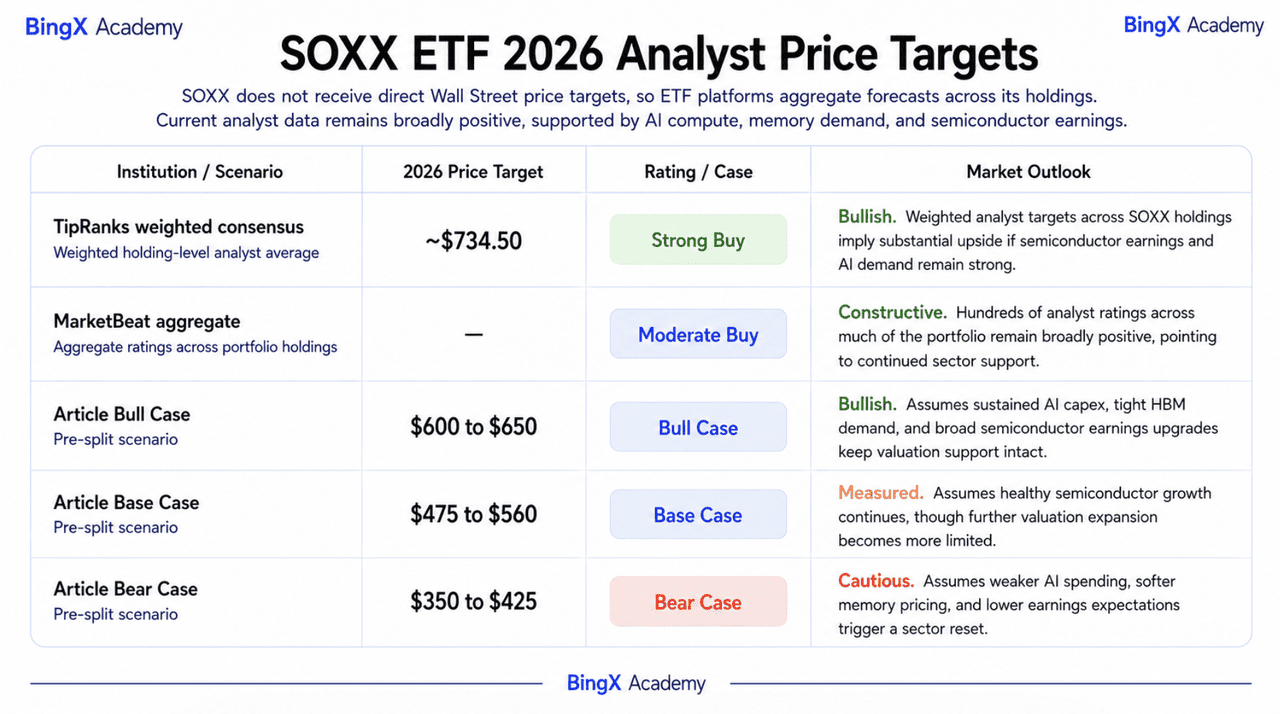
Unlike a single stock, SOXX does not receive direct price targets from individual Wall Street firms. Instead, ETF research platforms aggregate analyst forecasts for the companies inside the fund. As of early September 2026, the latest aggregate data remains broadly positive, reflecting strong expectations for AI compute, memory, custom silicon, and semiconductor-equipment earnings.
|
Institution / Scenario |
2026 Price Target |
Rating / Case |
Market Outlook |
|
TipRanks weighted consensus |
~$734.50 |
Strong Buy |
Bullish. Weighted analyst targets across SOXX holdings imply substantial upside if semiconductor earnings remain strong. |
|
MarketBeat aggregate |
— |
Moderate Buy |
Constructive. Hundreds of analyst ratings across most of the portfolio remain broadly positive. |
|
Article Bull Case |
$600–$650 |
- |
Bullish. Assumes sustained AI capex, tight HBM demand, and broad earnings upgrades. |
|
Article Base Case |
$475–$560 |
- |
Measured. Assumes healthy semiconductor growth but limited further valuation expansion. |
|
Article Bear Case |
$350–$425 |
- |
Cautious. Assumes weaker AI spending, softer memory pricing, and declining earnings expectations. |
How to Trade iShares Semiconductor ETF (SOXX) on BingX
Navigate the volatility of the semiconductor cycle using BingX TradFi and BingX AI tools. By leveraging AI-driven predictive analytics, you can better anticipate market sentiment shifts and price action around chip earnings, memory pricing, and AI capital-spending headlines.
Futures Trading: Long or Short SOXX ETF on BingX TradFi
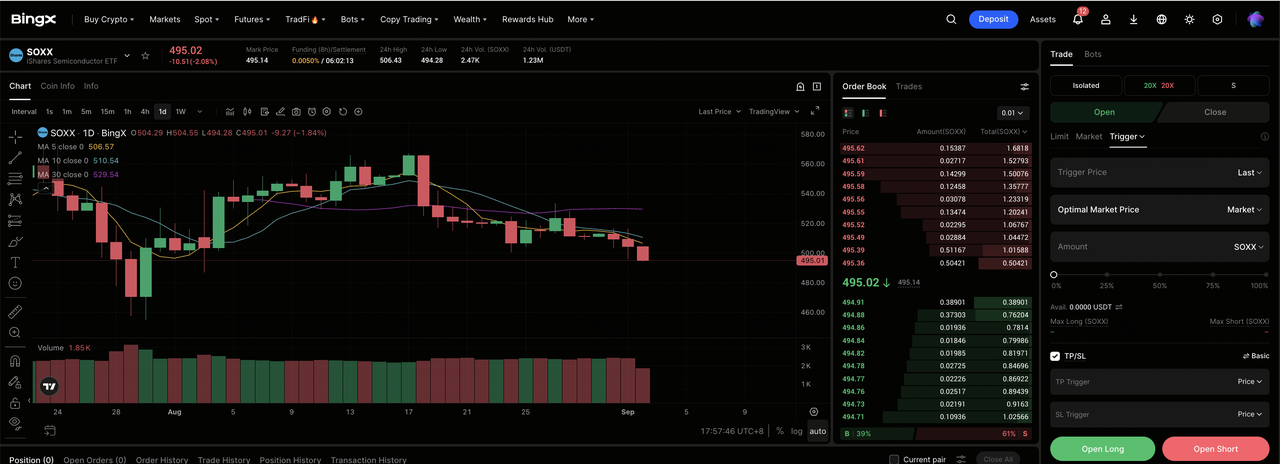
Step 1: Access BingX TradFi. Sign up and navigate to the specialized TradFi section. Complete KYC if required in your region and enable two-factor authentication before funding an account.
Step 2: Select iShares Semiconductor ETF (SOXX). Deposit USDT, then search for and select the SOXX-USDT perpetual futures contract.
Step 3: Choose your direction. Select Open Long if you expect AI chip demand to keep driving sector earnings and the rally to extend. Select Open Short if you expect stretched valuations, a memory-price rollover, or a broad tech de-rating to trigger a pullback.
Step 4: Select leverage and margin mode. Choose Isolated or Cross-Margin based on your risk tolerance. Because SOXX carries a beta of 2.0 and can move sharply on chip-sector news, conservative leverage and clear position sizing are important.
Step 5: Execute strict risk protocols. Set Take-Profit and Stop-Loss (TP/SL) levels before or immediately after entering the trade. SOXX can react quickly to earnings from its largest holdings, memory pricing, AI capital-spending updates, and broad market swings.
Top 5 Risks to Watch for SOXX Investors in 2026
SOXX benefits from strong AI and semiconductor demand, but its concentrated portfolio, premium valuation, and high volatility increase downside risk if the cycle weakens.
- Valuation leaves little room for disappointment. With a portfolio P/E near 62.7x, SOXX already prices in strong earnings growth. Softer guidance or weaker results from major holdings could trigger a sharp re-rating.
- Concentration increases single-stock risk. SOXX holds only 30 stocks, with Nvidia, Micron, AMD, and Broadcom accounting for roughly a third of the fund. A major disappointment from one or two large positions can materially affect ETF performance.
- Semiconductors remain highly cyclical. Memory pricing, inventories, and equipment spending can move quickly between expansion and contraction. A memory downturn or inventory correction could pressure earnings across several holdings at once.
- High volatility can amplify market selloffs. SOXX’s 2.08 three-year beta and roughly 38.4% three-year standard deviation mean sector corrections can be significantly larger than moves in the broader market.
- AI capital spending could eventually slow. Much of the current earnings outlook depends on hyperscalers continuing to expand AI infrastructure budgets. A slowdown in GPU, memory, networking, or data-center investment could weaken growth expectations across the portfolio.
Final Thoughts: Should You Invest in SOXX ETF in 2026?
SOXX enters the rest of 2026 as one of the most direct ways to invest in the AI-driven semiconductor rally. A roughly 93% year-to-date return, a $47.8 billion asset base, and low 0.34% costs are not in dispute. What is in dispute is whether the sector can keep growing its earnings into a portfolio valuation near 76x while carrying a beta of 2.0 and heavy concentration in a few names.
The bull case is that AI infrastructure demand, custom silicon, and memory tightness sustain a multi-year chip upcycle. The bear case is that stretched valuations and the industry's cyclicality set up a sharp drawdown if earnings growth slows. The main confirmation points to watch are the results of the largest holdings, memory pricing, AI capital-spending trends, and sector breadth. Remember that the November 5, 2026 split changes the per-share price but not the value of a position.
Risk Reminder: Investing in SOXX carries a high risk of capital loss. As a non-diversified, high-beta sector fund, SOXX is exposed to semiconductor cyclicality, concentration in its top holdings, an elevated valuation, and broad market swings. Investors should conduct independent research and assess their own risk tolerance before trading.
Related Reading
- Top AI Semiconductor Stocks to Buy in 2026: AI Chips and Supply Chain Complete Guide
- Top 10 AI Infrastructure Stocks to Buy in 2026: Chip Manufacturing and Design Leaders
- Top AI Data Center Stocks to Buy in 2026: Cloud, Servers, and AI Compute Infrastructure
- AMD vs. Nvidia Comparison 2026: Which AI Computing Stock Is the Better Buy?
- TSMC (TSM) Price Prediction 2026: Can Record AI Demand Lift TSM Stock to $527?
- Micron Stock Price Prediction 2026: $1,500 AI Supercycle or Peak Margin Cyclical Trap?
