


Vistra (VST) combines a large U.S. power-generation fleet with a retail electricity business serving millions of customers. Nuclear and natural-gas plants can meet data centers' round-the-clock demand, while long-term hyperscaler contracts could make more revenue predictable. Wholesale power prices, hedging outcomes and the time needed to expand nuclear capacity still determine how much of that opportunity becomes cash for shareholders.
The latest quarter showed stronger generation economics beneath softer reported revenue and profit. Vistra Q2 revenue fell 5.5% to $4.017 billion and net income slipped to $305 million, but ongoing adjusted EBITDA rose 31.0% to $1.767 billion as realized prices and acquired plants lifted results. Vistra reaffirmed its 2026 cash and EBITDA ranges. Contract delivery and sustained cash conversion remain the tests beyond one strong generation quarter.
The VST stock forecast for 2026 now centers on two competing views:
- The contracted-power bull case: Meta and AWS agreements, a stronger generation fleet and new data-center demand support sustained EBITDA and a higher valuation.
- The merchant-market bear case: Weaker power curves, project delays or heavier financing needs undercut the cash outlook before new contracts make a material contribution.
This guide breaks down the VST stock forecast, 2026 price scenarios, key risks and analyst outlooks, drawing on Vistra's August 7 second-quarter release, investor presentation and market data through October 19, plus how to trade VST stock futures on BingX TradFi with USDT collateral.
Top 5 Things for Vistra Investors to Know in October 2026
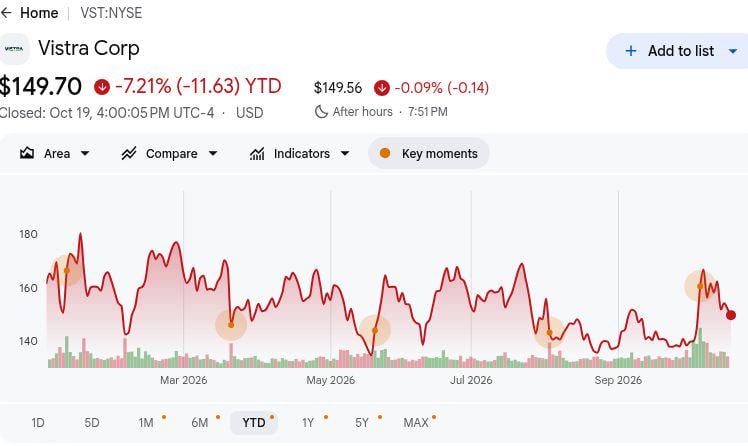
- VST closed at $149.70 on October 19, down 7.21% year to date. The completed-session price provides a reference for the forecasts below. Its gap from BMO Capital's $210 October target highlights the upside analysts see, although that target depends on future earnings and valuation assumptions.
- Q2 revenue declined 5.5% to $4.017 billion. Sales fell from $4.250 billion a year earlier, while net income slipped $22 million to $305 million. Stronger generation EBITDA contrasted with weaker headline results, making realized power margins more important to evaluating operating performance.
- Ongoing adjusted EBITDA increased $418 million to $1.767 billion. East-segment EBITDA rose to $642 million from $418 million, while Texas climbed to $311 million from $142 million. Higher energy and capacity prices, alongside a full quarter of Lotus plants, supported growth, although power-market conditions can fluctuate.
- Vistra reaffirmed its $6.8 billion to $7.6 billion 2026 EBITDA outlook. Ongoing adjusted free cash flow before growth remains projected at $3.925 billion to $4.725 billion. Approximately 100% of expected 2026 generation was hedged as of August 3, providing visibility, while the $7.4 billion to $7.8 billion 2027 opportunity remains preliminary rather than formal guidance.
- Meta's 2,609 MW nuclear agreement strengthens Vistra's long-term growth outlook. The 20-year agreements cover 2,176 MW of existing output and 433 MW of planned uprates, with deliveries beginning in late 2026. A conditional $4.2 billion federal loan commitment announced October 5 could support expansion, although funding has not yet been received.
What Is Vistra (VST)?
Vistra is a Texas-based integrated power company that generates and sells electricity across the United States. It operates approximately 44,000 megawatts of capacity from nuclear, natural gas, coal, solar, and battery-storage facilities, while serving around five million retail electricity customers. Its business combines recurring retail electricity sales with wholesale generation revenue, allowing Vistra to benefit from both customer demand and changing power prices. Major operations span Texas and eastern U.S. electricity markets, where energy prices, capacity payments, and weather conditions influence profitability.
Vistra is expanding its role in AI and data center infrastructure by securing long-term electricity agreements with major technology companies. Its 20-year contracts with Meta cover 2,609 megawatts of nuclear capacity, including planned upgrades through 2034, while an agreement with AWS supports demand at Comanche Peak. Vistra is also developing the Helix data center infrastructure venture and pursuing the Cogentrix acquisition to expand its power portfolio. These initiatives position the company to benefit from rising AI electricity demand, with future growth depending on contracted deliveries, nuclear upgrades, project execution, and cash generation.
Read More: Top AI Energy Stocks to Buy in 2026: Nuclear, Gas, Fuel Cells, and the AI Power Buildout
Vistra (VST) Q2 2026 Earnings Overview: Strong Generation Margins Offset Revenue Decline
Vistra reported Q2 2026 revenue of $4.017 billion, down 5.5% year over year, while net income declined to $305 million from $327 million. However, ongoing adjusted EBITDA increased 31% to $1.767 billion, driven by stronger generation margins across its East and Texas operations. Management reaffirmed its full-year adjusted EBITDA guidance of $6.8 billion to $7.6 billion and adjusted free cash flow before growth outlook of $3.925 billion to $4.725 billion, reinforcing expectations for stronger operating performance and cash generation.
|
Financial Metric |
Guidance / Consensus |
Reported / Actual |
Surprise |
|
Q2 revenue |
$4.250B a year earlier |
$4.017B |
Lower. Down $233M, or 5.5%. |
|
Q2 net income |
$327M a year earlier |
$305M |
Lower. Down $22M on hedge marks. |
|
Q2 adjusted EBITDA |
$1.349B a year earlier |
$1.767B |
Improved. Up $418M, or 31.0%. |
|
Q2 East EBITDA |
$418M a year earlier |
$642M |
Improved. Up $224M. |
|
Q2 Texas EBITDA |
$142M a year earlier |
$311M |
Improved. Up $169M. |
|
H1 operating cash flow |
$1.171B a year earlier |
$2.222B |
Improved. Up $1.051B. |
|
2026 adjusted EBITDA guide |
6.8B–7.6B prior guide |
6.8B–7.6B |
Reaffirmed. Range unchanged. |
|
2026 adjusted FCFbG guide |
3.925B–4.725B prior guide |
3.925B–4.725B |
Reaffirmed. Range unchanged. |
- Revenue declined 5.5% to $4.017 billion despite stronger generation margins. Sales fell $233 million from $4.250 billion, while ongoing adjusted EBITDA rose 31.0%. Stronger realized electricity prices and capacity revenue helped offset softer sales, highlighting the importance of generation profitability.
- Net income fell to $305 million amid higher derivative losses. Profit declined $22 million from $327 million a year earlier, including $488 million in additional unrealized losses. These accounting movements can differ from actual generation economics, making adjusted EBITDA important alongside reported earnings.
- East generation EBITDA jumped $224 million to $642 million. Texas EBITDA also rose $169 million to $311 million, supported by stronger energy and capacity prices and Lotus asset contributions. Both regions drove earnings growth, although future results remain sensitive to power prices.
- First-half operating cash flow increased $1.051 billion to $2.222 billion. Cash generation rose from $1.171 billion a year earlier, supporting stronger operating performance. Growth spending and debt obligations remain important as Vistra targets $3.925 billion to $4.725 billion in full-year adjusted free cash flow before growth.
- Vistra maintained its $6.8 billion to $7.6 billion 2026 EBITDA outlook. Approximately 100% of expected 2026 generation and 94% of 2027 volumes were hedged as of August 3, supporting earnings visibility. The $7.4 billion to $7.8 billion 2027 opportunity remains preliminary and excludes potential Meta and Cogentrix contributions.
Vistra (VST) 2026 Investment Outlook: $250 Bull Case vs. $110 Bear Case
Vistra's valuation depends on whether stronger generation margins and new contracted nuclear demand can translate into durable free cash flow. The 2026 hedge book provides useful near-term visibility, while Meta's phased start, planned uprates, merchant exposure, and financing choices leave the pace of upside less certain. The following ranges are editorial scenarios, not Wall Street targets.
The Bull Case: Contracted Nuclear Demand Pushes VST Toward $250
The Bull Case assumes Vistra maintains strong East and Texas generation margins as Meta-related nuclear deliveries begin in late 2026. Additional data-center power agreements and a successful Cogentrix acquisition could strengthen earnings, while the proposed federal loan could help finance nuclear capacity upgrades. Strong cash generation would also support continued shareholder repurchases.
A move toward $250 would require Vistra to deliver its $6.8 billion to $7.6 billion 2026 adjusted EBITDA guidance and demonstrate stronger contracted revenue visibility for 2027. Progress on the 433 MW nuclear uprates, additional power agreements, and sustained free cash flow would support a higher valuation.
The Base Case: Steady Cash Generation Keeps VST Between $155 and $195
The Base Case assumes Vistra's generation fleet and existing hedges support management's 2026 outlook, while new nuclear contracts contribute gradually. Stronger generation earnings provide stability, although wholesale power fluctuations and derivative accounting can create uneven quarterly results. Acquisitions and infrastructure spending may also limit cash available for repurchases.
VST could trade between $155 and $195 if adjusted EBITDA remains within $6.8 billion to $7.6 billion and adjusted free cash flow before growth reaches $3.925 billion to $4.725 billion. Continued operating execution would support the range, while weaker November results or delayed contract deliveries could pressure the outlook.
The Bear Case: Weaker Power Prices Pull VST Toward $110
The Bear Case assumes declining wholesale electricity prices reduce the value of Vistra's future unhedged generation. Delays in nuclear upgrades, less favorable financing, or higher acquisition costs could also pressure cash flow. These setbacks would weaken the expected contribution from growing data-center electricity demand.
A move toward $110 would become more likely if adjusted EBITDA falls below the $6.8 billion 2026 guidance floor, 2027 power prices deteriorate, or Meta-related nuclear milestones slip. Lower cash-flow expectations and weaker project returns could trigger valuation compression despite Vistra's existing generation capacity.
VST Stock Price Forecasts for 2026 By Wall Street Analysts
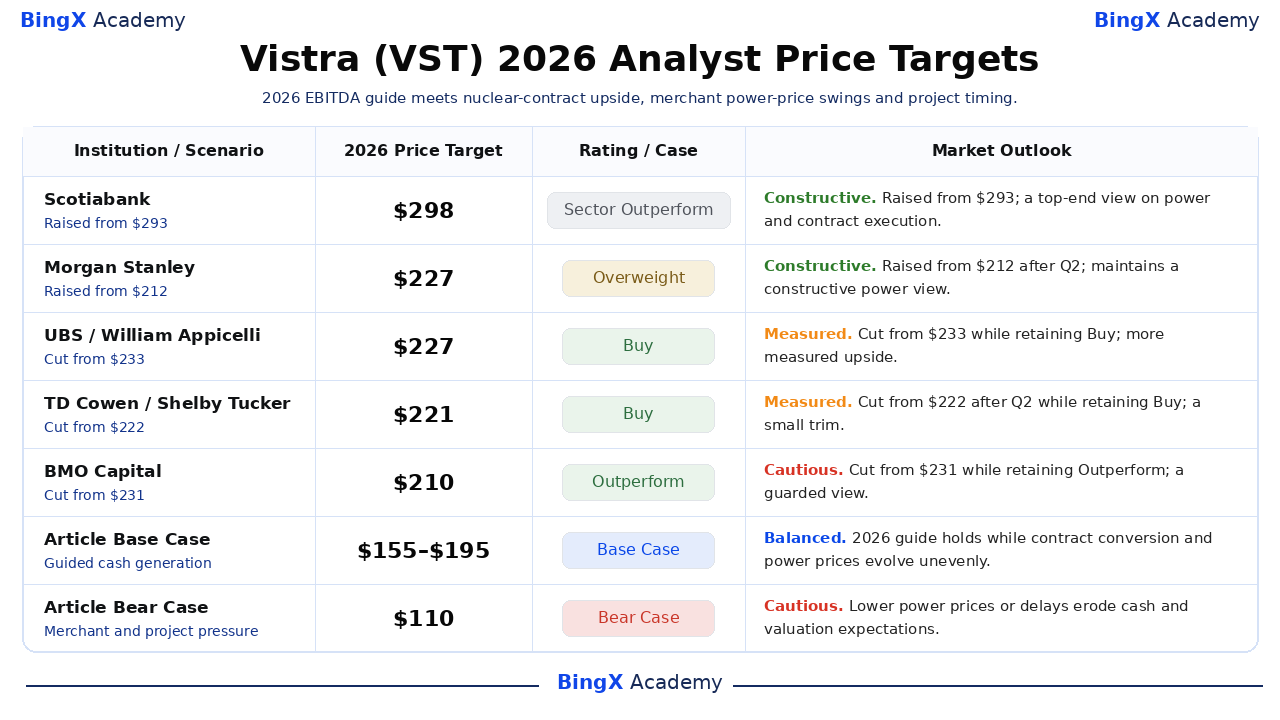
Five named, dated analyst actions provide outside reference points, not one agreed forecast. Scotiabank's $298 target in July sits far above BMO Capital's October $210 target, and both remain above VST's $149.70 October 19 close. Their ratings and revisions reflect different assumptions about contracted nuclear revenue, merchant power prices and execution. The final two rows are this article's editorial scenarios, kept separate from actual broker research.
|
Institution / Scenario |
2026 Price Target |
Rating / Case |
Market Outlook |
|
Scotiabank / Andrew Weisel |
$298 |
Sector Outperform |
Constructive. July 15: Raised from $293 while retaining Sector Outperform; the highest selected target demands strong execution. |
|
Morgan Stanley / Stephen Byrd |
$227 |
Overweight |
Constructive. August 21: Raised from $212 while retaining Overweight after second-quarter results. |
|
UBS / William Appicelli |
$227 |
Buy |
Measured. July 28: Cut from $233 while retaining Buy, tempering near-term upside assumptions. |
|
TD Cowen / Shelby Tucker |
$221 |
Buy |
Measured. August 19: Cut from $222 while retaining Buy; the one-dollar trim leaves a constructive rating. |
|
BMO Capital / James Thalacker |
$210 |
Outperform |
Cautious. October 5: Cut from $231 while retaining Outperform, showing a more guarded October view. |
|
Article Base Case |
$155 to $195 |
Base Case |
Balanced. Guidance holds as contracts contribute gradually and cash conversion supports repurchases. |
|
Article Bear Case |
$110 |
Bear Case |
Cautious. Weaker power prices and project delays pressure cash generation and valuation. |
How to Trade Vistra (VST) Stock on BingX
Trade Vistra's nuclear contracts, generation margins and cash-generation outlook using BingX TradFi and BingX AI tools. Because VST can react sharply to earnings, power-market moves and project milestones, traders should define both the catalyst and risk limits before entering a position.
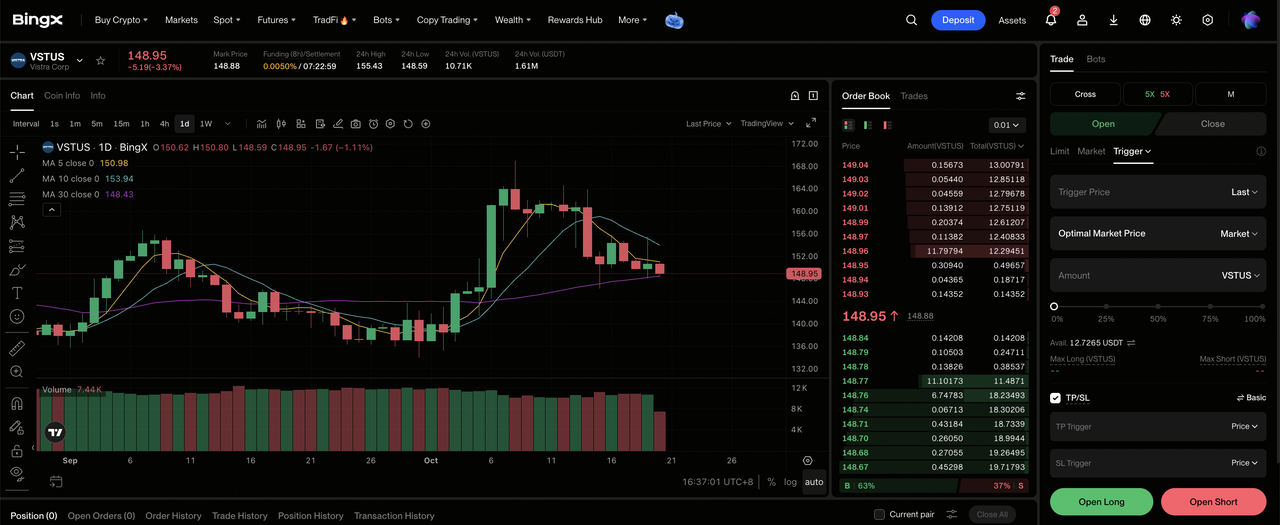
Step 1: Access BingX TradFi. Sign up and navigate to the specialized TradFi section on the BingX exchange dashboard.
Step 2: Select Vistra (VST). Search for and select the VSTUS-USDT perpetual futures contract.
Step 3: Choose your direction. Select Open Long if you expect stronger generation cash flow and contracted nuclear deliveries. Select Open Short if you expect lower power prices or delayed project milestones.
Step 4: Select leverage and margin mode. Choose Isolated or Cross-Margin based on your risk tolerance. VST fell 7.21% year to date through October 19, so conservative leverage and clear position sizing matter.
Step 5: Execute strict risk protocols. Set Take-Profit and Stop-Loss (TP/SL) levels before or immediately after entering the trade. VST can react quickly to November earnings, PPA updates and wholesale-power price changes.
Top 5 Risks to Watch for Vistra Investors in 2026
Vistra's strong generation earnings, hedged power output, and expanding nuclear opportunities support its growth outlook. However, electricity pricing, project execution, financing conditions, and capital allocation remain important factors determining how much of that growth translates into cash flow and shareholder returns.
- Lower power prices could weaken future earnings. Approximately 72% of expected 2028 generation was hedged as of August 3, leaving greater market-price exposure than in 2026. Sustained declines in ERCOT or PJM power prices could reduce future cash flow and pressure VST's valuation.
- Nuclear expansion delays could postpone contracted revenue. Meta's agreements include 433 MW of planned capacity upgrades through 2034. Construction, licensing, or equipment delays could postpone deliveries and associated cash flow.
- Conditional financing could raise project costs. The $4.2 billion Energy Department loan commitment remains subject to technical, legal, environmental, and financial conditions. Delayed funding could increase the cost of nuclear upgrades.
- Growth investments could limit shareholder buybacks. The pending Cogentrix acquisition and Helix's commitment of up to $1 billion require capital. Integration costs and debt obligations could compete with the approximately $1.2 billion remaining buyback authorization.
- Derivative volatility could complicate earnings visibility. Q2 net income fell $22 million despite a $418 million adjusted EBITDA increase, partly due to $488 million in additional unrealized derivative losses. Unfavorable hedge settlements could affect earnings and liquidity.
Final Thoughts: Should You Invest in Vistra in 2026?
Vistra has real generating assets, a large retail customer base and signed long-term nuclear agreements rather than only a future project pipeline. Second-quarter ongoing adjusted EBITDA rose 31.0% and management maintained a $6.8 billion to $7.6 billion 2026 range even as GAAP net income softened. The stock's $149.70 October 19 close reflects a market still testing how much of that operating strength will convert into sustained free cash flow.
The $250 bull case requires stronger contract conversion and continued power-market economics; the $110 bear case assumes weaker merchant prices and slower nuclear execution. Between them, the $155 to $195 base range depends on the reaffirmed cash guidance and measured project progress. Investors seeking firmer evidence can watch the scheduled November 6 earnings update, changes in 2027 hedges and concrete milestones for Meta deliveries and the Cogentrix transaction.
Risk Reminder: Trading and investing in equities like VST involves a high risk of capital loss. Wholesale power prices, derivative marks, nuclear-project timing, financing and leverage can change outcomes quickly. Conduct independent research before allocating capital.
Related Reading
- Top AI Energy Stocks to Buy in 2026: Nuclear, Gas, Fuel Cells, and the AI Power Buildout
- Top AI Data Center Stocks to Buy in 2026: Cloud, Servers, and AI Compute Infrastructure
- Bloom Energy (BE) Price Prediction 2026: Can AI Data-Center Power Push BE Toward $350?
- Oklo (OKLO) Price Prediction 2026: Can Nuclear Milestones Push OKLO Toward $100?
- NuScale Power (SMR) Price Prediction 2026: Can Project Conversion Push SMR Toward $20?
