In the landscape of digital asset infrastructure, the race to solve the blockchain trilemma, achieving scalability, security, and decentralization simultaneously, has converged on a dominant design philosophy: high-performance, monolithic Layer-1 networks. Unlike modular ecosystems that split execution, settlement, and data availability across separate rollups and layers, monolithic chains bundle these functions into a single, vertically integrated state machine.
Solana (SOL) and Sui (SUI) stand at the absolute apex of this architectural category. While Solana defends a multi-year lead with deep liquidity moats, an established developer base, and significant enterprise integrations, Sui has emerged as a formidable technological challenger, leveraging an entirely different approach to data modeling and smart contract safety.
For long-term investors, evaluating these networks goes far beyond tracking daily price fluctuations or short-term transaction spikes. True fundamental analysis requires looking under the hood to understand how their distinct execution models, programming languages, and economic frameworks handle real-world scale, manage network congestion, and incentivize validators.
This guide provides a comprehensive, structurally focused head-to-head analysis of Solana and Sui, establishing a blueprint for how investors should view both networks as core pillars of the next-generation blockchain economy.
Top 5 Architectural and Fundamental Factors for Sui and Solana Investors
- Account-Based State vs. Object-Centric Models: Solana organizes its global state around accounts and wallet balances, whereas Sui structures its state entirely around independent objects. This fundamental choice dictates how transactions are parallelized, how assets are held, and how network resources are allocated.
- Rust/Sealevel vs. Sui Move VM: Solana uses Rust to compile smart contracts directly to stateless runtime processes via its Sealevel parallel processing engine. Sui relies on Sui Move, a native, resource-oriented programming language designed from the ground up to prevent asset duplication and eliminate entire classes of smart contract exploits.
- Vertical vs. Horizontal Scaling Trajectories: Solana scales vertically, relying heavily on cutting-edge hardware optimizations and validator computing power. Sui utilizes horizontal scaling, enabling its network to add throughput capacity dynamically by distributing independent transaction sets across separate validation lanes.
- Varying Inflation and Token Supply Mechanics: Solana utilizes a disinflationary model where its supply continuously expands at a predictably decaying rate, offset by partial fee burns. Sui implements a strict, fixed maximum cap of 10 billion tokens, paired with an aggressive long-term vesting schedule for early investors and contributors.
- DeFi Composability vs. Asset-Heavy Applications: Solana’s unified global state makes it an exceptional environment for deep, high-frequency DeFi composability and order-book liquidity. Sui's parallel architecture and sub-second owned-object finality make it a native fit for high-velocity consumer apps, gaming economies, and independent asset transfers.
What Are Solana and Sui High-Performance Layer-1 Blockchains?
While the legacy digital asset ecosystem frequently relies on complex modular scaling layers to reduce latency, Solana and Sui stand out as vertically integrated, monolithic Layer-1 blockchains engineered to handle massive transactional volume natively on a single base layer.
What Is Solana (SOL)?
Launched in 2020 by Anatoly Yakovenko and built out by Solana Labs, Solana is an open-source, high-performance Layer-1 blockchain engineered for speed, low cost, and deterministic execution. The core innovation driving Solana is Proof of History (PoH), a cryptographically secure Verifiable Delay Function (VDF) that embeds an immutable timestamp directly into incoming transactions. By allowing the network to establish a reliable sequence of events before entering global consensus, Solana enables its parallel runtime, Sealevel, to process non-conflicting transactions concurrently across multi-core systems, regularly handling thousands of real-world transactions per second with average block times of 400 milliseconds.
From a market and liquidity perspective, Solana functions as a heavyweight network powerhouse. The asset commands a circulating market capitalization of approximately $41.29 billion, supported by a 24-hour spot trading volume of $2.56 billion. On-chain data demonstrates a deeply mature ecosystem with a massive Total Value Locked (TVL) in DeFi protocols reaching $4.887 billion. A standout vertical for the network is its institutional adoption in the Real-World Asset (RWA) space, which features a substantial RWA active market cap of $1.747 billion.
In terms of economic activity and fee capturing, the network processes heavy network volumes, generating $388,254 in native chain fees over a 24-hour window. This is driven by highly active trading applications, with decentralized apps (dApps) on the network yielding $3.29 million in direct application revenue and $6.58 million in app fees. Solana’s native token, SOL, trades around $71.18, sitting roughly 75.81% below its historic all-time high of $294.33 reached in January 2025.
What Is Sui (SUI)?
Launched in May 2023 by Mysten Labs, a team founded by ex-Meta cryptography engineers who previously led the technical development of the Diem and Novi blockchain initiatives, Sui is an agile Layer-1 network built to eliminate the scalability bottlenecks inherent in legacy account-based architectures. Sui abandons traditional global sequencing for independent assets. Instead, it treats every token, smart contract, and digital asset as an independent object. By combining this object-centric structure with its native Sui Move language and high-velocity Mysticeti DAG consensus engine, Sui allows non-conflicting transactions to completely bypass heavy consensus rounds, achieving near-instantaneous transaction finality.
From a performance and capital data perspective, Sui stands as an emerging, high-velocity challenger layer. The network possesses a circulating market cap of $2.98 billion, alongside a 24-hour trading volume of $428.93 million. While its on-chain ecosystem is younger than Solana's, Sui has scaled up a respectable TVL of $448.59 million. Its early institutional RWA footprint is expanding from a smaller baseline, currently recording an active RWA market capitalization of $23.19 million.
Because Sui’s object-centric framework is hyper-optimized for micro-costs, its baseline operational fees are notably lean, printing $3,592 in daily chain fees and $1,377 in chain revenue. Its ecosystem protocols pull in $85,367 in aggregate daily app fees, translating into $14,785 in direct application revenue. SUI’s token price trades around $0.7414, experiencing significant volatility down from its all-time high of $5.35 set in January 2025, but maintaining a massive margin over its historic all-time low of $0.3643.
Sui vs. Solana: Technical Comparison Matrix
To evaluate the long-term viability of both networks, investors must contrast their architectural profiles and fundamental operating metrics side-by-side:
|
Core Dimension |
Solana (SOL) |
Sui (SUI) |
|
Architectural Model |
Monolithic Single-Layer State |
Monolithic Single-Layer State |
|
Data Structure Model |
Account-Based (Global balance sheet) |
Object-Centric (Collection of typed resources) |
|
Primary Programming Language |
Rust (Compiled to BPF bytecode) |
Sui Move (Object-oriented dialect) |
|
Consensus Architecture |
Tower BFT + Proof of History |
DPoS + Mysticeti DAG BFT |
|
Transaction Parallelism |
Account-Level (Declared explicitly up-front) |
Object-Level (Inherent via asset independence) |
|
Execution Pathway |
Unified path for all transactions |
Dual path: Simple (Bypass) vs. Complex (Full BFT) |
|
Token Supply Structure |
Inflationary (Floor capped at 1.5% annually) |
Fixed maximum supply (Strictly capped at 10B SUI) |
|
Network Scaling Focus |
Vertical (Validator hardware performance) |
Horizontal (Parallel transaction lanes) |
|
Core Ecosystem Strengths |
High-Frequency Trading, Memecoins, DePIN |
Web3 Gaming, Micro-payments, Institutional Rails |
Key Differences Between Solana and Sui, and What It Means for Investors
By examining the underlying mechanics of these networks, investors can move past superficial speed metrics and evaluate how each chain's execution engine, asset safety framework, and node topography dictate long-term capital efficiency.
The Execution Parallelism Clash: Accounts vs. Objects
The defining technical divergence between Solana and Sui centers on how they prevent overlapping transactions from locking the network.
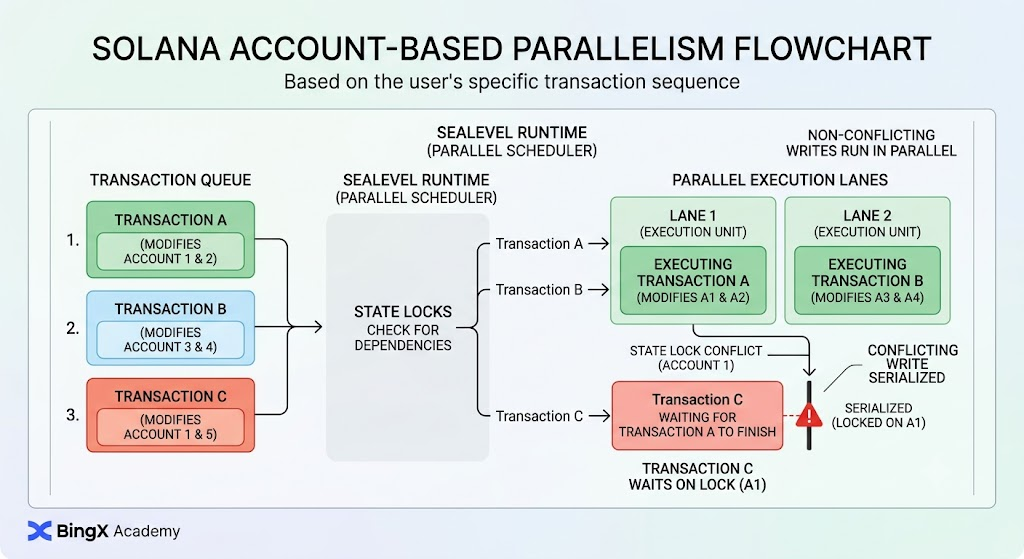
On Solana, transactions must declare upfront every single account they intend to modify. If two separate transactions try to write to the exact same account, such as a hot AMM liquidity pool or a high-volume minting contract, the Sealevel scheduler automatically serializes them. They must execute one after the other. In periods of extreme market volatility, this structural design creates localized state contention, resulting in transaction retries and priority fee spikes for users chasing execution.
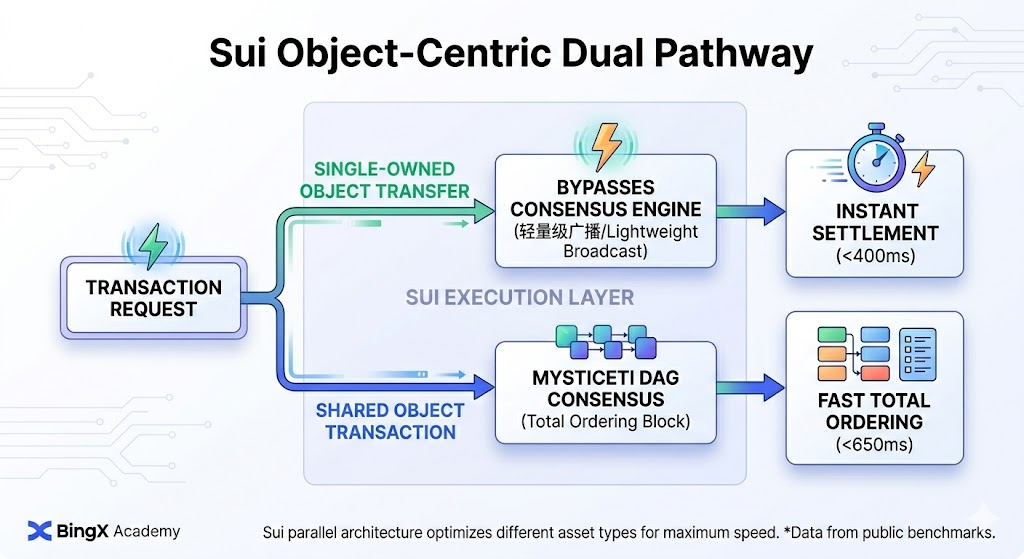
Sui resolves state contention by eliminating global sequencing for independent transactions. Because every asset exists as a distinct object with a unique ID, transactions that modify completely separate objects require absolutely zero coordination between validators. They run simultaneously down completely isolated parallel lanes.
Furthermore, Sui splits its execution pathway into two distinct streams:
- Simple Transactions: Transactions involving assets owned by a single address (like basic token transfers or NFT updates) bypass full consensus entirely, settling via a lightweight Byzantine consistent broadcast in under 400 milliseconds.
- Complex Transactions: Transactions involving shared objects (like multi-user lending pools or decentralized exchanges) go through the Mysticeti DAG consensus engine for total ordering, still reaching sub-second finality.
Smart Contract Security in Solana and Sui: Rust Extensibility vs. Move Resource Safety
From a risk management perspective, the programming environment dictates the structural safety of the applications deployed on-chain.
Solana utilizes Rust, a mainstream, highly mature language renowned for its strict memory safety and raw computational performance. However, because Rust was not natively built for blockchain ledgers, developers must write meticulous validation logic within their programs. Most historic exploits on Solana are not memory failures; they are logic flaws, such as incorrect signature verification, account spoofing, or reentrancy-like state updates within Cross-Program Invocations (CPIs).
Sui utilizes Sui Move, a specialized language designed explicitly for asset management. In the Move Virtual Machine (MoveVM), assets cannot be treated as simple integers or raw balances. They are defined as linear resources possessing hardcoded structural abilities (key, store, drop, copy).
The Move compiler strictly guarantees that assets cannot be accidentally duplicated, deleted, or double-spent in code. Because the type system itself enforces these conservation rules, common smart contract vulnerabilities, including the reentrancy attacks that have historically plagued the broader web3 space, are mitigated at the language level.
Sui vs. Solana: Tokenomics and Value Capture Models
An investor’s core framework for assessing long-term token value relies on how network usage translates into sustainable ecosystem incentives.
Solana's Disinflationary Fee-Burn Framework
Solana does not have a fixed maximum supply constraint. Instead, it relies on an inflationary issuance model designed to perpetually incentivize validators. The SOL inflation rate launched at 8% and decreases by 15% annually, systematically trending toward a permanent floor of 1.5% per year.
To offset this issuance, Solana burns exactly 50% of the base transaction fee for every transaction processed on-chain. The remaining 50% is awarded directly to the validator leader that block-mapped the data. Priority fees, optional premiums paid by users to fast-track their execution during congestion, are awarded fully to validators. This creates a direct correlation: as high-frequency trading and DePIN utilization increase, the organic token-burn velocity accelerates, counterbalancing structural inflation.
Sui's Fixed Cap and Storage Rebate System
Sui operates with a strict, absolute maximum cap of 10 billion tokens. SUI is utilized for gas fees, staking to secure the Delegated Proof-of-Stake (DPoS) architecture, and serving as a baseline asset within DeFi applications.
To manage long-term state growth, Sui implements a unique dual-fee model that separates computation costs from storage fees:
Total Gas Fee= (Computation Units × Reference Price) + (Storage Units × Storage Price)
When a transaction writes data to the blockchain, storage fees are charged upfront and deposited directly into a centralized Storage Fund. This fund pays out continuous staking yields to validators who maintain the historical ledger state.
Crucially, Sui features a Storage Rebate mechanism: when a user or protocol deletes old data from the state, such as closing out an empty account or an inactive tracking module, up to 99% of the original storage fee is refunded. This creates an economic incentive for developers to clean the blockchain state, preventing long-term state bloat and ensuring the ledger remains hardware-efficient.
How to Trade Solana (SOL) and Sui (SUI) on BingX
To simplify your market analysis, traders can leverage the BingX AI Claw tool to evaluate structural trends before executing trades through the step-by-step guides below.
Buy, Sell, or HODL SOL and SUI in the Spot Market
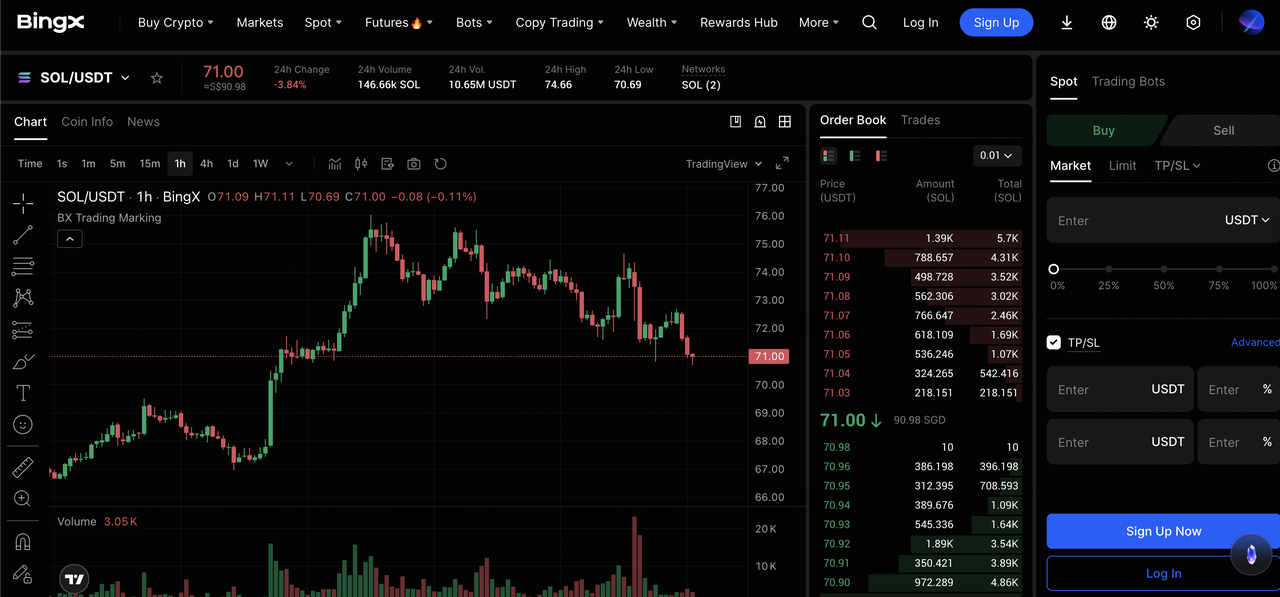
SOL/USDT trading pair on BingX spot market
- Access the Market: Log into your BingX account, navigate to the Spot trading section from the main dashboard, and search for either the SOL/USDT or SUI/USDT trading pair.
- Fund Your Account: Ensure your spot wallet is funded with a base currency like USDT, which is commonly used for Layer-1 trading pairs.
- Place Your Order: Choose a Market Order to buy or sell immediately at the current price, or a Limit Order to specify your preferred entry or exit price.
- Execute and Secure: Confirm the transaction details to execute your trade, after which your tokens will immediately settle securely inside your BingX account.
Long or Short SOL, SUI with Leverage in the Futures Market
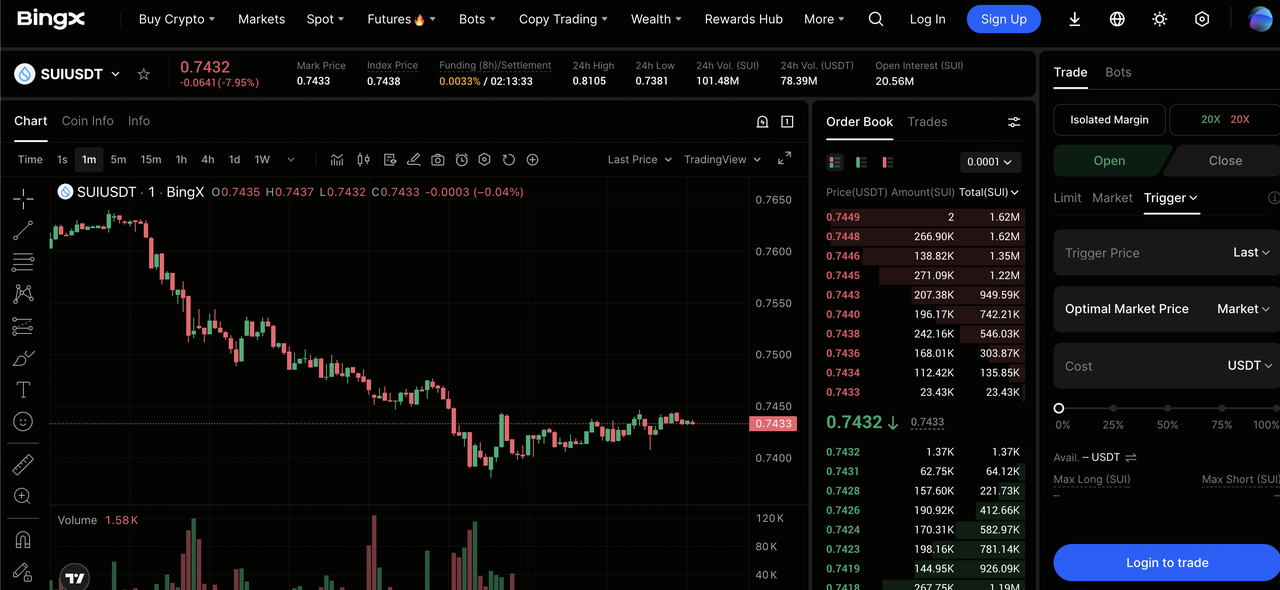
SUI/USDT perpetual contract on BingX futures market
- Open the Futures Terminal: Navigate to the Perpetual Futures section on the main exchange platform and choose your asset contract, e.g., SUI/USDT perpetuals or SOL/USDT perpetual contract.
- Select Position Parameters: Pick either Isolated Margin to silo your capital risk or Cross Margin mode, and adjust your preferred leverage multiplier.
- Analyze the Order Book: Evaluate real-time liquidity and depth, taking note of hot state metrics or localized congestion boundaries.
- Set Advanced Risk Safeguards: Choose your direction (Open Long or Open Short) and enter explicit Take-Profit and Stop-Loss (TP/SL) targets to protect your collateral against high-beta crypto market gaps.
Sui or Solana: Risk Assessment for Investors
While both protocols represent masterclasses in blockchain engineering, long-term asset allocators must account for distinct systemic vulnerabilities unique to each ecosystem:
Systemic Risks on Solana
- Hardware-Intensive Centralization Pressures: Solana's high vertical throughput demands exceptionally robust, enterprise-grade validator hardware. The capital requirements for running a high-performance node present a natural barrier to entry, concentrating consensus validation among well-capitalized data center operators.
- State Contention Vulnerabilities: Because popular smart contracts force localized serialization, high-frequency spikes in retail trading or meme token launches can trigger heavy transaction retry congestion, inflating priority fees and degrading user experience for adjacent protocols.
- MEV Extraction Friction: Solana hosts a highly complex, competitive Maximum Extractable Value (MEV) ecosystem. While frameworks like Jito auctions help structure this market, intense block-space competition can create execution uncertainties for basic retail transactions.
Systemic Risks on Sui
- Uncirculated Supply Overhang: Because SUI features a fixed total cap of 10 billion tokens where less than half of the supply is currently in active circulation, the ecosystem faces a long-dated, persistent release schedule of locked tokens. This steady stream of unlocked tokens flowing to early investors and ecosystem treasuries demands substantial, ongoing capital inflows to maintain long-term baseline valuations.
- Network Stability Hurdles: Sui's horizontal, object-centric architecture is highly sophisticated, but relatively young compared to older monolithic ledgers. Complex protocol upgrades can introduce edge-case bugs in internal gas-charging runtimes, requiring flawless coordinator alignment among its concentrated validator set to prevent mainnet halts.
- Ecosystem Bootstrapping Hurdles: Despite its structural throughput capacity and advanced security ergonomics, Sui started years behind Solana in building out its foundational layer of liquidity, user wallets, third-party data indexers, and oracle integrations.
Final Thoughts: What's a Better Investment in 2026, Solana or Sui?
When building out a long-term digital asset thesis, Solana and Sui should not be viewed as a zero-sum conflict. Instead, they represent two fundamentally valid, highly distinct answers to the challenge of scaling decentralized architecture.
Solana functions as the established blue chip of the monolithic sector. It possesses massive, battle-tested network effects, deep global liquidity, a dominant mindshare among retail trading communities, and deep institutional integration. It is an exceptional ecosystem for high-velocity financial applications, asset tokenization pipelines, and deeply integrated DePIN infrastructure where immediate access to a massive capital graph is paramount.
Sui represents the agile, structural evolution of high-concurrency ledger design. Its object-centric state architecture and Move-powered resource guardrails provide a robust, mathematically secure foundation for high-volume digital economies. It is structurally optimized for applications that require massive parallel throughput, ultra-low latency, and complex asset ownership models without the risk of localized state congestion, such as web3 gaming, autonomous AI agent interactions, and programmatic micro-payments.
A balanced allocation strategy acknowledges Solana’s undeniable distribution advantages and liquidity moats, while respecting Sui’s superior architectural flexibility and asset-safety framework as a high-beta challenger poised to capture substantial long-term market share.
Risk Reminder: Investing in high-throughput Layer-1 technologies involves substantial capital risk, exposed to structural smart contract upgrades, volatile fee market shifts, and hardware dependency dynamics. Always maintain strict risk management protocols, verify on-chain metrics via independent explorers, and align your position sizes with your long-term liquidity requirements.
