

Qualcomm (QCOM) is one of the world’s largest wireless semiconductor companies, spanning smartphone chips, automotive, IoT, PCs and an expanding push into data-center infrastructure. Snapdragon processors and modem technologies remain central to the handset business, while automotive, industrial IoT and PC products are becoming more important to long-term growth. This diversification gives Qualcomm broader AI exposure, but also leaves the stock sensitive to handset demand, memory costs and execution in newer markets.
Its latest quarter showed that transition is underway but incomplete. Fiscal Q3 2026 revenue reached $9.947 billion, while automotive and IoT revenue together grew 28% year over year even as total revenue declined 4%. The broader investment case depends on whether growth in automotive, IoT, PCs and data-center products can offset slower handset growth and become a larger, more profitable part of the business.
The QCOM stock forecast for 2026 now centers on two competing views:
- The diversification and inference case: Automotive design wins, edge computing and data-center products could widen Qualcomm’s addressable market and reduce the company’s dependence on annual smartphone cycles.
- The handset and execution case: A slower handset market, customer concentration, component availability and a higher cost base could keep earnings growth below the level required for a durable re-rating.
This guide breaks down the QCOM stock forecast, 2026 price scenarios, key risks, and analyst outlooks, drawing on Qualcomm’s July 29, 2026 fiscal Q3 earnings release, 10-Q, and market data through August 17, plus how to trade QCOM stock futures on BingX TradFi with USDT collateral.
Top 5 Things for Qualcomm Investors to Know in August 2026
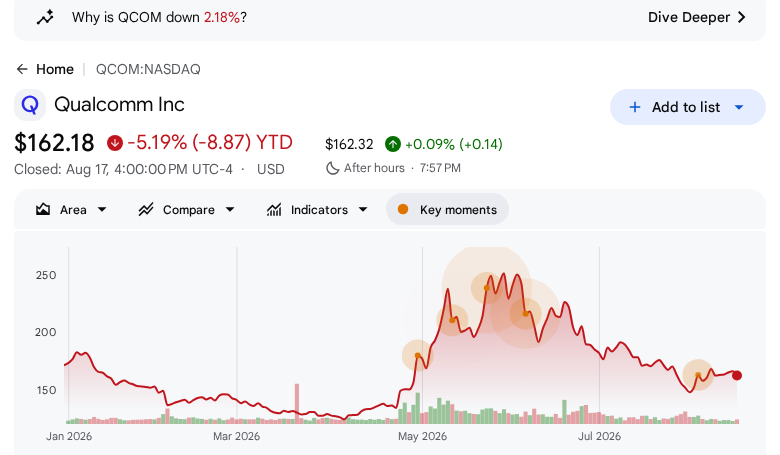
- The completed-session reference price was $162.18: QCOM closed at $162.18 on August 17 after trading between $161.45 and $166.34, according to Massive’s completed-session record. Google Finance showed the share down 5.19% year to date at that close. This is a reference point, not a live quote, and it makes the $204.24 consensus target a conditional expectation rather than a promised return.
- Fiscal Q3 revenue was $9.947 billion: Revenue declined 4% year over year, but was $252.1 million above the consensus estimate in the Followin data set. The distinction matters because a revenue beat can coexist with a lower year-on-year base, leaving the next guidance update more important than the headline comparison.
- Automotive and IoT are the growth proof points: Qualcomm said combined QCT Automotive and IoT revenue rose 28% year over year, while automotive logged its 23rd consecutive quarter of double-digit year-over-year growth. These lines support the diversification thesis, but must keep growing fast enough to change total-company growth.
- Management’s fiscal-2029 target is ambitious: At its June Investor Day, Qualcomm targeted $40 billion of non-handset revenue by fiscal 2029, including $10 billion in automotive and more than $14 billion in IoT. The target offers a measurable roadmap, not a booked result. Quarterly revenue mix, margins and customer adoption remain the confirmation tests.
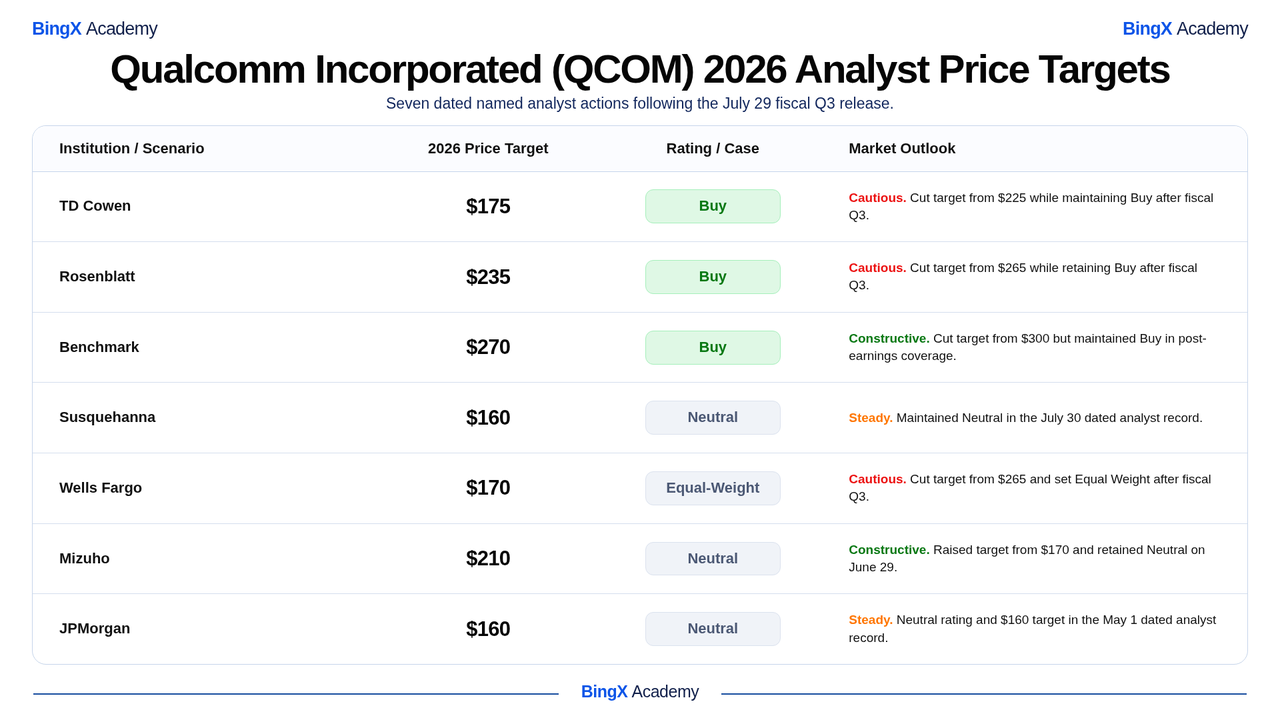
- The Street remains dispersed: Followin listed July 30 Buy or equivalent positive ratings from Benchmark, TD Cowen and Rosenblatt alongside Neutral, Equal Weight, Sector Perform and In Line ratings from several other firms. UBS maintained Neutral and cut its target to $170 from $190, while the aggregated target was $204.24. That range is evidence of uncertainty, not a single directional consensus.
What Is Qualcomm (QCOM)?

Qualcomm Incorporated is a San Diego technology company best known for wireless communications technology, Snapdragon processors and its large patent-licensing portfolio. Its QCT business sells chips and systems for handsets, automotive, IoT, PCs and networking, while QTL licenses cellular standard-essential and other patents. This structure gives Qualcomm a mix of cyclical semiconductor demand and higher-margin licensing economics, but also exposes the company to customer concentration, regulation, product cycles and competitive pressure across several markets.
The growth story increasingly extends beyond smartphones. Qualcomm is expanding in on-device AI, Snapdragon PCs, automotive platforms, industrial IoT, networking and data-center AI, where power efficiency and connectivity could support broader adoption. For investors, the key question is whether design wins in these newer businesses convert into meaningful revenue, margins and cash flow quickly enough to offset slower handset growth. Fiscal Q3 2026 showed progress in automotive and IoT, but consolidated revenue and earnings still declined year over year, leaving diversification execution central to the outlook.
Qualcomm (QCOM) Q3 FY2026 Earnings Overview: Diversification Grew While the Core Softened
- Revenue exceeded the tracked consensus, but fell from the prior year. Qualcomm reported $9.947 billion of fiscal Q3 revenue, versus $9.6949 billion estimated in Followin’s earnings-surprise record, yet revenue was 4% lower year over year. The causal lesson is that near-term market reactions can focus on the growth rate even when the reported figure clears expectations.
- Non-GAAP EPS missed modestly. Non-GAAP diluted EPS was $2.21 versus a $2.23 estimate, a $0.02 shortfall. The small magnitude should not be over-read, but it means the operating outlook and margin discussion carry more weight than a simple beat-or-miss label.
- Automotive and IoT expanded 28% combined. Qualcomm identified Automotive and IoT as the strongest QCT growth engines, with automotive reaching 23 consecutive quarters of double-digit year-over-year growth. This is the clearest operating support for the non-handset thesis.
- Profitability declined with revenue. GAAP net income was $2.002 billion, down 25% year over year, and GAAP diluted EPS was $1.87, down 23%. Investors should separate reported profitability from non-GAAP figures and watch whether mix gains can absorb supply and operating-cost pressure.
- Management pointed to a supply constraint. CEO Cristiano Amon described a challenging memory and supply environment while saying revenue landed at the high end of guidance. The next quarters will show whether constrained components defer revenue, compress margins or simply shift the timing of demand.
Read More: Qualcomm (QCOM) Q3 FY2026 Earnings Overview: Soft $2.15 EPS Outlook Triggers a 2.62% Decline
Qualcomm Q3 2026 Financial and Consensus Profile: Revenue, EPS and Margins
The table distinguishes company-reported fiscal Q3 results from the contemporaneous consensus record. It is deliberately narrow: the revenue and EPS comparisons identify the earnings tension, while the net-income line gives a GAAP profitability reference. A dash denotes that no comparable consensus was used in that row.
|
Financial Metric |
Guidance / Consensus |
Reported / Actual |
Surprise |
|
Q3 FY2026 revenue |
$9.6949B consensus |
$9.947B |
+$252.1M; +2.60% versus consensus |
|
Q3 FY2026 non-GAAP EPS |
$2.23 consensus |
$2.21 |
-$0.02; -0.90% versus consensus |
|
Q3 FY2026 GAAP net income |
— |
$2.002B |
-25% year over year |
Reported revenue at the high end of guidance does not itself settle the investment case. The revenue miss versus the prior year and the lower GAAP net income show why investors are demanding better evidence that automotive, IoT and data-center initiatives can scale profitably. Qualcomm’s Q3 10-Q and release should remain the primary source for these figures, with aggregator data used only for the specified consensus comparison.
Qualcomm (QCOM) 2026 Investment Outlook: $204 Bull Case vs. $145 Bear Case
The central test is whether non-handset execution can lift the company’s earnings power before handset-related pressure and component costs erode the benefits. The figures below are scenario references built around explicit operating conditions, not price guarantees or substitutes for analyst targets.
The Bull Case: Non-Handset Scaling Pushes QCOM Toward $204
The bull case assumes Automotive, IoT and data-center products scale faster than the corporate average while supply pressure eases. Qualcomm’s $40 billion fiscal-2029 non-handset target is the operating anchor; the $204 scenario is an editorial condition, not a promised market outcome.
Confirmation requires expanding QCT Automotive and IoT revenue, visible data-center traction and stable margins. The case weakens if adjacent growth is purchased through lower profitability or fails to lift consolidated revenue.
The Base Case: Diversification Progress Keeps QCOM Between $160 and $190
The base case assumes the company continues to add automotive, IoT and PC opportunities, but the smartphone and supply backdrop prevent a sharp near-term re-rating. Under that view, the August 17 completed-session close near $162.18 is neither proof of a bargain nor a definitive valuation floor. It is a market reference while investors wait for better visibility on fiscal Q4 and the next earnings cycle.
A $160 to $190 range is an editorial scenario, not a Street target. It assumes steady diversification without deterioration in licensing economics, while newer markets remain too small to offset weakness elsewhere.
The Bear Case: Handset and Margin Pressure Pulls QCOM Toward $145
The bear case assumes handset demand, customer shifts or supply costs keep total revenue under pressure, while the non-handset expansion takes longer to monetise. UBS’s July 30 Neutral rating and $170 target are not a bear target, but they show that a named firm saw limited upside relative to the then-prevailing price. A more adverse $145 editorial reference would require weaker guidance, further EPS-estimate reductions or evidence that component tightness is impairing margins.
If earnings growth is deferred while automotive and data-center plans remain long-duration options, investors may assign a lower multiple. Sustained growth, margins and customer traction would invalidate this scenario.
QCOM Stock Price Forecasts for 2026 By Wall Street Analysts
The seven rows below are dated, named third-party analyst actions only. They exclude consensus, high and low endpoints, and the article’s Bull/Base/Bear scenarios. Each row is a separate institution with a direct evidence record; the narrative scenarios remain analytical conditions rather than claims about Wall Street targets.
|
Institution / Scenario |
2026 Price Target |
Rating / Case |
Market Outlook |
|
TD Cowen |
$175 |
Buy |
Cautious. Cut target from $225 while maintaining Buy after fiscal Q3. |
|
Rosenblatt |
$235 |
Buy |
Cautious. Cut target from $265 while retaining Buy after fiscal Q3. |
|
Benchmark |
$270 |
Buy |
Constructive. Cut target from $300 but maintained Buy in post-earnings coverage. |
|
Susquehanna |
$160 |
Neutral |
Steady. Maintained Neutral in the July 30 dated analyst record. |
|
Wells Fargo |
$170 |
Equal-Weight |
Cautious. Cut target from $265 and set Equal Weight after fiscal Q3. |
|
Mizuho |
$210 |
Neutral |
Constructive. Raised target from $170 and retained Neutral on June 29. |
|
JPMorgan |
$160 |
Neutral |
Steady. Neutral rating and $160 target in the May 1 dated analyst record. |
How to Trade Qualcomm (QCOM) Stock on BingX
Trade Qualcomm’s handset, automotive, IoT and AI-infrastructure outlook using BingX TradFi and BingX AI tools. Because QCOM can react sharply to earnings, smartphone demand, chip-supply developments and new AI product announcements, traders should define both the catalyst and risk limits before entering a position.
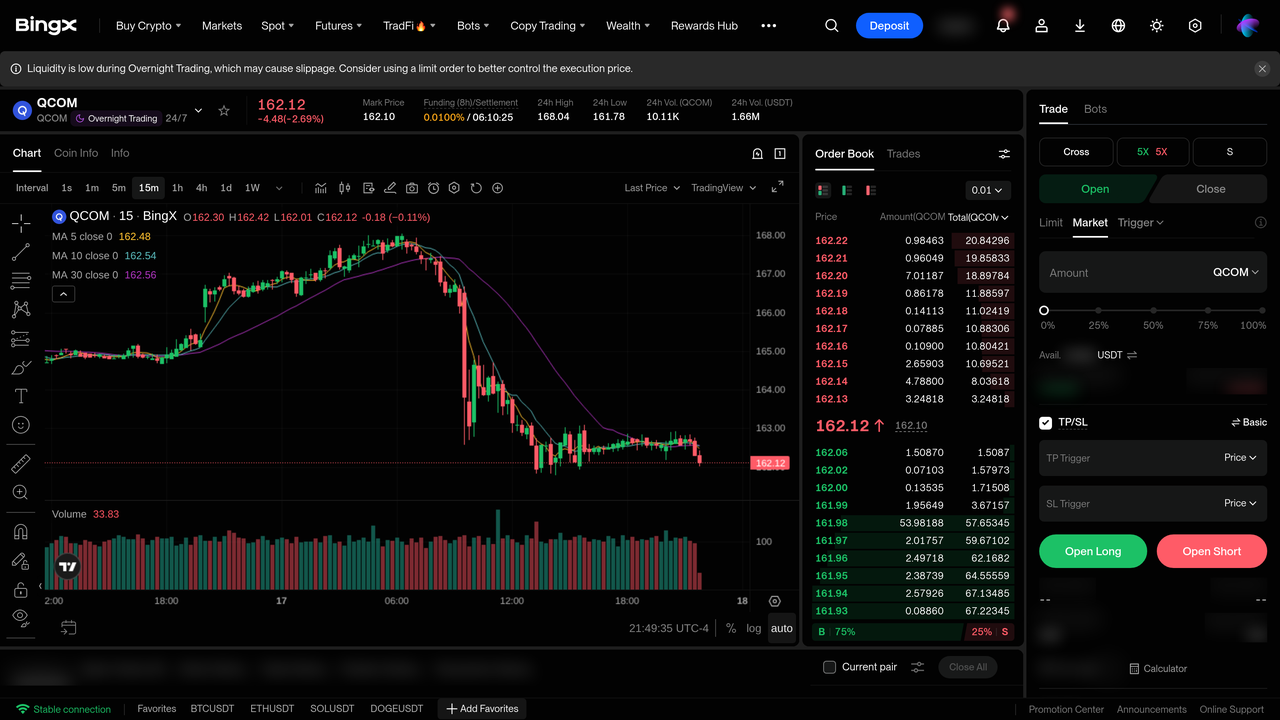
Step 1: Access BingX TradFi. Sign up and navigate to the specialized TradFi section on the BingX exchange dashboard.
Step 2: Select Qualcomm Incorporated (QCOM). Search for and select the QCOM-USDT perpetual futures contract.
Step 3: Choose your direction. Select Open Long if you expect automotive, IoT, PCs and data-center products to offset slower handset growth while margins remain resilient. Select Open Short if you expect weaker smartphone demand, rising memory costs, supply constraints or slower diversification to pressure revenue and profitability.
Step 4: Select leverage and margin mode. Choose Isolated or Cross-Margin based on your risk tolerance. QCOM can move quickly around earnings, guidance changes and semiconductor-sector news, so conservative leverage and clear position sizing are important.
Step 5: Execute strict risk protocols. Set Take-Profit and Stop-Loss (TP/SL) levels before or immediately after entering the trade. Monitor quarterly earnings, handset demand, Snapdragon PC adoption, automotive and IoT growth, data-center product updates, supply-chain conditions and major customer developments.
Top 5 Risks to Watch for Qualcomm Incorporated Investors in 2026
- Handset concentration and customer transitions: A meaningful share of Qualcomm’s economics remains exposed to handset demand and device-maker sourcing decisions. Diversification reduces this exposure only when non-handset revenue is realised at scale.
- Memory and component availability: Management cited a challenging memory and supply environment in fiscal Q3. Scarcity can defer device shipments, raise input costs or pressure customer budgets even when demand remains intact.
- Automotive conversion timing: Design wins and a $65 billion automotive design-win pipeline are leading indicators, not recognised revenue. Vehicle-platform delays or program changes can push expected revenue further into the future.
- Data-center competition and qualification risk: Qualcomm is entering a market with established CPU, accelerator and networking suppliers. Product capability must be matched by software support, customer validation and profitable volume.
- Licensing, regulatory and geopolitical exposure: Patent licensing and global semiconductor sales create exposure to legal, regulatory, trade-policy and regional demand changes. These risks can affect valuation even when a product roadmap remains technically competitive.
Final Thoughts: Should You Invest in Qualcomm Incorporated in 2026?
Qualcomm offers a differentiated mix of wireless IP, low-power compute, connectivity and expanding automotive and IoT products. The fiscal Q3 data provide genuine support for the diversification thesis: Automotive and IoT revenue grew 28% combined, while management formalised a large non-handset target. However, the same quarter also recorded a 4% decline in total revenue, a 25% decline in GAAP net income and a modest non-GAAP EPS shortfall versus consensus.
The useful checklist is operational: accelerating non-handset revenue, automotive conversion, data-center validation and resilient margins for bulls; weaker handset demand, delayed design-win revenue, cost pressure and EPS cuts for bears. Any decision should reflect horizon, risk tolerance and liquidity needs.
Risk Reminder: Trading and investing in equities like QCOM involves a high risk of capital loss. QCOM exposure includes semiconductor cycles, supplier constraints, customer concentration, derivative funding and liquidation risk when using perpetual contracts. Conduct independent research before allocating capital.
Related Reading
- Top AI Semiconductor Stocks to Buy in 2026: AI Chips and Supply Chain Complete Guide
- Nvidia (NVDA) Stock Price Outlook for 2026: Can Blackwell and Vera Rubin Take NVDA Back to $300?
- AMD Price Prediction 2026: $525 AI Sovereignty or $300 Valuation Trap?
- Broadcom (AVGO) Stock Outlook for 2026: AI Infrastructure King or Margin Victim?
- Apple (AAPL) Price Prediction 2026: Can Siri AI and the Foldable iPhone Push AAPL Past $400?
- TSMC (TSM) Price Prediction 2026: Can Record AI Demand Lift TSM Stock to $527?
