
Pi Network launched its Open Mainnet on February 20, 2025, after six years as a mobile mining app without a tradable token. Within weeks of launch, PI reached an all-time high of $2.99 on exchanges. By February 2026, it had fallen to an all-time low of $0.1312. As of early April 2026, it was trading around $0.17.
That price trajectory is not random noise. It is the predictable outcome of a specific tokenomics structure: a maximum supply of 100 billion tokens, of which only about 9% is currently circulating, with hundreds of millions of new tokens unlocking and entering the market every single month. Understanding that structure is the difference between interpreting PI's price as a buying opportunity and understanding it as a reflection of ongoing supply pressure.
This guide breaks down Pi Network's full supply architecture, explains how the ongoing migration process releases new tokens into circulation, and walks through how to calculate the real market cap versus the figure most casual observers are looking at.
Pi Network: Key Numbers at a Glance (Early Q2 2026)
|
Metric |
Value |
|
Maximum Supply |
100,000,000,000 PI (100 billion) |
|
Migrated to Mainnet |
~60.41 billion PI (as of May 2026) |
|
Exchange-Circulating Supply |
~9 to 9.2 billion PI (under 9.3% of max supply) |
|
Locked Off-Market (Pioneers) |
More than 58 billion PI |
|
Available on Exchanges |
Less than 5% of total supply |
|
Monthly Unlock Rate |
Hundreds of millions per month (April 2026: 231M PI) |
|
Open Mainnet Launch |
February 20, 2025 |
|
All-Time High |
$2.99 (shortly after launch) |
|
All-Time Low |
$0.1312 (February 11, 2026) |
|
Price (Early April 2026) |
~$0.17 (verify before publish) |
Breakdown of Pi Network's 100 Billion Token Supply
Pi Network has a hard cap of 100 billion PI tokens. That cap is not a projection or a target. It is the maximum number of PI that will ever exist, defined in the whitepaper and built into the protocol. No more than 100 billion PI can be issued under any circumstances.
The 100 billion cap is divided into four fixed allocations. Each allocation grows proportionally at the same rate as the community's migrated mining rewards, so the percentage split stays constant regardless of how many tokens have been issued at any given moment. The four categories are as follows.
|
Allocation |
Tokens (B) |
Share |
Purpose |
|
Community Mining Rewards |
65 billion |
65% |
Distributed to Pioneers who mine PI via the mobile app and contribute to network security |
|
Core Team |
20 billion |
20% |
Reserved for the founding team with a gradual vesting schedule to align long-term incentives |
|
Foundation Reserve |
10 billion |
10% |
Held for long-term ecosystem development, grants, and strategic deployment |
|
Liquidity |
5 billion |
5% |
Reserved to support exchange listings and market liquidity as the network expands |
|
Total |
100 billion |
100% |
Hard cap. No additional PI can be created beyond this limit. |
The most important structural feature of this table is the proportional growth mechanism. Because each allocation tracks the pace of community mining rewards migration, neither the Core Team's 20 billion allocation nor the Foundation's 10 billion allocation vests independently of community progress. When more community PIs migrate, more Core Team and Foundation PIs are also unlocked.
This means that the total supply entering the market is always greater than the community migration figures alone suggest, because each milestone in community migration simultaneously unlocks proportional shares for the team and the foundation.
Why PI's 65% Community Allocation Does Not Mean 65% Goes to Traders
The 65 billion community allocation sounds like the majority of the supply is in the hands of ordinary PI holders. In practice, the vast majority of that 65 billion remains locked in the mining app and has not been recorded on the actual blockchain.
As of May 2026, approximately 60.41 billion PI has been migrated to mainnet in technical terms, but more than 58 billion of that remains off-market and locked by individual Pioneers who have not yet completed the steps required to unlock it for exchange trading. Less than 5% of the total supply of 100 billion is actually available on exchanges.
The practical result: the token's trading price is currently set by a market operating on fewer than 5 billion liquid tokens, while over 90 billion PI tokens wait in various stages of lockup, vesting, or migration. That structural imbalance is the single most important fact for understanding PI's price behavior.
How Second Migrations Are Releasing More PI Coins Into Circulation
Pi Network's migration process has not happened in a single event. It is an ongoing, phased process that the Pi Core Team refers to as rolling migrations, with each wave releasing previously locked Pioneer balances onto the mainnet blockchain and, eventually, into exchange-available circulation.
How the Migration Process Works
- KYC completion: Before any Pioneer's mined PI can migrate, they must complete identity verification through Pi Network's built-in KYC process. This is a deliberate filter designed to exclude fake accounts, bots, and duplicates from the supply. Pioneers who cannot complete KYC forfeit their mined balance.
- Mainnet migration: Once KYC is approved, the Pioneer's mined PI balance is transferred from the app's internal ledger to an actual mainnet wallet. At this point, the PI exists on the blockchain but is typically subject to a lockup period before it can be transferred to exchanges.
- Lockup expiry and vesting: Migrated PI is released gradually according to individual lockup schedules that depend on when the Pioneer mined, how much they mined, and which lockup tier their balance falls into. This is what drives the monthly unlock cadence, with hundreds of millions of tokens entering exchange-accessible circulation.
- Exchange availability: Once the lockup period expires, the PI can be transferred to external wallets and exchange deposit addresses. This is the stage at which PI first appears in exchange order books and begins to affect the live trading price.
The Scale of Ongoing Unlocks
The monthly unlock rate is the variable that matters most for PI's near-term price trajectory. In April 2026, 231 million PI entered circulation in a single month. At the April price of approximately $0.17, that represented roughly $40 million in new supply hitting the market over 30 days. That figure is approximately 2% of the entire circulating market cap entering supply in one month.
For context, Bitcoin's annual inflation rate from new mining is under 1%. Ethereum's net issuance is near zero after the merge. PI's effective monthly supply growth from unlocks alone runs at an annualized rate that vastly exceeds both. This comparison is not an argument that PI cannot increase in value; it is an explanation of the sustained selling pressure that PI price must overcome to hold or rise.
What Are Second Migrations?
The term 'second migrations' refers to subsequent waves of Pioneers completing KYC and migrating balances that were not included in earlier migration batches. Pi Network processes migrations in prioritized groups based on KYC completion date, verification status, and network contribution level.
Earlier migration waves processed the most straightforward and highest-priority accounts.
Second and subsequent waves include accounts that required additional verification steps, experienced migration issues, or were held back due to suspected fraudulent activity under review. Each new wave adds previously off-market PI to the blockchain, beginning the lockup clock for those balances and eventually contributing to future monthly unlock figures.
The net effect is that the 58 billion-plus PI currently locked off-market will gradually enter blockchain over multiple years, with each batch starting its own lockup countdown. The total supply available on exchanges will grow steadily for the foreseeable future, regardless of what happens to PI's price.
Pi Network Market Cap: Calculating the 'Real' vs. 'IOU' Market Cap
The confusion around PI's market cap stems from three figures that are frequently misquoted, conflated, or selectively cited depending on whether the source is bullish or bearish on the token. Understanding all three is essential for making sense of PI's valuation.
The Three Market Cap Figures
|
Metric |
Formula |
Value at $0.17 |
What It Represents |
|
Circulating Market Cap |
Price x exchange-circulating supply (~9.2B PI) |
~$1.56 billion |
What the market is currently pricing based on the liquid supply only |
|
Migrated Market Cap |
Price x mainnet-migrated supply (~60.41B PI) |
~$10.27 billion |
Includes all PI on the blockchain, locked or not |
|
Fully Diluted Valuation (FDV) |
Price x max supply (100B PI) |
~$17 billion |
The theoretical market cap if every PI token that will ever exist is in circulation |
What Is the 'IOU' Market Cap?
Before the Open Mainnet launch, Pi existed only as an in-app balance. Pioneers had mined tokens that were tracked on Pi's servers but did not yet exist on any public blockchain. These pre-migration balances were, in a meaningful sense, IOUs: promises from Pi Core Team that the balance would eventually be honored with real mainnet tokens, contingent on completing KYC and migration.
The 'IOU market cap' concept extends beyond the pre-launch phase. Even today, more than 58 billion PI that has technically migrated to the mainnet remains locked and off-market. A Pioneer holding 1,000 PI in a locked mainnet wallet has PI that is 'real' in the sense that it exists on the blockchain, but it functions economically like an IOU because it cannot yet be sold, transferred, or converted into anything else.
The market price is set by the fraction of supply that has actually cleared lockups and reached exchanges, not by the full migrated balance.
This gap is why the circulating market cap and the fully diluted valuation differ by an order of magnitude. At a price of $0.17, the circulating market cap is approximately $1.56 billion. The fully diluted valuation is approximately $17 billion. A buyer at $0.17 is purchasing exposure to a token whose total future supply, if all 100 billion tokens ever enter circulation, would imply a valuation ten times higher than the market currently reflects.
The Math That Matters: What Price Implies What Valuation?
|
PI Price |
Circulating Mkt Cap (9.2B) |
Migrated Mkt Cap (60.41B) |
Fully Diluted Val (100B) |
|
$0.10 |
$920 million |
$6.04 billion |
$10 billion |
|
$0.17 (approx Apr 2026) |
$1.56 billion |
$10.27 billion |
$17 billion |
|
$0.50 |
$4.6 billion |
$30.2 billion |
$50 billion |
|
$1.00 |
$9.2 billion |
$60.4 billion |
$100 billion |
|
$2.99 (ATH) |
$27.5 billion |
$180 billion |
$299 billion |
The $1.00 row is particularly instructive. For PI to trade at $1.00, the market would need to be pricing the network at $9.2 billion on a circulating basis. That is comparable to established mid- to large-cap Layer 1 blockchains. But on a fully diluted basis, $1.00 PI implies a $100 billion valuation: larger than Ethereum's market cap at many points in its history and comparable to the largest Layer 1 ecosystems in existence.
This does not make $1.00 impossible, but it does clarify what it would require: a level of ecosystem utility, merchant adoption, and network activity that would rank Pi Network among the most used blockchains in the world. As of mid-2026, Pi's smart contract ecosystem (launched with WebAssembly contracts in early 2026 via Protocol 23) is in early stages, with most dApp activity concentrated within the Pi community rather than attracting external users or capital.
Why Pi Network Has No Burn Mechanism
One of the most common questions from PI holders is why there is no token burn. Most major cryptocurrencies with supply pressure issues have implemented burn mechanisms to permanently remove tokens from circulation and reduce supply over time. Pi Network has not.
The stated reason is that Pi's tokenomics are built around inclusive distribution rather than scarcity management. The community allocation is designed to reward Pioneers who contribute genuine network value, and burning tokens would contradict the fairness principle of distributing PI to real users who earned it through participation.
The practical consequence is that PI has no supply-side deflationary pressure. Every token ever issued will eventually enter circulation, and the only force that can support or increase PI's price is demand growth outpacing the monthly unlock schedule. Analysts and on-chain observers have flagged the absence of a burn mechanism as a structural concern, alongside questions about centralization around the Core Team's 20 billion allocation.
Pi Price Outlook: Long-Term Value Proposition vs. Short-Term Volatility
PI's price volatility since the Open Mainnet launch reflects the mismatch between the scale of community expectations built over six years of mobile mining and the reality of launching a new token into an open market with massive unlocked supply overhead.
The Bull Case for PI
- User base scale: Pi Network claims over 60 million registered users. Even if the majority are inactive or were bot accounts excluded by KYC, a verified active base of tens of millions represents a potential adoption surface larger than most blockchain projects have ever had at a comparable stage of development.
- Protocol 23 and smart contracts: The upgrade to Protocol 23 in Q2 2026 introduced WebAssembly-based smart contract capability. If third-party developers build applications that generate genuine external demand for PI (beyond the circular Pi-community economy), it creates demand that can absorb ongoing supply unlocks.
- Controlled unlock schedule: The monthly unlocks, while large in absolute terms, are structured and predictable. A structured unlock is easier for the market to absorb than a sudden unlock event. If PI's price stabilizes and demand grows, the predictable supply schedule works in the market's favor.
- KYC filter reducing effective supply: Pioneers who cannot complete KYC forfeit their mined balance. Analysis suggests the effective circulating supply may stabilize far below the 100 billion maximum, potentially in the 30 to 40 billion range over the long term, as a substantial portion of mining-app balances belong to accounts that will never complete migration.
The Bear Case for PI
- Supply inflation rate: PI's effective monthly issuance rate far exceeds Bitcoin and Ethereum. Every month, hundreds of millions of new tokens enter a market where organic demand growth has not kept pace. The 93% decline from the ATH is largely a supply-pressure story.
- No burn mechanism: Without any token destruction, the full supply trajectory trends inexorably toward the 100 billion cap. Even the most bullish demand scenario must contend with a fully diluted valuation that would rank Pi Network among the largest blockchain ecosystems in history.
- Circular economy risk: Most Pi ecosystem transactions currently involve Pi community members paying each other in PI for services and goods priced in PI. This creates a self-referential demand loop rather than the external demand that drives sustainable value. For PI to generate genuine value, merchants and users outside the Pi community need to want PI for things they cannot get elsewhere.
- Core Team allocation concentration: The 20 billion PI reserved for the Core Team represents 20% of the total supply. Even with a gradual vesting schedule, this concentration creates ongoing uncertainty about future selling pressure from the development team.
How to Trade PI on BingX: Step-by-Step
To trade Pi Network (PI) on BingX, create and verify your account, deposit USDT or crypto, search for the PI/USDT trading pair, place your order, and manage your risk with stop-loss and take-profit levels. Since PI's price is heavily influenced by monthly token unlocks, it's also important to monitor supply events before entering a trade.
- Create and Verify Your BingX Account: Sign up on BingX using your email address or phone number, then complete the KYC verification process. This unlocks full trading features, higher withdrawal limits, and improved account security.
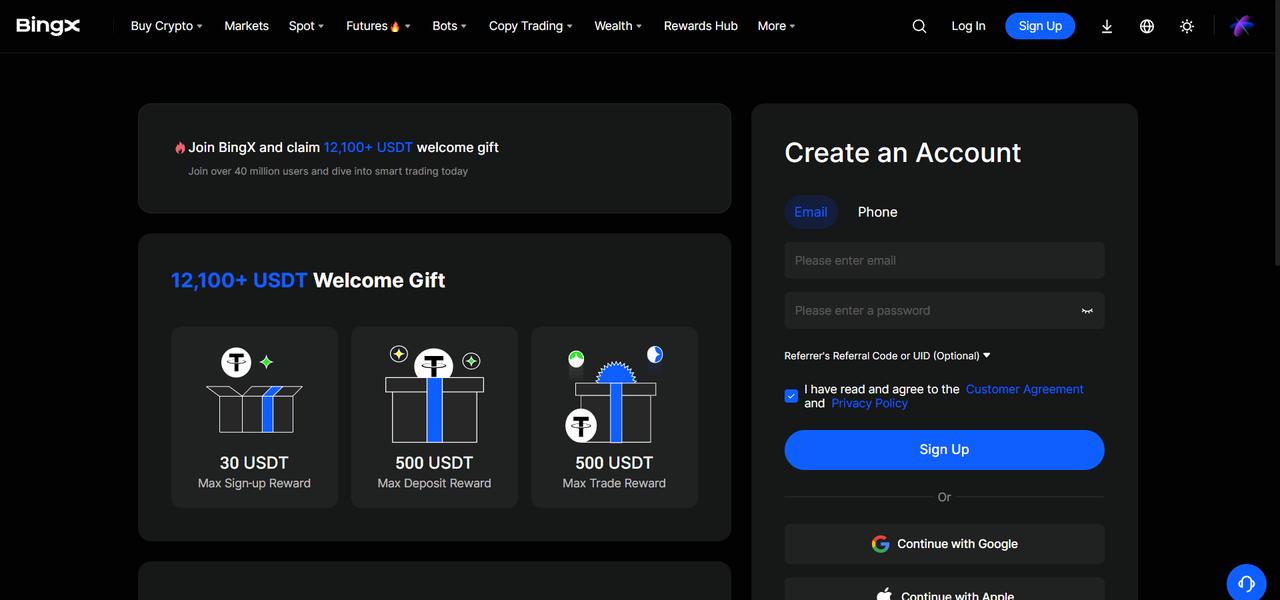
BingX account registration page — create your account and complete identity verification.
- Fund Your Account: Deposit USDT or another supported cryptocurrency into your BingX wallet, or purchase USDT using a credit or debit card where available. Most PI trading activity is conducted against the PI/USDT pair.
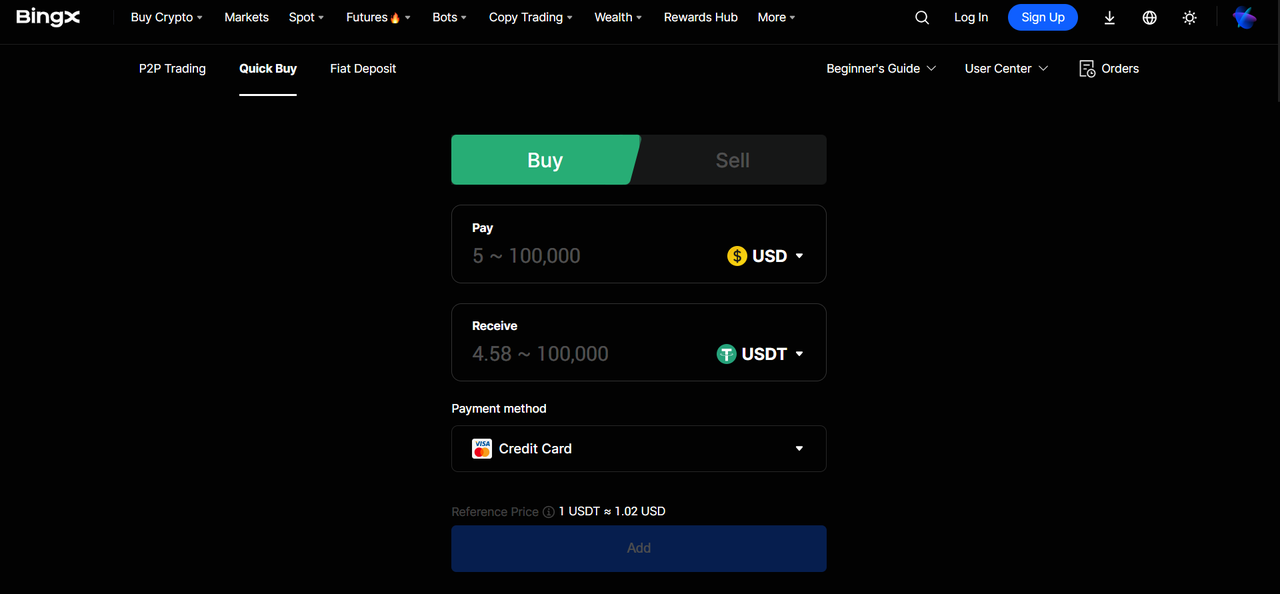
BingX Quick Buy — purchase USDT with fiat before trading PI.
- Search for PI/USDT: Use the BingX search bar to find "PI" or "PI/USDT," then select the PI/USDT perpetual contract to open the trading interface.
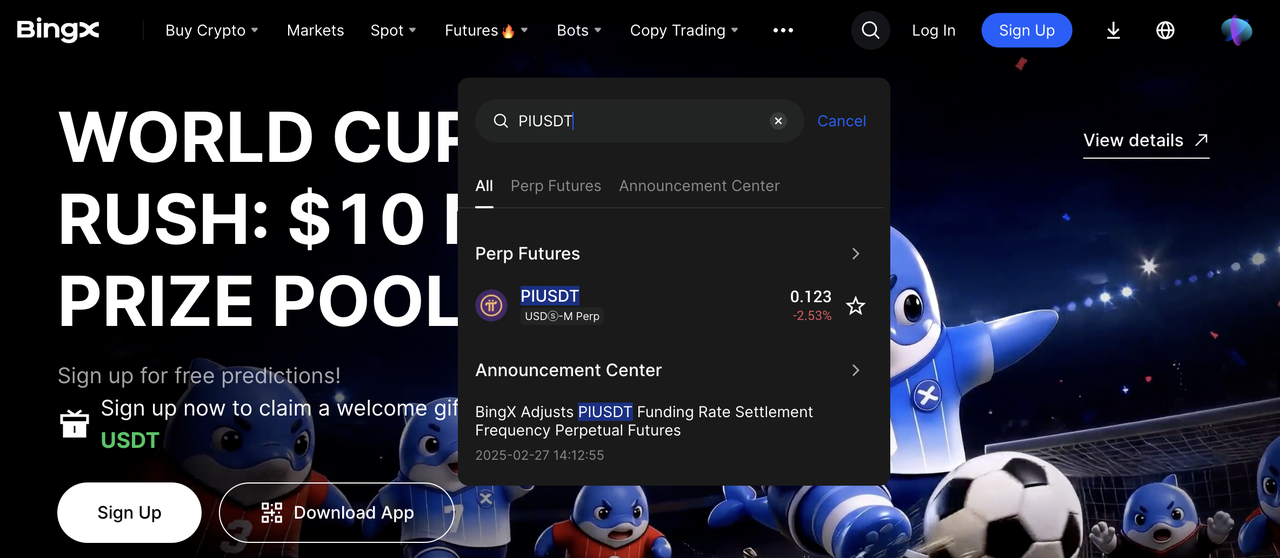
Searching PI/USDT on BingX opens the spot trading market.
- Choose Futures Trading: PI is available on BingX futures, allowing you to trade PI coins using leverage. This is the preferred option for most investors looking to gain exposure to Pi Network.
- Use Limit Orders for Better Entries: PI's order book can be thinner than major cryptocurrencies, which may result in higher slippage during volatile periods. Using a Limit order allows you to specify the maximum price you're willing to pay instead of buying at the current market price.
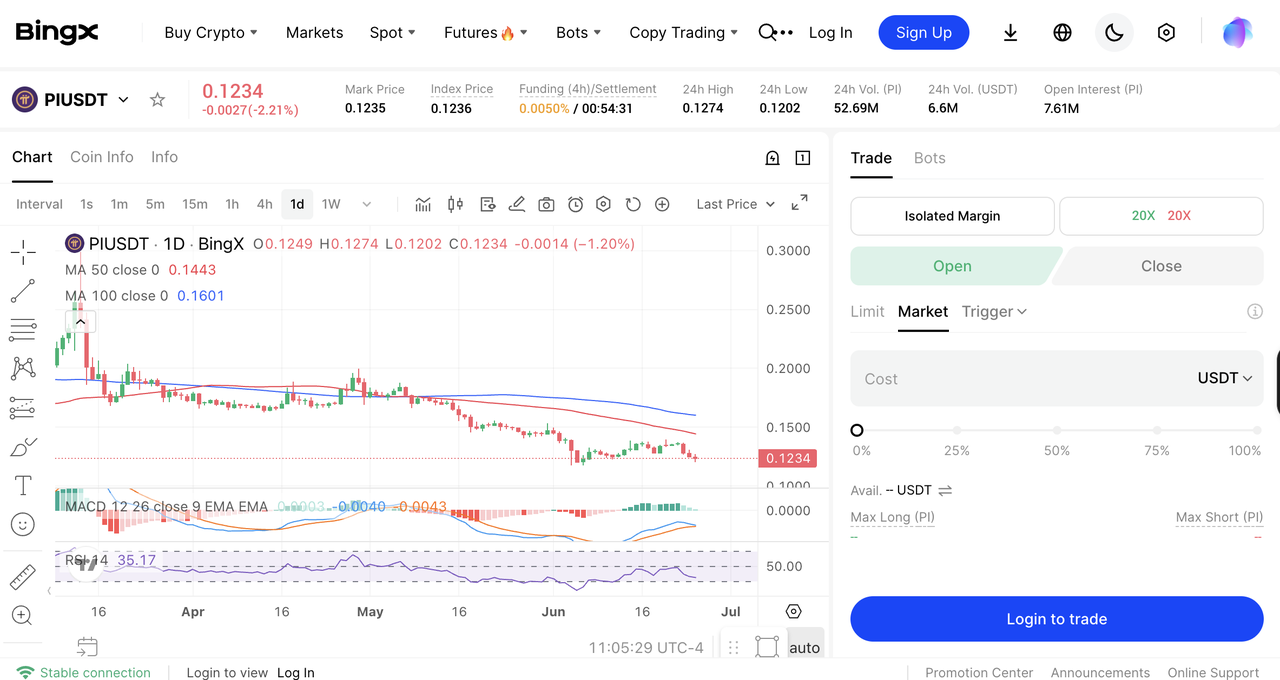
BingX trading interface for PI/USDT with Limit order selection.
- Monitor Token Unlocks Before Trading: One of the biggest drivers of PI's price is its monthly token unlock schedule. Large unlock events increase circulating supply and can create additional selling pressure, making it worthwhile to check upcoming unlocks before opening a position.
- Set Stop-Loss and Take-Profit Levels: Before confirming your trade, use BingX's built-in TP/SL tools to define your exit strategy. This helps protect your capital if the market moves against you, and automatically locks in profits when your target is reached.
- Monitor Your Position: After entering trade, keep an eye on circulating supply growth, ecosystem developments, and trading volume. These factors can significantly influence PI's price alongside broader crypto market sentiment.
What to Watch Before Trading PI
- Monthly unlock calendar: The single most important variable for PI's near-term price is the amount of supply entering the market each month. Large scheduled unlocks create predictable windows of selling pressure. Track community-compiled unlock calendars and avoid buying immediately before a large unlock event unless you have a specific reason to expect demand to absorb it.
- Circulating supply growth rate: Check the week-over-week change in circulating supply on CoinGecko or CoinMarketCap. A slowing growth rate in circulating supply is a positive signal; an accelerating growth rate signals more supply pressure ahead.
- Ecosystem activity signals: Monitor the number of active dApps, transaction volumes on the Pi blockchain, and merchant adoption announcements. These are early indicators of whether demand is building to meet supply. Rising on-chain activity without a rise in circulating supply sets up price appreciation.
- Use Limit orders: PI's order book depth is thin relative to major-cap assets. A market order in a significant position can be executed at a materially worse price than the quoted spread. Set limit orders at your target price and wait for a fill rather than accepting market execution.
Conclusion
Pi Network's price is driven as much by its tokenomics as by market demand. While its large user base and growing ecosystem offer long-term potential, ongoing token unlocks and supply expansion remain key factors affecting price performance. Whether you're investing or actively trading PI, BingX provides a convenient platform to trade PI/USDT using spot markets, advanced order types, and built-in risk management tools.
Related Articles
- What Is Pi Network and How to Mine PI Coins in 2026?
- Top 7 Pi Network dApps to Watch in 2025 (Beginner’s Guide)
- Making Every Trade Efficient: A Guide to Stable Spot Portfolio Growth
- Risk Management in Crypto Trading: 7 Rules Every Trader Must Know
- How to Keep a Trading Journal: A Complete Guide for Crypto Traders
- Implied Volatility in Crypto: What It Means and How to Trade It
- Altcoin Season: What It Is, How to Spot It, and How to Trade It
- Best 7 Cloud Mining Platforms to Mine Bitcoin in 2026
FAQs on Pi Network Tokenomics
1. What is Pi coin's total supply?
Pi Network has a hard cap of 100 billion PI tokens. This is the absolute maximum that will ever be issued. The actual supply in circulation is far lower: approximately 9 to 9.2 billion PI as of early Q2 2026, representing less than 9.3% of the maximum supply.
2. How much PI is circulating right now?
Approximately 9 to 9.2 billion PI was circulating on exchanges in early Q2 2026. This figure increases monthly as more Pioneer balances complete lockup and become available for trading. Verify the current figure at CoinGecko or CoinMarketCap before trading.
3. What is the difference between Pi coin's market cap and fully diluted valuation?
The circulating market cap multiplies the current price by the tokens actually tradeable on exchanges (approximately 9.2 billion). The fully diluted valuation (FDV) multiplies the price by the maximum possible supply (100 billion). At $0.17, the circulating market cap is approximately $1.56 billion while the FDV is approximately $17 billion. The gap reflects the massive supply that is locked, vesting, or not yet migrated.
4. What are Pi Network second migrations?
Second migrations refer to subsequent waves of Pioneers completing KYC and moving their mined PI balances from the app's internal ledger to the actual mainnet blockchain. Earlier migration waves processed the highest-priority accounts; subsequent waves bring in accounts that required additional verification or had earlier migration issues. Each wave adds previously off-market PI to the blockchain and starts a lockup countdown before those tokens eventually reach exchanges.
5. Why does PI price keep falling despite millions of users?a
The primary driver is supply inflation. Hundreds of millions of new PI tokens enter exchange circulation every month from unlocking schedules, while organic demand has not grown fast enough to absorb that sell pressure. With only 9% of the 100 billion maximum supply currently circulating and no burn mechanism, every month adds new supply to a market with limited external demand.
6. What would Pi coin need to be worth $1?
At $1.00 per PI and the current circulating supply of approximately 9.2 billion, PI's circulating market cap would be $9.2 billion, comparable to a mid-large Layer 1 blockchain. On a fully diluted basis, $1.00 implies a $100 billion valuation, which would rank Pi Network among the largest blockchain ecosystems in history by market cap. Reaching and sustaining $1.00 would require substantial ecosystem utility growth, genuine external demand, and continued supply absorption.
Read more: How Much Will Pi Coin Be Worth?
