
In May 2026, Palladium (XPD) stands at a historic crossroads. After suffering a 76% decline from its 2022 highs, the metal has recently staged a dramatic recovery, surging nearly 90% over the past 12 months to trade near $1,500. Investors are now weighing a massive structural supply deficit, estimated at 500,000 to 700,000 ounces, against a high-interest-rate environment that has pushed the U.S. Dollar Index (DXY) toward the critical 100 level.
The Agentic Web and AI Supercycle may dominate digital asset headlines, but in the physical world, the Strait of Hormuz disruption has sent Brent crude to $118, raising diesel costs for South African miners and tightening the global supply of critical minerals. This guide breaks down the Palladium price prediction for 2026 using data from the LBMA, Bank of America, Norilsk Nickel, and J.P. Morgan.
You will also discover how to trade Palladium futures with USDT through BingX TradFi.
Top 5 Things for Palladium Traders to Know in 2026
As Palladium navigates a high-stakes environment of trade wars and industrial shifts, traders must monitor these five factors:
- The U.S. Antidumping Duty: The Department of Commerce has issued a preliminary 132.83% duty on Russian palladium, restructuring global trade flows and creating a strategic premium for non-Russian supply.
- The Hybrid Boom: Contrary to early EV-only predictions, the 2026 market is seeing a surge in Hybrid Electric Vehicles (HEVs). These require higher palladium loadings than traditional ICE cars, extending the metal's demand runway.
- Monetary Transmission: Higher crude oil prices driven by the Iranian blockade have forced the FOMC to hold rates at 3.5%–3.75%. This strengthens the USD, which historically acts as a ceiling for palladium prices.
- Supply Concentration: Over 80% of palladium's global supply is concentrated in Russia and South Africa. Any further geopolitical escalation in these regions could trigger an immediate parabolic price spike due to low market liquidity.
- Technical Gap Risk: The U.S. Dollar Index is testing the April 8 bearish gap between 98.75 and 99.68. If the dollar breaks out above 100, palladium could face a liquidation flush regardless of its strong physical fundamentals.
What Is Palladium (XPD)?
Palladium is a silver-white precious metal, approximately 30 times rarer than gold. While it is a popular Real-World Asset (RWA) for portfolio diversification, its primary value in 2026 is its role as a high-performance catalyst.
As of May 2026, the palladium market is transitioning from a period of thrifting, where manufacturers used cheaper alternatives, back to a reverse substitution phase. Because palladium is now historically cheap compared to platinum, automakers are returning to high-content palladium catalysts.
On the BingX TradFi platform, traders can access these price movements through Palladium (XPD) CFDs, enabling leveraged exposure to a metal that is essential for both the automotive industry and the emerging hydrogen economy.
Palladium’s Performance in 2025: A Review
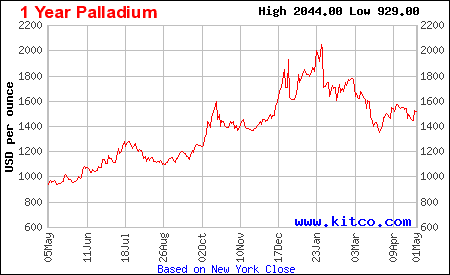
Palladium prices over the past 1 year (as of May 2026) | Source: KITCO
The year 2025 marked the 'Great Bottoming' for palladium prices. After hitting a cyclical floor near $900 in late 2024, prices exploded as the market realized that the EV transition was moving slower than anticipated in the U.S. and China.
By the end of 2025, palladium had surged to $1,651, supported by a 42% drawdown in above-ground stocks. This momentum carried into Q1 2026, with the metal briefly touching $2,195 before the recent macro-driven correction toward $1,500.
Palladium 2026 Investment Outlook: $2,900 Breakout vs. $1,100 Bear Trap
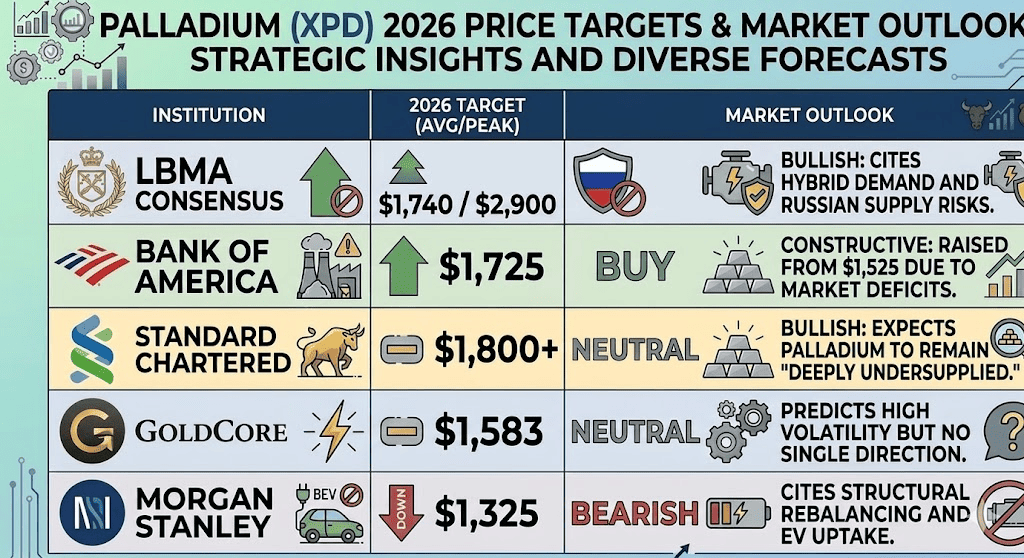
Palladium predictions for 2026 by various leading analysts
Navigating the Palladium market in 2026 requires understanding three distinct scenarios driven by geopolitical trade barriers and the Federal Reserve's rate path.
The Bull Case: The $2,900 Tariff Squeeze
This scenario hinges on a "Supply Shock Multiplier" triggered by the permanent implementation of the 132.83% U.S. preliminary antidumping duty on Russian palladium. Since Russia accounts for 40% of global mine production, North American fabricators would be forced into a frantic scramble for South African and recycled material. This protectionist pivot, combined with the Hybrid Boom where HEVs, carrying 10-15% higher PGM loadings than standard ICE vehicles, displace stalled EV sales, could push the structural deficit toward 1 million ounces.
Practically, this creates a Low Liquidity Squeeze on the NYMEX. With above-ground stocks already drawn down 42%, institutional trend-followers would likely trigger massive buy-stops above the $2,195 Q1 high. As secondary supply (recycling) fails to bridge the gap due to slow scrap collection rates, prices would likely target the $2,900 Fibonacci extension, making palladium a high-alpha debasement trade for investors seeking alternatives to overextended gold positions.
The Base Case: $1,400 – $1,850 Consolidation
The base case assumes a Macro-Fundamental Tug-of-War where a tight physical market is neutralized by restrictive monetary policy. While a 500,000 to 700,000-ounce deficit remains the baseline, the Federal Reserve’s 3.5%–3.75% restrictive rate keeps the U.S. Dollar Index coiling near the 99.68 resistance zone. This elevated opportunity cost prevents a sustained speculative breakout, as institutional capital remains concentrated in high-momentum sectors like semiconductors with a 41% growth rather than non-yielding industrial commodities.
For traders, this results in a high-volatility range-bound environment. The $1,400 floor is reinforced by the marginal cost of production for South African miners who are facing 60% higher energy costs and diesel disruptions. However, any rally toward $1,900 is met with distribution as industrial users hedge their requirements and the market anticipates a slow rebalancing through 2027. This scenario favors a mean-reversion strategy, buying the $1,400 support and taking profits at the $1,850 psychological ceiling.
The Bear Case: $1,100 Demand Destruction
The bearish outlook is predicated on a Geopolitical De-escalation & Recession event. If a diplomatic resolution reopens the Strait of Hormuz, Brent crude would likely crash from $118 toward the $70–$80 range, causing a rapid deflationary pulse. This would remove the energy-premium from the dollar and allow the Fed to pivot, but the benefit to metals would be offset by a sharp contraction in global automotive demand. A global recession would hit the 80% demand base for autocatalysts, potentially flipping the market from a deficit to a surplus as vehicle sales plummet.
Technically, the Bear Trap is confirmed if palladium fails to hold the $1,255 October 2024 breakout level. A decisive daily close below this mark would signal that the 2025–2026 rally was merely a dead-cat bounce driven by temporary tariff fears. As manufacturers accelerate the shift to Battery Electric Vehicles (BEVs) to save costs in a low-margin environment, speculative paper selling on the NYMEX would accelerate, liquidating the remaining long positions and driving prices to retest the $1,100 multi-year support floor.
Palladium Price Forecasts 2026: Leading Analyst Views
|
Institution |
2026 Target (Avg/Peak) |
Market Outlook |
|
LBMA Consensus |
$1,740 / $2,900 |
Bullish: Cites hybrid demand and Russian supply risks. |
|
Bank of America |
$1,725 |
Constructive: Raised from $1,525 due to market deficits. |
|
Standard Chartered |
$1,800+ |
Bullish: Expects palladium to remain "deeply undersupplied." |
|
Goldcore |
$1,583 |
Neutral: Predicts high volatility but no single direction. |
|
Morgan Stanley |
$1,325 |
Bearish: Cites structural rebalancing and EV uptake. |
How to Trade Palladium (XPD) Futures on BingX TradFi
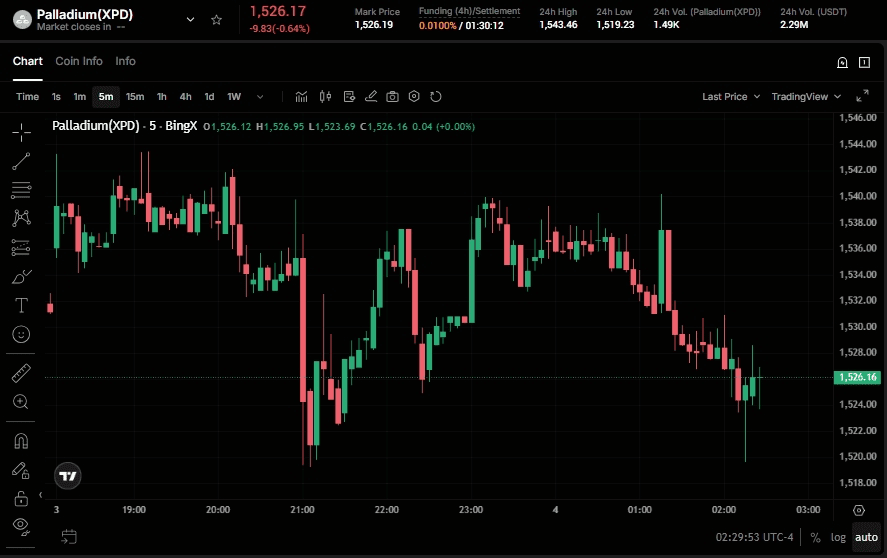
Palladium (XPD) perpetuals on BingX futures market
Capitalize on palladium's volatility using BingX TradFi and BingX AI's automated insights. Whether you are hedging against Russian supply disruptions or trading the debasemen" of fiat currencies, BingX offers the tools to trade XPD with precision.
- Access BingX TradFi: Go to the Commodities/Forex section.
- Select Palladium: Choose the PALLADIUM(XPD)-USDT contract.
- Analyze Trends: Use the BingX AI sentiment tool to track dollar strength (DXY) and energy correlations.
- Execute: Select Open Long if you believe the structural deficit will prevail, or Open Short to trade the bearish dollar-breakout scenario.
Final Thoughts: Is Palladium a Buy in 2026?
At $1,500, Palladium is trading near the marginal cost of production for many South African mines facing skyrocketing diesel and electricity costs. Historically, when prices hit the production cost floor during a supply deficit, it has signaled a major accumulation zone.
For the tactical trader, the immediate coiling effect of the U.S. Dollar is the primary risk. If the DXY fails at the 99.68 resistance, the resulting metals relief rally could be explosive. However, disciplined risk management is essential; palladium is known for its low liquidity and high volatility, meaning price swings can be violent.
Risk Reminder: Trading precious metals involves significant capital risk. Palladium’s market is smaller and less liquid than Gold, leading to rapid price swings. Always use Stop-Loss orders and conduct independent research.
Related Reading
- Platinum (PL) Price Prediction 2026: $2,500 Industrial Breakout or Speculative Retrace?
- Is Gold a Good Investment in 2026? Risks & Returns Explained
- Silver Price Prediction for 2026: Can XAG Surge Above $200 or Face a Correction?
- Is Copper (XCU) a Good Investment in 2026?
- Crude Oil Price Forecast 2026: $140 War Premium or $60 Surplus Baseline?
- How to Trade Commodities With Crypto in 2026 as Oil, Gold, Silver, and TradFi Go On-Chain
