Perpetual futures trading on BingX offers a sophisticated way to amplify your market position by speculating on the price movements of both crypto and traditional financial (TradFi) assets. While Standard Futures on BingX provide a simplified, per-order trading experience, Perpetual Contracts are the industry standard for those seeking continuous market exposure.
The defining characteristic of these contracts, as the name suggests, is that they have no expiry date. Unlike traditional futures that settle on a specific weekly, monthly, or quarterly date, BingX Perpetual Futures allow for long-term strategic positioning that you can hold indefinitely, provided margin requirements are met.
As of 2026, BingX ranks among the top 5 global derivatives exchanges, supporting over 40 million users, a massive array of over 1,100 trading pairs, leverage up to 500x, and offering USDT and USDC as margin. Whether you are looking to hedge your portfolio against volatility or capitalize on short-term price swings in Bitcoin, Gold, or the S&P 500, BingX’s Perpetual Futures platform is built for high-performance execution.
This guide will walk you through the essentials of setting up, executing, and managing your first perpetual futures trade on BingX, ensuring you have the essential risk management tools necessary for the 2026 trading environment.
What Is BingX Perpetual Futures Trading?
BingX Perpetual Futures are derivative contracts that allow you to buy (Long) or sell (Short) an underlying asset at a predetermined price without an expiration date. Because there is no delivery date, these contracts use a Funding Rate mechanism to ensure the futures price stays anchored to the real-time spot market price.
On BingX, the perpetual market is divided into two powerful sectors:
- Crypto Perpetuals: Trade high-liquidity digital assets like BTC, ETH, and emerging 2026 RWA (Real World Asset) tokens with up to 500x leverage.
- TradFi Perpetuals: Use your USDT margin to trade traditional instruments, including Commodities like Gold and Crude Oil, forex pairs like EUR/USD, stock indices like S&P 500 and NASDAQ 100, and stock futures like NVDA, AAPL, and TSLA.
How Perpetual Futures Trading Works on BingX
Before placing a trade, it is critical to understand the proprietary mechanics that BingX uses to govern risk and price stability.
- The Funding Rate Mechanism: To prevent the perpetual price from drifting away from the actual market (Spot) price, BingX employs a peer-to-peer funding fee.
- Settlement: These payments occur every 8 hours at 00:00, 08:00, and 16:00 (UTC).
- The Logic: When the market is bullish and the perpetual price is higher than the spot price, Longs pay Shorts. When the market is bearish, Shorts" pay "Longs. This keeps the contract price from deviating too far from the real-world value.
- Settlement: These payments occur every 8 hours at 00:00, 08:00, and 16:00 (UTC).
- Dual-Price Forced Liquidation Mechanism: BingX uses a sophisticated Dual-Price Mechanism to protect users from scam wicks, sudden, artificial price spikes on a single exchange that don't reflect the broader market.
- Index Price: A weighted average of spot prices from high-liquidity global exchanges, including Binance, Huobi, and OKX.
- Mark Price: Calculated using the Index Price plus a moving average of the funding basis.
- The Logic: On BingX, forced liquidation is only triggered when both the Mark Price and the Last Price reach the liquidation price. This dual-trigger mechanism ensures your position isn't closed just because of a temporary liquidity gap or a flash crash on the local BingX order book. Even if the Last Price on the chart hits your liquidation level, your trade remains safe if the global Mark Price has not confirmed the move.
- Index Price: A weighted average of spot prices from high-liquidity global exchanges, including Binance, Huobi, and OKX.
- Unified Multi-Asset Margin
As of 2026, BingX’s Multi-Asset Mode allows you to use various cryptocurrencies like BTC, ETH, USDT, USDC as margin simultaneously.
- Isolated Margin: Limits your risk strictly to the specific amount allocated to one trade.
- Cross Margin: Shares your entire account balance to maintain positions, allowing you to use a profitable Bitcoin long to collateralize a Gold short.
- Isolated Margin: Limits your risk strictly to the specific amount allocated to one trade.
- Exclusive: Guaranteed Price (GTD): BingX is one of the few platforms to offer an insurance-style feature for order execution. By enabling Guaranteed Price, the platform ensures your Stop-Loss executes at the exact price you set, completely eliminating slippage during high-volatility market gaps.
Why Choose BingX for Trading Perpetual Futures: 4 Key Benefits
In 2026, BingX has solidified its position as a global leader in derivatives by offering a high-performance ecosystem that blends institutional-grade liquidity with retail-friendly accessibility. While traditional exchanges focus solely on crypto, BingX’s unified One-Wallet architecture allows you to deploy capital across more than 700 crypto pairs and over 50 TradFi instruments, including Gold, Forex, and Global Indices, without ever leaving the platform.
The data speaks to BingX's commitment to trader success:
- Superior Execution: With peak daily volumes exceeding $26 billion, BingX offers some of the deepest liquidity in the industry, minimizing slippage even on high-leverage 500x trades.
- Cost-Efficient Trading: Top-tier VIP members benefit from a Zero-Fee structure on specific pairs, with standard maker fees starting as low as 0.02%, significantly lowering the barrier to profitability.
- Unrivaled Security: Backed by a $150M Shield Fund and a 100% Proof of Reserves (PoR) mandate, your assets are protected by an institutional-grade insurance layer against system-level anomalies.
- Advanced Price Protection: The proprietary Dual-Price Mechanism uses a global Mark Price to trigger liquidations, protecting you from scam wicks and local market manipulation that often plague lesser exchanges.
By combining the agility of crypto with the stability of TradFi, BingX provides the ultimate toolkit for the modern, diversified perpetual futures trader.
How to Start Perpetual Futures Trading on BingX (Web)
Follow these steps to transition from a spot holder to a professional futures trader on the BingX web platform.
Step 1: Fund Your Futures Account
Navigate to Assets and Transfer. Move your USDT from your Fund Account or Standard Futures Account into your Futures Account.
Step 2: Access the Perpetual Futures Trading Portal
Hover over Futures on the top menu and select Perpetual Futures. You can switch between Crypto and TradFi assets on the left side of the trading interface.
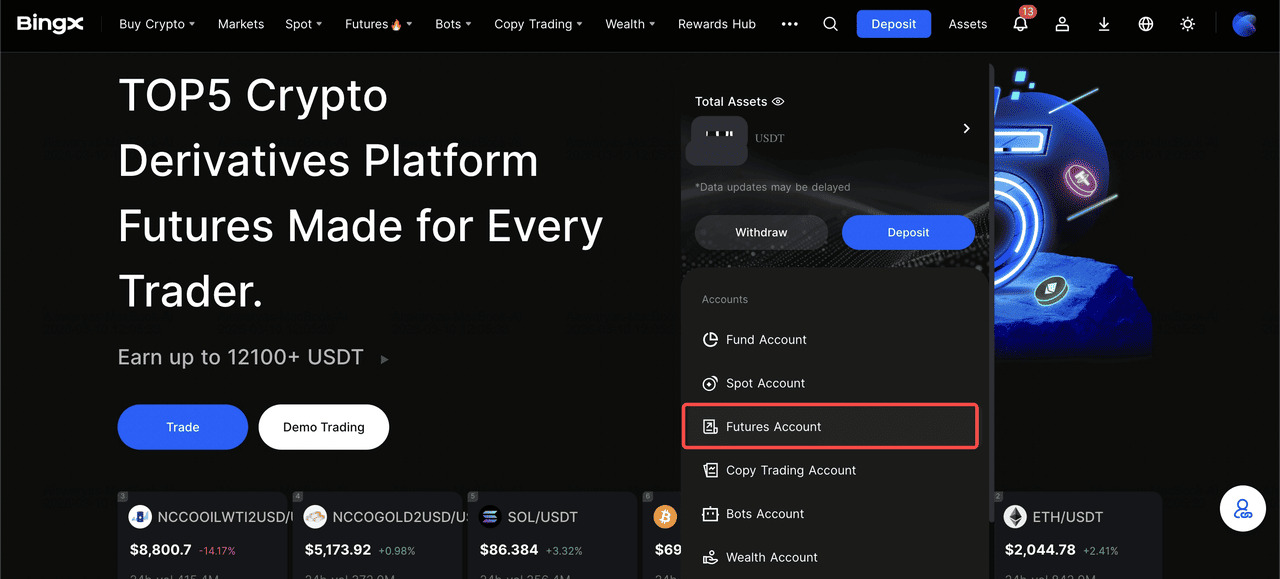
Step 3: Configure Your Margin and Leverage
On the right-hand panel:
- Select Isolated or Cross margin mode.
- Adjust your Leverage, e.g., 5x or 10x.
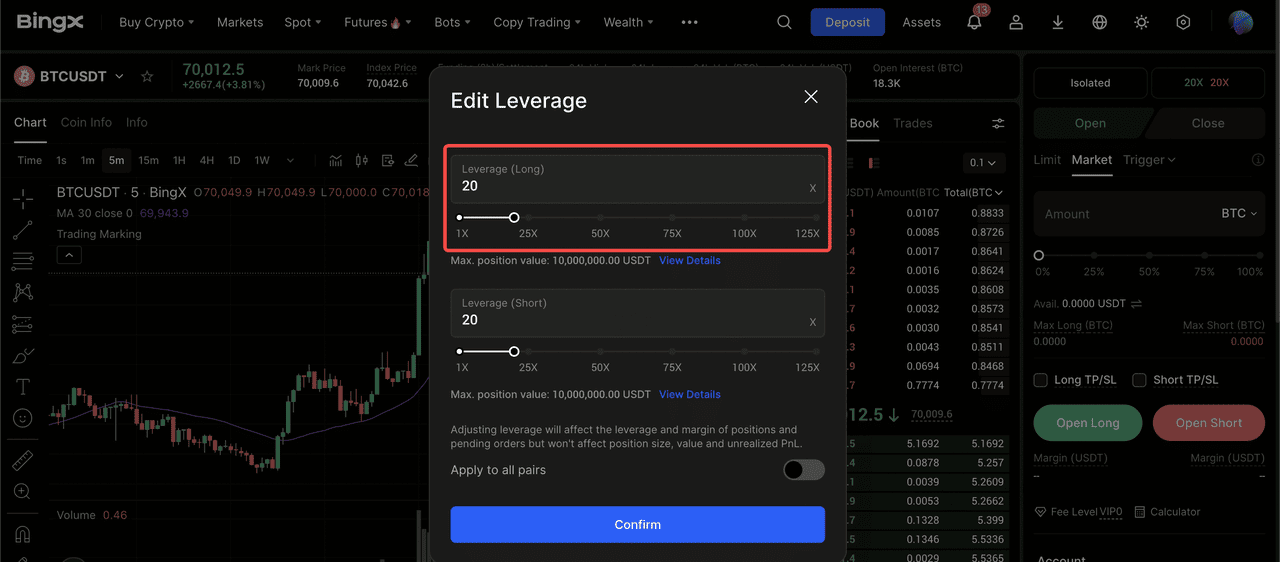
Tip: Use the BingX Calculator icon to simulate your estimated liquidation price before confirming.
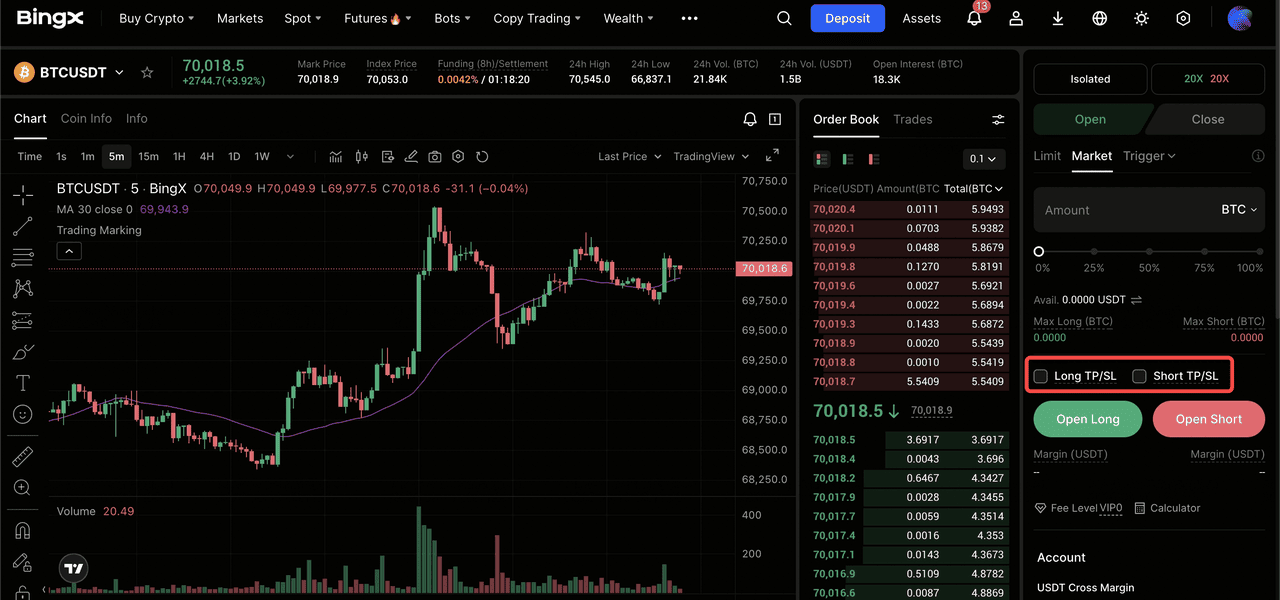
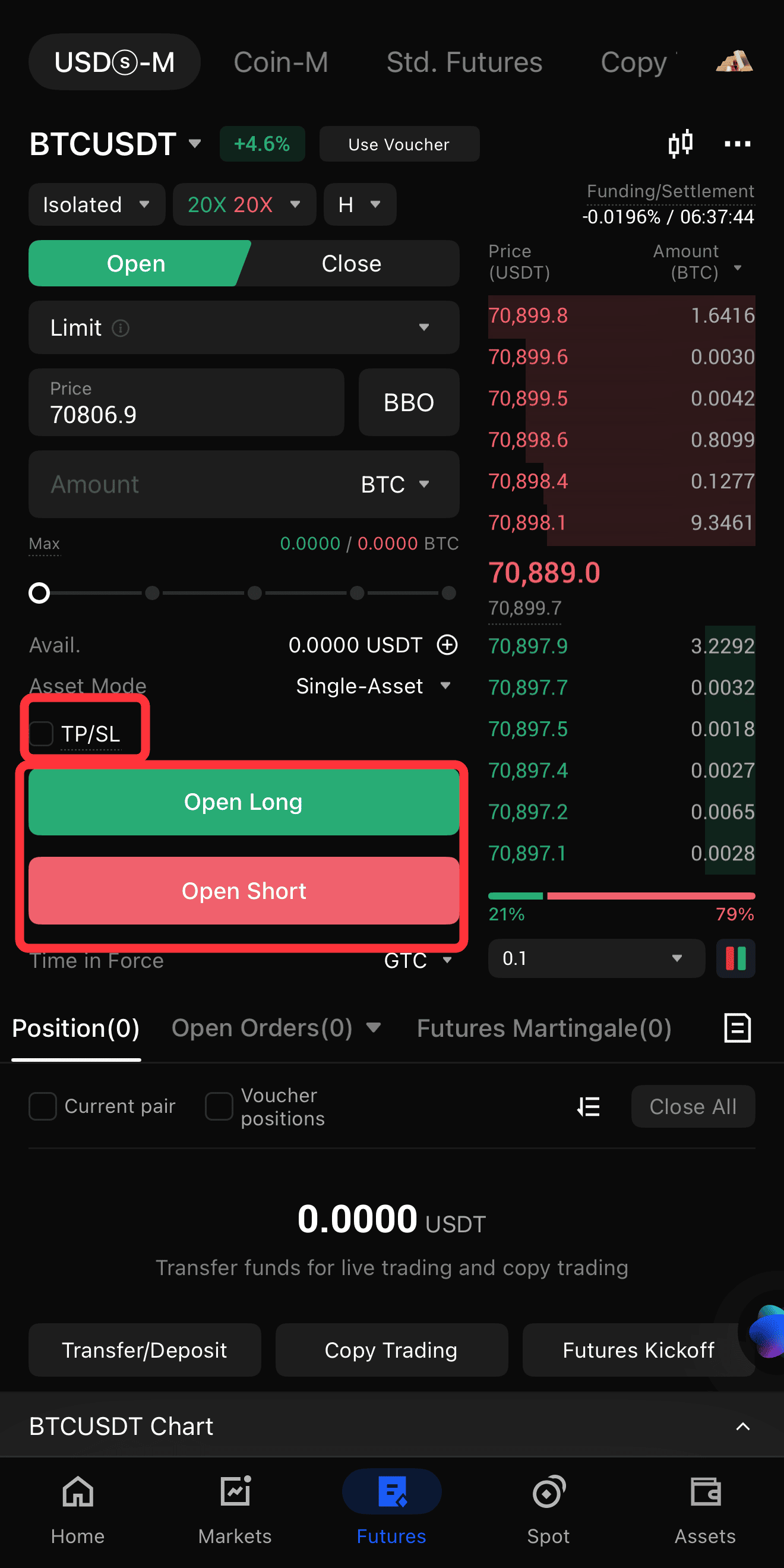
Step 4: Set Your Order and TP/SL
Choose your order type (Limit, Market, or Trigger). Enter the amount of USDT you wish to commit. Crucially, check the TP/SL (take-profit/stop-loss) box to set your exit targets immediately. Enable Guaranteed Price for your Stop-Loss to safeguard against slippage.
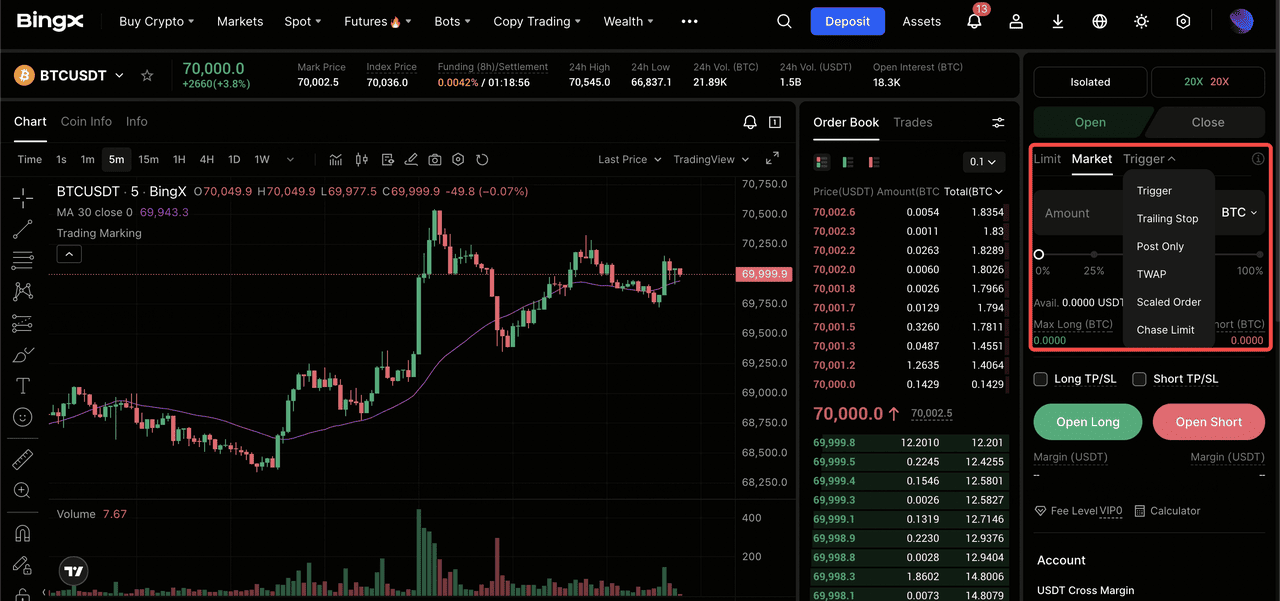
Step 5: Open and Monitor Your Position
Click Open Long if you are bullish or Open Short if you are bearish. Your active trade will appear in the Position tab at the bottom, where you can view real-time Unrealized PnL and ROI.
How to Start Perpetual Futures Trading on BingX (App)
The BingX app provides the same institutional-grade tools in a mobile-optimized format for trading on the go.
Step 1: Transfer Funds and Navigate to Perpetual Futures Market
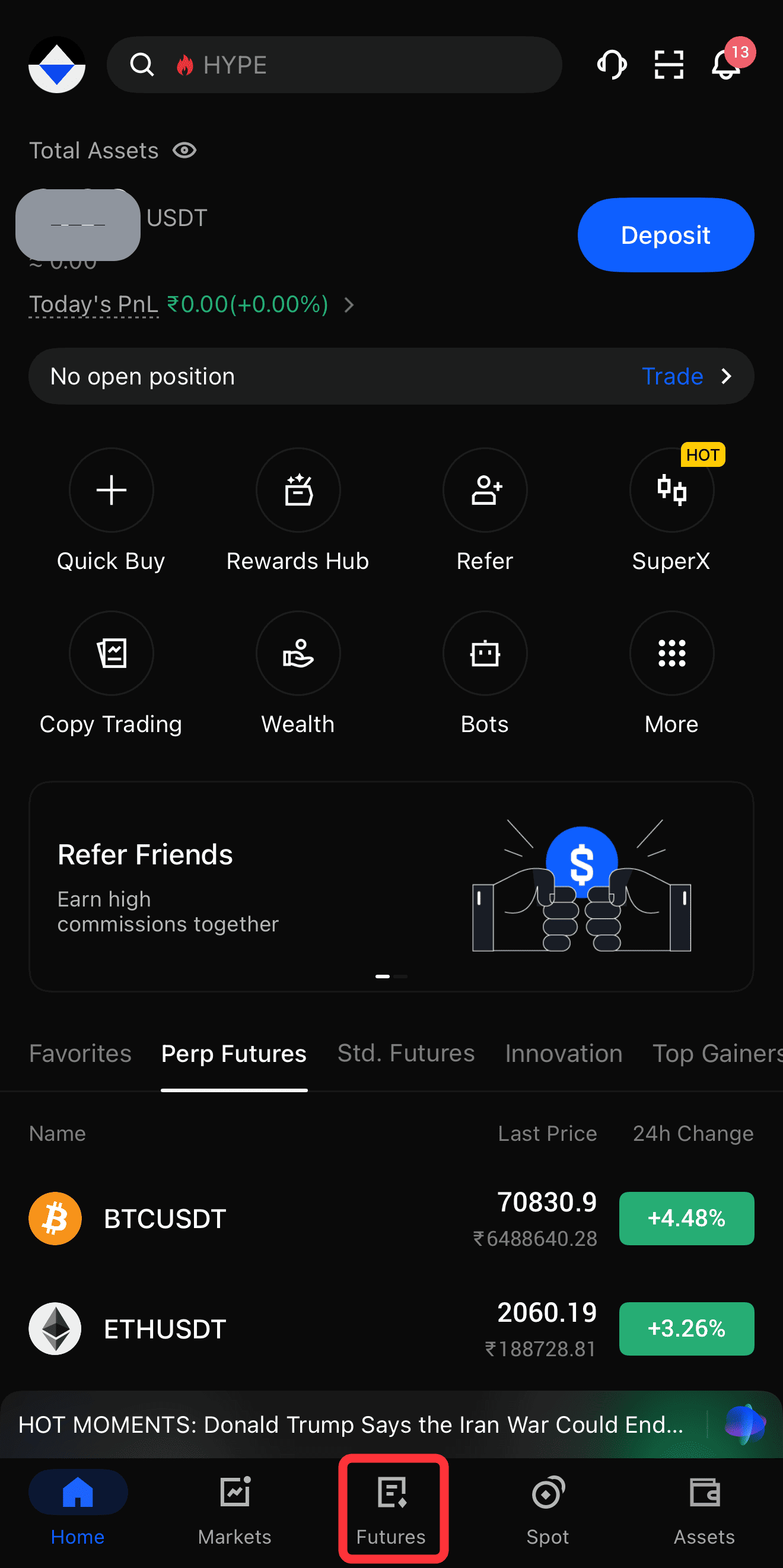
Tap Assets and Transfer to fund your Futures wallet. Then, tap the Futures icon in the center of the bottom navigation bar.
Step 2: Select Your Asset
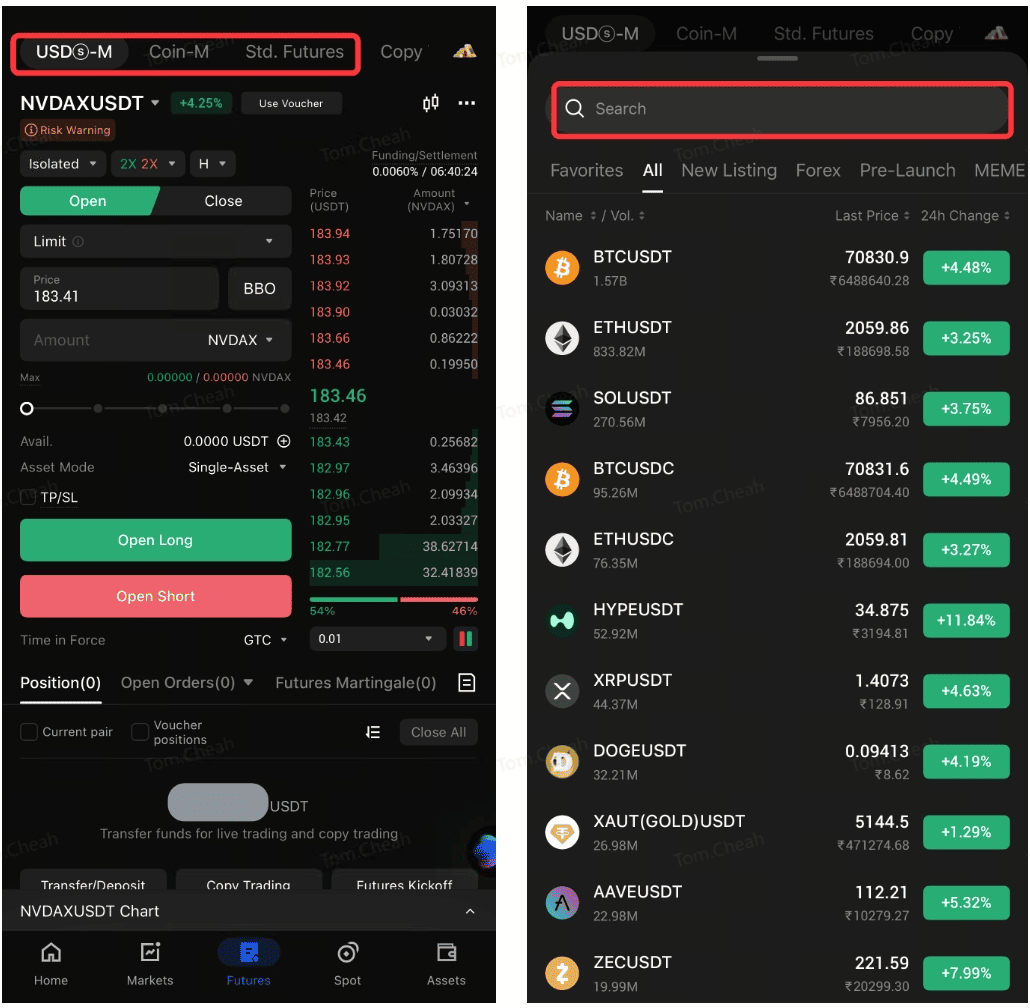
Tap the trading pair at the top, e.g., BTC/USDT, to open the market list. Use the tabs to filter by Crypto or TradFi assets like Gold or the NASDAQ 100.
Step 3: Set Your Trade Parameters
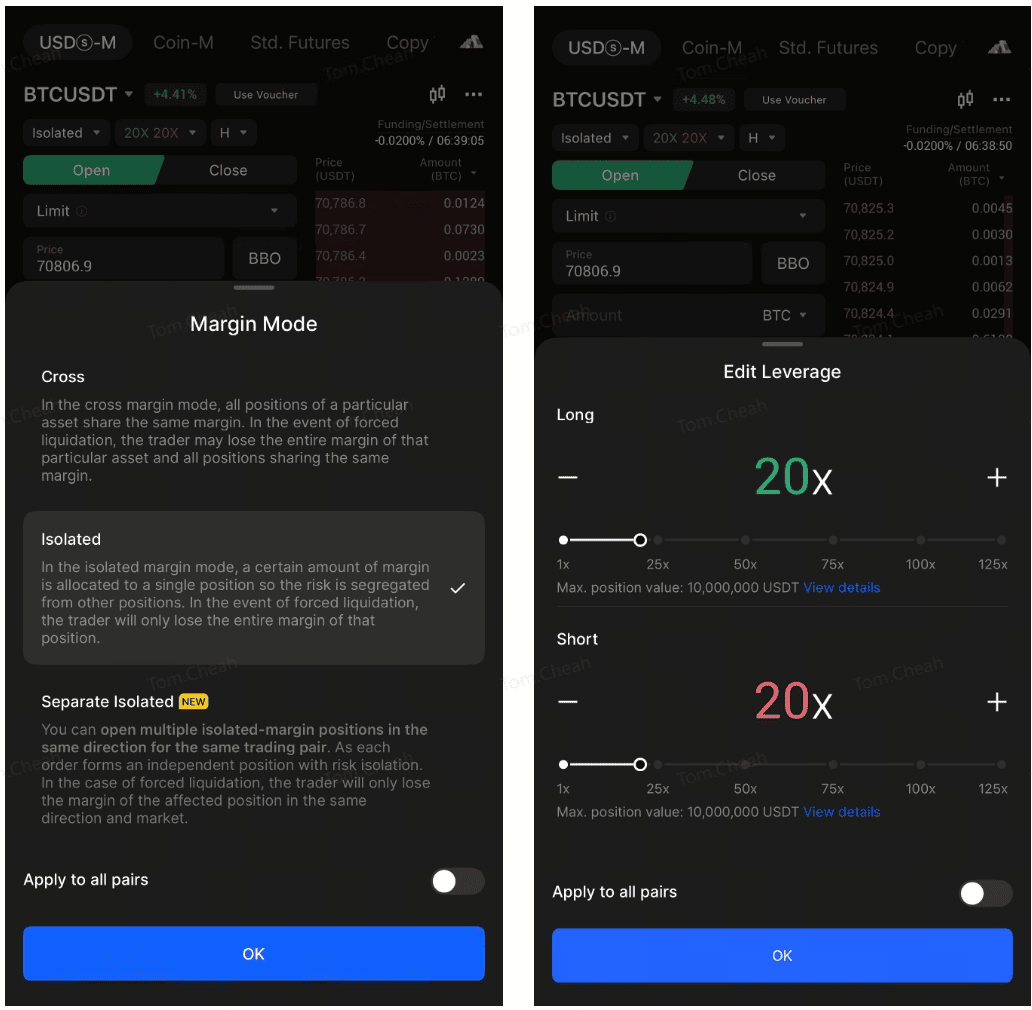
Toggle between Isolated/Cross and set your Leverage. Select Market for instant entry or Limit for a specific price.
Step 4: Execute with Protection
Enter your margin amount and toggle the TP/SL switch. Tap Buy or Sell to execute. You can manage your trade under the Positions tab, where you can Reverse the position or Close it with one tap.
Essential Risk Management Checklist for BingX Futures Traders
To remain profitable in the high-velocity environment of 2026, professional traders must move beyond basic stop-losses. This checklist integrates BingX’s proprietary safety infrastructure with practical execution steps to protect your capital against both market volatility and operational risks.
1. Optimize Your Fee Structure: The VIP Audit
In high-frequency or high-leverage trading, fees can consume up to 30% of your potential profits. Visit the VIP Center on the BingX dashboard to check your current tier.
Trading volumes now qualify you for Zero-Fee zones on specific TradFi pairs. If you are a Maker, providing liquidity with limit orders, your fees can start from as low as 0.02%, or even net-positive through rebates in certain promotional tiers. Lowering your overhead directly lowers your break-even point on every trade.
2. Master TradFi Market Gaps and Maintenance Margin
Trading the S&P 500 or Gold on BingX requires a different clock than 24/7 crypto. Monitor the Market Info tab for asset-specific closing times. If your margin is too thin, the system may liquidate you before the market closes to protect against a Monday Morning Gap, where the market opens significantly lower than it closed. Ensure your account has a buffer of at least 15-20% above the liquidation price before the weekend.
3. Utilize Visual Chart Order Execution
Typing prices into an order box is slow and prone to fat-finger errors. Enable Chart Trading in your preferences. On the TradingView-integrated chart, you can click and drag your Take-Profit (TP) and Stop-Loss (SL) labels.
In 2026, BingX’s interface allows you to see your Estimated PnL in real-time as you drag the line. This allows for dynamic risk management, tightening your stop-loss to the breakeven point visually as the price moves in your favor.
4. Use the BingX Calculator for "What-If" Scenarios
Open the calculator icon located above the Buy/Sell buttons. Before clicking Long, input your entry price and leverage to find your Exact Liquidation Price. If that price sits at a major support level, lower your leverage or add margin. Professionals never guess their liquidation point; they calculate it to the fourth decimal.
Conclusion: Should You Trade Perpetual Futures on BingX in 2026?
Perpetual futures trading on BingX bridges the gap between the flexibility of crypto and the stability of traditional markets. By utilizing the 2026 Safety Suite, including the Dual-Price Mechanism and Guaranteed Price, traders can leverage global volatility while maintaining strict control over their downside.
Success in the futures market is a marathon, not a sprint. Start with low leverage, utilize the built-in calculator, and always trade with an active stop-loss.
Disclaimer: Futures trading involves significant risk and the potential for total loss of funds. Leverage magnifies both gains and losses. Ensure you understand the mechanics of liquidation and funding rates before committing capital. Past performance of any asset or trader is not indicative of future results.
Related Reading
- BingX Tutorial | How to Get Started With Futures Trading
- 8 Best Crypto Futures Platform for Beginners in 2026
- How to Get Started with Trading Futures on BingX: Beginner’s Guide
- What Is Liquidation in Crypto Futures Trading? How to Calculate Liquidation Price
- Crypto Futures Funding Rate Explained: How It Affects Longs, Shorts, and Trading Costs
FAQs on Perpetual Futures Trading
1. Why is my liquidation price different from the market price?
Liquidations are triggered by the Mark Price to protect you from local price spikes and artificial scam wicks on a single exchange. The Mark Price represents a weighted average of global spot prices from multiple top-tier exchanges. While the Last Price on the chart shows where the most recent trade occurred on BingX, you should always monitor the Mark Price to gauge your true risk level and proximity to liquidation.
2. What is the difference between USDT-M and Coin-M Perpetual Futures?
USDT-M contracts are settled in USDT, meaning your margin and profits are in stablecoins, ideal for those who want to avoid the price volatility of their collateral. Coin-M contracts use the underlying cryptocurrency (e.g., BTC or ETH) as margin, which is preferred by long-term holders who want to accumulate more of the asset itself while trading.
3. How do I avoid slippage during high market volatility?
The most effective way to eliminate slippage on BingX is by using the Guaranteed Price (GTD) feature. Unlike a standard Stop-Loss, which executes at the best available market price, GTD ensures your order is filled at your exact preset price, regardless of market gaps or sudden price spikes.
4. Why is my Liquidation Price changing even though I haven't added funds?
In Cross Margin mode, your liquidation price is dynamic because it is tied to your entire futures account balance. If you open other positions or if the value of your unrealized PnL changes, your available margin fluctuates, causing the estimated liquidation price to move. To keep a fixed liquidation price, use Isolated Margin.
5. Can I trade Stock Indices and Commodities 24/7 on BingX?
While Crypto Futures trade 24/7, TradFi assets (like the S&P 500, Gold, or Forex) follow global market hours. If the underlying traditional exchange is closed for the weekend or a public holiday, trading for those specific contracts on BingX will be paused. Always check the "Market Info" tab for specific asset session times.
