

Hedera Hashgraph (HBAR) has solidified its position in 2026 as the foundational trust layer for the enterprise digital economy, surpassing 71 billion total transactions. Powered by its unique hashgraph consensus algorithm rather than a traditional blockchain structure, Hedera’s native staking mechanism offers structural advantages over typical delegated networks.
As of mid-2026, the network is secured by a decentralized global council of Fortune 1000 institutions, non-profits, and universities running KYC'd consensus nodes. The maximum annual reward rate is capped at 2.5% by the Hedera Governing Council, with the actual network APY typically hovering between 1.97% and 2.5%, depending on network conditions and total participation.
For HBAR holders, native staking serves a dual purpose: it directly strengthens the network's consensus voting power while providing a completely liquid stream of passive income. Unlike other networks that lock up your funds, Hedera features zero unbonding periods and zero slashing risks. Whether you are a retail investor looking for long-term growth or an enterprise developer deploying utility tokens, understanding Hedera’s 24-hour staking periods is key to optimizing your portfolio.
This guide explores the most effective ways to stake HBAR in 2026, from Hedera Hashgraph to hardware wallet integrations.
What Is Hedera Layer-1 Distributed Ledger Technology?
Hedera is an open-source, public distributed ledger technology (DLT) designed to provide enterprise-grade security, rapid transaction finality, and predictable low fees. Instead of using a traditional chain of blocks, Hedera utilizes hashgraph technology, a system based on a "gossip about gossip" protocol and "virtual voting."
This breakthrough approach allows the network to process over 10,000 transactions per second (TPS) with a blistering 2.9-second consensus finality. Governed by a rotating Council of global institutions, Hedera delivers parallel transaction processing, built-in EVM compatibility for Solidity developers, and a highly sustainable carbon-negative footprint.
Read more: What Is Hedera (HBAR) and How Does aBFT Consensus Power the Hashgraph Ecosystem?
What Is the Role of the HBAR Token in the Hedera Ecosystem?
HBAR is the native cryptocurrency of the Hedera network, serving two critical functions:
- Network Security: The network operates on a coin-weighted proof-of-stake model. Staking HBAR increases a node's voting weight in the consensus algorithm, making the network highly resilient to cyberattacks.
- Network Fuel: HBAR is used to pay for transaction fees across all network services, including smart contract execution, file storage, and token transfers.
What Is HBAR Tokenomics?
Hedera features a fixed total supply of 50 billion HBAR. Transaction fees on the network are uniquely pegged to a fixed fiat cost in USD, starting at $0.0001, but paid dynamically in HBAR at the time of execution. To streamline the network, a central Fee Collection Account (0.0.802) consolidates all daily transaction fees. At the end of each 24-hour staking period, these fees are distributed via a single synthetic transaction to network destinations, primarily funding the Staking Reward Account (0.0.800).
What Is Hedera Staking and How Does It Work?
Hedera staking uses a native proxy-weighting mechanism where your HBAR balance is pointed toward a specific consensus node. Because running a validator node is restricted to Council members, regular token holders participate by choosing a node to back.
Crucially, Hedera staking is completely non-custodial. When you stake, your HBAR tokens never leave your wallet, remain fully liquid at all times, and are never locked down. There is no concept of bonding or slashing, meaning your principal can never be slashed or seized due to node downtime or misbehavior. Your entire account balance is automatically factored into the node's consensus weight, and your voting power updates dynamically with your wallet balance.
Key Terms to Know Before Staking HBAR Tokens
- Staking Period: A fixed 24-hour window starting and ending at midnight UTC. To earn rewards for a specific day, your account must remain staked to the node for the entire period.
- Staking Reward Account (0.0.800): The official, keyless network account responsible for distributing rewards to eligible stakers.
- Fee Collection Account (0.0.802): The network account that pools day-to-day transaction fees before funneling them into the reward account.
- Indirect Staking: A feature where Account A proxies its stake to Account B, and Account B stakes to a node. The consensus weight of both accounts combines, but all structural rewards are paid out exclusively to Account B.
Why Stake Hedera (HBAR) in 2026?
Staking HBAR in 2026 offers an incredibly secure, low-friction yield strategy in the Web3 space. With the Linux Foundation managing the codebase as Project Hiero, the ecosystem features high-tier institutional trust. Staking HBAR gives you a steady 2% to 2.5% yield without compromising asset liquidity.
Because there is no unbonding lock-up period, you retain the ultimate freedom to trade, swap, or utilize your HBAR in response to sudden market movements while supporting an energy-efficient infrastructure that consumes less electricity per transaction than a standard Visa swipe.
How Much HBAR Do You Need to Start Staking?
- Self-Custody Wallets: The protocol-level minimum stake threshold is currently set to 0 HBAR, meaning any fractional amount of HBAR can immediately begin earning rewards.
- Validator Nodes: Running a consensus node requires network permissioning via the Hedera Governing Council; nodes are assigned specific maximum caps to prevent reward dilution.
What Are the Top 3 Ways to Stake HBAR in 2026?
Hedera accommodates multiple staking methods tailored to different user preferences, from quick centralized exchange portals to secure hardware wallet routing.
1. Native Staking HBAR on Hedera via Non-Custodial Mobile and Web Wallets
For users seeking direct, on-chain exposure and individual node choice, native software wallets like HashPack represent the primary gateway to the ecosystem. Other popular supported software options include Kabila, BankSocial, and Atomic Wallet.
How to Delegate via HashPack Wallet
- Purchase HBAR on the BingX Spot Market, then withdraw your assets to your personal Hedera account address.
- Open your HashPack wallet and navigate to the Stake tab.
- Click on Stake your HBAR.
- Browse the network node registry. Use live explorers like HashScan.io to cross-verify node performance and identify validators that are not over-saturated beyond their maximum stake capacity.
- Confirm the transaction. Your entire wallet balance is instantly staked to the designated node without leaving your possession. Rewards will begin accruing after your first full 24-hour UTC calendar period.
To stop staking, simply return to the Stake tab, select Unstake, and approve. Because Hedera lacks an unbonding period, your tokens are instantly freed up for immediate transfer.
2. Liquid Staking HBAR on Stader Labs to Earn Auto-Compounding Rewards
In 2026, Stader Labs provides an optimized asset management interface featuring highly competitive yields (historically up to 5.90% APY depending on dynamic pool emissions and DeFi incentives) by issuing HBARX tokens in exchange for deposited HBAR.
- Navigate to the official Stader Hedera DApp on your desktop browser.
- Connect a supported non-custodial wallet, such as HashPack, containing your HBAR balance.
- Input the amount of HBAR you wish to deposit into the Stader smart contract.
- Review the current exchange rate, e.g., 1.40 HBAR per HBARX, and approve the transaction.
- Receive newly minted HBARX directly in your wallet. The smart contract automatically handles token association.
Note: HBARX is a value-accruing token. Rewards are systematically auto-compounded directly into the staking pool every 24-hour epoch, meaning your HBARX does not increase in quantity, but steadily grows in underlying value relative to HBAR. You can trade HBARX instantly across Hedera DeFi protocols or un-stake via Stader with a brief 1-day unbonding period.
3. Advanced Staking: Ledger Hardware Wallet Integration
For long-term investors prioritizing high-grade security for large allocations, pairing a Ledger hardware wallet (Nano S, X, or Stax) with a non-custodial front-end like HashPack offers cold-storage protection with on-chain functionality.
How to Stake HBAR Using a Ledger Hardware Wallet
Staking with a Ledger device keeps your private seed phrase isolated offline, requiring physical device verification for all outbound movements.
- Configure Your Hardware Device: Connect your Ledger to your computer or phone, open Ledger Live, navigate to the Manager tab, and install the latest Hedera app. Open the app on your physical device.
- Sync with HashPack: Access the HashPack Web App or extension. Click Connect Hardware Wallet, select Connect Ledger via WebHID, and choose Get public key. Name your new account and select your base currency.
- Fund and Select Node: Copy your newly generated Ledger-secured Hedera address, including its verification checksum. Transfer your HBAR from BingX to this address.
- Execute Delegation: Within the HashPack Ledger portal, select your desired staking node from the active Hedera Council list. Review the transaction parameters on your physical Ledger screen and press both buttons simultaneously to sign and authorize the delegation.
How to Collect Staking Rewards on Ledger
Hedera rewards do not automatically drop into your account on a clockwork daily basis; they accumulate as pending balances on-chain. Rewards are officially triggered and paid out into your wallet whenever your account balance changes. You can trigger a payout by sending a small fraction of HBAR to yourself, changing node configurations, or executing standard transactions.
Important Warning: You can safely accumulate pending rewards for up to 365 days. If your wallet goes 365 consecutive days without triggering a rewards transaction, any rewards earned prior to that 365-day period will expire and be dropped permanently. Make it a habit to trigger a payout at least once a quarter.
How to Buy Hedera (HBAR) on BingX
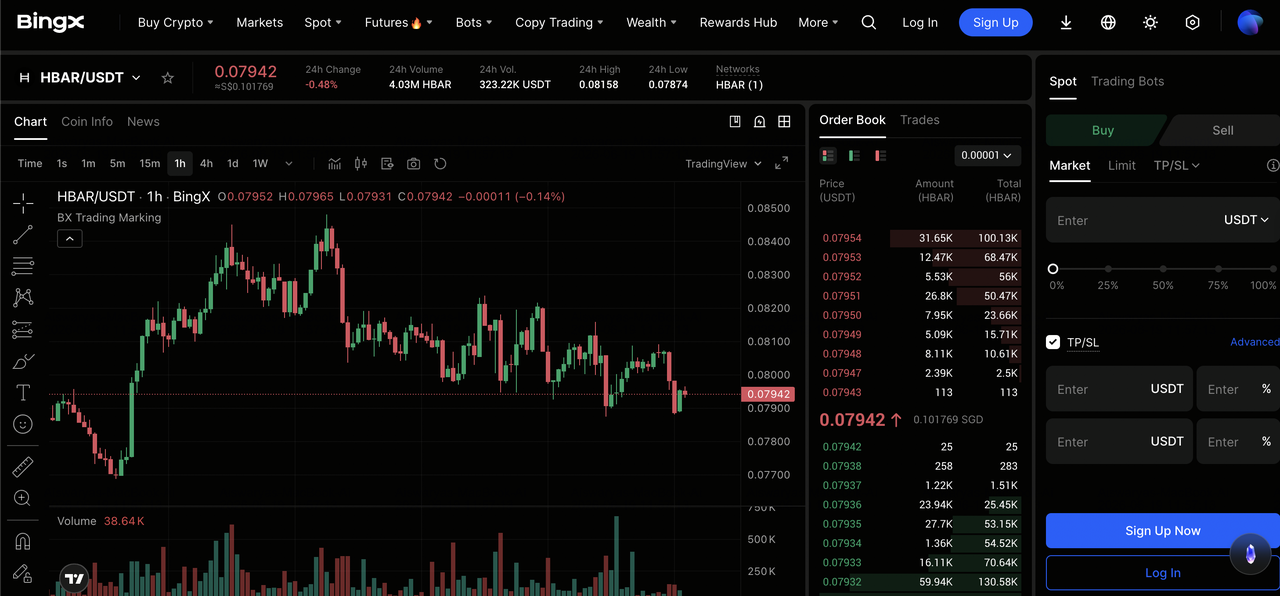
HBAR/USDT trading pair on BingX spot market
Before entering the staking ecosystem, you can utilize the BingX platform to securely accumulate HBAR tokens.
- Fund Your Account: Use the Buy Crypto hub to acquire stablecoins like USDT using your credit card, bank wire, or peer-to-peer (P2P) transfers.
- Access the Spot Market: Navigate to the Spot market and search for the HBAR/USDT trading pair.
- Execute Your Purchase: Utilize a Market Order for instantaneous execution at current spot pricing, or set a Limit Order to establish a precise entry target.
- Deploy Assets: Move your settled HBAR tokens into your Fund Account or withdraw them to self-custody wallets for on-chain staking.
How to Manage Risks and Maximize Rewards When Staking Hedera (HBAR)
While Hedera is structurally engineered to minimize risk, adhering to these strategic practices ensures your capital remains optimized:
- Monitor Node Removals via HashScan: Nodes are occasionally removed from the network address book when temporary nodes are replaced by permanent institutional infrastructure. When a node is removed, it stops generating rewards immediately, and any uncollected pending rewards accrued on that node are lost. Regularly check HashScan.io to verify your node is active.
- Account for the Maximum Stake Cap: Hedera nodes feature an individual maximum stake limit. If a node becomes over-saturated with too much aggregate HBAR, its reward distribution proportions do not scale past the cap, effectively diluting individual yields. Select active nodes that sit safely below their maximum allocation limits.
- Automate Your Rewards Frequency: Because rewards expire after 365 days of account inactivity, executing a simple automated transaction or manually sending a fractional HBAR payment to your wallet every few months ensures your hard-earned rewards are systematically captured and compounded on-chain.
- Maintain Liquid Gas Buffers: While Hedera transaction costs are incredibly low (fractions of a cent), always maintain a small unspent reserve of 1 to 2 HBAR in your available wallet balance to cover the network gas fees required to process future outbound transfers or node reconfigurations.
Final Word: Should You Stake Hedera in 2026?
Staking HBAR in 2026 provides a structured option for generating yield within the Layer-1 ecosystem. The absence of traditional bonding timelines and slashing rules mitigates the principal risks commonly found in other Proof-of-Stake protocols.
For users prioritizing capital efficiency, Stader Labs provides an avenue for auto-compounding rewards and external DeFi utility via HBARX, while native self-custody and Ledger setups allow users to participate directly in network validation tracking. Given the 0 HBAR minimum threshold and instant liquidity, native staking serves as a highly flexible mechanism for managing long-term HBAR positions.
Risk Reminder and Technical Considerations: While native staking avoids protocol-level slashing, users must remain vigilant regarding third-party smart contract vulnerabilities when using liquid staking platforms like Stader Labs. Additionally, participants need to monitor their node's active status on HashScan and ensure they trigger a wallet transaction at least once every 365 days to prevent accrued native rewards from expiring.
Related Reading
- What Is Hedera (HBAR) and How Does aBFT Consensus Power the Hashgraph Ecosystem?
- What Is the Hedera (HBAR) ETF and How Does It Work?
- How to Stake NEAR Protocol (NEAR) and Earn Passive Rewards in 2026
- How to Stake Cardano (ADA) and Earn Passive Rewards in 2026
- How to Stake Ethereum (ETH) in 2026: Top Ways to Know
FAQs on Hedera (HBAR) Staking
1. How long does it take to unstake HBAR?
Unstaking HBAR is instant. Hedera does not use an unbonding or lock-up period, so your tokens remain 100% liquid and available for transfer immediately upon requesting an unstake action.
2. Is there a risk of losing my HBAR to slashing?
No. The Hedera network does not use slashing rules. Your tokens remain securely held inside your own wallet address, meaning you can never lose your underlying principal due to validator downtime or malicious node activity.
3. How often are Hedera staking rewards calculated and distributed?
Staking rewards are calculated across fixed 24-hour periods starting at midnight UTC. Accumulated rewards are officially distributed and deposited into your balance whenever a transaction changes your account balance.
4. Do Hedera staking rewards expire?
Yes, pending rewards can only be claimed up to 365 days back. If your account goes completely inactive for over 365 consecutive days without triggering a reward payout transaction, rewards earned outside of that 365-day window are permanently dropped.
5. What happens if the node I am staked to gets removed?
If a node is decommissioned or removed from the network address book, it stops earning rewards. Furthermore, any pending rewards accrued on that specific node that were not claimed before removal become unclaimable. You must manually open your wallet and point your stake to an active node to resume earning.
