
Cryptocurrency perpetual futures are the derivatives with the highest liquidity and trading volume in the global crypto market, covering a wide range of assets from mainstream coins like BTC and ETH to various altcoins. For Taiwanese cryptocurrency investors, perpetual futures are not just tools for participating in short-term fluctuations of individual assets, but also key channels for cross-currency strategic positioning: increasing exposure during altcoin season rotations, establishing hedge positions between mainstream and altcoins, or earning arbitrage profits through funding rate differentials between different tokens—all these operations require perpetual futures to complete.
However, with the vast variety of cryptocurrencies and their extremely different volatility levels, directly applying leverage and stop-loss standards suitable for BTC to altcoins may result in losing principal in the first wave of violent fluctuations. Mainstream coins have daily volatility of about 3% to 8%, mid-tier coins 5% to 12%, and small altcoins can reach 15% to 30% or more. A single leverage standard is not suitable for all coins, and this is one of the risks most commonly underestimated by contract traders.
This article starts with the general framework of perpetual futures, systematically breaking down core mechanisms including leverage and margin, isolated and cross margin, funding rates, and forced liquidation. Using BingX, which provides a Traditional Chinese interface, as an example, we organize four mainstream strategies for multi-currency perpetual futures, complete operational procedures, and five risk management principles to help Taiwanese investors establish a contract trading framework covering multiple currencies. The content of this article is for reference only and does not constitute investment advice. Cryptocurrency contract trading carries high risks, and you should assess your risk tolerance before investing.
Key Takeaways
- Cryptocurrency perpetual futures cover a wide range of multi-currency assets: Including BTC, ETH, SOL, XRP and various altcoins, with no expiration date, using funding rate mechanisms to keep contract prices close to spot prices. BingX perpetual futures charge 0.02% maker fees and 0.05% taker fees, with funding rates settled every 8 hours (Taipei time 8:00, 16:00, 0:00).
- Different coins have vastly different volatility: Mainstream coins (BTC, ETH) have daily volatility of about 3% to 8%, mid-tier coins (SOL, AVAX) about 5% to 12%, and small altcoins can reach 15% to 30% or more. Leverage and stop-loss settings should be adjusted differentially according to coin characteristics and cannot apply the same standard.
- Isolated margin mode is suitable for most investors: It can limit individual risks to that specific margin amount, especially when operating multiple coins simultaneously, preventing a single altcoin liquidation from dragging down the entire account. Cross margin is suitable for advanced users skilled in managing multiple positions.
- Four representative strategies: Including trend following, cross-currency hedging, altcoin seasonal rotation, and funding rate arbitrage, each corresponding to different market conditions and capital scale requirements. In practice, most investors focus on one or two strategies.
- The key to long-term profitability in contract trading lies in risk management: Rather than the strategy itself, stop-loss discipline, position control, fee cost assessment, and emotional management are indispensable fundamentals, and these requirements should be even stricter when operating altcoins.
What Are Crypto Perpetual Futures? Differences Between Spot and Standard Futures
Cryptocurrency perpetual futures are derivative contracts based on specific crypto assets with no expiration date. After posting margin, investors can open positions without actually holding the underlying token and can choose to go long or short. The price of perpetual futures is anchored to spot prices through funding rate mechanisms: when contract prices deviate from spot prices, longs and shorts pay fees to each other, pulling the price differential back. This design allows investors to hold positions indefinitely, unlike standard contracts that require rolling before expiration, making them particularly suitable for medium to short-term swing trading or hedging purposes.
Compared to spot trading, the biggest difference in perpetual futures is leverage and bidirectional operations. Spot cryptocurrency purchases require full payment and only profit when prices rise; perpetual futures allow opening leveraged positions with partial margin, participating in markets whether bullish or bearish. This feature enables investors to profit from short selling during bear markets or establish hedge positions for spot holdings. However, the double-edged nature is also evident: when prices move unfavorably to a certain extent, positions will be forcibly liquidated, and margin may be wiped out instantly.
Compared to standard futures, the biggest advantage of perpetual futures is eliminating expiration rollover costs, but funding rates settled every 8 hours continuously generate costs that may significantly erode returns during long-term holdings. Standard futures have fixed expiration dates and are suitable for time-specific or event-driven trading. When choosing tools, Taiwanese investors can make comprehensive judgments based on four aspects: holding period, capital scale, leverage needs, and underlying volatility. For mainstream coins, perpetual futures are a relatively mature choice; for highly volatile altcoins, spot allocation might actually be more stable.
Crypto Spot vs. Perpetual Futures vs. Standard Futures: Key Differences
|
Comparison Item |
Cryptocurrency Spot |
Cryptocurrency Perpetual Futures |
Cryptocurrency Standard Futures |
|
Token Ownership |
Actually hold tokens |
No actual tokens held, only trade contracts |
No actual tokens held, only trade contracts |
|
Expiration Date |
None |
No expiration date |
Usually have fixed terms or expiry settlement |
|
Short Selling |
Usually no direct short selling support |
Support both long and short |
Support both long and short |
|
Leverage Usage |
Usually no leverage |
Can use leverage |
Can use leverage |
|
Main Costs |
Spot trading fees, withdrawal fees |
Trading fees, funding rates |
Trading fees, expiry settlement fees |
|
Suitable Uses |
Long-term holding, spot investment |
Short-term trading, long/short operations, hedging |
Time-specific strategies, event-driven operations |
|
Main Risks |
Price decline, custody risk |
Leverage amplified losses, forced liquidation, funding rate costs |
Leverage risks, expiry settlement risk |
How Do Crypto Perpetual Futures Work? Leverage, Funding Rates, and Liquidation Explained
The reason cryptocurrency perpetual futures have become the highest trading volume derivatives in the global crypto market lies in their combination of leverage, bidirectional long/short trading, and 24/7 market characteristics. However, the high capital efficiency of perpetual futures also comes with higher volatility and liquidation risks, especially given the characteristic differences between various coins, making a single operational approach unsuitable for all contract assets. Understanding core mechanisms like leverage, margin, funding rates, and forced liquidation is the first step in establishing multi-currency contract trading strategies.
1. Leverage and Margin
Leverage represents the multiple between actual invested funds and controlled position size. For example, using 5x leverage to open a 1,000 USDT equivalent position only requires 200 USDT margin. Higher leverage allows the same capital to control larger positions, but margin gets consumed faster during adverse price movements. BingX offers high leverage for mainstream coin perpetual futures, while some small altcoins have lower maximum leverage due to liquidity depth limitations. In practice, using leverage close to the upper limit is not recommended, as crypto market daily volatility is already far higher than traditional financial products, and altcoin volatility is even more dramatic. Using excessive leverage is equivalent to handing over principal during minor market fluctuations. Margin mainly consists of two types:
- Initial Margin: Funds required when opening positions.
- Maintenance Margin: Minimum amount required to maintain positions. When available account funds fall below this level, the system may initiate forced liquidation.
In practical operations, margin invested in a single trade should generally not exceed 20% of total futures account funds to avoid short-term violent fluctuations of individual positions affecting overall fund safety. For highly volatile altcoins, this proportion should be more conservative, recommended to be controlled within 10%.
Extended reading: What is leverage in futures trading? How to use leverage to enhance risk-adjusted returns?
2. Isolated vs Cross Margin
- Isolated Margin Mode: Manages individual trade margins independently. Even if that trade gets forcibly liquidated, losses are limited to that specific margin amount without affecting other funds in the account. This mode's advantage is clear risk scope and easier control of maximum single-trade losses. Most newcomers to cryptocurrency perpetual futures typically choose isolated margin mode first.
- Cross Margin Mode: Uses the entire futures account balance as shared margin. When individual positions are temporarily unfavorable, other funds in the account can be used as buffer, making liquidation less likely; however, if the market moves significantly against you, it may affect the entire futures account at once.
Overall, cross margin mode offers higher flexibility but also relies more on comprehensive fund and risk management capabilities. For most Taiwanese investors, isolated margin is usually a more stable choice, especially when operating multiple currencies simultaneously, as isolated margin can prevent single coin liquidations from dragging down the entire account.
Extended reading: 2026 BingX Futures Cross vs. Isolated Margin Tutorial: Beginner Risk Management Guide
3. Funding Rate
Funding Rate is one of the biggest differences between perpetual and standard futures, primarily used to keep cryptocurrency perpetual futures prices continuously close to spot market prices. To achieve balance, funding rates are periodically paid between longs and shorts, thereby reducing deviation between contract and spot prices.
- When market is bullish: When contract prices are higher than spot prices, longs need to pay funding rates to shorts.
- When market is bearish: When contract prices are lower than spot prices, shorts pay longs.
BingX's cryptocurrency perpetual futures funding rates are settled every 8 hours, corresponding to Taipei time 0:00, 8:00, and 16:00, with position holders paying or receiving fees during settlement. Funding rate levels vary significantly between different coins: mainstream coins during bull/bear transitions typically maintain between 0.01% to 0.05% per 8 hours, but altcoins during strong trends often spike to 0.1% or higher, with annualized costs exceeding 100%. Before placing orders, besides observing price direction, it's recommended to simultaneously check current funding rates and historical trends to avoid long-term holding in unfavorable environments. Funding rates are also one source of income for professional arbitrageurs, with related strategies explained in subsequent sections.
4. Liquidation
Forced Liquidation is one of the most critical risks in cryptocurrency perpetual futures, also known as "getting liquidated." When position floating losses continue to expand and account equity falls below maintenance margin, the system automatically closes the position to prevent further loss expansion. After forced liquidation, that margin is usually significantly lost, and if market liquidity is insufficient, additional losses may occur due to slippage, with altcoin slippage losses being particularly noticeable. Liquidation price is highly correlated with leverage multiples:
- 5x Leverage: Triggers liquidation at approximately 18% to 20% adverse price movement
- 10x Leverage: Triggers at approximately 9% to 10%
- 20x Leverage: May liquidate at about 4% to 5% volatility
However, actual liquidation distance also varies with underlying volatility: BTC's high leverage still has relatively stable support buying, but small altcoins may experience large flash crashes when funds withdraw, causing seemingly safe leverage to trigger liquidation within seconds. Pre-setting stop losses is a basic tool to avoid forced liquidation, and different coins should use differentiated stop-loss ranges, which will be detailed in subsequent sections.
Crypto Perpetual Futures Trading Strategies: 4 Popular Ways to Trade Crypto Futures
Due to diverse underlying assets, cryptocurrency perpetual futures can execute richer strategy types than single-asset futures. Below are four multi-currency strategies commonly used by Taiwanese investors, each with specific applicable scenarios, required capital scales, and risk characteristics. In practice, most investors focus on one or two strategies to avoid losing discipline by frequently switching between different strategies.
1. Trend Following
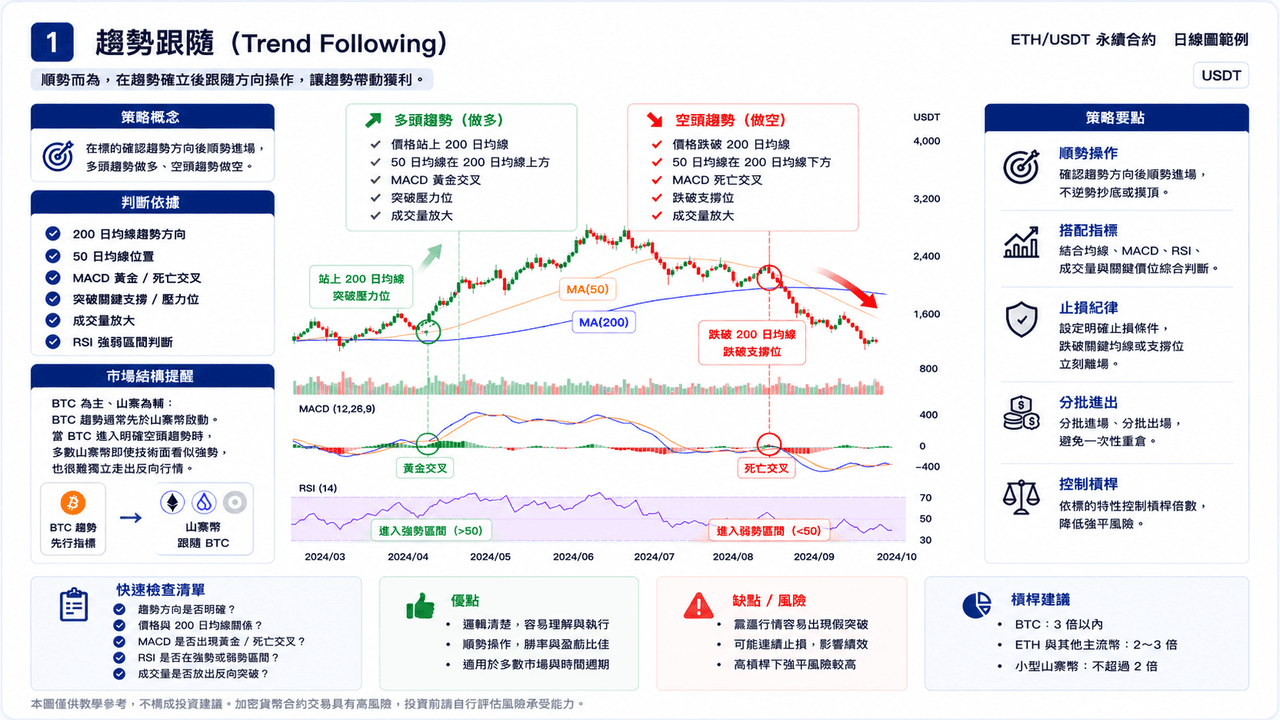
Trend following is the most common futures trading strategy, with core logic being to enter positions following confirmed trend directions - going long in uptrends and short in downtrends. Judgment criteria usually include 200-day moving average, 50-day moving average, MACD golden cross or death cross, breaking key support or resistance levels, and other technical signals. For cryptocurrencies, trend following can be applied simultaneously to BTC, ETH, and mainstream altcoins, but execution should pay special attention to the "BTC-dominated, altcoin-supplemented" market structure. BTC trends usually start before altcoins, and when BTC enters a clear bearish trend, most altcoins will struggle to independently move in opposite directions even if technically appearing strong.
Trend following's advantages are clear logic and easy execution, while disadvantages include false breakouts during ranging markets leading to consecutive stop-losses. It's recommended to combine with clear stop-loss conditions (such as immediately exiting when falling below key moving averages) and gradual entry mechanisms to avoid one-time heavy positions. Leverage recommendations: BTC within 3x, ETH and other mainstream coins 2-3x, small altcoins no more than 2x.
Trend Following Signals: Quick Checklist
|
Observation Item |
Bullish Signal |
Bearish Signal |
Risk Warning |
|
Trend Direction |
Market enters uptrend |
Market enters downtrend |
False breakouts prone in ranging markets |
|
BTC Trend Confirmation |
BTC simultaneously bullish |
BTC simultaneously bearish |
Altcoins struggle independent moves when BTC opposite |
|
200-day MA |
Above 200-day MA |
Below 200-day MA |
Weak signals when repeatedly crossing near MA |
|
MACD |
Golden Cross |
Death Cross |
Prone to noise during consolidation |
|
RSI |
Enters strong zone |
Enters weak zone |
Extreme zones don't guarantee continuation |
|
Volume |
Price rise with volume expansion |
Price fall with volume expansion |
Low-volume breakouts less credible |
2. Pair Trading (Cross-Asset Hedging)
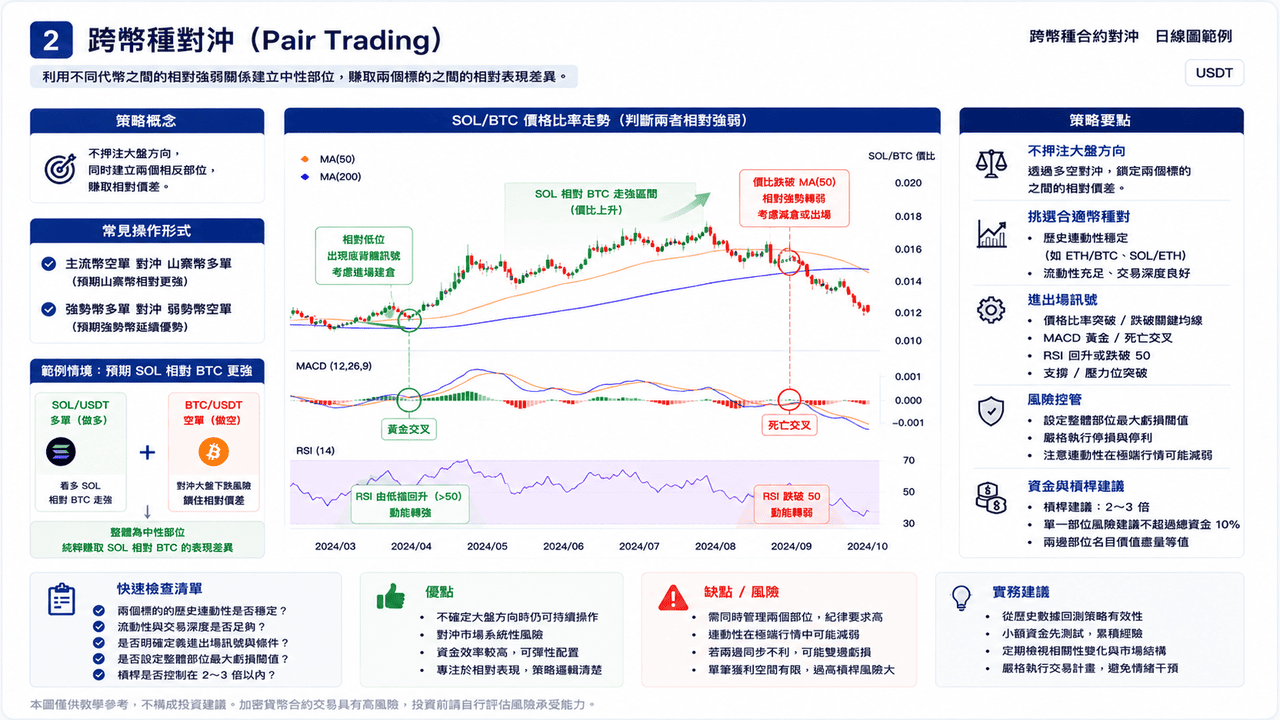
Cross-currency hedging is a strategy that establishes neutral positions using relative strength relationships between different tokens. The most common form is "mainstream coin shorts hedging altcoin longs" or "strong coin longs hedging weak coin shorts." For example, expecting SOL to be stronger relative to BTC during a certain period, you can simultaneously open SOL longs and BTC shorts, locking in relative spreads while avoiding SOL longs being dragged down during overall market declines. This strategy doesn't bet on overall market direction but purely profits from relative performance differences between two assets.
Cross-currency hedging's advantage is enabling continuous operations during uncertain market direction phases, while disadvantages include needing to manage two positions simultaneously, requiring higher capital and discipline demands, and correlation between two assets may suddenly weaken during extreme market conditions causing bilateral losses. In practice, it's recommended to choose currency pairs with stable historical correlation (like ETH/BTC, SOL/ETH) and strictly set maximum loss thresholds for overall positions. Leverage should be controlled at 2-3x, as hedging strategies have limited single-trade profit potential, and excessive leverage amplifies losses when correlations break down.
Pair Trading Use Cases: Quick Checklist
|
Item |
Description |
|
Strategy Purpose |
Profit from relative performance differences between different tokens without betting on overall market direction |
|
Core Logic |
Simultaneously establish strong coin longs and weak coin shorts, locking in relative spreads |
|
Applicable Scenarios |
Unclear market direction, expecting specific coins to be relatively stronger or weaker than others |
|
Common Approach |
Choose currency pairs with stable historical correlation (like ETH/BTC, SOL/ETH), establish equivalent long/short positions |
|
Main Advantages |
No market direction betting, can operate during sideways or uncertain market conditions |
|
Main Disadvantages |
Need to manage two positions simultaneously, correlation may suddenly weaken during extreme market conditions |
|
Leverage Recommendation |
Recommended 2-3x leverage to avoid bilateral losses when correlation breaks down |
|
Notes |
Strictly set overall position maximum loss thresholds, prioritize mainstream pairs over obscure altcoin pairs |
3. Altseason Rotation
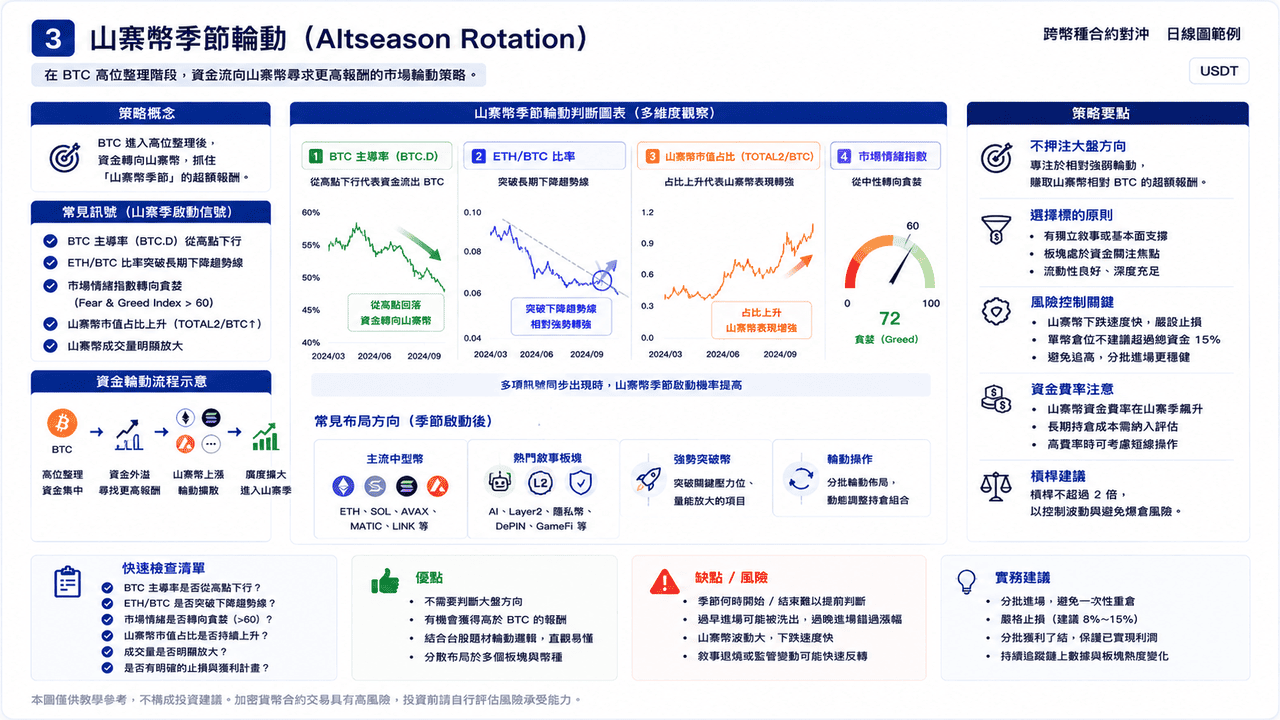
Altcoin season rotation is a unique phenomenon in crypto markets, usually occurring when BTC enters high-level consolidation phases and market funds begin flowing to altcoins seeking higher returns. This phase is called "Altseason," with common signals including BTC Dominance declining from peaks, ETH/BTC ratio breaking long-term downtrend lines, market sentiment index shifting from neutral to greed, etc. During these phases, going long on ETH, SOL, AVAX and other mid-tier altcoins, or selecting representative projects from sectors with independent narratives (like AI, L2, privacy coins), often achieves higher returns than BTC.
For Taiwanese investors, this strategy combines the familiar "thematic rotation" logic from Taiwan stock markets, making it relatively intuitive. However, execution difficulty lies in that season start and end times can often only be determined in hindsight. Entering too early may get washed out during BTC-dominated phases, while entering too late misses the biggest gains. It's recommended to combine with strict stop-losses (altcoin decline speeds are usually faster than rises) and gradual profit-taking mechanisms, with leverage not exceeding 2x. Altcoin funding rates often spike during seasons, and long-term holding costs should be factored into assessments.
Extended reading: What is Bitcoin Dominance (BTC.D)? What's its relationship with altseason? How to apply in crypto trading strategies
Altseason Rotation Signals: Quick Checklist
|
Item |
Description |
|
Strategy Purpose |
Capture excess returns of mid-tier altcoins relative to BTC during Altseason phases |
|
Core Logic |
When BTC enters high-level consolidation, funds flow to altcoins; select mid-tier mainstream altcoins for long positions |
|
Applicable Scenarios |
BTC dominance declining from peaks, ETH/BTC ratio breaking downtrend lines, market sentiment turning greedy |
|
Common Approach |
Go long ETH, SOL, AVAX or sector representatives with independent narratives (AI, L2, privacy coins) |
|
Main Advantages |
Can achieve higher potential returns than BTC, thematic rotation logic familiar to Taiwanese investors |
|
Main Disadvantages |
Season timing difficult to predict beforehand, too early or late entry may miss trends or get washed out |
|
Leverage Recommendation |
Recommended not exceeding 2x, altcoin decline speeds usually faster than rises |
|
Notes |
Altcoin funding rates often spike during seasons, holding costs should be factored into assessments |
4. Funding Rate Arbitrage
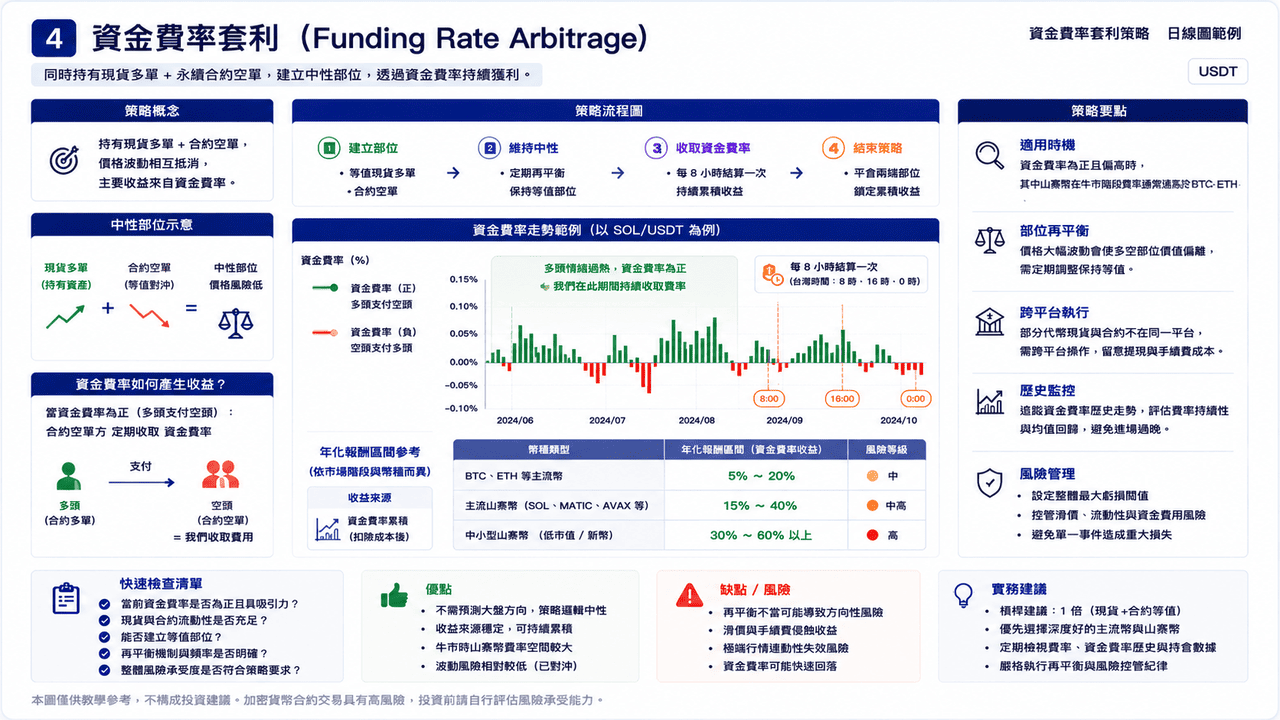
Funding rate arbitrage is an advanced strategy with core logic of simultaneously holding spot longs and perpetual futures shorts, establishing neutral positions to continuously collect funding rate income when bullish sentiment overheats and funding rates are positive. Since spot longs and futures shorts cancel each other's price movements, overall position P&L mainly comes from funding rate accumulation. For cryptocurrencies, altcoin funding rates during bull markets often far exceed BTC and ETH, offering larger arbitrage opportunities but with correspondingly higher slippage costs and liquidity risks.
Practical requirements include: sufficient capital to simultaneously establish equivalent positions on both sides, strict position rebalancing, cross-exchange execution capabilities (some tokens' spot and futures aren't on the same platform), and comprehensive funding rate historical monitoring. BingX's futures pages provide current and historical funding rate data as basic tools for executing such strategies. Funding rate arbitrage typically yields 5% to 20% annually for mainstream coins and 30% to 60%+ for altcoins, but comes with significantly higher liquidation and slippage risks, suitable for advanced investors with larger capital scales who can precisely manage cross-platform positions.
Extended reading: How to conduct Ethereum arbitrage in Taiwan? DeFi strategy comparison and BingX operation tutorial (2026)
Funding Rate Arbitrage Use Cases: Quick Checklist
|
Item |
Description |
|
Strategy Purpose |
Collect funding rate income through neutral positions when funding rates are positive |
|
Core Logic |
Simultaneously hold spot longs and perpetual futures shorts, establishing market-neutral positions |
|
Applicable Scenarios |
Overheated bullish sentiment, perpetual futures funding rates persistently positive |
|
P&L Source |
Spot longs and futures shorts cancel price movements, main income from funding rate accumulation |
|
Operating Conditions |
Sufficient capital to establish equivalent positions on both sides, cross-platform execution capabilities |
|
Risk Control Focus |
Regular position rebalancing to avoid nominal value deviation after significant price movements |
|
Tool Requirements |
Track current and historical funding rate data, BingX futures pages serve as basic reference tools |
|
Return Characteristics |
Mainstream coins 5%-20% annually, altcoins can reach 30%-60%+, but risks correspondingly higher |
|
Suitable Groups |
Advanced investors with larger capital scales who can precisely manage cross-platform positions |
How to Trade Crypto Perpetual Futures on BingX
BingX provides Traditional Chinese interface cryptocurrency perpetual futures, supporting BTC, ETH, SOL, XRP and other mainstream coins plus various altcoin trading, integrating TradingView charts, BingX AI market analysis and copy trading functions, making it the most direct futures trading tool for Taiwanese investors. Order processes are basically identical on desktop and mobile app versions. Below is a universal five-step operation tutorial applicable to all cryptocurrency perpetual futures.
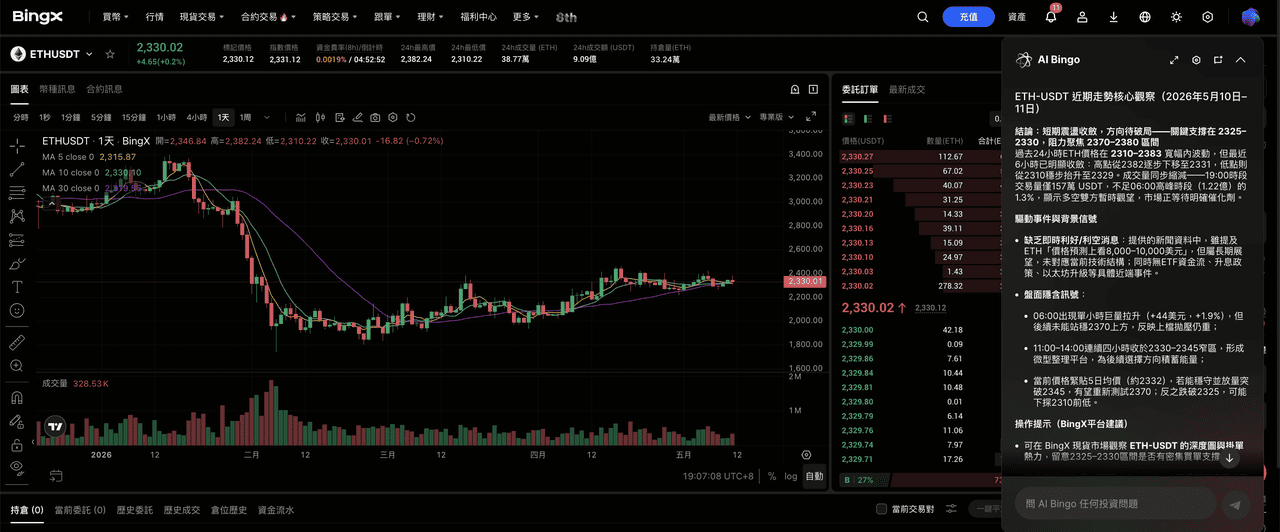
1. Transfer USDT margin to perpetual futures account: After logging into BingX, go to "Assets" → "Fund Transfer" page to transfer USDT from spot account to perpetual futures account. Margin invested per trade should not exceed 20% of total futures account balance, and should be controlled within 10% when operating altcoins. If Taiwanese users have insufficient USDT balance, they can first buy USDT with TWD on MAX or BitoPro, then withdraw via TRC-20 chain to BingX (fees under $1), or directly buy USDT with TWD via credit card or third-party payments on BingX's "Buy Crypto" page.
2. Select target currency and enter perpetual futures page: From the top menu, enter "Futures Trading" → "Perpetual Futures," search for target tokens (like BTC-USDT, ETH-USDT, SOL-USDT, etc.). The page displays real-time prices, order book depth, trade records, and current funding rates. Before placing orders, check funding rates and next settlement time (Taipei time 8:00, 16:00, 0:00) to assess short-term holding fee costs. For altcoin investors, pay extra attention to order book depth, as tokens with insufficient depth easily cause significant slippage during large orders.
3. Use BingX AI and TradingView charts to determine direction: BingX futures pages have built-in TradingView charts, allowing switching between 1-minute to monthly timeframes, with overlays for moving averages, RSI, MACD, Bollinger Bands and other technical indicators to judge trends and support/resistance levels. You can also open BingX AI for structured market analysis summaries as auxiliary basis for long/short decisions. For altcoin traders, it's recommended to simultaneously monitor BTC trend direction, as under crypto market rotation patterns, altcoin performance is usually influenced by overall BTC trends.
4. Choose isolated margin mode, set leverage and place orders: Recommend selecting isolated margin mode to limit single trade risks to that specific margin amount. Leverage settings should be adjusted differentially based on coin volatility: BTC and other mainstream coins recommended 3-5x, mid-tier coins (SOL, AVAX) recommended 2-3x, small altcoins recommended not exceeding 2x. After selecting long or short direction, input order quantity, and prioritize limit orders over market orders to reduce trading costs and slippage impact. Confirm all parameters before submitting orders.
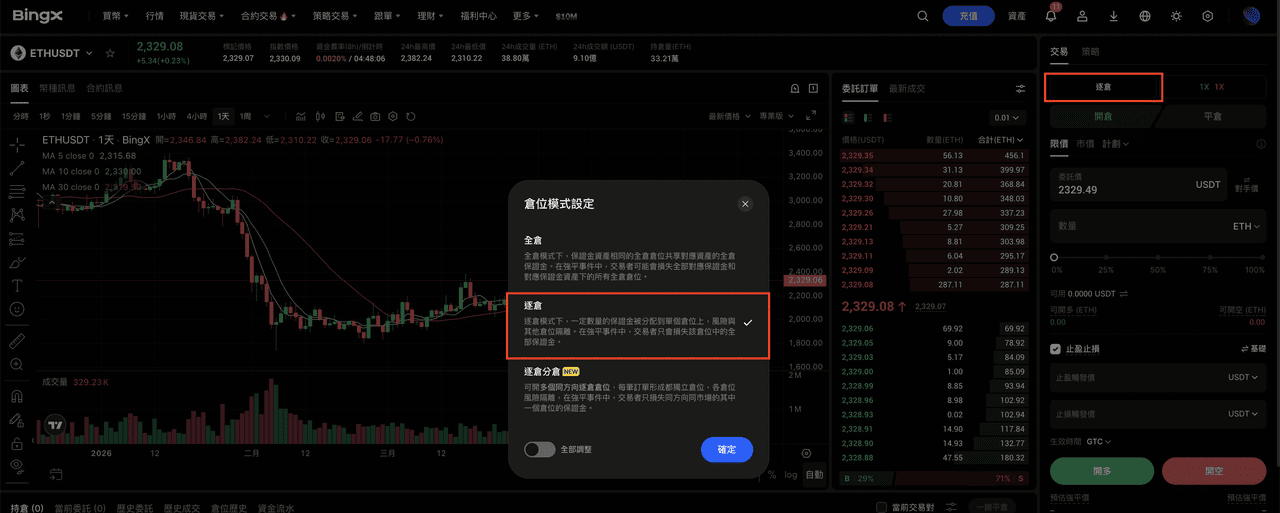
5. Immediately set stop-loss and take-profit: After opening positions, immediately set Stop Loss and Take Profit - these are the most basic risk control tools in futures trading and should not be omitted. Stop-loss ranges should be adjusted by coin type and timeframe: BTC and other mainstream coins 4-hour 3%-6%, daily 6%-10%; mid-tier coins 4-hour 5%-8%, daily 8%-12%; small altcoins 4-hour 7%-12%, daily 12%-20%. Take-profit levels commonly configure at 1.5-2x+ the stop-loss range. After setup, monitor position status anytime on the "Positions" page and adjust or manually close based on market changes.
5 Risk Management Strategies for Crypto Perpetual Futures
Risk management in futures trading is often more important than strategy selection. Most loss cases don't stem from the strategies themselves, but from lack of discipline allowing single trades to consume large amounts of capital. The following five principles are basic risk control guidelines that every cryptocurrency perpetual futures investor should follow, applicable regardless of which coins you operate or which strategies you adopt.
- Set leverage differentially based on coin volatility: Different coins should use different leverage standards. BTC and other mainstream coins recommended 3-5x, mid-tier coins (ETH, SOL) recommended 2-3x, small altcoins not exceeding 2x. Applying the same leverage to all coins is one of the most common mistakes among futures beginners. Altcoin liquidation risk at 5x leverage may be higher than BTC at 10x leverage. Higher leverage means smaller error margins; while low leverage reduces potential returns, it also improves long-term survival rates.
- Set stop-losses immediately for each trade, with ranges adjusted by coin type: Positions without stop-losses expose capital completely to market volatility. Different coins should use differentiated stop-loss ranges: mainstream coins 4-hour 3%-6%, mid-tier coins 5%-8%, small altcoins 7%-12%. Once stop-loss prices are set, they shouldn't be arbitrarily canceled or lowered - this is one of the main causes of futures trader bankruptcy.
- Strictly control single-trade margin, be more conservative with altcoins: Mainstream coin single-trade margin should not exceed 20% of total futures account balance, altcoins should be controlled within 10%. Even when very confident about a trade, reserve at least 80% of funds for unexpected situations. Altcoin daily flash crash ranges can reach 30%+, and excessive positions can easily lose entire futures accounts in one crash.
- Assess funding rate costs before long-term holding: Different coins have vastly different funding rates: mainstream coins typically maintain 0.01%-0.05% per 8 hours, while altcoins during strong phases can spike to 0.1%+, with annualized costs exceeding 100%. Check current and recent rate trends before opening positions, and set holding time limits. If directional positions must be held long-term, prioritize spot over futures.
- Avoid emotional trading and revenge position sizing: After consecutive losses, many investors try to quickly recover through higher leverage or larger positions, but such "revenge trading" is often one of the most common liquidation causes in futures markets, amplified by crypto's high volatility. In practice, set daily maximum loss limits - once reached, stop all trading for that day. Long-term stable profits often come from discipline and risk control, not short-term high-leverage operations.
Conclusion: Should You Trade Crypto Perpetual Futures in 2026?
Cryptocurrency perpetual futures are among the most important derivatives in crypto markets, enabling investors to amplify bull market movements, conduct short hedging in bear markets, and establish market-neutral strategies through funding rate arbitrage. For Taiwanese investors familiar with crypto market rotation patterns who can differentially adjust leverage and stop-losses based on coin characteristics, perpetual futures can supplement scenarios that pure spot holding cannot address, making them quite important tools in cryptocurrency investment portfolios.
However, leverage itself is a double-edged sword. While perpetual futures improve capital efficiency, they simultaneously amplify volatility and loss risks. Many investors new to futures trading often lose most of their capital quickly due to high leverage, lack of stop-losses, or emotional trading, with this risk further amplified by altcoin volatility. For Taiwanese investors wanting to start with cryptocurrency perpetual futures in 2026, a more reasonable approach is usually starting with mainstream coins (BTC or ETH), using small amounts, low leverage (2-3x), and single strategies to accumulate practical experience, then trying altcoins or multi-currency strategies after mastering basic risk management.
In practical operations, BingX provides Traditional Chinese interface, TradingView charts, BingX AI auxiliary analysis, and copy trading functions. For those just starting with cryptocurrency perpetual futures, the operational threshold is relatively low and it's easier to establish complete trading processes. However, regardless of which platform you use, long-term stable profitability ultimately depends on risk management, capital control, and trading discipline, not short-term market direction accuracy.
Related Reading
- How to Trade BTC Perpetual Futures in Taiwan? Complete Bitcoin Perpetual Futures Operation Tutorial (2026)
- How to Trade ETH Perpetual Futures in Taiwan? Complete Ethereum Perpetual Futures Operation Tutorial (2026)
- How to Invest in Bitcoin in Taiwan? Complete Bitcoin Investment Strategy Guide (2026)
- 2026 BingX Perpetual Futures Tutorial: Cryptocurrency Perpetual Futures Beginner Guide
- Complete Comparison and Recommendations of Taiwan Cryptocurrency Futures Trading Platforms (2026): Fees, Liquidity and Security Comparison
