
Navigating the crypto markets in 2026 requires more than just a 'buy low, sell high' mentality; it requires a surgical understanding of how assets are valued and exchanged. On BingX spot market, the Trading Pair is the foundational unit of every transaction, acting as the bridge between the asset you want to hold and the currency you use to measure its worth. Unlike traditional retail shopping, where prices are static, spot trading is a dynamic environment where every buy is simultaneously a sell.
As a global leader in spot and derivatives trading, BingX provides a high-performance matching engine designed to ensure that price discovery is transparent, fair, and efficient. By mastering the relationship between Base and Quote currencies, you can move beyond simple clicking and start trading with the precision of a professional, ensuring your entries and exits are grounded in mathematical reality.
This guide breaks down exactly what trading pairs are, the logic of asset-changing, and the mechanics of the order book that drive price discovery on BingX.
What Are Base and Quote Currencies in Spot Trading and How Do They Work?
Every spot trade on BingX involves a Trading Pair, which is the specialized exchange relationship between two digital assets. In any pair, e.g., BTC/USDT, the two assets play distinct roles:
- Base Currency: The first asset listed in the pair (BTC). This is the asset you are looking to buy, sell, or hold.
- Quote Currency: The second asset listed (USDT). This is the valuation unit used to determine the price of the base currency.
In the pair BTC/USDT, the price tells you exactly how much USDT (the quote) is required to purchase 1 BTC (the base). If the price displayed on BingX is 70,000, then 1 BTC = 70,000 USDT.
In practice, the quote currency functions as the accounting backbone of your spot account. While you may hold dozens of different base currencies like ETH, SOL, or XRP, your total portfolio value is typically aggregated and displayed in the value of your primary quote currency, usually a stablecoin like USDT. By anchoring volatile assets to a stable quote, BingX allows you to track your real-world purchasing power regardless of market swings.
What Is Price Discovery on the BingX Spot Market and How Does It Work?
On BingX, prices aren't set by the exchange; they are discovered through the interaction of thousands of global participants. Here is the breakdown of the matching mechanics:
- The Central Limit Order Book (CLOB): BingX utilizes a high-speed matching engine that aggregates all buy and sell orders. A transaction only occurs when a buyer’s maximum bid matches or exceeds a seller’s minimum ask.
- Asset Changing Logic: Every trade is a 1:1 exchange of value. If you buy BTC/USDT, your USDT balance decreases since you sold USDT while your BTC balance increases. This double-sided logic is the core of the asset-changing framework.
- Time and Price Priority: The BingX engine prioritizes orders based on the best price first. If two traders offer the same price, the order placed first in time is filled first.
- Market Depth and Liquidity: The thickness of the order book determines how stable the price is. High liquidity pairs have millions of USDT waiting at every price level, preventing a single trade from causing a massive price swing.
- The Spread: The gap between the highest buyer (Bid) and the lowest seller (Ask). On BingX Spot, tight spreads ensure you get the fairest market price with minimal slippage.
What Are Pricing Methods on BingX Spot Trading: Market Orders vs. Limit Orders
Understanding price discovery is useless if you don't know how to interact with it. The pricing method you choose determines your role in the market's liquidity.
Key Differences: Maker vs. Taker Pricing
|
Feature |
Limit Order (Maker) |
Market Order (Taker) |
|
Price Control |
High (You set the exact price) |
Low (Executes at best available price) |
|
Execution Speed |
Variable (May never fill) |
Instantaneous |
|
Market Impact |
Adds liquidity to the book |
Removes liquidity from the book |
|
Best Scenario |
Entering at a specific "dip" |
Panic buying or urgent exits |
|
Fees |
Often lower (Maker fee) |
Often higher (Taker fee) |
A Limit Order (Maker) acts as a strategic liquidity provider, placing a resting order on the books that only executes once the market moves to your specified price. This provides absolute control over entry costs, eliminating the risk of overpaying during high volatility. From a data perspective, using limit orders is essential for high-volume traders on BingX to qualify for the Maker rebate or lower fee tier, as these orders add to the platform's market depth. However, the trade-off is execution risk; if the market misses your price by a single tick, your order remains unfilled, potentially causing you to miss a significant trend.
In contrast, a Market Order (Taker) prioritizes speed over price precision by immediately matching against the best available orders in the current book. While this ensures an instantaneous fill, it incurs slippage, where the average execution price deviates, sometimes by 0.05% to 2% or more in low-liquidity pairs, from the displayed ticker price. Because market orders take liquidity away from the exchange, they typically carry higher fees. This method is best reserved for time-sensitive scenarios, such as emergency stops or mooning assets where the opportunity cost of an unfilled limit order far outweighs the expense of slippage and taker fees.
While a Market Order uses the current discovered price to give you an instant fill, it leaves you vulnerable to Slippage, the difference between the price you see and the price you actually get. Professional traders on BingX often use Limit Orders to make the market, waiting for the price discovery process to come to them.
How to Use Market Depth as a Safety Mechanism
For spot traders, the ultimate enemy is a liquidity gap. Professional traders rely on Order Book Depth as a safety net to ensure their orders don't move the market against themselves.
If the Last Price of an altcoin is $1.00, but the order book only has $500 worth of sell orders at that price, a $5,000 market buy order will sweep the book, potentially buying the last coins at $1.10. This results in a 10% instant loss due to poor pricing logic.
- During High Volatility: In fast-moving markets, BingX recommends using Trigger Orders to ensure your price discovery logic stays intact even if you aren't at your desk.
- Minimum Transaction Units: Every pair on BingX has a minimum order size, e.g., 5 USDT. Understanding these rules prevents ghost orders that fail to execute due to improper quantity settings.
Read more: How to Use Order Book Depth and Market Data for Bitcoin Trading
How to Navigate Spot Trading Pairs on BingX: Step-by-Step
On BingX, switching between pairs and analyzing their pricing logic is seamless across both web and mobile platforms.
Selecting Your Spot Trading Pair on BingX Web
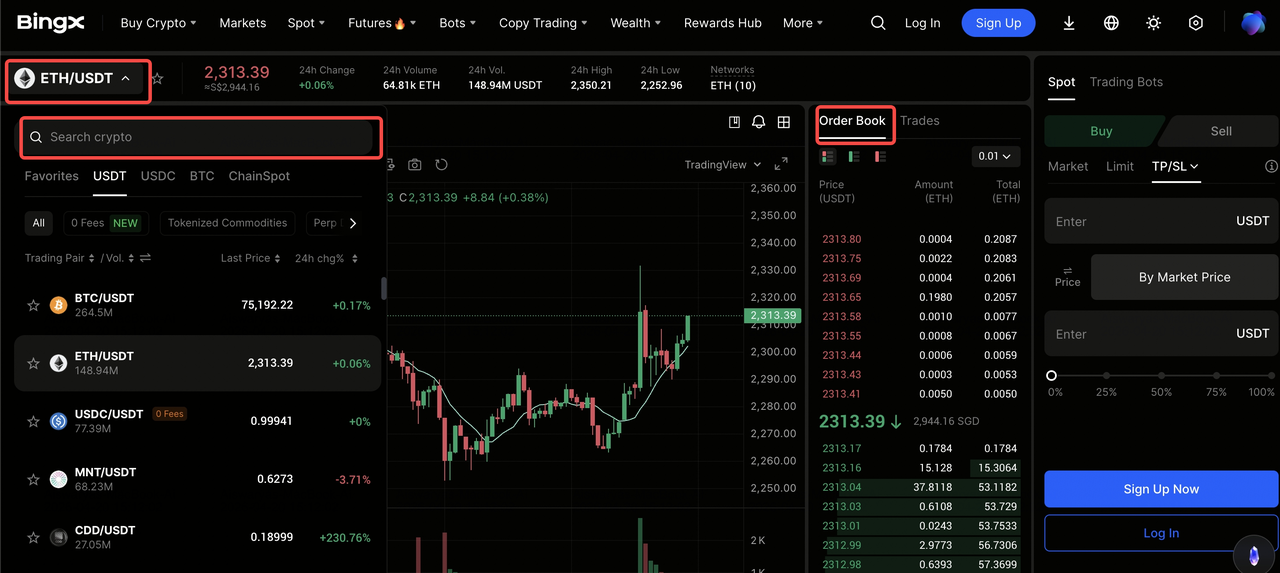
How to choose a trading pair on the BingX spot market (web)
- Access the Market: Navigate to the Spot trading tab.
- Search Pair: Use the search bar to find your desired Base/Quote pair, e.g., ETH/USDT.
- Analyze Depth: Look at the red and green numbers flanking the price; this is your real-time price discovery engine.
Selecting Your Spot Pair on the BingX App
- Spot Tab: Tap the Spot icon at the bottom of the app.
- Pair Selector: Tap the current pair name at the top left to open the full list of available markets.
- Check Details: Tap the Chart icon to see the K-line and the Depth tab to see the current bid/ask spread.
Top 3 Tips for BingX Spot Traders: How to Manage Pricing Logic
The gap between your ideal price and the execution price is where profits are won or lost. Use these professional guardrails:
- Monitor the Spread: In low-volume pairs, the spread can be wide. Avoid market orders here; use limit orders to avoid paying an invisible premium.
- Understand Pricing Precision: Different pairs have different decimal limits, e.g., BTC might move in $0.10 increments while an altcoin moves in $0.00001. Setting prices outside these increments will result in an error.
- Factor in Trading Fees: Remember that BingX deducts a small fee from the Quote currency if buying or Base currency if selling. Ensure your Minimum Transaction Unit accounts for this deduction so you aren't left with dust or tiny, untradable balances.
Conclusion: How to Establish a Reusable Spot Trading Framework
Mastering trading pairs and pricing methods is the first step toward a stable trading career. By understanding that every trade is a mathematical exchange between a Base and Quote asset, you decouple your emotions from the price and start focusing on the Value and Liquidity of your positions.
However, a framework is only as good as its execution. While understanding price discovery protects you from slippage, it doesn't protect you from market direction. Traders should always use the BingX Spot Grid or DCA tools to automate their pricing logic and reduce the impact of short-term volatility.
Ready to test the engine? Open the BingX Spot Market and watch how the Bid/Ask spread reacts to global news in real-time.
Related Reading
- How to Start Spot Trading on BingX: A Beginner’s Guide (2026)
- How to Buy and Sell Crypto on the BingX App: A Step-by-Step Guide (2026)
- Best 10 Crypto Spot Trading Platforms for Beginners in 2026
- Bitcoin Spread vs. Hidden Fees: What Are the Top Cheapest Crypto Platforms to Buy Bitcoin in 2026?
- How to Use Order Book Depth and Market Data for Bitcoin Trading
FAQs on Spot Trading Pairs
1. Why can't I find a pair like BTC/XRP on the BingX spot market?
Most pairs on BingX use a stablecoin like USDT and USDC or a major asset like BTC as the Quote currency. If a direct pair doesn't exist, you may need to perform a triangular trade, e.g., Sell BTC for USDT, then use USDT to buy XRP.
2. What happens to the Quote currency when I place a buy order when spot trading?
Your quote currency is exchanged for the Base currency when you place a Buy order in the spot market. Your USDT balance will decrease, and your BTC balance will increase. You now "own" the asset and can withdraw it to a personal wallet.
3. Does the Matching Mechanism ever fail?
The mechanism only fails if there is zero liquidity (no one willing to sell at any price). On BingX, our deep liquidity pools ensure that even large orders in major pairs find a match within milliseconds.
