The global financial landscape is on the verge of a historic milestone as SpaceX prepares to make its public market debut. The listing will officially propel individual wealth into the eleven-figure territory, minting the first verified trillionaire in modern economic history. With the aerospace giant formally issuing its updated IPO prospectus, the public offering is set to radically restructure the global billionaire index. At the center of this financial shift is Elon Musk, whose net worth is poised to scale unprecedented heights.
Read more: What Is Elon Musk's Net Worth in 2026?
Elon Musk's Net Worth Poised to Sail Past $1 Trillion in SpaceX IPO
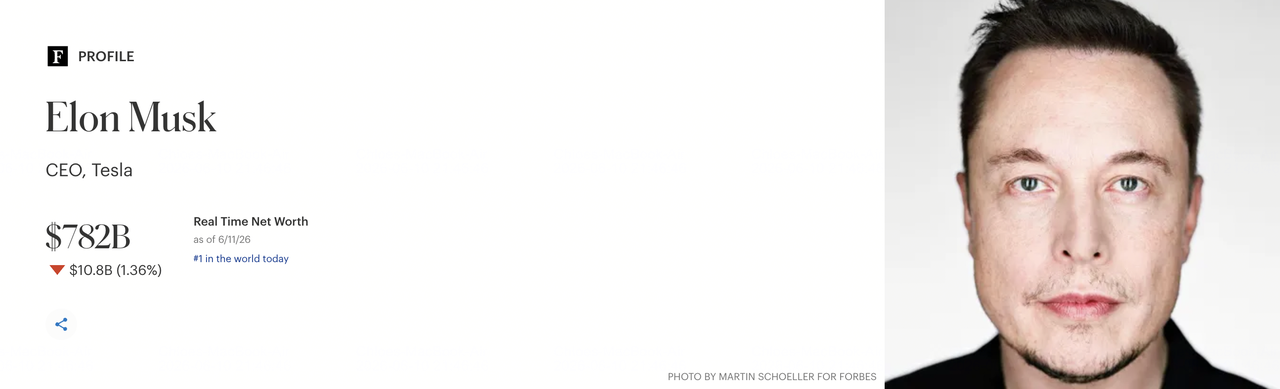
Source: Forbes
The world’s richest person is on the doorstep of trillionaire status. According to the company’s updated IPO prospectus published on Wednesday, SpaceX plans to price its upcoming public offering at $135 a share. This fixed pricing yields an implied company valuation of approximately $1.77 trillion.
For 54-year-old Elon Musk, this landmark offering comes 16 years after he first took Tesla public. At the target valuation, Musk's personal fortune will comfortably eclipse the $1 trillion mark, widening the gap between himself and the rest of the world's wealthiest individuals. Forbes currently lists Musk’s net worth at $826 billion before the SpaceX IPO, placing him far ahead of Google co-founder Larry Page, who sits in second place just below $300 billion.
Read more: SpaceX Will File for Historic $75 Billion IPO at $1.75 Trillion Valuation on June 12, 2026
Key Elements of the Record Breaking SpaceX Initial Public Offering
- The Trading Symbol and Exchange Location: Space Exploration Technologies Corporation will hold its historic initial public offering on the Nasdaq exchange, trading publicly under the stock ticker symbol SPCX.
- The Historical Funding Milestone: The company has bypassed standard Wall Street price ranges by setting a single, fixed issue price of $135 per share. Through this structural framework, the company aims to raise roughly $75 billion in fresh capital at an implied corporate market valuation of $1.77 trillion, officially making it the single largest initial public offering in global financial history.
- The Unprecedented Retail Investor Allocation: In a major departure from traditional Wall Street mega-cap listing procedures, up to 30% of the newly issued Class A shares have been explicitly reserved for individual retail investors. Everyday market participants can subscribe to the pre-listing allocation through mainstream retail brokerages including Fidelity, Charles Schwab, Robinhood, and SoFi
- The Strongly Oversubscribed Market Status: Early capital tracking indicates that institutional investor demand is heavily oversubscribed. This significant accumulation of buying pressure means the stock could experience a dramatic price pop and begin trading at a substantial premium the moment it opens on the public markets.
- The Performance Reality and Historical Context: Wall Street analysts urge long-term caution based on prior equity data. Historical market trends show that past mega-cap public listings frequently face near-term hurdles, occasionally struggling to outperform broad, passive market benchmarks like the S&P 500 index during their initial calendar quarters of active public trading.
The Anatomy of a $866 Billion Aerospace Fortune
The primary catalyst for this historic wealth accumulation is Musk's massive equity stake in the reusable rocket maker. The updated prospectus reveals that his holdings in SpaceX are worth $866.5 billion on paper.
- Concentrated Voting Control: Following the public offering, Musk’s voting control of SpaceX will remain north of 82% due to a dual-class share structure. This setup shields his executive decision-making from outside public investors while providing economic exposure to the markets.
- The 366-Day Lock-Up Barrier: Public market investors will not see Musk liquidate his position anytime soon. The filing mandates that he must hold onto all of his shares for a full year.
- Corporate Alignment: In the risk factors section of the prospectus, SpaceX explicitly noted the importance of this equity concentration, stating, "We believe that Mr. Musk’s substantial ownership interest in us provides him with an economic incentive to assist us to be successful." The filing further clarifies that after the 366-day lock-up period, Musk will not be subject to any obligation to maintain his ownership interest and may elect to sell or reduce his stake.
Read more: How to Trade SpaceX Pre-IPO on BingX Pre-IPO: SPACEX (VNTL), SPACEX (PreStocks), and SPCX
A Diversified Trillion-Dollar Corporate Empire
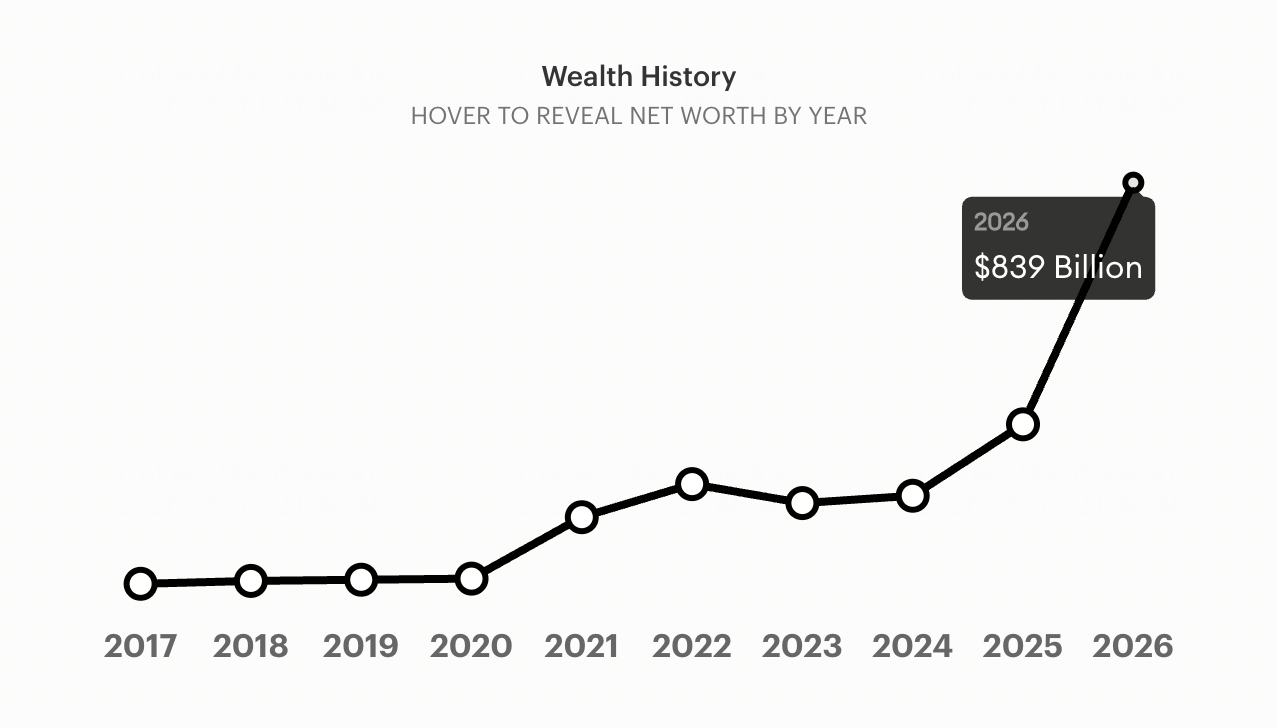
Assuming SpaceX hits the Nasdaq at or near its expected valuation, Musk will oversee two of the eight most valuable U.S. companies. Upon listing, SpaceX will sit ahead of both Tesla and Meta among the trillion-dollar megacaps. This massive aerospace wealth is layered on top of a highly lucrative electric vehicle anchor; Musk currently owns stock in Tesla worth roughly $355 billion, supplemented by stock options that could add more than $100 billion to that total.
Musk’s wealth has been steadily building for well over a decade, punctuated by Tesla’s stock beginning to surge heavily in 2013. He first became the world’s wealthiest person in 2021 by passing Amazon founder Jeff Bezos. While his net worth has seen intense volatility, such as when Tesla’s stock sank 65% in 2022 before soaring to new heights, the SpaceX IPO brings a secondary engine of stable, multi-hundred-billion-dollar liquidity.
Read more: Top Space Stocks to Buy Ahead of SpaceX IPO
SpaceX's Valuation Premium vs. Fundamental Revenues
While SpaceX will command a public valuation that challenges the largest corporate entities on Earth, its underlying revenue remains significantly smaller than its tech peer equivalents.
|
Company |
Implied Public Valuation |
Annual Revenue |
|
SpaceX |
$1.77 Trillion |
$18.67 Billion |
|
Tesla |
$1.00+ Trillion |
$95.00 Billion |
|
Meta |
$1.00+ Trillion |
$200.00+ Billion |
Source: Investing.com
This disconnect highlights the immense premium investors are placing on SpaceX's future capabilities, particularly its dominant commercial launch monopoly and the scaling footprint of its Starlink satellite internet network.
Read more: Should You Participate in SpaceX IPO: Pros and Cons
Mars Colonization and Corporate Consolidation
The $1 trillion threshold may simply represent a starting point for Musk's long-term net worth. Some institutional investors have speculated that Musk’s ultimate plan could be to merge SpaceX and Tesla as a mechanism to consolidate artificial intelligence resources and streamline future capital raises. Furthermore, his wealth accumulation is structurally tied to aggressive, far-out corporate benchmarks.
SpaceX has officially linked Musk’s future equity compensation rewards to two primary long-term milestones: achieving a staggering $7.5 trillion market cap and successfully colonizing Mars with at least 1 million inhabitants. These parameters mirror his arrangements at Tesla, where shareholders approved a highly publicized 12-tranche pay plan tied entirely to incremental market-cap gains and strict operational achievements.
Read more: How Elon Musk Affects Bitcoin Price
How to Trade SpaceX Pre-IPO on BingX
BingX provides a comprehensive suite of options spanning its Futures and Pre-IPO markets, giving users 24/7 flexibility to capture pre-listing momentum.
SpaceX Venture Token ($VNTL) and SpaceX PreStocks Stock Futures
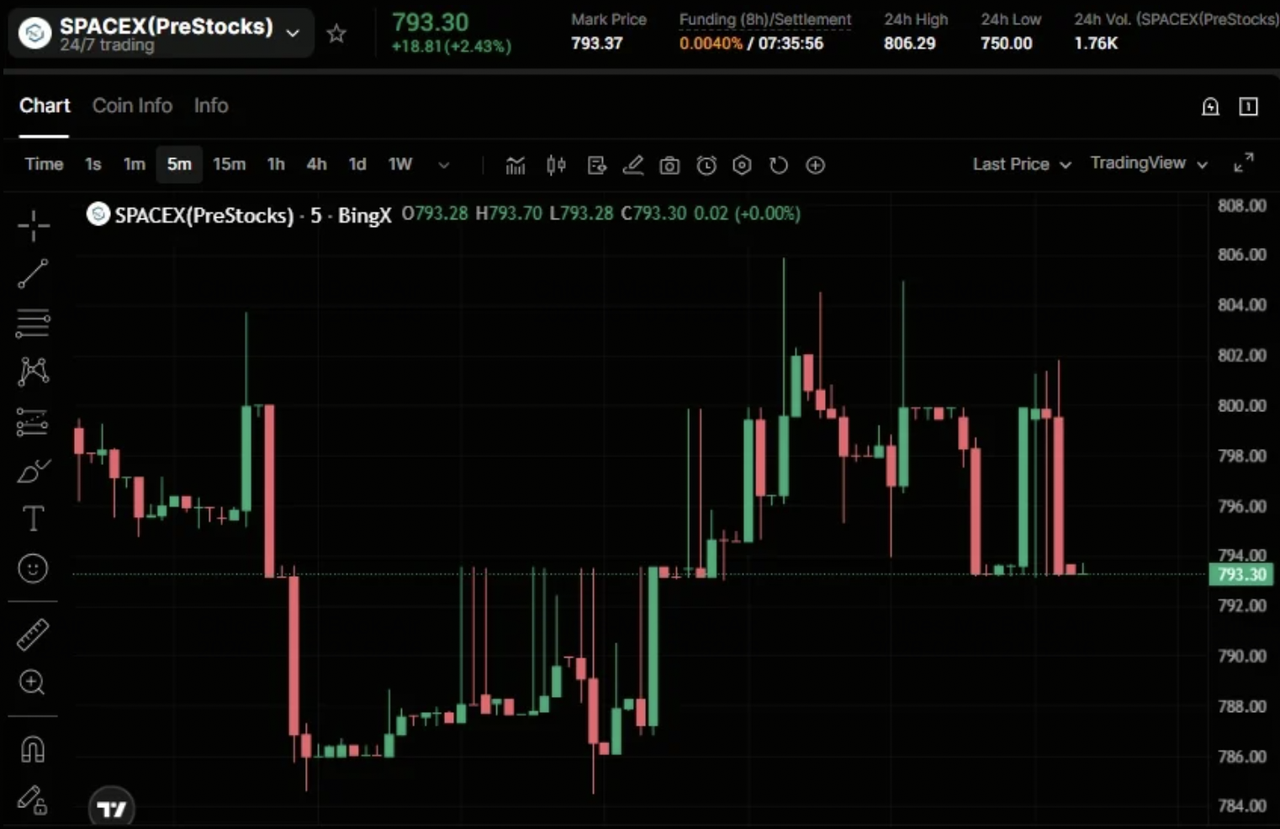
SpaceX PreStock on BingX futures market
The first two options function as high-performance, tokenized Real-World Assets (RWAs) hosted within the BingX Futures ecosystem. These assets mirror the economic performance and price action of SpaceX's private equity valuation, which saw secondary market employee tender offers trade near $185 per share earlier in the year. They allow traders to utilize leverage, e.g., 2x to 20x, and trade fractionally with as little as 10 USDT, completely bypassing traditional accredited investor hurdles.
SpaceX (SPCX) on BingX Pre-IPO
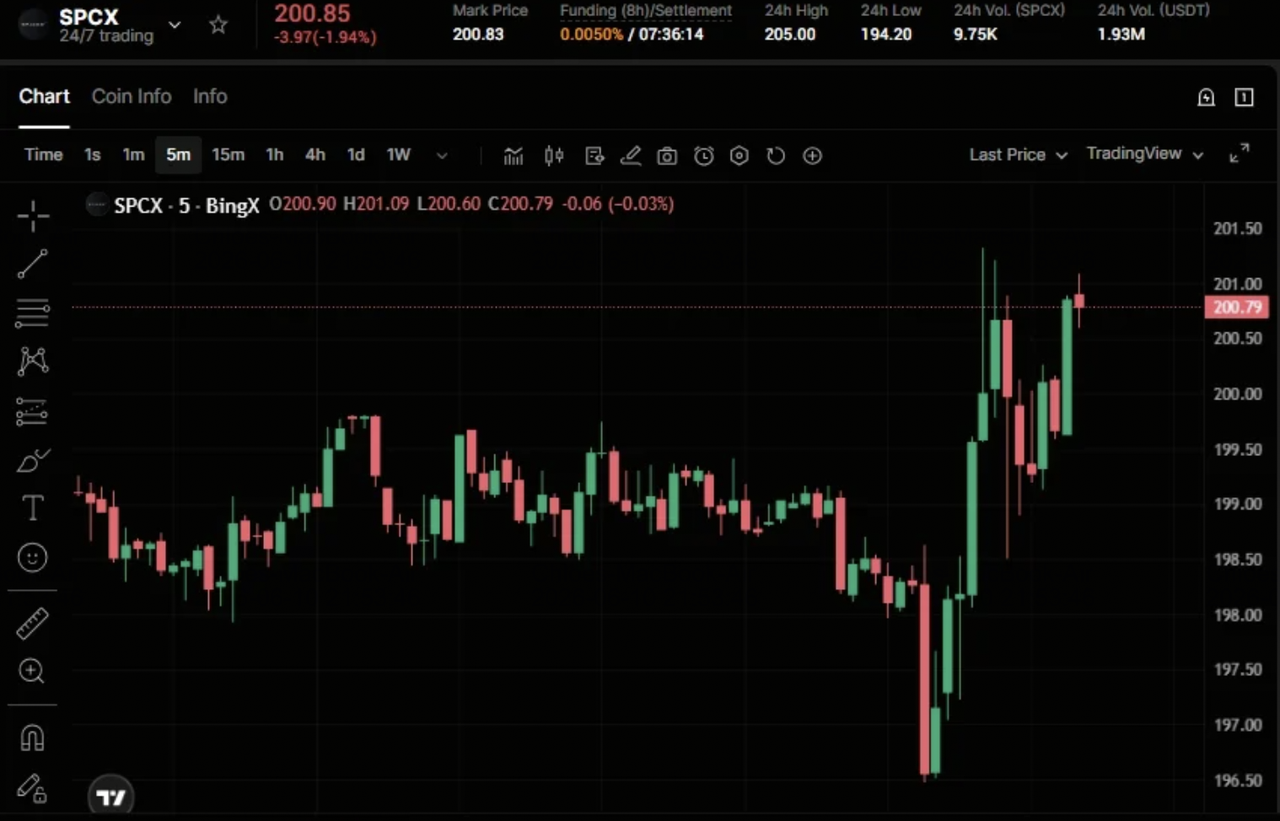
SpaceX (SPCX) on BingX pre-IPO
The third option sits directly in the specialized BingX Pre-IPO Zone. This product specifically tracks the upcoming public instrument SPCX under its officially filed Nasdaq ticker. It provides direct, speculative exposure to the impending June 12 listing dynamics, allowing traders to buy or short the asset based on fast-moving news surrounding the IPO roadshow, pricing expectations, and index inclusion updates.
Conclusion: Can SpaceX IPO Make Elon Musk a Trillionaire?
The upcoming SpaceX listing represents a defining moment for modern capital markets. By locking in an $866.5 billion paper valuation from aerospace alone, the transaction firmly transitions Elon Musk from a multi-billionaire to the world's premier trillionaire. While the company's valuation multi-packs a massive premium relative to its current revenue, the strict 366-day lock-up period and ambitious deep-space corporate milestones ensure that Musk's financial trajectory remains deeply tethered to the future of global infrastructure and interplanetary exploration.
Related Reading
- How Elon Musk Affects Bitcoin Price
- What Is Changpeng Zhao(CZ)’s Net Worth in 2026?
- Vitalik Buterin’s Net Worth in 2026: How Much Does the Ethereum Co-Founder Own?
- What Is Brian Armstrong’s Net Worth in 2026?
- How to Trade SpaceX Pre-IPO on BingX Pre-IPO: SPACEX (VNTL), SPACEX (PreStocks), and SPCX
- Top Space Stocks to Buy Ahead of SpaceX IPO
- Should You Participate in SpaceX IPO: Pros and Cons
- Top 10 Things to Know About the SpaceX IPO: Pricing, Valuation, and How to Trade It
- What Is SpaceX Tokenized Stock (SPCXB) and How to Buy It?
