


Archer Aviation (ACHR) develops electric vertical-takeoff aircraft and aviation software for commercial and defense markets. Its Midnight aircraft is designed for short-distance air-taxi operations, while Halo, Thunder, and ZEE expand the platform into autonomous and defense applications. That broader strategy gives Archer multiple potential revenue paths, but also increases certification, manufacturing, integration, and execution risk.
Archer Aviation Q2 revenue reached $5.0 million versus $1.9 million expected, adjusted EBITDA loss totaled $177.1 million, and liquidity ended at $1.561 billion. Archer is also expanding beyond Midnight through the planned addition of Boeing’s Wisk Aero, Insitu, and SkyGrid assets. For investors, the key question is whether certification progress and new commercial or defense programs can generate meaningful revenue before continued development spending leads to further dilution.
The ACHR stock forecast for 2026 now centers on two competing views:
- The certification and platform-expansion case: Progress toward Midnight certification, early operations, and expansion into autonomous and defense aviation could create multiple sources of future revenue.
- The cash-burn and execution case: Heavy development costs, integration work, and uncertain certification timelines could keep free cash flow negative and increase reliance on additional capital.
This guide breaks down the ACHR stock forecast, 2026 price scenarios, key risks and analyst outlooks, drawing on Archer Aviation’s August 10 Q2 2026 earnings release, quarterly filing and market data through September 8, plus how to trade ACHR stock futures on BingX TradFi with USDT collateral.
Top 5 Things for ACHR Investors to Know in September 2026
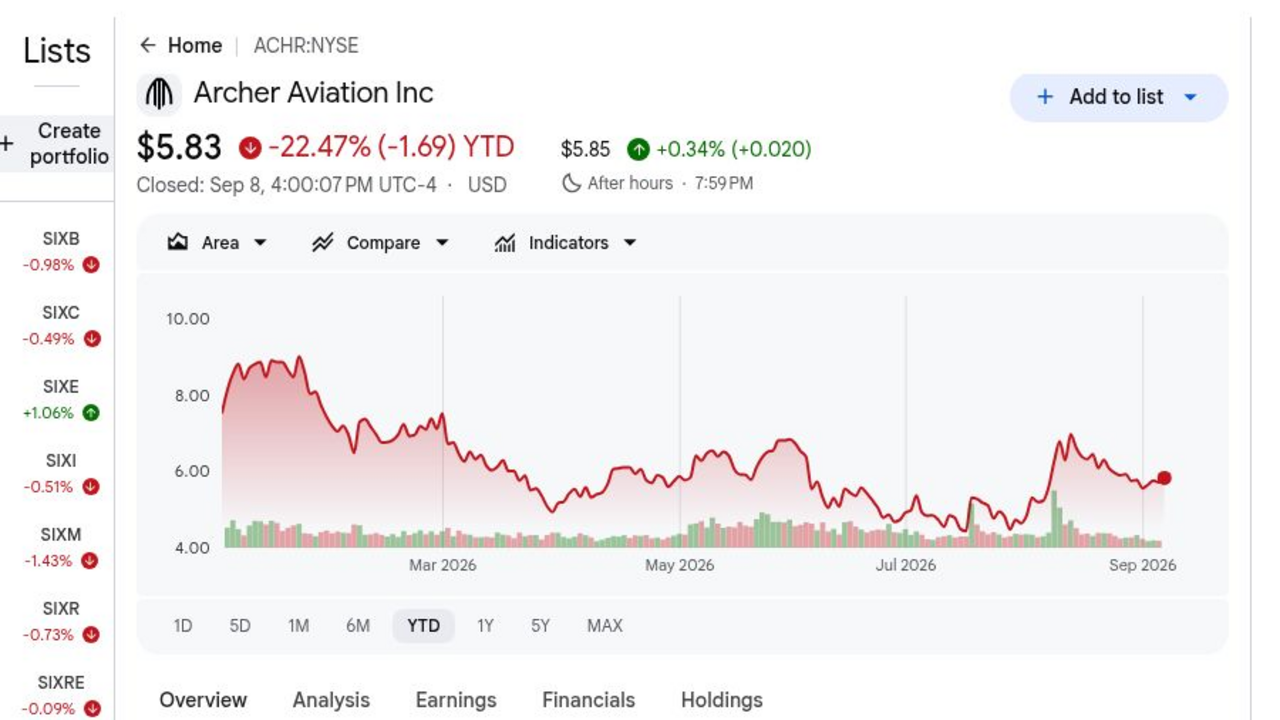
- ACHR closed at $5.83 on September 8 and was down 22.47% YTD: The stock remained below its $14.62 high despite gaining 24.6% in August. Boeing enthusiasm can lift ACHR, though certification uncertainty and capital needs constrain the rerating.
- Q2 revenue reached $5.0 million versus the $1.9 million FactSet estimate: Revenue rose $3.4 million from Q1 through Hawthorne Airport. The beat establishes an operating base, though it remains small beside a $263.2 million net loss and commercialization costs.
- Adjusted EBITDA loss was $177.1 million within the $170 million to $200 million guidance range: It widened $4.6 million sequentially. Q3 guidance for another $170 million to $200 million loss confirms that certification, testing and production remain expensive.
- Liquidity ended at $1.561 billion after declining $215.3 million during Q2: Operations used $156.4 million, capital expenditure consumed $37.1 million and the Hawthorne acquisition used $25.0 million. The balance sheet provides runway, though repeated draws at this scale would narrow it quickly.
- Insitu could add more than $200 million of annual revenue across 35 countries: Boeing's Wisk, Insitu and SkyGrid add drones, autonomy and software, with Boeing taking a 19.75% stake. Closing, integration and share consideration remain central to per-share value.
What Is Archer Aviation (ACHR)?
Archer Aviation (ACHR) develops electric and hybrid vertical-takeoff aircraft, aviation software, and supporting infrastructure for commercial and defense customers. Its flagship Midnight eVTOL is designed to carry one pilot and four passengers on short urban routes, while the broader portfolio includes propulsion systems, autonomy software, training, maintenance, and vertiport-related services. Over time, Archer expects aircraft sales, commercial operations, software, and defense programs to become the main revenue sources.
Its long-term strategy is expanding well beyond air taxis. United Airlines has been a commercial partner since 2021, while Stellantis supports manufacturing plans for Archer’s Georgia facility. Archer also began developing hybrid VTOL aircraft with Anduril, creating the Halo and Thunder platforms for defense use. The planned Boeing transaction would add Wisk Aero, Insitu, and SkyGrid, broadening Archer’s autonomous-aircraft and software capabilities, while international expansion plans include Abu Dhabi and a proposed Los Angeles network around the 2028 Olympics.
Read More: Top Space Stocks to Buy Ahead of SpaceX IPO
Archer Aviation (ACHR) Q2 2026 Earnings Overview: Revenue Growth Meets Heavy Certification Spending
Archer generated $5.0 million of Q2 revenue versus the $1.9 million FactSet estimate and matched the $0.34 consensus loss per share, yet its GAAP net loss widened to $263.2 million. Adjusted EBITDA loss reached $177.1 million, near the favorable end of the $170 million to $200 million guidance range, while liquidity declined to $1.561 billion. The quarter therefore combined early operating revenue and program progress with a cash-intensive commercialization path.
|
Financial Metric |
Guidance / Consensus |
Reported / Actual |
Surprise |
|
Q2 2026 revenue |
$1.9M consensus; $1.6M in Q1 |
$5.0M |
Beat. Exceeded consensus by $3.1M and rose $3.4M sequentially. |
|
GAAP diluted loss per share |
$0.34 loss consensus; $0.36 loss in Q2 2025 |
$0.34 loss |
Matched. Met consensus and improved by $0.02 year over year. |
|
GAAP net loss |
$217.7M in Q1; $206.0M one year ago |
$263.2M loss |
Widened. Increased $45.5M sequentially and $57.2M YoY. |
|
Adjusted EBITDA |
$170M-$200M loss guidance; $172.5M in Q1 |
$177.1M loss |
In range. Landed near the favorable end; widened $4.6M sequentially. |
|
Cash and short-term investments |
$1.776B at March 31 |
$1.561B |
Declined. Fell $215.3M, leaving substantial but shrinking liquidity. |
|
Capital expenditure |
— |
$37.1M |
Investment phase. Supported manufacturing and operating capacity. |
|
Q3 2026 adjusted EBITDA outlook |
— |
$170M-$200M loss |
Heavy spending. Guidance brackets Q2's $177.1M loss and extends the investment cycle. |
- Revenue of $5.0 million beat consensus by $3.1 million: It rose from $1.6 million in Q1 as Hawthorne Airport operations expanded. This establishes an operating base, though aircraft deliveries rather than airport services must ultimately carry the valuation and offset Archer's larger cost structure.
- The $0.34 GAAP loss per share matched consensus and improved by $0.02 year over year: The $263.2 million net loss increased $57.2 million from Q2 2025. A larger diluted share count softened the per-share result, so investors must monitor operating performance and dilution together.
- Adjusted EBITDA loss of $177.1 million landed inside the $170 million to $200 million range: It was $4.6 million worse than Q1 as flight-testing, certification and production work increased. Similar Q3 guidance shows management prioritizing milestones over near-term loss reduction.
- Liquidity of $1.561 billion fell by $215.3 million during the quarter: Operations used $156.4 million and capital expenditure used $37.1 million. The balance supports development, yet the Boeing transaction and manufacturing buildout make cash control and equity issuance increasingly important.
- Operating expenses rose $28.0 million sequentially to $284.2 million: Research and development reached $186.0 million versus $122.4 million one year earlier. Higher spending can advance certification and new platforms, though measurable flight, production and regulatory milestones must justify the larger fixed-cost base.
Read More: Rocket Lab Stock Forecast 2026: Can RKLB's Space Infrastructure Play Break $150 After Its 400% Run?
Archer Aviation (ACHR) 2026 Investment Outlook: $18 Bull Case vs. $4.50 Bear Case
ACHR's outlook depends on whether FAA work and strategic assets become repeatable revenue. The $18 bull scenario requires certification and integration progress, while the $4.50 bear scenario reflects delays, losses near $177 million and dilution. These are editorial scenarios, not Wall Street targets.
The Bull Case: Certification Progress and Boeing Expansion Push ACHR Toward $18
The Bull Case assumes Midnight keeps advancing through FAA certification, limited operations begin before full commercial scale, and the Boeing transaction closes as planned. Wisk, SkyGrid, Insitu, and Archer’s defense programs would broaden revenue beyond passenger eVTOLs.
A move toward $18 would require repeatable flights, steady certification progress, higher manufacturing output, and controlled cash burn. Boeing integration, new defense awards, and revenue growth beyond $5.0 million per quarter would provide the clearest confirmation.
The Base Case: Steady Program Progress Keeps ACHR Between $8 and $12
The Base Case assumes certification and production continue moving forward while passenger revenue develops gradually. Archer’s $1.561 billion liquidity position provides runway, but adjusted EBITDA losses remain high and near-term execution stays more important than profitability.
Under this scenario, ACHR could trade mainly between $8 and $12. Continued flight milestones, transaction closing, and controlled spending would support the range, while slower certification or weaker contract conversion would limit upside.
The Bear Case: Certification Delays and Dilution Pull ACHR Toward $4.50
The Bear Case assumes FAA certification takes longer, Midnight production ramps slowly, and Boeing integration adds costs before dependable revenue arrives. A longer development cycle would increase financing needs and dilution risk.
A move toward $4.50 would become more likely if flight milestones slip, quarterly cash use stays above $200 million, or additional equity issuance is needed. Delayed revenue and a larger share count would pressure the valuation.
ACHR Stock Price Forecasts for 2026 By Wall Street Analysts
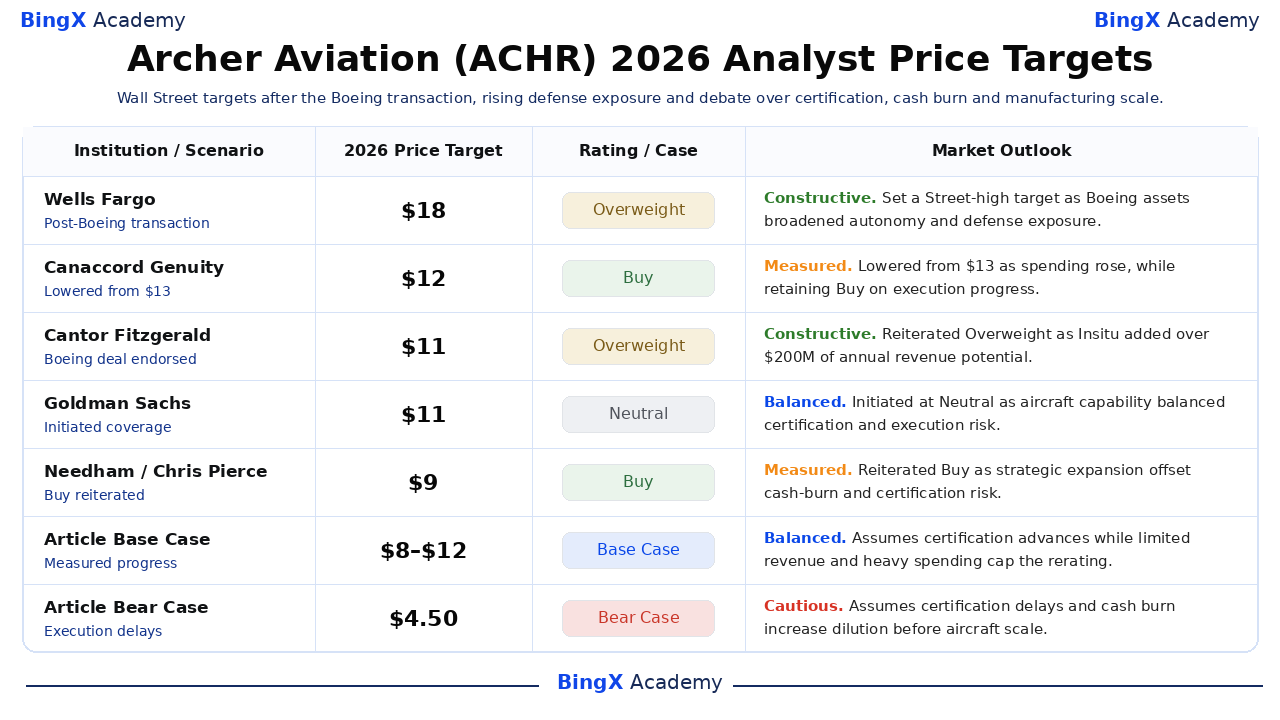
Wall Street targets span $8 to $18 versus ACHR's $5.83 close. The wide gap reflects competing assumptions about FAA timing, manufacturing, Boeing integration and Insitu revenue. Each target is a 12-month research reference rather than a guaranteed 2026 outcome for investors.
|
Institution / Scenario |
2026 Price Target |
Rating / Case |
Market Outlook |
|
Wells Fargo |
$18 |
Overweight |
Constructive. August 11: set a Street-high target as Boeing assets broadened autonomy and defense exposure. |
|
Canaccord Genuity / Austin Moeller |
$12 |
Buy |
Measured. May 12: lowered from $13 on spending while retaining Buy. |
|
Cantor Fitzgerald / Andres Sheppard |
$11 |
Overweight |
Constructive. August 11: reiterated Overweight as Insitu added over $200 million in annual revenue. |
|
Goldman Sachs / Anthony Valentini |
$11 |
Neutral |
Balanced. December 1: initiated at Neutral as capability balanced execution risk. |
|
Needham / Chris Pierce |
$9 |
Buy |
Measured. August 11: reiterated Buy as expansion offset certification risk. |
|
Article Base Case |
$8-$12 |
Base Case |
Balanced. Assumes certification advances while limited revenue and heavy spending cap the rerating. |
|
Article Bear Case |
$4.50 |
Bear Case |
Cautious. Assumes certification delays and cash burn increase dilution before aircraft scale. |
How to Trade Archer Aviation (ACHR) Stock on BingX
Trade Archer Aviation's certification, Boeing-integration and manufacturing outlook using BingX TradFi and BingX AI tools. ACHR can react sharply to regulatory decisions, financing and defense awards, so define the catalyst and risk limits before entering.
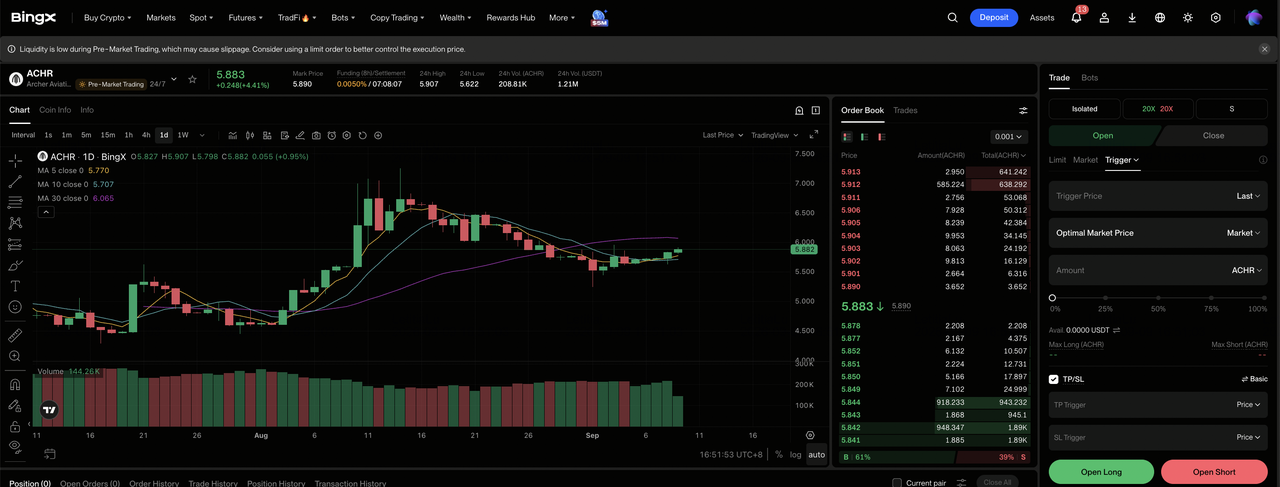
Step 1: Access BingX TradFi. Sign up and navigate to the specialized TradFi section on the BingX exchange dashboard.
Step 2: Select Archer Aviation (ACHR). Search for and select the ACHR-USDT perpetual futures contract.
Step 3: Choose your direction. Select Open Long if certification and Boeing integration improve the revenue outlook. Select Open Short if regulatory delays or heavier cash use weaken per-share value.
Step 4: Select leverage and margin mode. Choose Isolated or Cross-Margin based on your risk tolerance. ACHR's $4.30 to $14.62 52-week range shows why conservative leverage and clear position sizing are important.
Step 5: Execute strict risk protocols. Set Take-Profit and Stop-Loss (TP/SL) levels before or immediately after entering the trade. ACHR can react quickly to FAA decisions, flight tests, manufacturing updates, defense contracts and capital raises.
Top 5 Risks to Watch for Archer Aviation Investors in 2026
Archer has substantial liquidity and unusually strong aerospace partners, though five execution risks can still alter the timing, financing needs and per-share value of its commercial plan.
- FAA certification can move slower than operating plans: Midnight must satisfy multiple safety gates before passenger service. A delay would defer aircraft revenue while testing costs continue, extending the period investors fund development without dependable commercial cash inflow.
- Manufacturing scale may pressure aircraft economics: Archer and Stellantis must convert low-volume builds into repeatable Georgia production. Supplier delays, rework or weak output could raise unit cost, postpone deliveries and reduce the margin assumptions supporting valuation.
- A $215.3 million quarterly liquidity decline raises dilution risk: Archer retained $1.561 billion, though operations used $156.4 million and capital expenditure used $37.1 million. Prolonged spending at similar levels could require additional equity before aircraft revenue scales.
- The Boeing transaction adds integration and ownership complexity: Wisk, Insitu and SkyGrid broaden Archer, while Boeing receives a 19.75% stake. Delayed closing, higher integration expense or weak synergies could dilute investors without delivering expected revenue benefits.
- Customer commitments depend on certification and operating readiness: United Airlines, Abu Dhabi and Los Angeles plans create demand visibility, though orders and routes depend on approvals, infrastructure and reliable production. Slippage in one area can defer several revenue streams.
Final Thoughts: Should You Invest in Archer Aviation in 2026?
Archer now has a broader investment case than Midnight alone. The planned Boeing assets could contribute more than $200 million of annual Insitu revenue, Anduril expands defense exposure and $1.561 billion of liquidity supports certification and manufacturing. If these pieces produce operating evidence, the $18 bull scenario becomes credible, though it remains conditional rather than a forecast promise.
The central risk is the distance between a $5.0 million quarterly revenue base and a $263.2 million net loss. Investors should monitor FAA gates, repeatable Midnight flights, Georgia production, Boeing-transaction closing and quarterly liquidity changes. Progress across those measures could support the $8 to $12 base range, while delays and additional dilution would strengthen the $4.50 bear case.
Risk Reminder: ACHR is a high-volatility, loss-making aerospace stock exposed to certification, manufacturing, financing and transaction risk. Analyst targets and article scenarios are reference frameworks rather than price guarantees. Use conservative position sizing, limited leverage and predefined stop-loss levels when trading stock futures.
Related Reading
- Top Space Stocks to Buy Ahead of SpaceX IPO
- Top Defense Stocks to Buy in 2026: Primes, Missiles, Drones, Space, and AI-Enabled Warfare
- GE Aerospace (GE) Price Prediction 2026: Can the $190B Backlog Defy Valuation Fears?
- Firefly Aerospace Stock Outlook 2026: Can Launch Vehicles, Spacecraft Services Drive FLY to $45+?
- Virgin Galactic in 2026: Can SPCE Cross $6 on Fleet Transition, Delta-Class Capital Restructuring?
- Rocket Lab Stock Forecast 2026: Can RKLB's Space Infrastructure Play Break $150 After Its 400% Run?
