



Workday (WDAY) sells cloud applications for HR, payroll, finance and planning to large organizations. Long-term subscriptions and high retention give it a recurring base, while Sana and specialized agents aim to automate work across those applications. That broader platform could increase customer spending, but new infrastructure costs and slower bookings can weaken the cash return from AI adoption.
The latest quarter showed resilient subscriptions and better adjusted margins without a matching gain in cash flow. Workday fiscal Q2 FY2027 revenue rose 12.8% to $2.649 billion, subscription revenue increased 13.9%, and non-GAAP operating margin reached 31.1%. Free cash flow fell to $460 million even as agentic AI supplied more than a quarter of new annual contract value. Paid expansion and cash recovery remain the next tests.
The WDAY stock forecast for 2026 now centers on two competing views:
- The AI expansion case: Paid agents, durable renewals and better operating leverage could rebuild confidence and support an editorial Bull Case toward $225.
- The slower bookings case: Softer subscription demand, delayed monetization and weaker cash conversion could compress the valuation and pull WDAY toward an editorial Bear Case of $150.
This guide breaks down the WDAY stock forecast, 2026 price scenarios, key risks and analyst outlooks, drawing on quarterly filings, management guidance and October product announcements, plus how to trade WDAY stock futures on BingX TradFi with USDT collateral.
Top 5 Things for Workday Investors to Know in October 2026
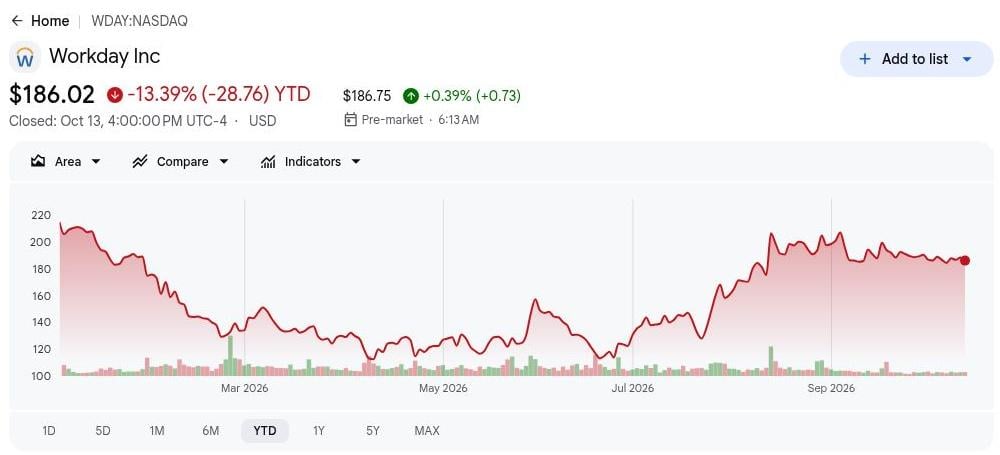
- WDAY closed at $186.02 after a 13.39% YTD decline. The completed-session reference remains below its start-of-year level. S&P Global's $11.08 FY2027 adjusted EPS estimate implies 16.8 times earnings. Further recovery requires greater confidence that agents improve subscription growth.
- Q2 revenue grew 12.8% to $2.649 billion. Subscriptions increased 13.9% and non-GAAP EPS reached $2.75 versus $2.21. Sales and profitability are improving together. That combination needs to persist as guided Q3 subscription growth steps down to 12%.
- Agentic AI ARR reached roughly $600 million. The presentation showed growth above 200% and over $100 million of new agentic AI annual contract value. More than 5,500 customers use an organic agent. ARR and contract value differ from recognized revenue, requiring careful comparison.
- FY2027 subscription guidance approaches $9.95 billion. Management expects $9.940 billion to $9.950 billion, representing 13% growth, a 31.0% adjusted margin and $3.180 billion of annual free cash flow. Delivery across all three would strengthen confidence in growth quality.
- Workday's platform reaches more than 80 million contracted users. Sana became the new Workday Home on October 13, broadening the interface for agent-led tasks. Sana Concierge remains limited to early adopters, with general availability expected in Q1 2027. Revenue impact depends on staged adoption.
What Is Workday (WDAY)?
Workday connects employee records, payroll, financial management, procurement and planning in a cloud subscription platform. Organizations can use common data, permissions and approval workflows across teams rather than maintaining separate systems for each function. Implementation services support deployments, while multi-year contracts, renewals and module expansion drive recurring revenue. More than 11,500 organizations, including over 65% of the Fortune 500, use the software. Workday reports one cloud-applications segment, so investors cannot isolate AI revenue in the standard earnings breakdown.
Workday is placing Sana at the front of existing workflows and using its Agent System of Record to govern automated activity. The Financial Audit Agent and Workday Learning extend the product set, while the AWS Data Cloud integration connects governed HR and finance data to external services. The planned C1.ai acquisition could add identity controls for people and agents after closing. Customer use, paid expansion and retention will show whether these additions deepen subscriptions beyond product availability.
Read More: Salesforce (CRM) Price Prediction 2026: Can Agentforce-Led Growth Push CRM Toward $330?
Workday (WDAY) Q2 FY2027 Earnings Overview: Subscription Revenue Rises 13.9% as Margins Improve
Workday reported Q2 FY2027 revenue of $2.649 billion, up 12.8% year over year and $9 million above consensus, while subscription revenue increased 13.9% to $2.471 billion. Adjusted EPS reached $2.75, and non-GAAP operating margin improved to 31.1%. Management projected full-year subscription revenue of $9.940 billion to $9.950 billion, although free cash flow declined 21.8% to $460 million, keeping cash conversion an important measure of profitability.
|
Financial Metric |
Guidance / Consensus |
Reported / Actual |
Surprise |
|
Q2 FY2027 revenue |
$2.640B LSEG consensus |
$2.649B |
Beat. $9M above estimate; up 12.8% YoY. |
|
Adjusted diluted EPS |
$2.21 a year earlier |
$2.75 |
Improved. Up 24.4% year over year. |
|
GAAP net income |
$228M a year earlier |
$632M |
Higher. Up $404M, including a $374M tax benefit. |
|
Subscription revenue |
$2.169B a year earlier |
$2.471B |
Grew. Up 13.9% year over year. |
|
12-month backlog |
$7.911B a year earlier |
$9.034B |
Expanded. Up 14.2% year over year. |
|
Non-GAAP operating margin |
29.0% a year earlier |
31.10% |
Improved. Up 2.1 percentage points. |
|
Free cash flow |
$588M a year earlier |
$460M |
Lower. Down 21.8% year over year. |
|
FY2027 subscription revenue outlook |
— |
9.940B–9.950B |
Guided. About 13% annual growth. |
- Subscription revenue rose 13.9% to $2.471 billion. Revenue increased by $302 million from $2.169 billion, with existing customers contributing 60% of subscription growth and new customers 40%. Expansion within the installed base remains central to Workday's recurring revenue growth.
- More than 5,500 customers adopted Workday's organic AI agents. Adoption increased over 35% sequentially, with agentic AI ARR reaching approximately $600 million. Growing enterprise usage creates monetization opportunities, although renewals, contract expansion, and infrastructure costs will determine profitability.
- The 12-month subscription backlog grew 14.2% to $9.034 billion. Total backlog increased 8.0% to $27.403 billion, supporting near-term revenue visibility. The slower growth in total backlog makes customer renewals and longer-term contract expansion important indicators of sustained demand.
- Non-GAAP operating margin improved to 31.1%. Adjusted margin increased from 29.0%, while GAAP operating margin reached 11.8%, up from 10.6%. GAAP net income of $632 million included a $374 million tax benefit, making recurring operating profitability a more useful measure of earnings progress.
- Free cash flow declined 21.8% to $460 million. Operating cash flow fell to $520 million from $616 million, while capital spending increased to $60 million from $28 million. With $1.3 billion spent on repurchases and another $4 billion authorized, stronger cash generation will be important to sustaining shareholder returns.
Workday (WDAY) 2026 Investment Outlook: $225 Bull Case vs. $150 Bear Case
Workday's remaining-2026 outlook depends on whether customers turn agent adoption into larger subscriptions and stronger cash flow. Its large installed base, high retention and near-term backlog support steady growth. Slower bookings, rising AI delivery costs and a lag between product launches and paid deployment would weaken the case for higher earnings estimates.
The Bull Case: AI Expansion Pushes WDAY Toward $225
The Bull Case assumes agents increase spending within existing customers, building on roughly $600 million of agentic AI ARR and 97% gross retention. Sana reaches more employees through the installed platform. If new subscriptions grow faster than the infrastructure and support costs of serving agents, margins and per-share earnings can improve together.
A move toward $225 would require Q3 subscription growth above the guided 12%, stronger near-term backlog and intact annual cash guidance. Paid expansion, rather than access to announced tools, would provide the clearest confirmation.
The Base Case: Steady Subscriptions Keep WDAY Between $175 and $205
The Base Case assumes Workday delivers its $9.940 billion to $9.950 billion annual subscription range and 31.0% adjusted margin while AI adoption matures. Near-term backlog grew 14.2%, giving revenue visibility, but total backlog grew 8.0%. Product launches deepen the platform before every tool reaches full commercial scale.
WDAY could trade mainly between $175 and $205 if retention stays firm and free cash flow improves toward the $3.180 billion annual goal. Backlog acceleration would lift the range; reduced subscription or cash guidance would weaken it.
The Bear Case: Slower Bookings Pull WDAY Toward $150
The Bear Case assumes customers defer new modules or competing agents slow paid expansion. Subscription costs rose 18% in Q2, faster than sales, so weaker bookings would make cloud capacity and product spending harder to absorb. Softer cash generation could also limit the buybacks used to support per-share earnings.
A move toward $150 would become more likely if Q3 subscriptions or near-term backlog miss guidance and cash conversion deteriorates. Delayed C1.ai integration or weak Sana usage would add to the concern that AI costs precede revenue.
WDAY Stock Price Forecasts for 2026 By Wall Street Analysts
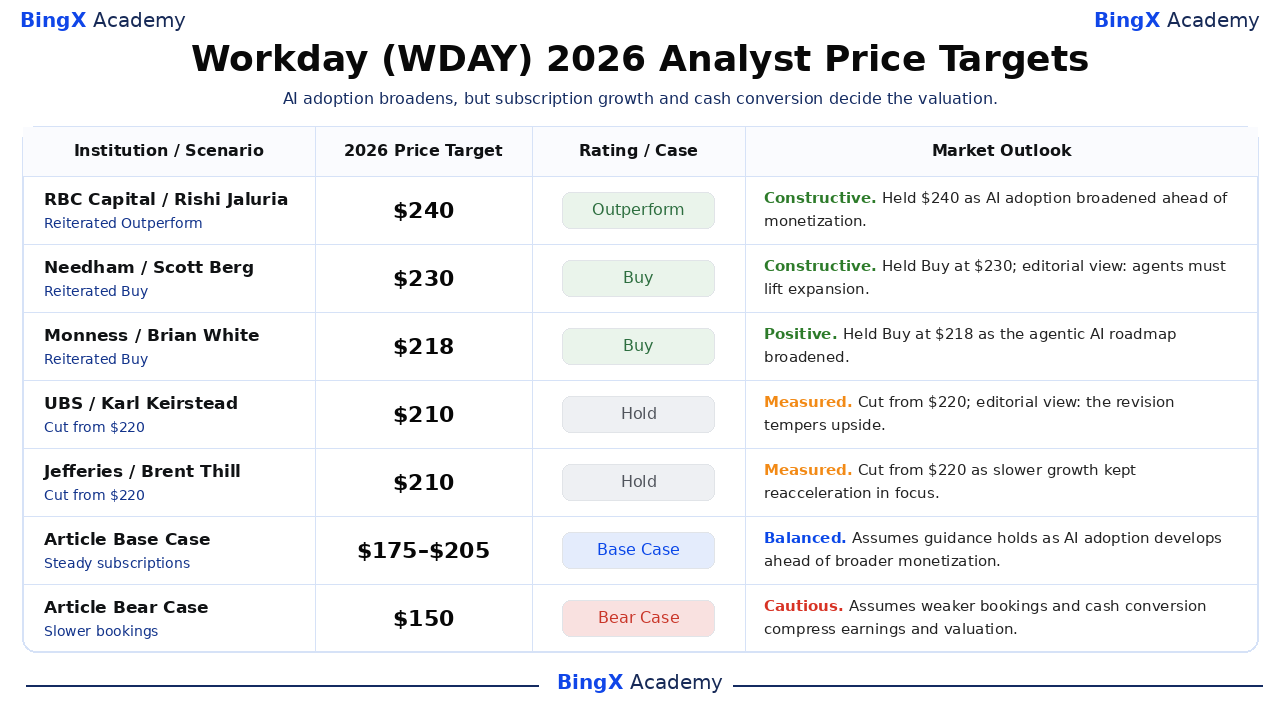
Six named firms provide dated targets from $201 to $240, generally over 12 months. This article's remaining-2026 scenarios use a shorter horizon. The table preserves reported actions and broker commentary; interpretations beyond the sourced action are labeled editorial. Differing targets reflect differing expectations about growth and valuation.
|
Institution / Scenario |
2026 Price Target |
Rating / Case |
Market Outlook |
|
RBC Capital |
$240 |
Outperform |
Constructive. October 5: Rishi Jaluria reiterated Outperform and $240. AI adoption strengthened the platform opportunity; the note emphasized adoption before monetization. |
|
Needham |
$230 |
Buy |
Constructive. October 5: Scott Berg reiterated Buy and $230. Editorial reading: the Buy stance supports upside if agent adoption improves customer expansion. |
|
Monness |
$218 |
Buy |
Positive. October 5: Brian White reiterated Buy and $218. The published note emphasized AI innovation and Workday's agentic platform roadmap. |
|
UBS |
$210 |
Hold |
Measured. October 14: Karl Keirstead cut the target from $220 to $210 and retained Hold. Editorial reading: the lower target tempers upside expectations after the annual event. |
|
Jefferies |
$210 |
Hold |
Measured. October 8: Brent Thill cut the target from $220 to $210 and retained Hold. Slower revenue and backlog growth left subscription reacceleration as the key test. |
|
Citi |
$201 |
Hold |
Measured. October 14: Steve Enders reiterated Hold and $201. The published note linked the long-term AI platform strategy to the reiterated FY2028 outlook. |
|
Article Base Case |
175–205 |
Base Case |
Balanced. Assumes guidance holds as AI adoption develops ahead of broader monetization. |
|
Article Bear Case |
$150 |
Bear Case |
Cautious. Assumes weaker bookings and cash conversion compress earnings and valuation. |
How to Trade Workday (WDAY) Stock on BingX
Trade Workday's subscription growth, agent adoption and cash-conversion outlook using BingX TradFi and BingX AI tools. Because WDAY can react sharply to earnings, bookings and product announcements, traders should define both the catalyst and risk limits before entering a position.
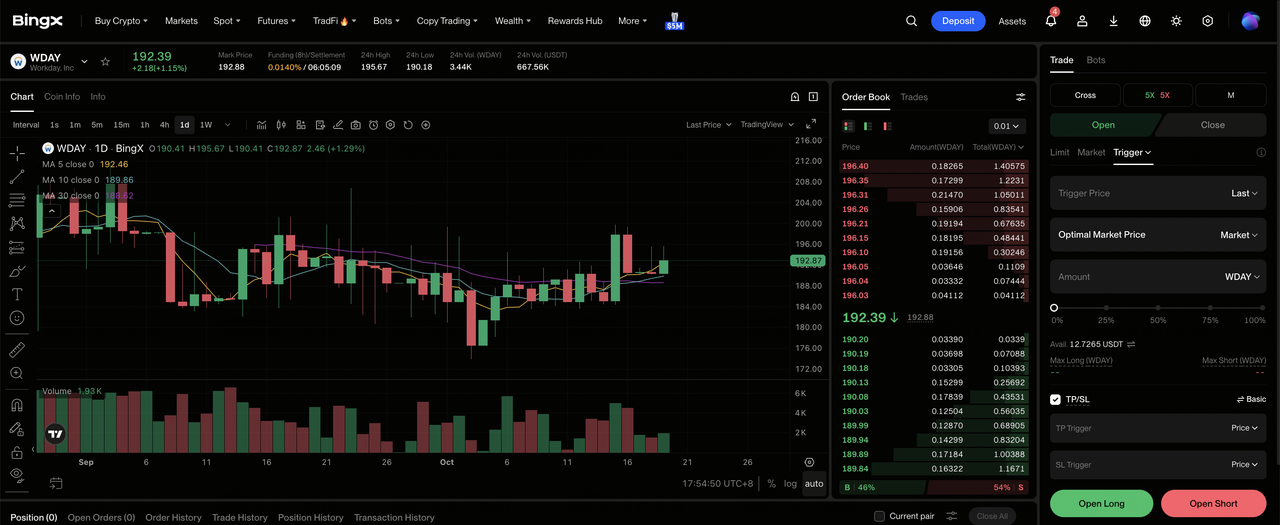
Step 1: Access BingX TradFi. Sign up and navigate to the specialized TradFi section on the BingX exchange dashboard.
Step 2: Select Workday (WDAY). Search for and select the WDAY-USDT perpetual futures contract.
Step 3: Choose your direction. Select Open Long if you expect agent adoption to strengthen subscription growth and cash generation. Select Open Short if you expect slower bookings or rising infrastructure costs to weaken profitability.
Step 4: Select leverage and margin mode. Choose Isolated or Cross-Margin based on your risk tolerance. The 13.39% YTD decline through October 13 shows why conservative leverage and clear position sizing are important.
Step 5: Execute strict risk protocols. Set Take-Profit and Stop-Loss (TP/SL) levels before or immediately after entering the trade. WDAY can react quickly to quarterly results, subscription guidance, backlog changes, Sana adoption and acquisition updates.
Top 5 Risks to Watch for Workday Investors in 2026
Workday has durable customer relationships, but its share value depends on paid expansion, the cost of delivering new agents and whether reported margin gains convert into cash.
- Slower customer expansion would weaken recurring growth. Existing customers supply 60% of subscription growth. Smaller renewals or deferred module purchases could reduce incremental revenue despite high retention, lowering forward earnings estimates and the platform's valuation multiple.
- AI delivery costs can outrun new subscriptions. Q2 subscription costs rose 18%, including $33 million of additional infrastructure expense. More agent usage before pricing catches up could weaken gross-profit contribution despite strong customer-adoption figures and broader product reach.
- Product timing can delay expected returns. Sana Concierge's general availability is expected in Q1 2027; C1.ai should close in Q4 FY2027. Deployment or integration setbacks delay commercial benefits after development and management resources have already been committed.
- Buybacks compete with investment for cash. Q2 repurchases consumed $1.3 billion against $460 million free cash flow, with cash and securities at $3.403 billion. Spending above cash generation can reduce flexibility for acquisitions and product development.
- Adjusted profits can overstate owner economics. Q2 share-based compensation was $462 million, contributing to the gap between 11.8% GAAP and 31.1% adjusted margins. Monitor dilution and repurchases together because maintaining the share count can consume substantial cash.
Final Thoughts: Should You Invest in Workday in 2026?
Workday's recurring software franchise remains substantial, with high retention and a large installed base that agents can reach. Q2 showed AI adoption and better margins. The question is how much incremental subscription revenue and cash those tools create. Sana's new interface and the planned C1.ai acquisition broaden the opportunity, with commercial execution determining the return.
The $175 to $205 Base Case provides a balanced framework for the remaining months of 2026 because it recognizes steady subscriptions without assuming immediate monetization of every launch. A conservative investor could monitor Q3 subscriptions, backlog, annual cash guidance and paid agent expansion. Better results would support $225; weaker bookings and cash conversion would favor the $150 Bear Case.
Risk Reminder: Trading and investing in equities like WDAY involves a high risk of capital loss. Subscription demand, AI competition, deployment reliability, acquisition integration, stock-based compensation and valuation changes can affect returns. Conduct independent research before allocating capital.
Related Reading
- Salesforce (CRM) Price Prediction 2026: Can Agentforce-Led Growth Push CRM Toward $330?
- Oracle (ORCL) Price Prediction 2026: Can AI Cloud Growth Push ORCL Toward $260?
- Alphabet (GOOGL) Price Prediction 2026: Can 82% Cloud Growth and AI Push GOOGL Stock to $430?
- AppLovin (APP) Price Prediction 2026: Can AXON Growth Push APP Toward $600?
- IBM (IBM) Price Prediction 2026: Can Software and Quantum Growth Push IBM Toward $350?
