
UiPath (PATH) provides enterprise automation and business-orchestration software that coordinates AI agents, robots, people and applications across governed workflows. Robotic process automation remains the installed base, while Maestro, agent-building, process intelligence, testing and document understanding broaden the platform. This evolution increases exposure to enterprise AI spending but also leaves PATH sensitive to new competitors, customer consolidation and the pace of agentic AI monetization.
The latest quarter showed durable growth and better profitability without fully resolving the demand debate. UiPath Fiscal Q2 2027 revenue reached $410.3 million, up 13% year over year, while annualized renewal run-rate rose 12% to $1.938 billion and net new ARR reached $37 million. The broader case depends on whether AI-led deals can lift net new ARR faster than mature automation workloads slow.
The PATH stock forecast for 2026 now centers on two competing views:
- The $23 agentic automation case: Maestro becomes the control layer for enterprise AI workflows, accelerating ARR and sustaining operating leverage.
- The $10 competitive-disruption case: AI-native tools reduce demand for traditional automation and keep new-customer growth below the level required for a re-rating.
This guide breaks down the PATH stock forecast, 2026 price scenarios, key risks and analyst outlooks, drawing on UiPath's September 3 fiscal Q2 2027 earnings release, quarterly filing and market data through September 15, plus how to trade PATH stock futures on BingX TradFi with USDT collateral.
Top 5 Things for UiPath Investors to Know in September 2026
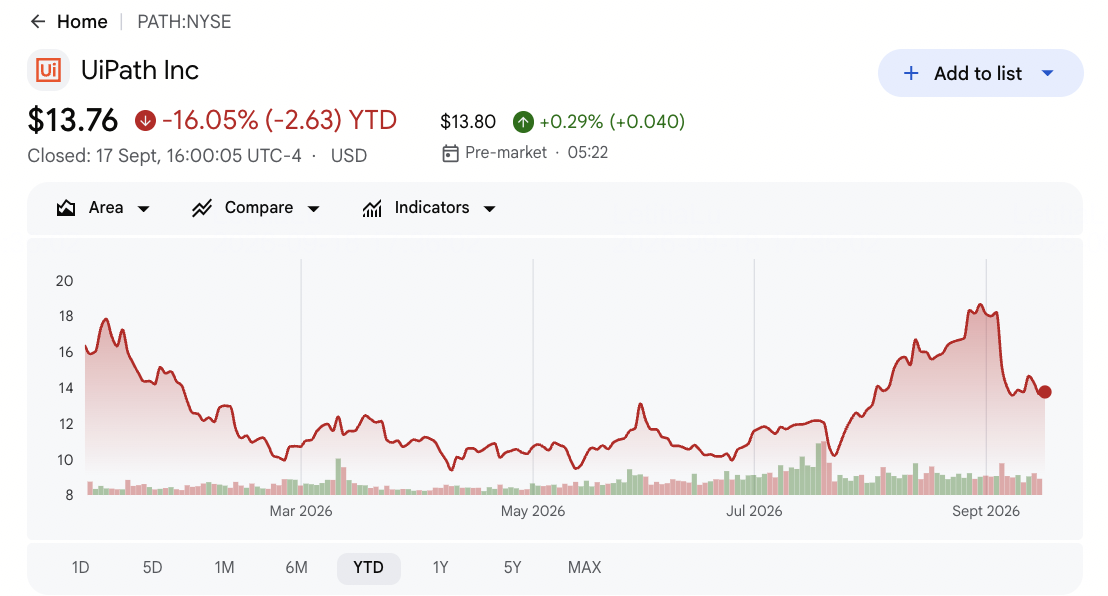
- PATH closed at $13.76 on September 17 and was down 16.05% in 2026: Shares fell about 16% after Q2 despite a revenue beat and higher annual guidance. The reaction shows that investors want clearer proof that AI adoption can accelerate recurring revenue.
- Quarterly revenue reached $410.3 million and beat consensus by about $12.4 million: Revenue rose 13% year over year versus the $397.85 million estimate. Q3 guidance of $440 million to $445 million points to slower growth of roughly 8%.
- ARR rose 12% to $1.938 billion with $37 million of net new ARR: Dollar-based net retention remained 109%, showing that existing customers continued expanding. Stronger valuation support will require AI products to drive larger net additions, not only retention.
- GAAP operating income reached $32 million and non-GAAP operating income reached $89 million: UiPath generated a 22% non-GAAP operating margin and $31 million of adjusted free cash flow. Profitability gives management more room to invest in AI agents and orchestration while maintaining discipline.
- Full-year revenue guidance rose to $1.789 billion to $1.794 billion: The midpoint increased by $13 million from the prior range. Management also expects year-end ARR of $2.065 billion to $2.070 billion and about $445 million of non-GAAP operating income.
What Is UiPath (PATH)?
UiPath is an enterprise software company built around automation, orchestration and process improvement. Its platform combines robotic process automation, APIs, AI agents, document understanding, process mining, testing and governance so organizations can automate work across legacy systems and modern cloud applications. Customers generally purchase term subscriptions, maintenance and related services, creating recurring revenue measured through annualized renewal run-rate. The platform is used in finance, healthcare, government, telecommunications and other regulated environments where auditability and deterministic execution matter.
The long-term strategy is to position UiPath Maestro as an orchestration layer connecting AI agents, software robots, enterprise applications and employees. Maestro Flow adds a developer-focused canvas, and Maestro Case targets exception-heavy workflows such as investigations and approvals. UiPath also extends distribution through Microsoft, SAP, Google Cloud, Amazon Web Services, Deloitte and other technology and consulting partners. The direction moves the company beyond standalone RPA toward the broader AI software application layer without abandoning the governed automation base.
UiPath (PATH) Q2 FY2027 Earnings Overview: Revenue, ARR and Operating Leverage Improve
UiPath reported $410.3 million of revenue against $397.85 million expected, a beat of about $12.4 million and 13% year-over-year growth. Non-GAAP EPS matched consensus at $0.15, GAAP diluted EPS improved to $0.07 from zero, and ARR rose 12% to $1.938 billion with 109% retention. Management raised full-year revenue to $1.789 billion to $1.794 billion and retained about $445 million of non-GAAP operating income. The main tension is whether improving margins can be paired with faster AI-led recurring revenue growth.
Read More: UiPath (PATH) Q2 FY2027 Earnings Overview: $410M Revenue Beat Triggers a 16.63% Price Selloff
|
Financial Metric |
Guidance / Consensus |
Reported / Actual |
Surprise |
|
Q2 FY2027 revenue |
$397.85M consensus |
$410.3M |
Beat. About $12.4M above consensus; up 13% YoY. |
|
Q2 non-GAAP EPS |
$0.15 consensus |
$0.15 |
Met. Operating discipline offset continued investment. |
|
Q2 GAAP diluted EPS |
$0.00 a year earlier |
$0.07 |
Improved. GAAP profitability expanded. |
|
Annualized renewal run-rate |
$1.730B a year earlier |
$1.938B |
Expanded. ARR rose 12% with $37M net new ARR. |
|
Dollar-based net retention |
— |
109% |
Positive. Existing customers expanded spending. |
|
Non-GAAP operating income |
— |
$89M |
Profitable. Margin reached about 22%. |
|
Q3 FY2027 revenue outlook |
— |
$440M-$445M |
Higher sequentially. The midpoint implies roughly 8% YoY growth. |
|
FY2027 revenue outlook |
Prior $1.776B-$1.781B |
$1.789B-$1.794B |
Raised. The midpoint increased by $13M. |
|
FY2027 non-GAAP operating income |
— |
About $445M |
Disciplined. Guidance preserves operating leverage. |
- Revenue of $410.3 million beat consensus by about $12.4 million: The 13% growth rate shows that the automation platform continues to expand despite AI disruption concerns. The next test is whether Q3 reaches the $440 million to $445 million range.
- Non-GAAP EPS of $0.15 matched consensus: GAAP net income reached $36.1 million and diluted EPS improved to $0.07. Profitability reduces the need to choose between platform investment and near-term financial discipline. Continued GAAP income would make the improvement more durable.
- ARR of $1.938 billion rose 12% with $37 million net new ARR: Retention of 109% confirms expansion among existing customers, yet the smaller net-new figure keeps acquisition and AI monetization central to the debate. Faster additions are needed for a stronger re-rating.
- Non-GAAP operating income reached $89 million: The 22% margin and $31 million of adjusted free cash flow show that growth is reaching operating results. UiPath also held $1.405 billion of cash, equivalents and marketable securities. That liquidity supports product investment and selective acquisitions.
- Full-year revenue guidance rose by $13 million at the midpoint: The new $1.789 billion to $1.794 billion range sits above the prior outlook, while year-end ARR guidance of $2.065 billion to $2.070 billion requires another $127 million to $132 million increase.
UiPath (PATH) 2026 Investment Outlook: $23 Bull Case vs. $10 Bear Case
UiPath's 2026 outlook depends on whether AI agents and orchestration can accelerate recurring revenue without weakening margins. Existing automation deployments and strong profitability provide support, while slower net new ARR and AI-native competition remain the main risks.
The Bull Case: Strong AI Agent Adoption Pushes PATH Toward $23
The Bull Case assumes Maestro, AI agents and governed automation win broader deployments across regulated enterprises. Eighteen of UiPath's top 20 Q2 deals included AI, showing that new products are entering real customer deployments rather than remaining isolated pilots.
A move toward $23 would require net new ARR to rise above $37 million, retention to remain near or above 109% and operating margin to stay strong as investment continues. Year-end ARR above $2.065 billion would strengthen the case.
The Base Case: Steady ARR Growth Keeps PATH Between $15 and $18
The Base Case assumes revenue and ARR continue growing at low-double-digit rates, while profitability offsets slower customer acquisition. Existing RPA deployments and partner distribution support renewals, though competition limits valuation expansion.
Under this scenario, PATH could trade mainly between $15 and $18. Revenue within guidance, retention near 109% and non-GAAP operating income around the $445 million annual target would support the range. Net new ARR staying near $37 million would cap the upside.
The Bear Case: Stronger AI Competition Pulls PATH Toward $10
The Bear Case assumes enterprises increasingly automate through cloud, application and model providers, reducing demand for a separate orchestration platform. Large deal cycles could also lengthen as customers compare UiPath with embedded AI tools.
A move toward $10 would become more likely if ARR growth falls below 10%, retention drops under 100% or full-year revenue guidance is cut. Strong margins would soften the impact, though slower recurring growth would likely pressure the valuation.
PATH Stock Price Forecasts for 2026 By Wall Street Analysts
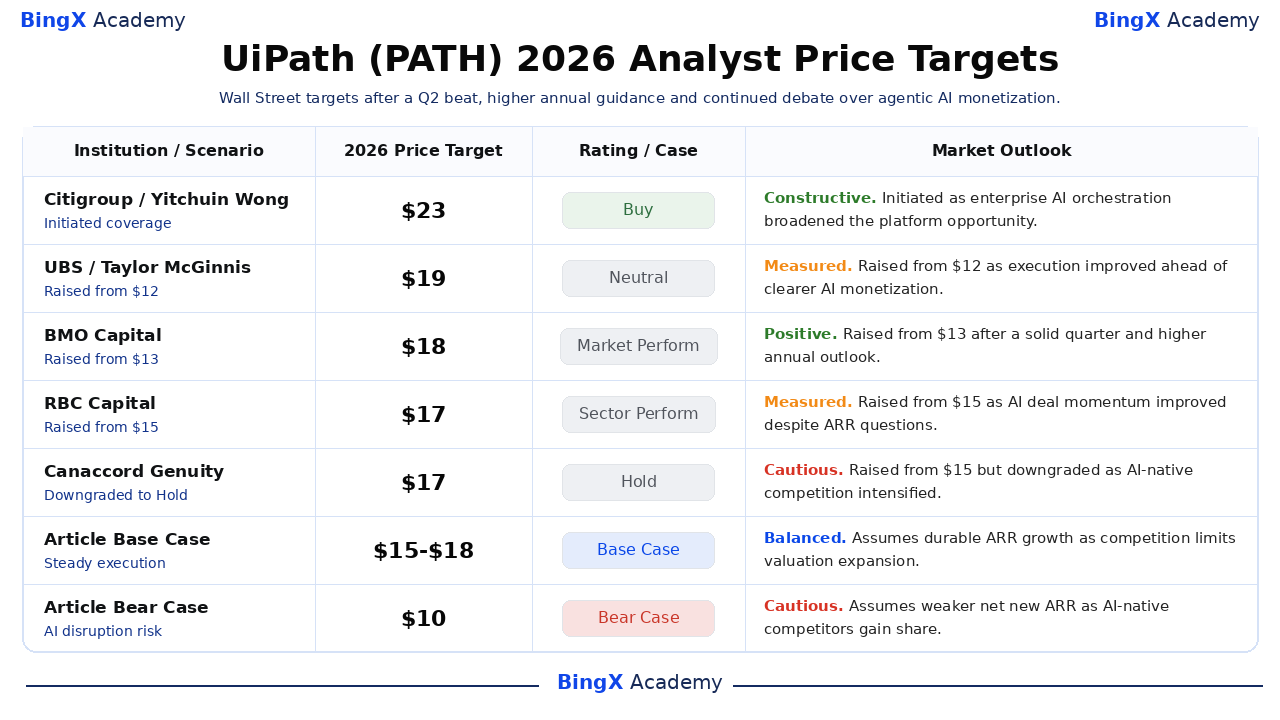
Analyst actions after Q2 show a wide range of interpretations. Citigroup initiated at Buy with a $23 target, whereas Canaccord raised its target to $17 and downgraded the shares to Hold. The group recognizes improved execution but remains divided on the pace and defensibility of agentic AI monetization.
|
Institution |
2026 Price Target |
Rating |
Market Outlook |
|
Citigroup |
$23 |
Buy |
Constructive. September 8: initiated as enterprise AI orchestration broadened the platform opportunity. |
|
UBS |
$19 |
Neutral |
Measured. August 31: raised from $12 as execution improved ahead of clearer AI monetization. |
|
BMO Capital |
$18 |
Market Perform |
Positive. September 4: raised from $13 after a solid quarter and higher annual outlook. |
|
RBC Capital |
$17 |
Sector Perform |
Measured. September 4: raised from $15 as AI deal momentum improved despite ARR questions. |
|
Canaccord Genuity |
$17 |
Hold |
Cautious. September 4: raised from $15 but downgraded as AI-native competition intensified. |
|
Article Base Case |
$15-$18 |
Base Case |
Balanced. Assumes durable ARR growth as competition limits valuation expansion. |
|
Article Bear Case |
$10 |
Bear Case |
Cautious. Assumes weaker net new ARR as AI-native competitors gain share. |
How to Trade UiPath (PATH) Stock on BingX
Trade UiPath's agentic-AI adoption, recurring-revenue growth and margin outlook using BingX TradFi and BingX AI tools. Because PATH can react sharply to earnings, product announcements and competitive developments, define both the thesis and loss limit before entering a position.
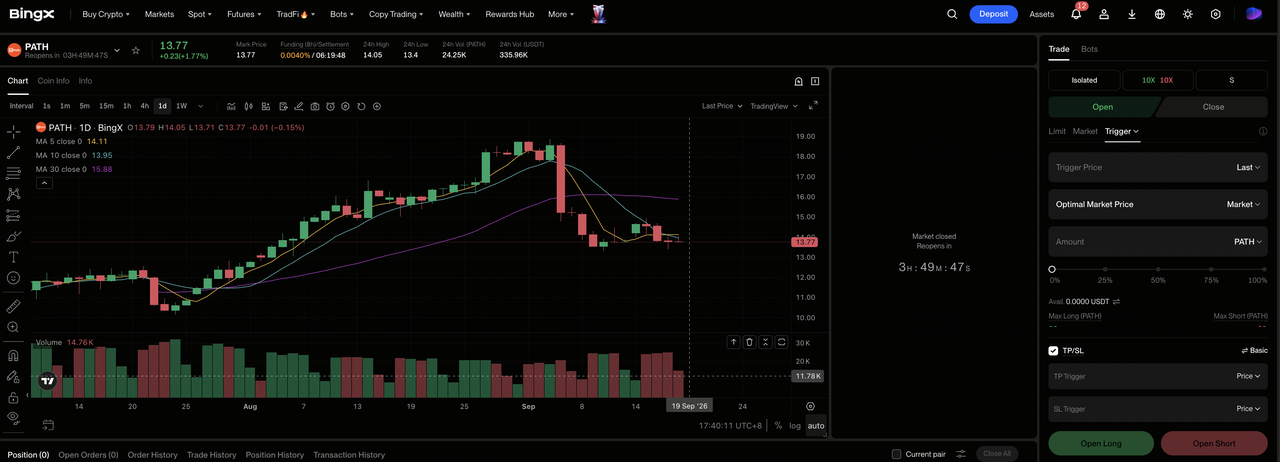
Step 1: Access BingX TradFi. Sign up and navigate to the specialized TradFi section on the BingX exchange dashboard.
Step 2: Select UiPath (PATH). Search for and select the PATH-USDT perpetual futures contract.
Step 3: Choose your direction. Select Open Long if agentic deal conversion accelerates and margins remain firm. Select Open Short if AI-native competition slows ARR or guidance weakens.
Step 4: Select leverage and margin mode. Choose Isolated or Cross-Margin based on your risk tolerance. The roughly 16% post-earnings decline shows why conservative leverage matters.
Step 5: Execute strict risk protocols. Set Take-Profit and Stop-Loss (TP/SL) levels before or immediately after entering the trade. Monitor net new ARR, retention, guidance and competitive product launches.
Top 5 Risks to Watch for UiPath Investors in 2026
UiPath has improved profitability while its automation market is changing quickly. These risks can slow recurring revenue, weaken retention and pressure the valuation even if earnings stay positive.
- AI-native competitors could slow new customer growth: Cloud and software vendors can embed automation directly into their platforms. That could reduce new UiPath deployments, increase discounting and weaken long-term retention.
- Net new ARR could remain too low: Q2 added $37 million of net new ARR. If additions do not accelerate, future revenue visibility could weaken and the year-end ARR target would become harder to reach.
- Large deals can shift between quarters: Enterprise automation projects often require lengthy approvals. Delayed decisions can move ARR and revenue into later periods even when the sales pipeline remains active.
- Leadership changes can create execution risk: Changes across finance and operations add new accountability during a major product transition. Disruption in sales, finance or delivery could slow conversion as customers evaluate UiPath's agentic products.
- A lower valuation multiple could limit upside: Slower growth or higher interest rates can reduce the multiple investors pay even if UiPath stays profitable. Stronger ARR growth and new-customer demand would be needed to offset that pressure.
Final Thoughts: Should You Invest in UiPath in 2026?
UiPath's Q2 showed a healthier operating business, with a $12.4 million revenue beat, 12% ARR growth, positive GAAP operating income and higher annual guidance. The stock still needs evidence that agentic products can increase net new ARR rather than merely protect the installed base. Investors should watch ARR additions, retention, AI participation in major deals and operating margin together, since growth without monetization or margin without new demand would leave the thesis incomplete.
A conservative decision framework would look for net new ARR to rise above $37 million, retention to remain near 109% and annual non-GAAP operating income to track toward $445 million. Meeting all three tests would support the base or bull case. Slower recurring growth, weaker retention or evidence that embedded AI tools are displacing UiPath would favor the bear case despite current profitability.
Risk Reminder: Stock-linked perpetual futures involve leverage and can amplify losses. Analyst targets and article scenarios are conditional reference points, not guarantees.
Related Reading
- Adobe (ADBE) Price Prediction 2026: Can AI Monetization Push ADBE Toward $520?
- AppLovin (APP) Price Prediction 2026: Can AXON Growth Push APP Toward $600?
- Figma (FIG) Price Prediction 2026: $36.00 AI Launchpad or Overvalued Post-IPO Hangover Trap?
- CrowdStrike (CRWD) Price Prediction 2026: Can AI Security and Falcon Flex Push CRWD Toward $280?
- Arm Holdings (ARM) Price Prediction 2026: Can AI Compute Demand Push ARM Toward $350?
