


TeraWulf (WULF) develops and operates power-backed digital infrastructure for artificial intelligence, high-performance computing and bitcoin mining. Lake Mariner remains its largest operating campus, and new projects in Kentucky and Maryland are intended to make long-duration HPC leases the main revenue engine. That transition expands the opportunity beyond bitcoin, though it also raises exposure to construction timing, project financing and customer concentration.
The latest quarter showed that transition is underway but incomplete. TeraWulf Q2 2026 revenue reached $44.8 million, with $31.9 million of HPC lease revenue representing 71% of the total, even as consolidated revenue declined 6% year over year. The investment case now depends on whether 336 MW under construction can begin earning rent on schedule without capital costs or dilution overwhelming the contracted economics.
The WULF stock forecast for 2026 now centers on two competing views:
- The $40 AI infrastructure case: Lake Mariner deliveries and the 401 MW Anthropic lease convert secured power into predictable, long-duration HPC cash flow.
- The $10 execution-risk case: construction delays, financing costs or new share issuance weaken returns before the contracted campuses reach full utilization.
This guide breaks down the WULF stock forecast, 2026 price scenarios, key risks and analyst outlooks, drawing on TeraWulf's August 5 Q2 2026 earnings release, quarterly filing and market data through September 15, plus how to trade WULF stock futures on BingX TradFi with USDT collateral.
Top 5 Things for TeraWulf Investors to Know in September 2026
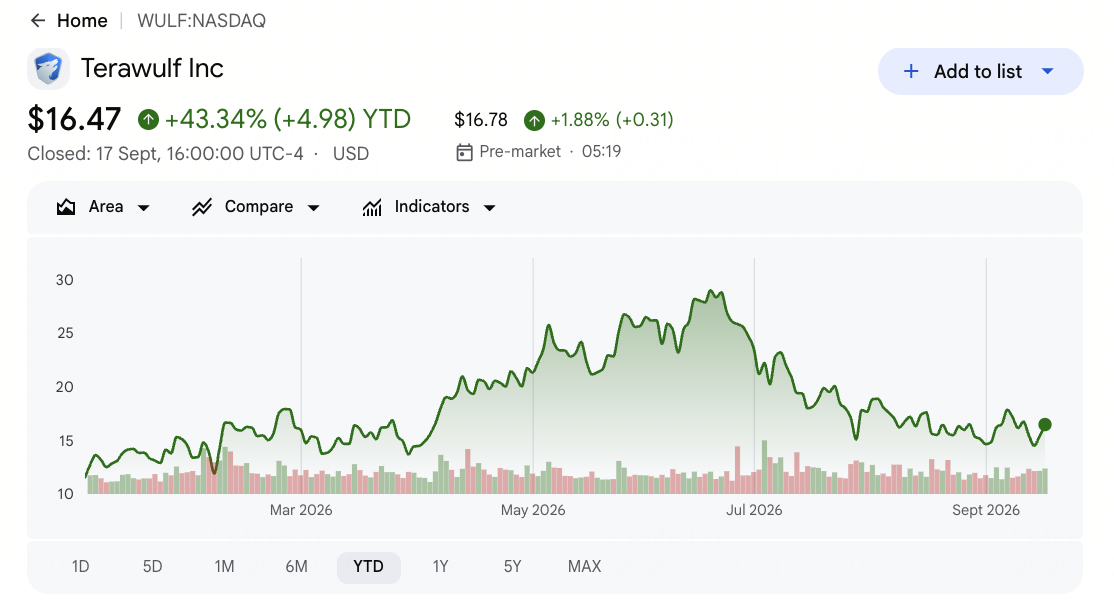
- WULF closed at $16.47 on September 17 and was up 43.34% in 2026: The rally reflects a major re-rating around AI data-center capacity. Shares still sit below the $35.48 Street average, though further upside depends on signed leases converting into delivered capacity and cash flow.
- Q2 revenue reached $44.8 million and missed consensus by about $5.7 million: Revenue fell from $47.6 million a year earlier as bitcoin-mining revenue dropped to $12.8 million. The miss shows why the transition cannot be judged only by long-term contract values.
- HPC lease revenue reached $31.9 million and supplied 71% of sales: TeraWulf had 81 MW generating revenue at quarter-end and increased that to 102 MW after CB-3 entered service. The mix shift shows contracted compute is replacing more volatile mining revenue.
- Another 336 MW was under construction after 102 MW entered service: CB-4 is expected to begin phased delivery in the second half of 2026, with CB-5 targeted for early 2027. At $8 million to $10 million per critical IT MW, schedule and cost control remain central.
- The Anthropic lease represents $19 billion of initial-term revenue: The 20-year agreement covers about 401 MW at Justified and could reach $33 billion with both five-year extensions. Initial delivery is planned for the second half of 2027, creating strong visibility but also a long construction period.
What Is TeraWulf (WULF)?
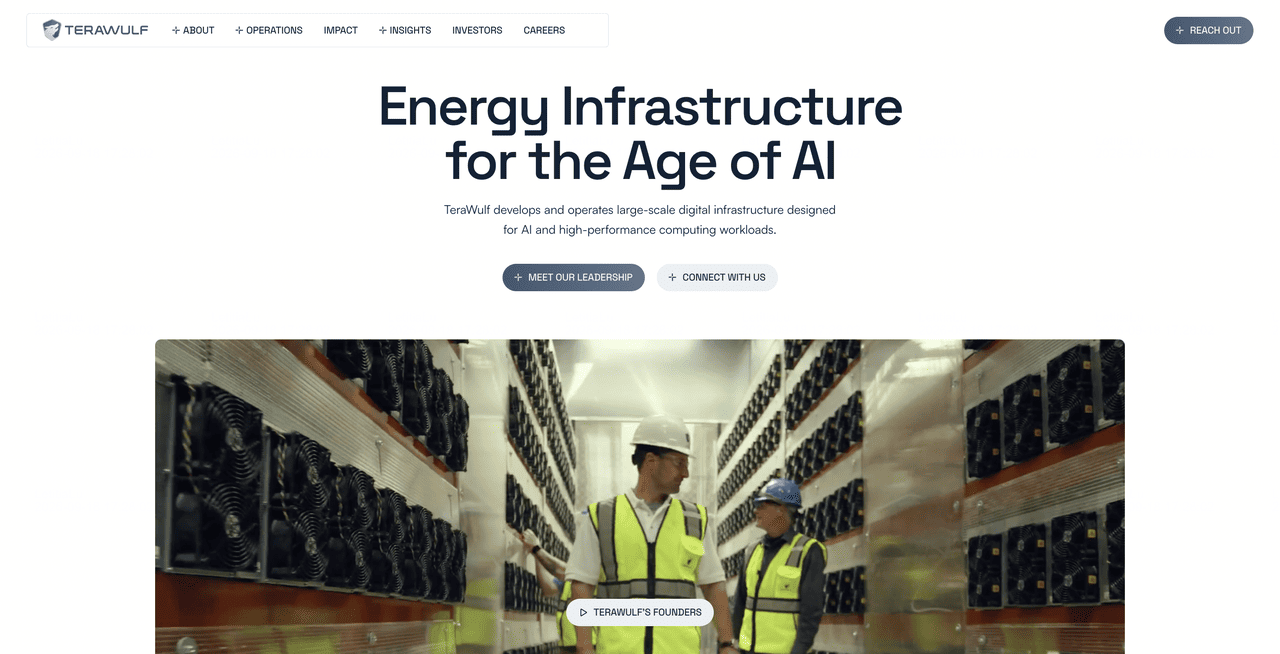
TeraWulf is a U.S. digital-infrastructure developer that combines control of land, power connections and data-center construction with ongoing facility operations. Its Lake Mariner campus in New York hosts both HPC tenants and bitcoin-mining equipment, allowing existing electrical infrastructure to be repurposed as higher-value compute capacity. Revenue comes from long-term HPC leases and digital-asset mining, though the strategic direction increasingly favors contracted AI workloads. The company also develops large campuses where secured power is the scarce asset.
The long-term platform now spans Lake Mariner and Lake Hawkeye in New York, Justified and Muskie in Kentucky, and Chesapeake in Maryland. Anthropic has committed to approximately 401 MW at Justified, Fluidstack leases Lake Mariner capacity, and Google provides credit support tied to Fluidstack obligations. Management also targets 250 MW to 500 MW of incremental critical IT contracting each year. These relationships connect TeraWulf to the broader AI data-center investment cycle while leaving delivery economics dependent on power, construction and financing.
Read More: Top High-Performance Computing (HPC) Stocks to Watch in 2026: Accelerated Computing Market Leaders
TeraWulf (WULF) Q2 2026 Earnings Overview: HPC Leasing Becomes the Main Revenue Engine
TeraWulf reported $44.8 million of revenue against a $50.49 million consensus estimate, a miss of about $5.7 million and a 6% year-over-year decline. GAAP loss per share reached $1.94 versus a $0.19 expected loss, though the result included a $755.7 million warrant remeasurement loss. The operating change was more constructive: HPC lease revenue reached $31.9 million, 102 MW was producing revenue after CB-3 delivery, and $3.0 billion of cash and restricted cash supported 336 MW under construction. The tension is whether contracted growth can outrun capital costs and dilution.
|
Financial Metric |
Guidance / Consensus |
Reported / Actual |
Surprise |
|
Q2 2026 revenue |
$50.49M consensus |
$44.8M |
Missed. About $5.7M below consensus and down 6% YoY. |
|
Q2 diluted EPS |
$0.19 loss consensus |
$1.94 loss |
Missed. Warrant remeasurement and development costs widened the loss. |
|
HPC lease revenue |
No prior-year contribution |
$31.9M |
Scaled. HPC supplied 71% of revenue. |
|
Revenue-generating IT capacity |
81 MW at June 30 |
102 MW after CB-3 |
Expanded. CB-3 activated $600M of Google credit support. |
|
Capacity under construction |
— |
336 MW |
Advancing. CB-4 starts delivery in H2 2026. |
|
Cash and restricted cash |
— |
About $3.0B |
Liquid. Funding supports contracted construction. |
|
Anthropic lease |
— |
$19B initial term |
Contracted. The 401 MW lease can reach $33B with extensions. |
|
Annual contracting target |
Previous target |
250-500 MW |
Reaffirmed. Management maintained the annual goal. |
- Revenue of $44.8 million missed consensus by about $5.7 million: The 6% year-over-year decline reflected digital-asset revenue falling to $12.8 million from $47.6 million. New HPC revenue softened the drop but was not yet large enough to drive overall growth.
- The $1.94 GAAP loss per share was $1.75 wider than consensus: A $755.7 million warrant remeasurement loss drove much of the accounting result. Investors still need to separate non-cash volatility from recurring interest and construction costs.
- HPC revenue of $31.9 million reached 71% of quarterly sales: The mix confirms that TeraWulf is becoming an AI infrastructure lessor rather than remaining mainly a bitcoin miner. The key uncertainty is the cost and timing required to bring each contracted megawatt into service.
- Revenue-generating capacity rose from 81 MW to 102 MW: CB-3 completion satisfied conditions for $600 million of Google credit support. Repeating that milestone across CB-4 and CB-5 is the next major execution test.
- About $3.0 billion of cash supported 336 MW under construction: Liquidity is substantial, but the expected $8 million to $10 million cost per critical IT MW keeps development highly capital intensive. Staying within cost guidance is essential to per-share value.
Read More: CoreWeave (CRWV) Price Prediction 2026: Can AI Cloud Demand Push CRWV Toward $175?
TeraWulf (WULF) 2026 Investment Outlook: $40 Bull Case vs. $10 Bear Case
TeraWulf's 2026 outlook depends on whether its AI data-center buildout can move from contracted capacity into revenue-producing megawatts without major delays or dilution. HPC leasing now drives most revenue, but construction cost and financing remain the main execution tests.
The Bull Case: Strong AI Data-Center Growth Pushes WULF Toward $40
The Bull Case assumes CB-4 and CB-5 enter service on schedule, lifting revenue-producing capacity well beyond 102 MW. The $19 billion Anthropic lease, Fluidstack commitments and Google credit support make the revenue path more predictable and reduce reliance on bitcoin prices.
A move toward $40 would require delivery within the $8 million to $10 million per-MW cost range, new contracts inside the 250 MW to 500 MW annual target and limited dilution from project financing. Rising HPC revenue and recurring operating cash flow would strengthen the case.
The Base Case: Steady Capacity Growth Keeps WULF Between $24 and $32
The Base Case assumes construction progresses broadly on schedule and HPC leasing becomes the dominant revenue source. Investors still discount the long gap between capital spending and rent commencement, leaving the 336 MW buildout exposed to timing and financing risk.
Under this scenario, WULF could trade mainly between $24 and $32. Quarterly growth in revenue-producing megawatts, stable cost guidance and more credit-supported customers would support the range. A slower ramp or equity-funded spending would cap the upper end.
The Bear Case: Project Delays and Dilution Pull WULF Toward $10
The Bear Case assumes project schedules slip, construction costs rise or financing becomes more expensive. Since Anthropic capacity begins only in the second half of 2027, delays would push major contracted revenue further out.
A move toward $10 would become more likely if revenue-producing capacity stalls near 102 MW, annual contracting falls below 250 MW or new share issuance increases materially. Weaker bitcoin economics could add further pressure before HPC revenue fully scales.
WULF Stock Price Forecasts for 2026 By Wall Street Analysts
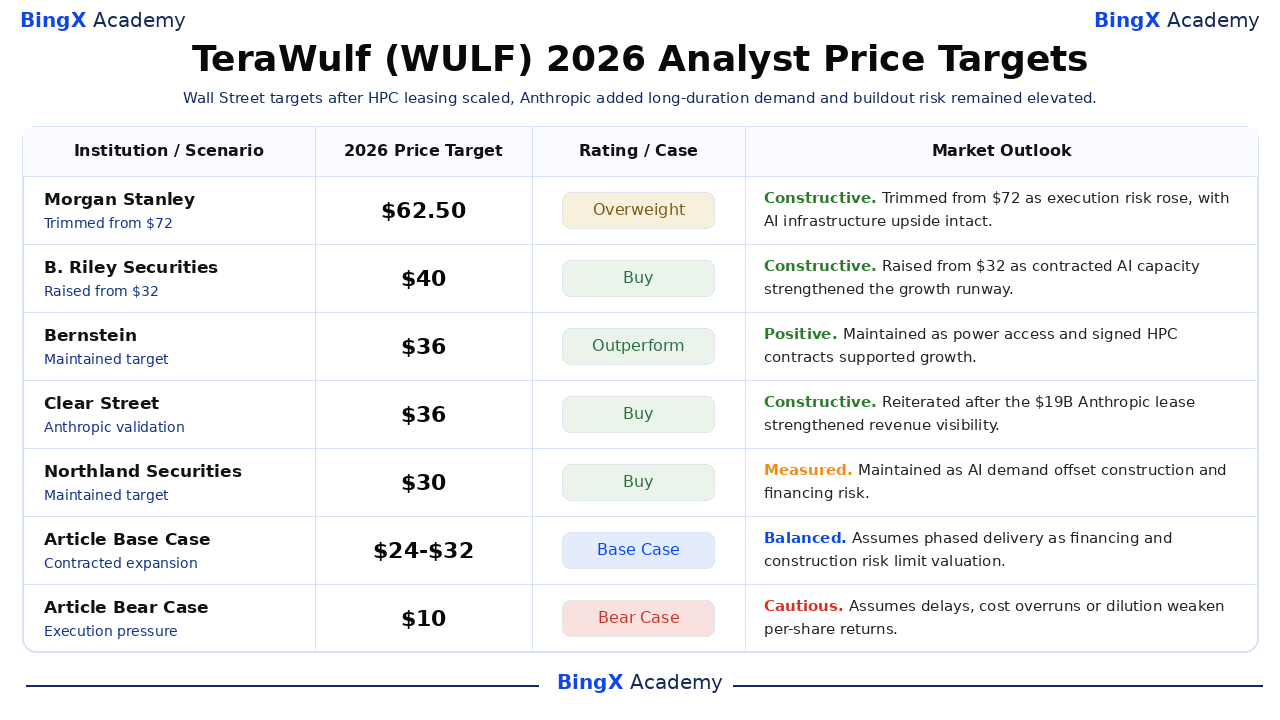
Wall Street remains constructive, though the targets span different assumptions about contract value, financing and execution. Morgan Stanley's $62.50 target is the highest selected reference, while Northland's $30 target is the lowest among these five named actions. These are 12-month targets rather than guarantees or the article's editorial scenarios.
|
Institution |
2026 Price Target |
Rating |
Market Outlook |
|
Morgan Stanley |
$62.50 |
Overweight |
Constructive. August 13: cut from $72 as risk-adjusted assumptions changed, with AI infrastructure upside intact. |
|
B. Riley Securities |
$40 |
Buy |
Constructive. August 3: raised from $32 as contracted AI capacity strengthened the runway. |
|
Bernstein |
$36 |
Outperform |
Positive. September 1: maintained as power access and signed HPC contracts supported growth. |
|
Clear Street |
$36 |
Buy |
Constructive. July 6: reiterated after the $19 billion Anthropic lease validated the platform. |
|
Northland Securities |
$30 |
Buy |
Measured. September 10: maintained as AI demand offset construction and financing risk. |
|
Article Base Case |
$24-$32 |
Base Case |
Balanced. Assumes phased delivery as financing and construction risk limit valuation. |
|
Article Bear Case |
$10 |
Bear Case |
Cautious. Assumes delays, cost overruns or dilution weaken per-share returns. |
How to Trade TeraWulf (WULF) Stock on BingX
Trade TeraWulf's capacity-delivery, AI-contract and financing outlook using BingX TradFi and BingX AI tools. Because WULF can react sharply to construction updates, financing and bitcoin prices, define the catalyst and risk limit before entering a position.
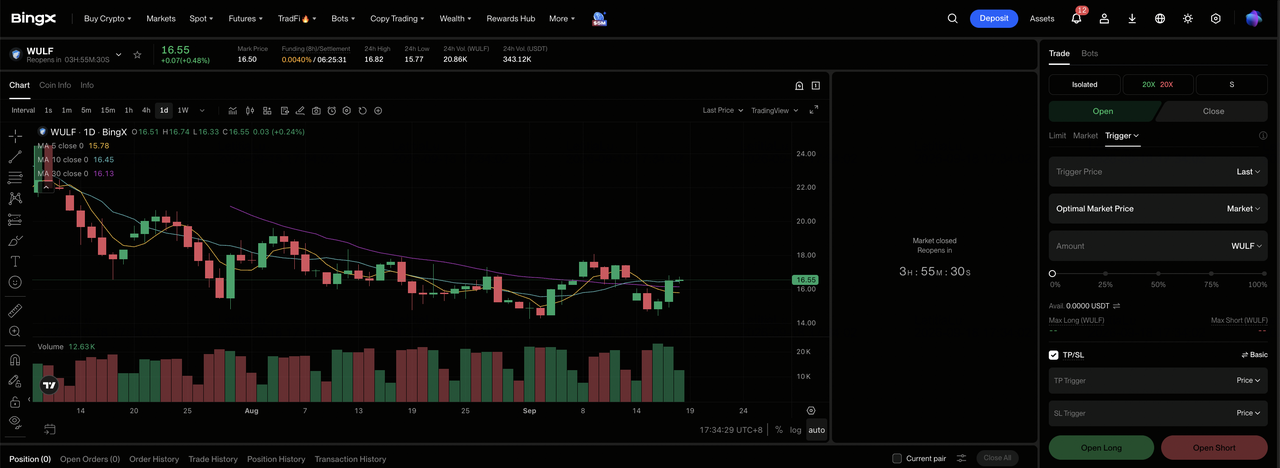
Step 1: Access BingX TradFi. Sign up and navigate to the specialized TradFi section on the BingX exchange dashboard.
Step 2: Select TeraWulf (WULF). Search for and select the WULF-USDT perpetual futures contract.
Step 3: Choose your direction. Select Open Long if HPC delivery accelerates and financing remains controlled. Select Open Short if construction delays, dilution or weaker mining economics pressure per-share value.
Step 4: Select leverage and margin mode. Choose Isolated or Cross-Margin based on your risk tolerance. WULF's sensitivity to contracts and financing makes conservative leverage important.
Step 5: Execute strict risk protocols. Set Take-Profit and Stop-Loss (TP/SL) levels before or immediately after entering the trade. Monitor capacity delivery, project costs, financing and bitcoin prices.
Top 5 Risks to Watch for TeraWulf Investors in 2026
TeraWulf has large contracted AI demand, but its buildout remains capital intensive. These risks can delay revenue, increase financing needs and reduce per-share value.
- Construction delays could postpone rent: TeraWulf has 336 MW under construction. Delays could extend cash burn, push lease revenue into later periods and postpone financing support tied to completed facilities.
- Higher financing costs could weaken project returns: Multi-billion-dollar campuses require debt, project financing or equity. More interest expense or restrictive financing terms would leave less cash for future expansion and shareholders.
- Large customers increase concentration risk: Anthropic, Fluidstack and Google support major parts of TeraWulf's AI infrastructure strategy. A delayed deployment or contract change from one large customer could affect utilization, revenue timing and financing terms.
- Equity financing could dilute shareholders: New shares can fund capacity but reduce each existing share's claim on future cash flow. Issuance at a lower stock price would increase the dilution required to fund the same construction budget.
- Power and permitting delays could slow capacity growth: Controlled megawatts cannot generate rent until interconnection, utilities and facilities are ready. Regulatory or power delays could therefore push contracted revenue and cash generation further out.
Final Thoughts: Should You Invest in TeraWulf in 2026?
TeraWulf has stronger evidence of an AI infrastructure transition than it did a year ago. HPC leasing already contributes 71% of quarterly revenue, 102 MW is earning rent and the $19 billion Anthropic lease creates long-duration demand. The missing proof is cash-generating delivery at scale. Investors should monitor megawatts entering service, cost per MW, financing terms and share count rather than valuing contract headlines alone.
A conservative decision framework would require CB-4 delivery to begin within the stated schedule, development costs to remain near $8 million to $10 million per critical IT MW and financing to avoid excessive dilution. Progress against those tests would strengthen the base and bull cases. Slippage, higher funding costs or a rising share count would favor the bear case even if contracted demand remains intact.
Risk Reminder: Stock-linked perpetual futures involve leverage and can amplify losses. Analyst targets and article scenarios are conditional reference points, not guarantees.
Related Reading
- Top High-Performance Computing (HPC) Stocks to Watch in 2026: Accelerated Computing Market Leaders
- Top AI Data Center Stocks to Buy in 2026: Cloud, Servers, and AI Compute Infrastructure
- Top Bitcoin Mining Stocks to Buy in 2026: BTC Hashrate Meets the AI Infrastructure Pivot
- MARA Holdings (MARA) Price Prediction 2026: Can Bitcoin Scale and AI Infrastructure Push MARA Toward $24?
- CleanSpark (CLSK) Price Prediction 2026: $27.00 AI Hyperscaler or 32% Short-Squeezed Mining Trap?
- IREN Limited (IREN) Price Prediction 2026: Can the AI Cloud Expansion Drive IREN Higher?
