



Super Micro Computer (SMCI), commonly known as Supermicro, designs complete server, storage and rack-scale systems for artificial intelligence, cloud, enterprise and edge workloads. Its modular Building Block Solutions combine processors, accelerators, memory, networking, power and cooling in configurations built around customer requirements. AI infrastructure remains the main growth engine, though project timing, component supply and working-capital requirements can make revenue and cash generation volatile.
The latest quarter showed both the scale of demand and the variability of the model. SMCI Q4 FY2026 net sales reached $11.1 billion, up 93% year over year yet about $450 million below the cited consensus. Non-GAAP EPS reached $1.70, GAAP gross margin rebounded to 17.5% and management entered FY2027 with more than $60 billion of new orders. The investment case depends on turning that pipeline into profitable shipments without another cash-flow reversal.
The SMCI stock forecast for 2026 now centers on two competing views:
- The AI rack-scale expansion case: A record order pipeline, direct liquid cooling and manufacturing capacity above 6,000 racks per month could support the $65 billion–$72 billion FY2027 revenue outlook and drive SMCI toward $60.
- The margin and cash-conversion case: Large project timing, customer concentration, lower-margin AI systems and rising inventory could keep free cash flow below earnings and pull the stock toward $24.
This guide breaks down the SMCI stock forecast, 2026 price scenarios, key risks and analyst outlooks, drawing on Supermicro's August 11 Q4 FY2026 earnings release, annual filing and market data through September 15, plus how to trade SMCI stock futures on BingX TradFi with USDT collateral.
Top 5 Things for Supermicro Investors to Know in September 2026
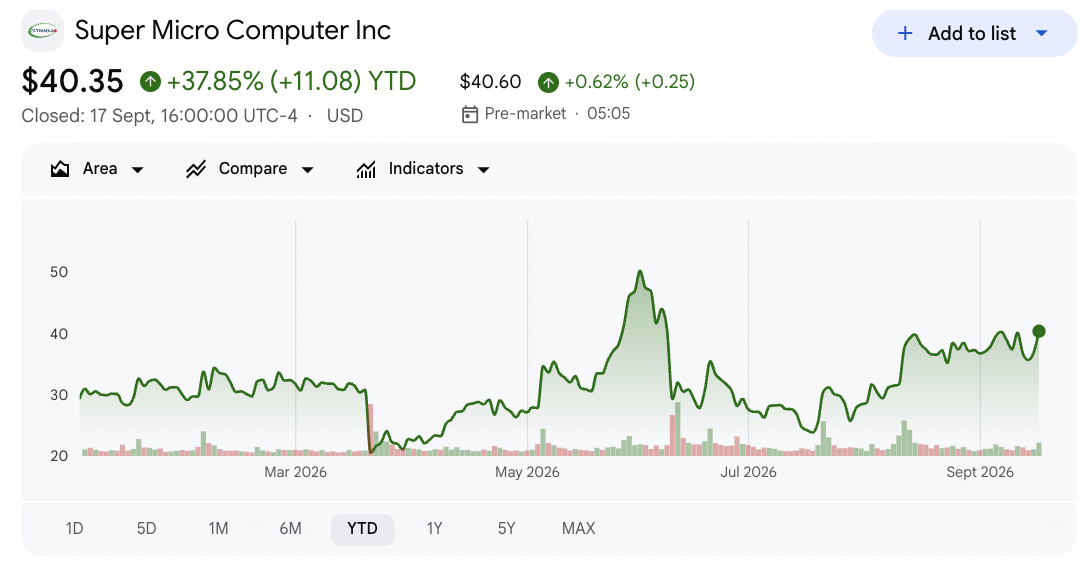
- SMCI closed at $40.35 on September 17 and remained up 37.85% YTD: Shares still traded about 39% below the $58.78 52-week high, showing that AI growth remains attractive but execution, compliance and margin concerns still weigh on valuation.
- Q4 revenue reached $11.1 billion, up 93% year over year: Sales rose from $5.8 billion a year earlier and $10.2 billion in Q3, but still missed the roughly $11.55 billion consensus. Customer-site readiness can continue shifting large amounts of revenue between quarters.
- GAAP gross margin rebounded to 17.5% from 9.9% in Q3: Better customer and product mix lifted profitability and helped non-GAAP EPS reach $1.70 versus $0.94 expected. Management expects Q1 FY2027 margin to normalize to 10.4% to 10.8%, making durability the key test.
- More than $60 billion of new orders created record backlog: Supermicro added several hundred enterprise and other customers and ended FY2026 with nine customers generating more than $1 billion each. The broader mix reduces dependence on one account, though order timing still drives quarterly revenue.
- FY2027 revenue guidance reached $65 billion to $72 billion: The $68.5 billion midpoint stands about $16 billion above the cited $52.5 billion Street estimate. Delivering it requires Q1 revenue of $14.5 billion to $15.5 billion and enough components, power and customer capacity to convert backlog on schedule.
What Is Super Micro Computer (SMCI)?
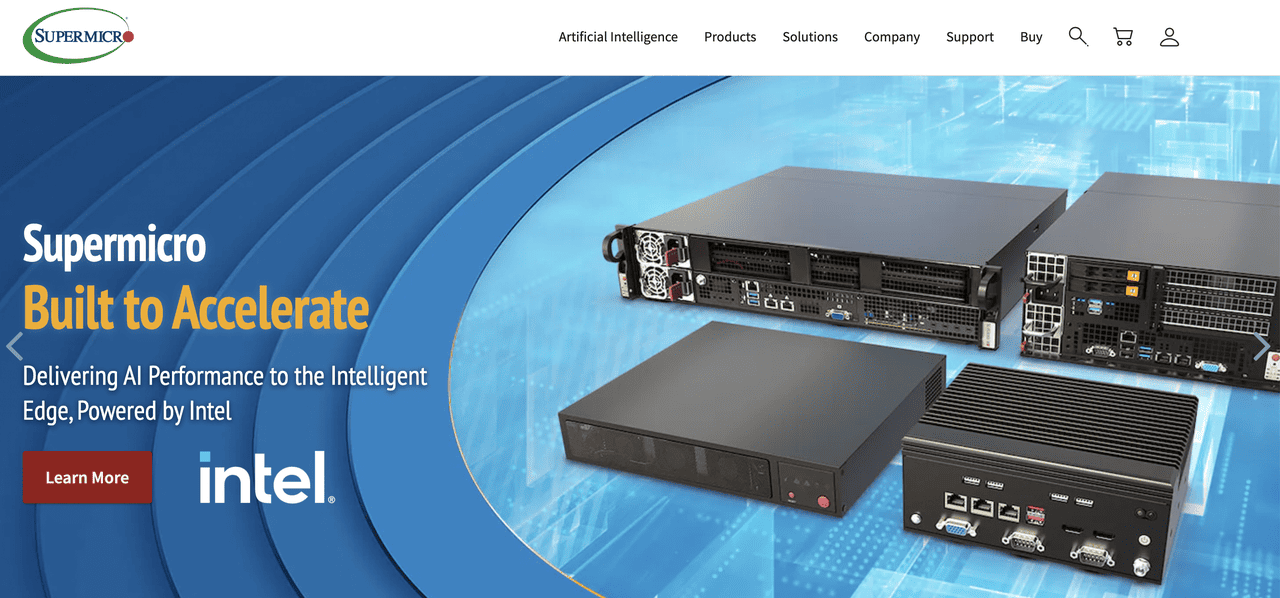
Super Micro Computer is an infrastructure manufacturer that engineers and assembles servers, storage platforms, networking systems and complete data-center racks. Its Building Block Solutions model uses common components and modular designs to configure products around different CPU, GPU, memory, storage and networking combinations. Customers include cloud operators, enterprises, governments, telecom providers and technology companies. Revenue depends on hardware shipments, though engineering speed, thermal design and the ability to deliver integrated racks create differentiation.
Supermicro's long-term strategy centers on Data Center Building Block Solutions and direct liquid cooling for high-density AI clusters. The company supports platforms from NVIDIA, AMD and Intel and is expanding manufacturing in the United States, Taiwan and Malaysia beyond 6,000 racks per month, including capacity for more than 3,000 liquid-cooled racks. Enterprise and channel revenue reached $5.6 billion in Q4, up 172% year over year, broadening the business beyond a few hyperscale deployments.
Read More: Top AI Server Stocks to Buy in 2026: Rack-Scale Systems, GPU Servers, and AI Servers Infrastructure
Super Micro Computer (SMCI) Q4 FY2026 Earnings Overview: Revenue, EPS and AI Infrastructure Growth
Supermicro reported $11.1 billion of revenue against roughly $11.55 billion expected, yet non-GAAP EPS of $1.70 exceeded the $0.94 estimate as GAAP gross margin rebounded to 17.5%. Full-year revenue rose 78% to $39.1 billion, Q4 operating cash flow returned to a positive $747 million and more than $60 billion of new orders supported a $65 billion–$72 billion FY2027 outlook. The main tension is whether the exceptional Q4 mix can translate into durable margins and cash flow as shipment volume accelerates.
|
Financial Metric |
Guidance / Consensus |
Reported / Actual |
Surprise |
|
Q4 FY2026 net sales |
$11.55B Visible Alpha consensus |
$11.1B |
Missed. About $450M below consensus, though up 93% YoY. |
|
Q4 non-GAAP diluted EPS |
$0.94 consensus; $0.65–$0.79 guidance |
$1.70 |
Beat. $0.76 above consensus and more than doubled YoY. |
|
Q4 GAAP diluted EPS |
$0.53–$0.67 guidance |
$1.62 |
Beat. $0.95 above the guidance ceiling. |
|
Q4 GAAP gross margin |
9.9% in Q3 FY2026 |
17.50% |
Expanded. Increased 760 bps sequentially. |
|
Q4 operating cash flow |
$6.6B used in Q3 FY2026 |
$747M provided |
Improved. Returned to positive quarterly cash generation. |
|
FY2026 net sales |
$22.0B in FY2025 |
$39.1B |
Grew. Increased 78% YoY. |
|
FY2026 GAAP net income |
$1.0B in FY2025 |
$2.2B |
Grew. More than doubled YoY. |
|
Q1 FY2027 revenue outlook |
$11.8B FactSet consensus |
$14.5B–$15.5B |
Above. $15.0B midpoint exceeded consensus by $3.2B. |
|
FY2027 revenue outlook |
$52.5B Wall Street estimate |
$65B–$72B |
Above. $68.5B midpoint exceeded the estimate by $16B. |
- Revenue of $11.1 billion grew 93% yet missed consensus by about $450 million: Customer infrastructure readiness deferred several contracts into Q1 FY2027 or later. That timing explains why backlog can expand rapidly without every order becoming same-quarter revenue or cash collection.
- Non-GAAP EPS of $1.70 beat consensus by $0.76: The figure also exceeded the $0.79 guidance ceiling and rose from $0.41 a year earlier. A favorable mix drove the upside, so Q1's expected 10.4%–10.8% margin will test how repeatable the earnings gain is.
- GAAP gross margin reached 17.5%, up from 9.9% sequentially: The 760-basis-point recovery lifted non-GAAP operating margin to 14.3% from 7.2%. Margin expansion can create substantial earnings leverage, though a reversal would transmit quickly through reported EPS and valuation.
- Operating cash flow improved to positive $747 million from a $6.6 billion use: Quarterly free cash flow reached roughly $722 million. Full-year operating cash flow remained negative by $6.8 billion as inventory ended at $12.9 billion, keeping cash conversion central to the thesis.
- FY2027 revenue guidance of $65 billion–$72 billion implies up to 84% growth: The outlook rests on record backlog, AI demand and manufacturing scale. Conversion must occur without another working-capital surge or margin collapse for revenue growth to increase per-share value.
Read More: Dell Technologies (DELL) Price Prediction 2026: $700 AI Upside vs. $380 Execution Risk
Super Micro Computer (SMCI) 2026 Investment Outlook: $60 Bull Case vs. $24 Bear Case
SMCI's outlook depends on whether more than $60 billion of new orders converts into revenue, margins and cash quickly enough to validate the FY2027 forecast. The following ranges are BingX Academy editorial scenarios rather than Wall Street targets or price promises.
The Bull Case: Strong AI Server Demand Pushes SMCI Toward $60
The Bull Case assumes Q1 revenue lands near the $15.5 billion guidance ceiling and the order pipeline supports growth through the rest of FY2027. Direct liquid cooling becomes a stronger differentiator as rack power density rises, while manufacturing capacity above 6,000 racks per month helps shorten deployment times.
A move toward $60 would require revenue near the upper half of the $65 billion to $72 billion range, gross margin stabilizing above 11% after Q1 and positive operating cash flow across multiple quarters. Slower inventory growth and broader customer diversification would strengthen the case.
The Base Case: Steady AI Demand Keeps SMCI Between $38 and $48
The Base Case assumes backlog converts broadly on schedule, though product and customer mix pull gross margin back from the 17.5% Q4 level. Revenue growth remains strong, while inventory financing, project timing and competition keep earnings and free cash flow from rising as quickly as sales.
Under this scenario, SMCI could trade mainly between $38 and $48. Q1 revenue within $14.5 billion to $15.5 billion, non-GAAP EPS within $1.01 to $1.10 and gross margin near 10.4% to 10.8% would support the range. Another major shipment delay or cash-flow reversal would cap the upper end.
The Bear Case: Lower Margins, Project Delays and Legal Scrutiny Pull SMCI Toward $24
The Bear Case assumes customer facilities, power availability or component timing delay order conversion while competition keeps pricing aggressive. Inventory and receivables rise before cash arrives, while ongoing legal and compliance scrutiny adds costs and could weaken customer or investor confidence.
A move toward $24 would become more likely if FY2027 revenue falls below $65 billion, gross margin drops below 9%, operating cash flow turns materially negative again or legal and compliance issues escalate. Lower earnings estimates and weaker confidence in both execution and governance would pressure the valuation.
SMCI Stock Price Forecasts for 2026 By Wall Street Analysts
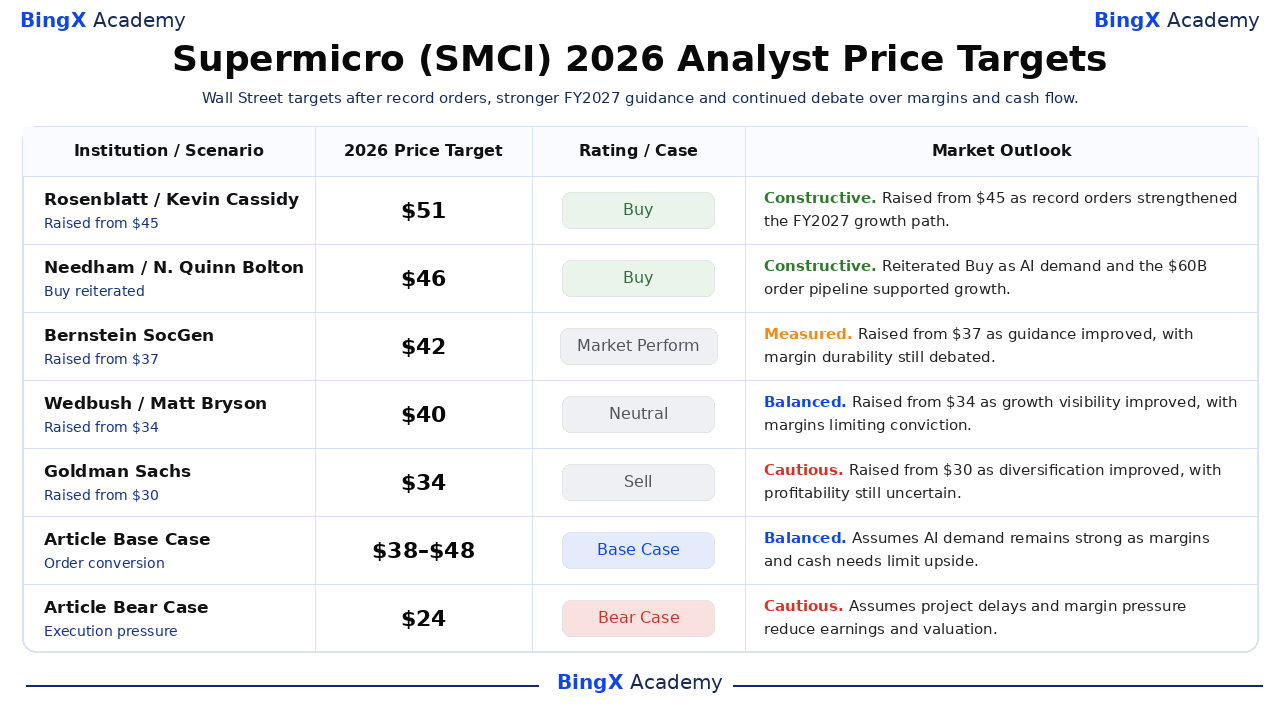
Analysts remain divided between record AI demand and the margin, working-capital and execution burden required to serve it. The five dated actions below span Buy through Sell and show different assumptions for order conversion. These targets are third-party reference points rather than price promises. The Base and Bear rows are BingX Academy editorial scenarios.
|
Institution / Scenario |
2026 Price Target |
Rating / Case |
Market Outlook |
|
Rosenblatt / Kevin Cassidy |
$51 |
Buy |
Constructive. August 12: raised from $45 as record orders strengthened the FY2027 growth path. |
|
Needham / N. Quinn Bolton |
$46 |
Buy |
Constructive. August 12: reiterated as AI demand and the $60 billion pipeline supported growth. |
|
Bernstein SocGen / Mark Newman |
$42 |
Market Perform |
Measured. August 13: raised from $37 as guidance improved, with margin durability still debated. |
|
Wedbush / Matt Bryson |
$40 |
Neutral |
Balanced. August 12: raised from $34 as growth visibility improved, with margins limiting conviction. |
|
Goldman Sachs / Katherine Murphy |
$34 |
Sell |
Cautious. August 12: raised from $30 as diversification improved, with profitability still uncertain. |
|
Article Base Case |
$38–$48 |
Base Case |
Balanced. Assumes AI demand remains strong as margins and cash needs limit upside. |
|
Article Bear Case |
$24 |
Bear Case |
Cautious. Assumes project delays and margin pressure reduce earnings and valuation. |
How to Trade Super Micro Computer (SMCI) Stock on BingX
Trade Supermicro's AI-rack, liquid-cooling and margin outlook using BingX TradFi and BingX AI tools. Because SMCI can react sharply to project timing, earnings and compliance news, traders should define both the catalyst and risk limits before entering a position.
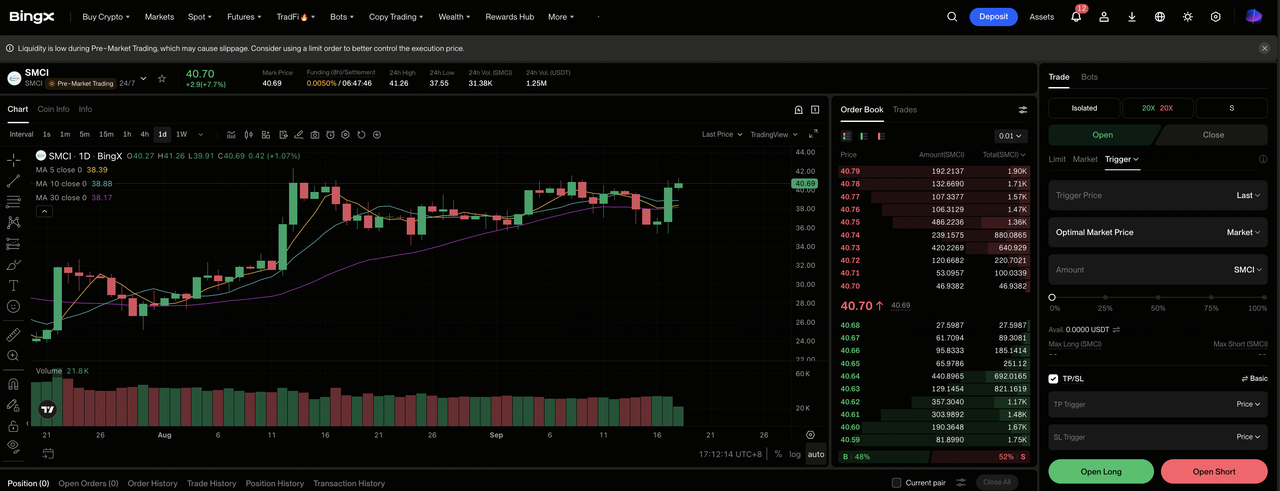
Step 1: Access BingX TradFi. Sign up and navigate to the specialized TradFi section on the BingX exchange dashboard.
Step 2: Select Super Micro Computer (SMCI). Search for and select the SMCI-USDT perpetual futures contract.
Step 3: Choose your direction. Select Open Long if order conversion and margins support the Bull Case. Select Open Short if delays or cash requirements weaken expected per-share economics.
Step 4: Select leverage and margin mode. Choose Isolated or Cross-Margin based on your risk tolerance. SMCI's 39% gap from its 52-week high shows why conservative leverage and clear position sizing are important.
Step 5: Execute strict risk protocols. Set Take-Profit and Stop-Loss (TP/SL) levels before or immediately after entering the trade. SMCI can react quickly to guidance, shipments, margins and regulatory developments.
Top 5 Risks to Watch for Supermicro Investors in 2026
Supermicro's growth model depends on component purchases, inventory, customer readiness and final payment. These risks can affect margins, cash flow and per-share value.
- Gross-margin swings can outweigh revenue growth: GAAP gross margin moved from 9.9% in Q3 to 17.5% in Q4, while Q1 guidance points to 10.4% to 10.8%. Even a one-point margin change on multi-billion-dollar revenue can materially affect EPS.
- Working capital can absorb cash quickly: FY2026 operating cash flow was negative $6.8 billion and inventory ended at $12.9 billion. If inventory keeps growing faster than shipments, financing needs could rise despite strong reported revenue.
- Large customers can create timing risk: Nine customers generated more than $1 billion each in FY2026. A delayed facility or specification change from one major buyer could shift revenue between quarters and reduce factory utilization.
- Export rules can restrict products and customers: Advanced AI servers use controlled components subject to changing rules across jurisdictions. Tighter restrictions or compliance issues could delay shipments and remove demand from some markets.
- Competition can keep AI-system margins low: Dell, HPE, cloud operators and ODMs compete for many of the same accelerator-based deployments. Aggressive pricing could turn backlog into revenue without producing enough cash flow to support a higher valuation.
Final Thoughts: Should You Invest in Super Micro Computer in 2026?
Supermicro enters late 2026 with exceptional demand evidence. Q4 revenue grew 93%, new orders exceeded $60 billion and FY2027 guidance reached $65 billion–$72 billion. The same results also show why the stock remains contested. Revenue missed consensus, Q1 margin is expected to normalize and full-year operating cash flow remained deeply negative.
The Bull Case supports $60 if order conversion, liquid cooling and broader enterprise demand produce both earnings and cash. The Bear Case points to $24 if project delays, export controls or margin pressure weaken estimates. Conservative traders may wait for Q1 revenue, gross margin, inventory and operating cash flow before increasing exposure.
Risk Reminder: Trading and investing in equities like SMCI involves a high risk of capital loss. Earnings misses, guidance changes, competition, regulatory action, valuation shifts and leveraged trading can produce rapid losses. Conduct independent research before allocating capital.
Related Reading
- Top AI Data Center Stocks to Buy in 2026: Cloud, Servers, and AI Compute Infrastructure
- Top AI Server Stocks to Buy in 2026: Rack-Scale Systems, GPU Servers, and AI Servers Infrastructure
- NVIDIA (NVDA) Price Prediction 2026: Can AI Infrastructure Growth Drive NVDA Toward $420?
- AMD Price Prediction 2026: Can AI Growth Push AMD Toward $700?
- Intel (INTC) Price Prediction 2026: Can AI CPU Demand Push INTC Toward $145?
