



Space Exploration Technologies Corp., commonly known as SpaceX (SPCX), operates reusable launch systems, the Starlink satellite network, secure Starshield services and an expanding AI infrastructure business. Connectivity is currently the largest revenue and profit engine, while Starship and AI investments are intended to create future capacity. That breadth gives SpaceX several growth paths, but leaves the stock sensitive to engineering schedules, capital intensity and an exceptionally large valuation.
The latest quarter showed rapid growth with a large cash-demand tradeoff. SpaceX Q2 2026 revenue reached $7.814 billion, up 92% and roughly $914 million above consensus, while adjusted EBITDA increased 191% to $3.538 billion. Starlink subscribers doubled to 12 million and AI revenue rose 247% to $2.561 billion, yet quarterly capital expenditure surged to $18.369 billion as SpaceX expanded compute and satellite infrastructure.
The SPCX stock forecast for 2026 now centers on two competing views:
- The connectivity, reusability and AI-scale case: Starlink's 12 million subscribers, Starship flight progress and $14.1 billion of contracted cloud sales create operating leverage across communications, launch and compute.
- The capital-intensity and valuation case: $18.369 billion of quarterly capex, a $1.257 billion AI operating loss and uncertain Starship schedules keep cash conversion below the level required to support a multitrillion-dollar valuation.
This guide breaks down the SPCX stock forecast, 2026 price scenarios, key risks and analyst outlooks, drawing on SpaceX's August 4, 2026 Q2 earnings release, quarterly filing and market data through September 24, plus how to trade SPCX stock futures on BingX TradFi with USDT collateral.
Top 5 Things for SpaceX Investors to Know in September 2026
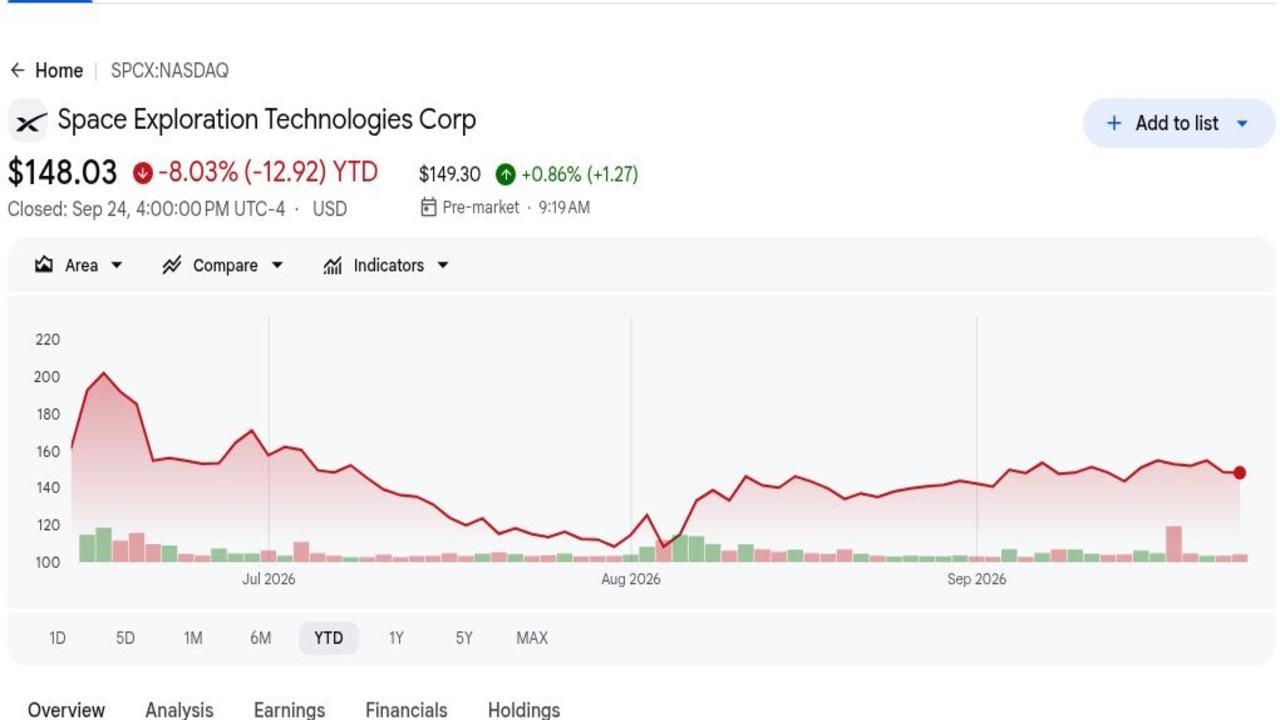
- $148.03 left SPCX down 8.03% since its June listing: The September 24 reference close remained above the $135 IPO price but 34.4% below the $225.64 post-listing high. The decline shows how quickly valuation concerns offset initial scarcity and index demand.
- $7.814 billion of Q2 revenue beat consensus by roughly $914 million: Revenue rose 92% from $4.071 billion, led by Connectivity and AI. The beat established that SpaceX's operating scale is expanding faster than the pre-earnings market expected across several businesses.
- 12 million Starlink subscribers doubled year over year: Connectivity revenue increased 66% to $4.291 billion and operating income rose 79% to $1.656 billion. This segment is the clearest source of current profit funding the broader launch and AI portfolio.
- $18.369 billion of quarterly capex increased more than sixfold: AI accounted for $15.828 billion, compared with $749 million a year earlier. The spending supports compute growth, but also explains why revenue and adjusted EBITDA do not yet translate cleanly into free cash flow.
- $47.5 billion of backlog accompanied $100 billion of liquidity: The balance sheet gives SpaceX capacity to invest in Starship, Starlink and AI. Investors still need backlog conversion and capital discipline because cash resources alone do not guarantee attractive per-share returns.
What Is SpaceX (SPCX)?
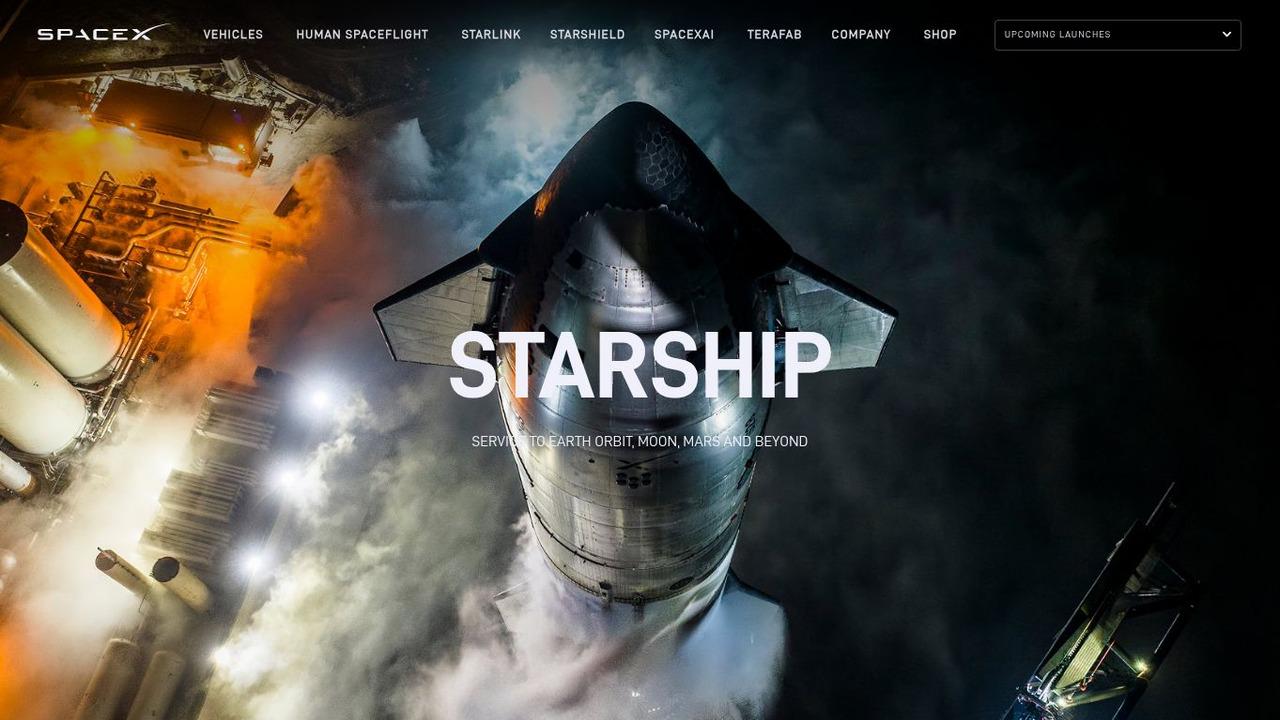
SpaceX is a vertically integrated aerospace, satellite-communications and AI infrastructure company founded in 2002. Its Space segment designs and launches Falcon rockets, Dragon spacecraft and the developing Starship system. Connectivity operates Starlink broadband and direct-to-device services, while Starshield serves national-security customers. The AI segment includes compute infrastructure, Grok and related subscription and cloud services. Manufacturing, satellites, launch sites, software and network operations are managed within one platform.
The long-term strategy uses launch economics to deploy SpaceX's own communications and compute infrastructure at scale. Starlink serves consumers, enterprises, airlines and governments, with American Airlines, Southwest, Virgin Atlantic, Iberia and Aer Lingus among highlighted aviation relationships. Mobile partnerships include SoftBank, NTT Docomo and Spark NZ, while Starshield held more than $6 billion of multi-year U.S. government awards. Starship remains central because full reusability could lower deployment costs for next-generation satellites and orbital infrastructure.
Read More: How the SpaceX IPO on June 12 Is Launching Elon Musk Past the Trillion-Dollar Net Worth Mark
SpaceX (SPCX) Q2 2026 Earnings Overview: 92% Revenue Growth and Starlink Scale Support AI Expansion
SpaceX reported Q2 revenue of $7.814 billion versus roughly $6.9 billion expected, a loss of $0.09 per share versus a $0.26 loss consensus, and adjusted EBITDA of $3.538 billion, up 191%. Connectivity revenue reached $4.291 billion and AI revenue reached $2.561 billion, while Starlink subscribers doubled to 12 million. The central tradeoff was $18.369 billion of capex, including $15.828 billion for AI infrastructure.
Read More: SpaceX (SPCX) Q2 2026 Earnings Overview: $18.37B AI Capex Triggers a 13.61% Price Selloff
|
Financial Metric |
Guidance / Consensus |
Reported / Actual |
Surprise |
|
Q2 revenue |
$6.9B consensus |
$7.814B |
Beat. Roughly $914M above consensus; up 92% YoY. |
|
Q2 loss per share |
-$0.26 consensus |
-$0.09 |
Beat. Loss was $0.17 narrower than expected. |
|
Q2 adjusted EBITDA |
$1.214B a year earlier |
$3.538B |
Expanded. Increased 191% YoY. |
|
Connectivity revenue |
$2.588B a year earlier |
$4.291B |
Expanded. Increased 66% YoY. |
|
AI revenue |
$737M a year earlier |
$2.561B |
Accelerated. Increased 247% YoY. |
|
Starlink subscribers |
6.0M a year earlier |
12.0M |
Doubled. Added 1.7M sequentially. |
|
Q2 capital expenditure |
$2.825B a year earlier |
$18.369B |
Surged. AI represented $15.828B. |
|
Cash and marketable securities |
— |
$100B |
Liquid. Supports a $47.5B backlog and investment plan. |
- $7.814 billion of revenue grew 92% and beat by roughly $914 million: Space, Connectivity and AI all expanded, with total revenue rising from $4.071 billion. The breadth of growth reduces dependence on launch alone and supports a multi-engine valuation framework.
- The $0.09 loss per share was $0.17 better than consensus: Net loss narrowed to $541 million from $1.008 billion. The improvement shows operating leverage across the portfolio, though absolute profitability remains insufficient relative to the company's capital program and ambitious infrastructure timetable.
- $4.291 billion of Connectivity revenue increased 66%: Segment operating income rose 79% to $1.656 billion and adjusted EBITDA reached $2.597 billion. Starlink is therefore producing current economics that can partially fund riskier projects, including Starship development and AI infrastructure.
- $2.561 billion of AI revenue increased 247%: AI adjusted EBITDA turned positive at $1.146 billion, even as operating loss remained $1.257 billion. The difference highlights heavy depreciation, stock compensation and infrastructure investment behind the growth and current operating loss.
- $18.369 billion of capex exceeded revenue by $10.555 billion: AI spending alone reached $15.828 billion. The $100 billion balance sheet can absorb near-term investment, but future valuation depends on those assets producing durable contracts, attractive margins and eventual cash flow.
SpaceX (SPCX) 2026 Investment Outlook: $300 Bull Case vs. $100 Bear Case
SpaceX's 2026 outlook depends on whether Connectivity profits and contracted AI demand can support Starship and compute investment without permanent cash-flow pressure. Wall Street targets remain unusually dispersed because small differences in long-term launch cost, satellite penetration and AI margins produce enormous valuation changes.
The Bull Case: Starlink and Starship Push SPCX Toward $300
The Bull Case assumes Connectivity continues growing above 50%, Starship demonstrates reliable reuse and contracted cloud demand converts into high-margin AI revenue. Q2 already delivered 12 million Starlink subscribers, $1.656 billion of Connectivity operating income and $14.1 billion of contracted cloud sales.
A move toward $300 requires launch and satellite deployment milestones to arrive on schedule, AI adjusted EBITDA to remain positive and capital spending to produce visible revenue. Revenue growth above 60% with declining capex intensity would provide the strongest confirmation.
The Base Case: Connectivity Growth Keeps SPCX Between $150 and $190
The Base Case assumes Starlink subscriber and enterprise growth remains strong while Starship and AI spending prevent clean free-cash-flow conversion. The $100 billion liquidity position limits financing pressure, though investors apply a lower multiple than during the immediate post-IPO rally.
SPCX could trade mainly between $150 and $190 if Connectivity operating income continues expanding and backlog remains near $47.5 billion. Another quarter of capex above twice revenue or slowing subscriber additions would weaken the range.
The Bear Case: Capex and Delays Pull SPCX Toward $100
The Bear Case assumes Starship development slips, AI contracts convert more slowly and $18.369 billion of quarterly capex remains elevated. Connectivity stays profitable and continues adding subscribers, but cannot fund every launch, satellite and compute platform without sustained cash consumption.
A move toward $100 becomes more likely if AI operating losses remain above $1 billion, Starlink growth falls below 30% or Starship misses major reuse milestones. Under that combination, lower estimates and multiple compression would reinforce each other.
SPCX Stock Price Forecasts for 2026 By Wall Street Analysts
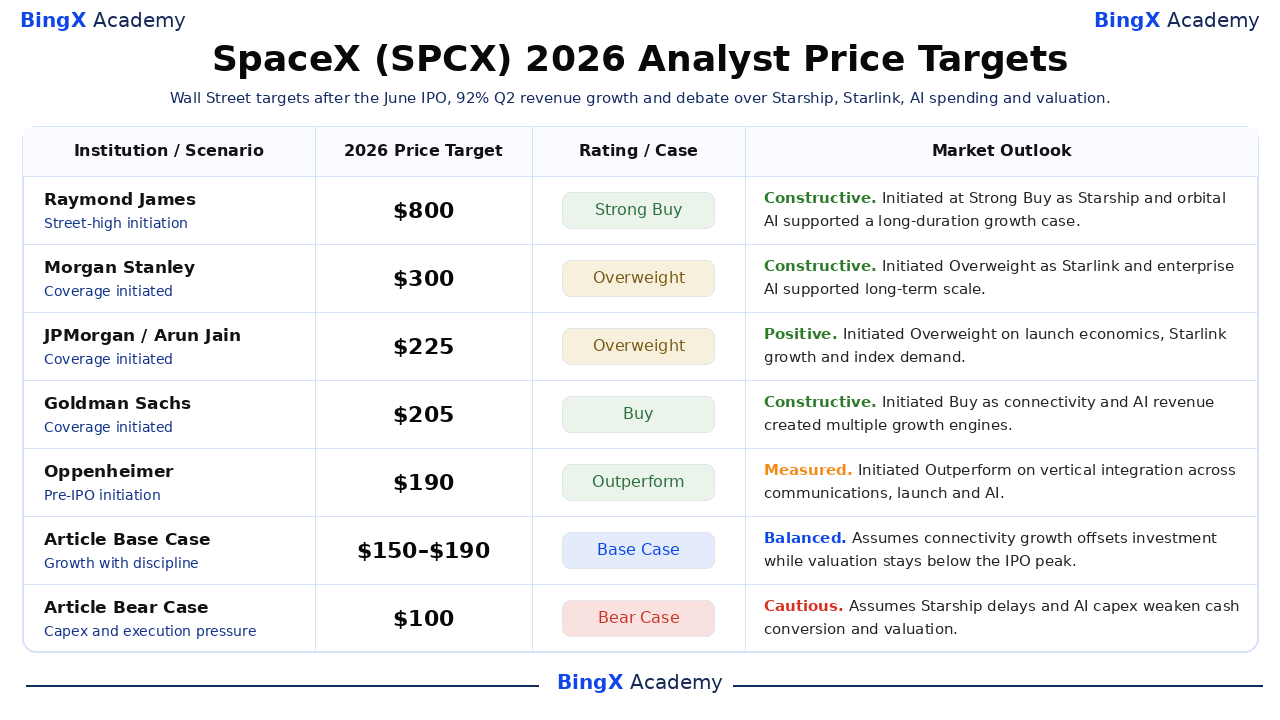
The five dated actions below show targets from $190 to $800, reflecting radically different assumptions about Starship, Starlink, AI infrastructure and long-term margins. They are third-party reference points rather than a single consensus forecast, and the final two rows are BingX Academy editorial scenarios.
|
Institution / Scenario |
2026 Price Target |
Rating / Case |
Market Outlook |
|
Raymond James |
$800 |
Strong Buy |
Constructive. July 7: initiated with a Street-high target based on Starship, Starlink and orbital AI. |
|
Morgan Stanley / Adam Jonas |
$300 |
Overweight |
Constructive. July 7: initiated as launch dominance, Starlink and enterprise AI supported scale. |
|
JPMorgan / Arun Jain |
$225 |
Overweight |
Positive. July 7: initiated on reusable launch economics, Starlink growth and index demand. |
|
Goldman Sachs / Eric Sheridan |
$205 |
Buy |
Constructive. July 7: initiated as Connectivity and AI created multiple growth engines. |
|
Oppenheimer / Timothy Horan |
$190 |
Outperform |
Measured. June 11: initiated before the IPO on vertical integration across communications, launch and AI. |
|
Article Base Case |
150–190 |
Base Case |
Balanced. Assumes Connectivity growth offsets investment while valuation stays below the IPO peak. |
|
Article Bear Case |
$100 |
Bear Case |
Cautious. Assumes Starship delays and AI capex weaken cash conversion and valuation. |
How to Trade SpaceX (SPCX) Stock on BingX
Trade SpaceX's Starlink growth, Starship milestones and AI-spending outlook using BingX TradFi and BingX AI tools. Because SPCX can react sharply to launches, contracts, capex and lockup supply, traders should define both the catalyst and risk limits before entering a position.
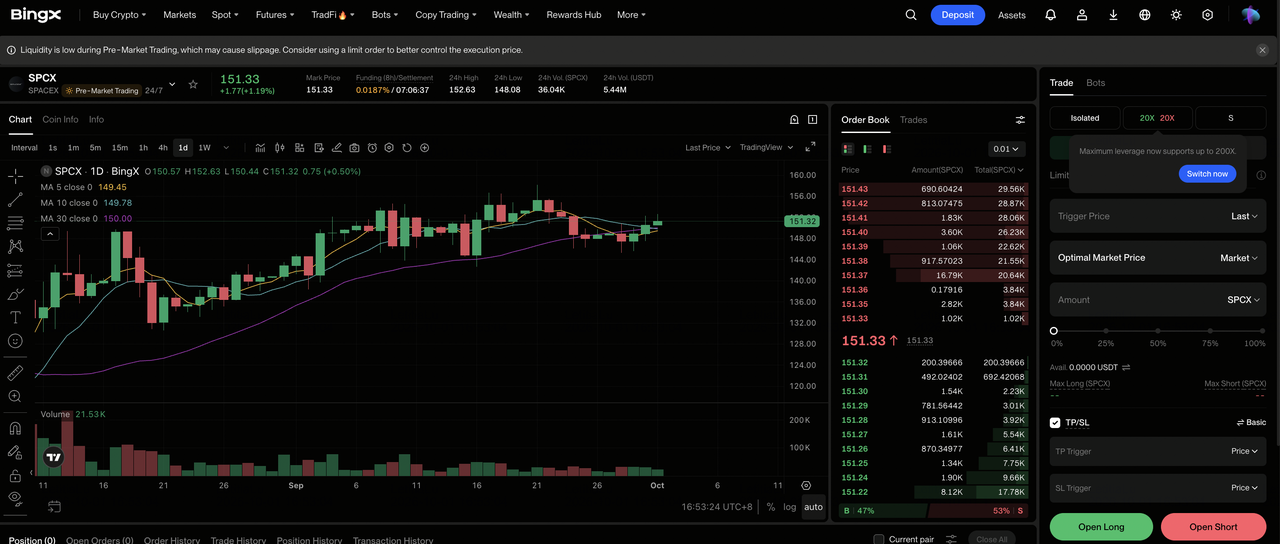
Step 1: Access BingX TradFi. Sign up and navigate to the specialized TradFi section on the BingX exchange dashboard.
Step 2: Select SpaceX (SPCX). Search for and select the SPCX-USDT perpetual futures contract.
Step 3: Choose your direction. Select Open Long if Starlink growth and Starship execution improve. Select Open Short if capex, delays or valuation pressure intensify.
Step 4: Select leverage and margin mode. Choose Isolated or Cross-Margin based on your risk tolerance. The move from $225.64 to $148.03 shows why conservative leverage and clear position sizing matter.
Step 5: Execute strict risk protocols. Set Take-Profit and Stop-Loss (TP/SL) levels before or immediately after entering the trade. SPCX can react quickly to flight tests, subscriber growth, government awards, AI contracts and share unlocks.
Top 5 Risks to Watch for SpaceX Investors in 2026
SpaceX's valuation assumes several capital-intensive businesses scale successfully at the same time. Delays in launch, AI infrastructure, or funding could materially reduce future cash flow and valuation.
- Starship delays can affect several businesses: Reusability supports launch costs, Starlink deployment, and future orbital infrastructure. Further delays could raise costs and push revenue milestones into later years.
- Capital spending remains extremely high: Q2 capex of $18.369 billion exceeded revenue by $10.555 billion. Continued spending at that level could pressure liquidity and free cash flow even if adjusted EBITDA stays positive.
- AI profitability remains unproven: AI revenue reached $2.561 billion, but the segment recorded a $1.257 billion operating loss. Higher utilization and margins will be needed to justify continued infrastructure spending.
- Lockup releases can increase share supply: More restricted shares becoming eligible for sale could pressure the stock independently of operating performance, especially if investor demand weakens.
- High valuation magnifies execution risk: Founder voting control limits minority influence, while analyst targets range from $190 to $800. Even modest reductions in long-term growth or margin expectations could materially reduce the valuation.
Final Thoughts: Should You Invest in SpaceX in 2026?
SpaceX's first public-company quarter delivered unusually strong evidence: revenue rose 92%, Starlink subscribers doubled, Connectivity operating income reached $1.656 billion and adjusted EBITDA increased 191%. The company also ended Q2 with $100 billion of liquidity and $47.5 billion of backlog, giving it substantial capacity to fund launches, satellites and compute infrastructure.
The Bull Case requires Starship, Starlink and AI contracts to convert growth into cash flow, supporting a path toward $300. The Bear Case reflects $18.369 billion of quarterly capex, engineering delays and valuation compression that could pull SPCX toward $100. Conservative traders may monitor subscriber additions, Connectivity profit, AI operating loss, capex intensity and Starship reuse milestones together.
Risk Reminder: Trading and investing in equities like SPCX involves a risk of capital loss. Engineering setbacks, capital spending, governance, valuation changes and leveraged trading can produce rapid losses. Conduct independent research before allocating capital.
Related Reading
- How the SpaceX IPO on June 12 Is Launching Elon Musk Past the Trillion-Dollar Net Worth Mark
- Top Space Stocks to Buy Ahead of SpaceX IPO
- Top Defense Stocks to Buy in 2026: Primes, Missiles, Drones, Space, and AI-Enabled Warfare
- Planet Labs (PL) Price Prediction 2026: Can Defense Demand Push PL Toward $35?
- Rocket Lab (RKLB) Price Prediction 2026: Can New Rocket and Defense Growth Push RKLB Toward $150?
