
Snap Inc. (SNAP) operates Snapchat, a camera-first communications platform supported by messaging, Stories, Spotlight, Snap Map and augmented-reality tools. Advertising remains the largest revenue source, while subscriptions, paid storage and premium creative products are becoming more important. This transition broadens the business, though SNAP remains sensitive to advertiser demand, high-value user trends and the cost of investing in artificial intelligence and Specs hardware.
The latest quarter showed stronger monetization and operating discipline, with important limits. SNAP Q2 2026 revenue reached $1.60 billion, up 19% year over year, as advertising revenue rose 9% to $1.28 billion and other revenue climbed 85% to $316 million. Daily active users increased 5% to 493 million, though slower growth and pressure in North America and Europe keep audience quality central to the investment case.
The SNAP stock forecast for 2026 now centers on two competing views:
- The monetization recovery case: stronger ad products, Snapchat+ and Memories Storage lift revenue per user as cost discipline improves cash generation.
- The user and investment case: weakness in high-value regions and rising AI or Specs spending prevent revenue growth from producing durable profitability.
This guide breaks down the SNAP stock forecast, 2026 price scenarios, key risks and analyst outlooks, drawing on Snap's August 3 Q2 2026 earnings release, quarterly filing and market data through September 9, plus how to trade SNAP stock futures on BingX TradFi with USDT collateral.
Top 5 Things for Snap Investors to Know in September 2026
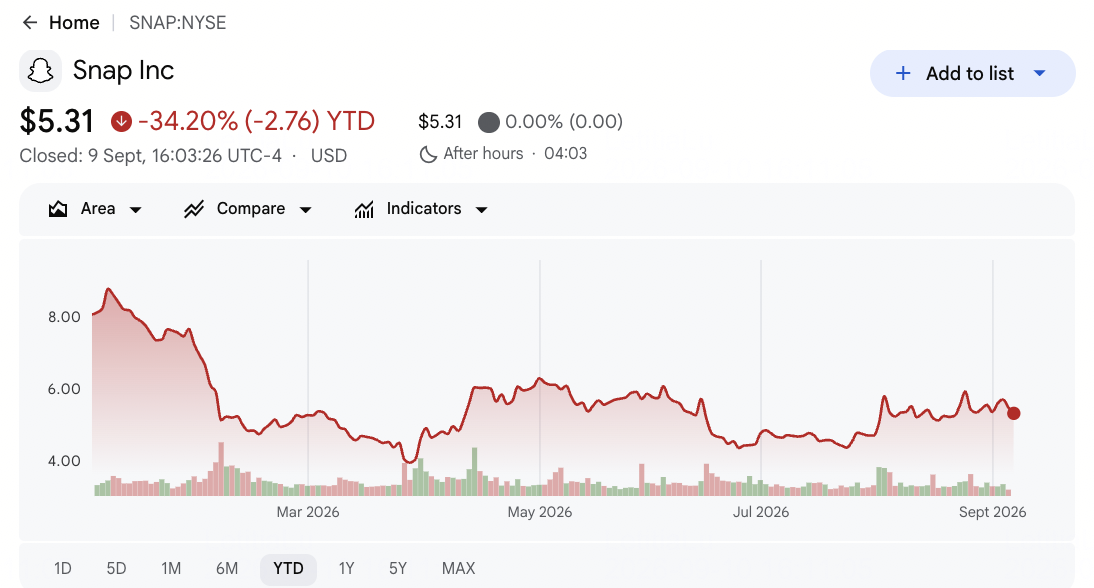
- SNAP closed at $5.31 after falling 34.20% YTD: The stock stood $3.97 below its $9.28 52-week high even after Q2 results beat expectations. The decline shows that investors still require sustained monetization and profitability progress rather than one favorable quarter.
- Q2 revenue rose 19% to $1.60 billion: Sales finished about $60 million above the $1.54 billion FactSet consensus, and the adjusted loss of $0.10 per share was $0.02 narrower than expected. Both metrics improved, giving the recovery thesis firmer evidence.
- Other revenue surged 85% to $316 million: Snapchat+, Lens+ and Memories Storage created a second revenue stream equal to nearly 20% of quarterly sales. With fewer than 3% of monthly users paying, subscription penetration still has considerable room to expand over time.
- Daily active users reached 493 million and monthly users reached 971 million: Both exceeded consensus by roughly 5.1 million and 10.4 million respectively. Global scale remains substantial, though lower user growth in valuable Western markets can weaken average revenue per user and advertiser reach.
- Full-year infrastructure costs increased to $1.65 billion to $1.70 billion: The range rose by $50 million at each end as Snap added AI and machine-learning capacity. Management is investing to improve engagement and ads, though the spending raises the earnings hurdle for those tools.
What Is Snap Inc. (SNAP)?
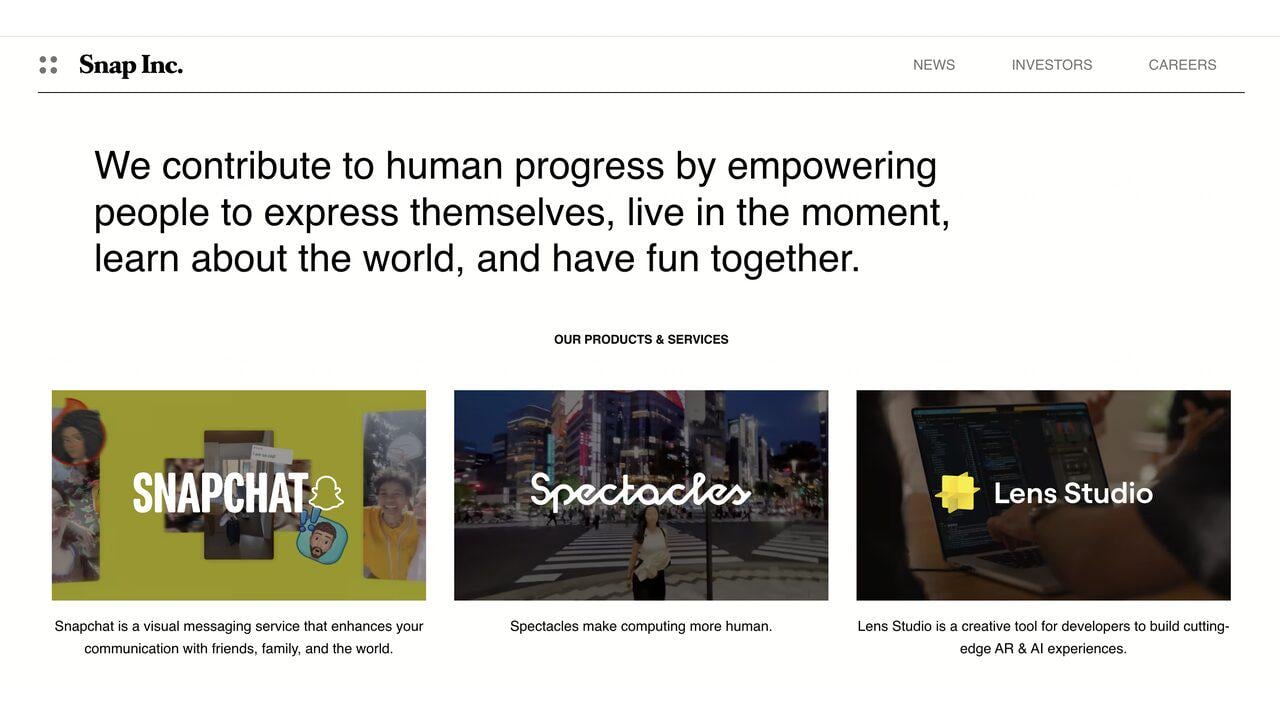
Snap Inc. is a technology company whose flagship Snapchat application combines visual messaging, public content, location sharing and augmented reality in one mobile service. Camera, Chat, Stories, Spotlight and Snap Map organize the user experience, while Bitmoji provides a portable avatar layer. Snap sells performance and brand advertising across these surfaces, including Sponsored Snaps and AR formats. It also earns direct revenue from Snapchat+, Lens+, paid Memories Storage and other premium features, and it develops Specs as a potential long-term computing platform.
Snap's long-term direction centers on improving recommendation and advertising systems with AI, expanding direct user payments and turning augmented reality into a broader developer platform. Snapchat+ gives the company a continuing channel for premium features, and Spotlight and Snap Map create additional discovery and commercial inventory. Qualcomm has supported Snap's wearables roadmap through Snapdragon platforms, while brands and agencies use Lens Studio and automated campaign products to build AR experiences and performance ads. Specs extends that strategy beyond smartphones, creating a possible hardware and spatial-computing business if developers and consumers adopt the platform over several years.
Snap Inc. (SNAP) Q2 2026 Earnings Overview: Revenue, Users and Subscription Growth
Snap delivered $1.60 billion of Q2 revenue versus $1.54 billion expected, an adjusted loss of $0.10 per share versus a $0.12 loss expected, and 493 million daily active users versus 487.9 million expected. Advertising revenue rose 9% to $1.28 billion, other revenue climbed 85% to $316 million, and the GAAP net loss narrowed to $164 million from $262.6 million. Q3 revenue guidance of $1.70 billion to $1.74 billion exceeded the $1.70 billion consensus at the midpoint, though the higher $1.65 billion to $1.70 billion infrastructure-cost outlook creates a clear profitability tradeoff.
Read More: Snap (SNAP) Q2 2026 Earnings Overview: $1.60B Revenue and Ad Momentum Drive a 14.88% Price Rally
|
Financial Metric |
Guidance / Consensus |
Reported / Actual |
Surprise |
|
Q2 2026 revenue |
$1.54B consensus |
$1.60B |
Beat. About $60M above consensus; up 19% YoY. |
|
Q2 adjusted loss per share |
$0.12 loss consensus |
$0.10 loss |
Beat. Loss was $0.02 narrower than expected. |
|
Q2 GAAP net loss |
— |
$164M loss |
Improved. Narrowed from $262.6M a year earlier. |
|
Advertising revenue |
$1.23B consensus |
$1.28B |
Beat. About $50M above consensus; up 9% YoY. |
|
Other revenue |
— |
$316M |
Accelerated. Up 85% YoY on subscriptions and storage. |
|
Daily active users |
487.9M consensus |
493M |
Beat. About 5.1M above consensus; up 5% YoY. |
|
Monthly active users |
960.6M consensus |
971M |
Beat. About 10.4M above consensus; up 4% YoY. |
|
Q3 2026 revenue outlook |
$1.70B consensus |
$1.70B–$1.74B |
Above. The $1.72B midpoint topped consensus by $20M. |
|
2026 infrastructure-cost outlook |
Prior $1.60B–$1.65B |
$1.65B–$1.70B |
Raised. AI and machine-learning investment increased the range. |
- Revenue of $1.60 billion grew 19%: The result exceeded consensus by about $60 million as North American advertising improved and World Cup spending helped demand. Sustaining that pace without event-related support would strengthen the case that ad-product changes are working.
- The adjusted loss of $0.10 per share beat by $0.02: Snap narrowed the GAAP net loss by about $99 million to $164 million while adjusted costs rose only 4%. Cost controls are beginning to convert revenue growth into better earnings, even though GAAP profitability remains unfinished.
- Other revenue of $316 million rose 85%: Direct revenue expanded much faster than the 9% advertising increase, lifting diversification through Snapchat+, Lens+ and Memories Storage. A higher paid-user rate would reduce Snap's exposure to volatile advertising budgets and improve revenue visibility.
- 493 million daily users grew 5% as monthly users reached 971 million: Both counts beat forecasts, though growth slowed from prior rates and pressure remained in North America and Europe. Monetization gains therefore need to offset the weaker mix of incremental users.
- Q3 revenue guidance reached a $1.72 billion midpoint: The midpoint stood $20 million above consensus, but the infrastructure-cost range also rose to as much as $1.70 billion for 2026. Better AI recommendations and ad conversion must produce measurable returns to preserve operating leverage.
Snap Inc. (SNAP) 2026 Investment Outlook: $10 Bull Case vs. $4 Bear Case
The central question is whether improving ads and direct revenue can outgrow regional audience pressure and the cost of building AI systems and Specs.
The Bull Case: Advertising and Direct Revenue Push SNAP Toward $10
The Bull Case assumes AI-based ad tools improve campaign performance and bring larger North American advertisers back to Snapchat. Advertising growth stays in the low double digits, direct revenue expands faster than the core business, and the 16% workforce reduction helps more revenue growth reach earnings and cash flow.
A move toward $10 would require quarterly revenue at or above the $1.72 billion Q3 midpoint, paid products to expand beyond the current sub-3% share of monthly users, and Specs to show credible developer or consumer demand. Stable high-value users and further estimate increases would strengthen the case.
The Base Case: Better Monetization Keeps SNAP Between $6 and $8
The Base Case assumes advertising improves gradually while Snapchat+, Lens+ and storage build a larger second revenue stream. Global users continue growing, but weakness in North America and Europe limits improvement in audience quality, while higher AI infrastructure costs offset part of the savings from restructuring.
SNAP could trade mainly between $6 and $8 if revenue stays near guidance, direct revenue continues growing and the GAAP loss narrows further. Failure to stabilize high-value regional users or rising infrastructure costs would limit the upper end.
The Bear Case: User Pressure and Higher Costs Pull SNAP Toward $4
The Bear Case assumes daily users keep declining in North America and Europe, making Snapchat less attractive to advertisers focused on higher-value audiences. Subscription growth slows before it becomes large enough to offset weaker advertising, while AI infrastructure and Specs keep fixed costs elevated.
A move toward $4 would become more likely if revenue falls below the $1.70 billion guidance floor, user growth misses expectations or the GAAP loss stops narrowing. Weak Specs adoption, tighter youth-safety rules or lower advertiser returns could add further pressure.
SNAP Stock Price Forecasts for 2026 By Wall Street Analysts
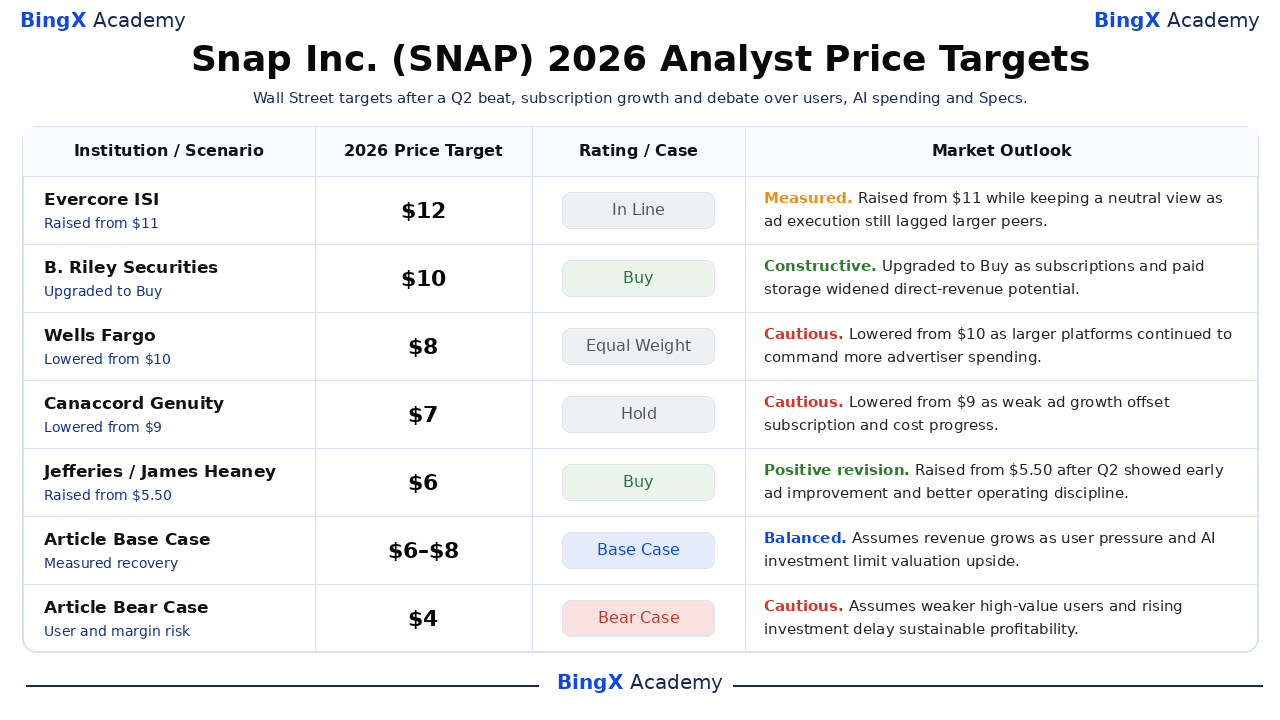
These five dated actions span $6 to $12 and show how sharply views differ on advertising execution, subscriptions, regional users and infrastructure costs. The distribution also shows why no single target should be treated as a forecast. The final Base and Bear rows are BingX Academy editorial scenarios rather than Wall Street forecasts or price guarantees.
|
Institution / Scenario |
2026 Price Target |
Rating / Case |
Market Outlook |
|
Evercore ISI |
$12 |
In Line |
Measured. August 6: raised from $11 despite soft advertising execution and retained a neutral view. |
|
B. Riley Securities |
$10 |
Buy |
Constructive. February 5: upgraded as subscriptions and paid Memories Storage widened direct-revenue potential. |
|
Wells Fargo |
$8 |
Equal Weight |
Cautious. February 5: lowered from $10 as larger platforms continued to command more advertiser spending. |
|
Canaccord Genuity |
$7 |
Hold |
Cautious. February 5: lowered from $9 as weak ad growth offset subscription and cost progress. |
|
Jefferies |
$6 |
Buy |
Positive revision. August 4: raised from $5.50 after Q2 showed early ad improvement and better operating discipline. |
|
Article Base Case |
$6–$8 |
Base Case |
Balanced. Assumes revenue grows as user pressure and AI investment limit valuation upside. |
|
Article Bear Case |
$4 |
Bear Case |
Cautious. Assumes weaker high-value users and rising investment delay sustainable profitability. |
How to Trade Snap Inc. (SNAP) Stock on BingX
Trade Snap's advertising, subscription and Specs outlook using BingX TradFi and BingX AI tools. Because SNAP can react sharply to earnings, product launches and regulation, traders should define both the catalyst and risk limits before entering a position.
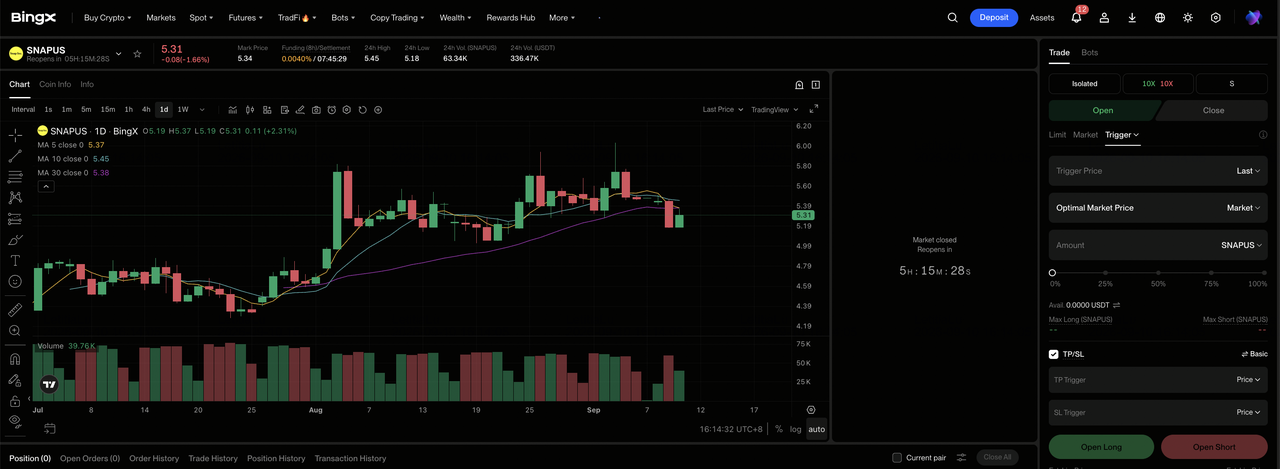
Step 1: Access BingX TradFi. Sign up and navigate to the specialized TradFi section on the BingX exchange dashboard.
Step 2: Select Snap Inc. (SNAP). Search for and select the SNAPUS-USDT perpetual futures contract.
Step 3: Choose your direction. Select Open Long if advertising, subscriptions and cost discipline support the Bull or Base Case. Select Open Short if regional users, higher investment or weak Specs demand validate the Bear Case.
Step 4: Select leverage and margin mode. Choose Isolated or Cross-Margin based on your risk tolerance. SNAP's 34.20% YTD decline shows why conservative leverage and clear position sizing are important.
Step 5: Execute strict risk protocols. Set Take-Profit and Stop-Loss (TP/SL) levels before or immediately after entering the trade. SNAP can react quickly to ad trends, user data, Specs updates and youth-safety rules.
Top 5 Risks to Watch for SNAP Investors in 2026
Snap’s recovery depends on user quality, advertising demand, AI spending, hardware investment and regulation, all of which can directly affect revenue growth and cash flow.
- Weakness in North America and Europe could hurt monetization: Global DAU reached 493 million, but declines in higher-value regions would shift more users toward markets with lower ARPU. That could reduce advertiser demand and revenue per user even if total users keep growing.
- Advertising still drives most of Snap’s revenue: Advertising generated $1.28 billion of Q2 revenue, roughly four-fifths of total sales. A weaker economy, geopolitical disruption or softer campaign performance could hit revenue faster than the $316 million direct-revenue business can offset.
- AI spending may rise before returns become clear: Snap increased its infrastructure-cost outlook to $1.65 billion to $1.70 billion. If better recommendations and ad tools fail to improve engagement or conversion, higher spending could slow progress from the current $164 million net loss toward profitability.
- Specs could absorb capital without building a large market: The $2,195 product targets an early and uncertain category. Weak developer interest or limited consumer adoption could extend hardware losses and pull resources away from Snapchat’s advertising and subscription businesses.
- Youth-safety rules could reduce engagement and raise costs: Age-verification requirements, access limits and litigation across several markets may restrict product use or advertising inventory. Higher compliance and legal expenses could also weigh on cash flow and per-share value.
Final Thoughts: Should You Invest in SNAP in 2026?
Snap's Q2 results supplied credible recovery evidence. Revenue grew 19%, other revenue rose 85%, both major user counts beat expectations and the net loss narrowed by almost $100 million. The unresolved issue is whether these improvements can persist as the company spends up to $1.70 billion on infrastructure and pursues a high-risk Specs roadmap.
The Bull Case requires stronger advertising, direct revenue and cash conversion to justify $10. The Bear Case requires regional user weakness and investment costs to keep profitability distant, supporting $4. Conservative traders may wait for another quarter near or above the $1.72 billion revenue midpoint and clearer stabilization in North America and Europe before treating a recovery as durable.
Risk Reminder: Trading and investing in equities like SNAP involves a high risk of capital loss. Advertising cycles, user trends, technology spending, regulation, product execution and leverage can produce rapid losses. Conduct independent research before allocating capital.
Related Reading
- Top 10 AI Infrastructure Stocks to Buy in 2026: Chip Manufacturing and Design Leaders
- Top AI Hyperscaler Stocks to Watch in 2026: The $700 Billion Cloud Infrastructure Race
- Meta (META) Price Prediction 2026: Can AI Monetization Push META Toward $1,000?
- Reddit (RDDT) Price Prediction 2026: Can AI Data Opportunities Push RDDT Toward $300?
- Qualcomm (QCOM) Stock Price Prediction 2026: Can QCOM Break $260 on Edge AI Growth?
- AMC Stock Price Prediction 2026: Fundamental Turnaround or Massive Dilution Trap?
