


Quantinuum (QNT) is a full-stack quantum-computing company that develops trapped-ion hardware, operating software, cybersecurity products and application tools. Helios provides the current commercial hardware platform, while Nexus, TKET, InQuanto and Quantum Origin extend the business into developer access, chemistry and cryptography. This breadth creates several routes to revenue, though the valuation remains sensitive to contract timing, technical milestones and the cost of building fault-tolerant systems.
The latest quarter showed faster commercial activity from a small base. Quantinuum Q2 revenue rose 279% to $8 million and bookings reached $81 million through June, prompting management to establish 2026 revenue guidance of $28 million to $32 million and later lift bookings expectations to at least $120 million. Adjusted EBITDA still posted a $68 million loss, leaving commercialization speed and spending discipline at the center of the investment case.
The QNT stock forecast for 2026 now centers on two competing views:
- The fault-tolerant commercialization case: Oracle deployment, stronger bookings and continued Helios performance could validate the full-stack platform and pull future Sol and Apollo revenue closer.
- The long-duration execution case: uneven contract conversion, concentrated customers and persistent research spending could keep losses far above revenue and compress the post-IPO valuation.
This guide breaks down the QNT stock forecast, 2026 price scenarios, key risks and analyst outlooks, drawing on Quantinuum's August 11 Q2 2026 earnings release, quarterly filing and market data through September 15, plus how to trade QNT stock futures on BingX TradFi with USDT collateral.
Top 5 Things for Quantinuum Investors to Know in September 2026
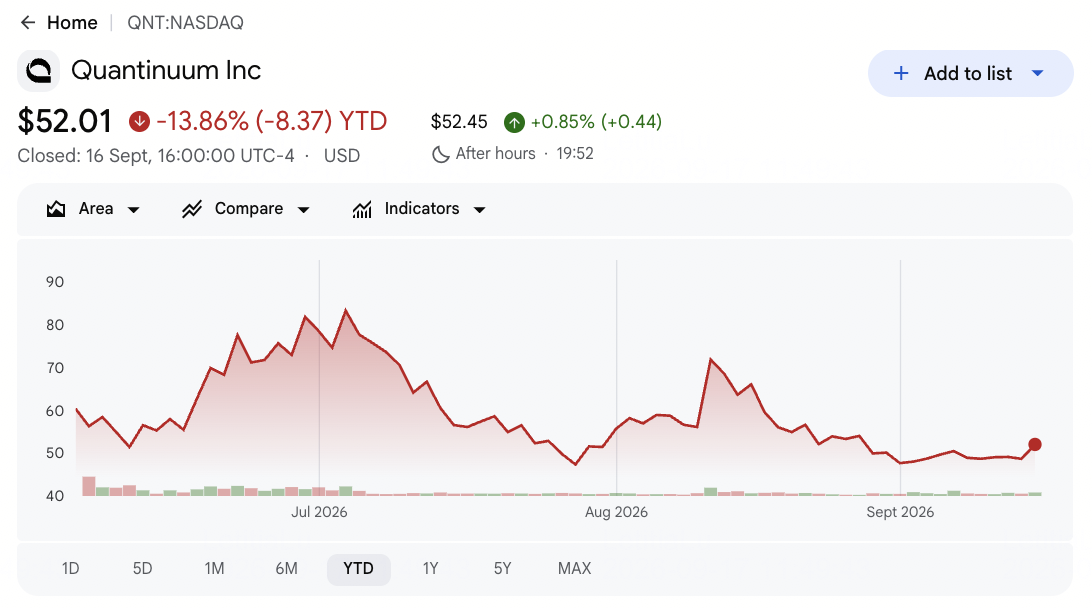
- QNT closed at $48.63, 18.95% below its $60 IPO price: Shares also remained 44% below the $86.79 July high, showing how quickly enthusiasm around quantum milestones can reverse when commercialization timing comes into focus.
- Q2 revenue rose 279% to $8 million: Sales increased from $2.1 million a year earlier and slightly exceeded published expectations. Growth is strong, though quarterly revenue still covers only a small part of the negative $68 million adjusted EBITDA result.
- Bookings expectations increased to at least $120 million: Quantinuum had $81 million booked through June before the Oracle Helios agreement improved visibility. The gap versus the $28 million to $32 million annual revenue outlook shows that contract conversion will take multiple periods.
- Cash and short-term investments reached $2.1 billion: The June IPO raised $1.68 billion through the sale of 28 million shares at $60. The larger runway supports Sol development for 2027 and Apollo for 2029, though spending discipline remains important while losses stay high.
- A $100 million CHIPS R&D award supports the manufacturing roadmap: The September agreement adds federal support alongside GlobalFoundries and Monarch Quantum. The funding lowers part of the development burden, though technical progress still needs to convert into repeatable commercial systems and customer revenue.
What Is Quantinuum (QNT)?
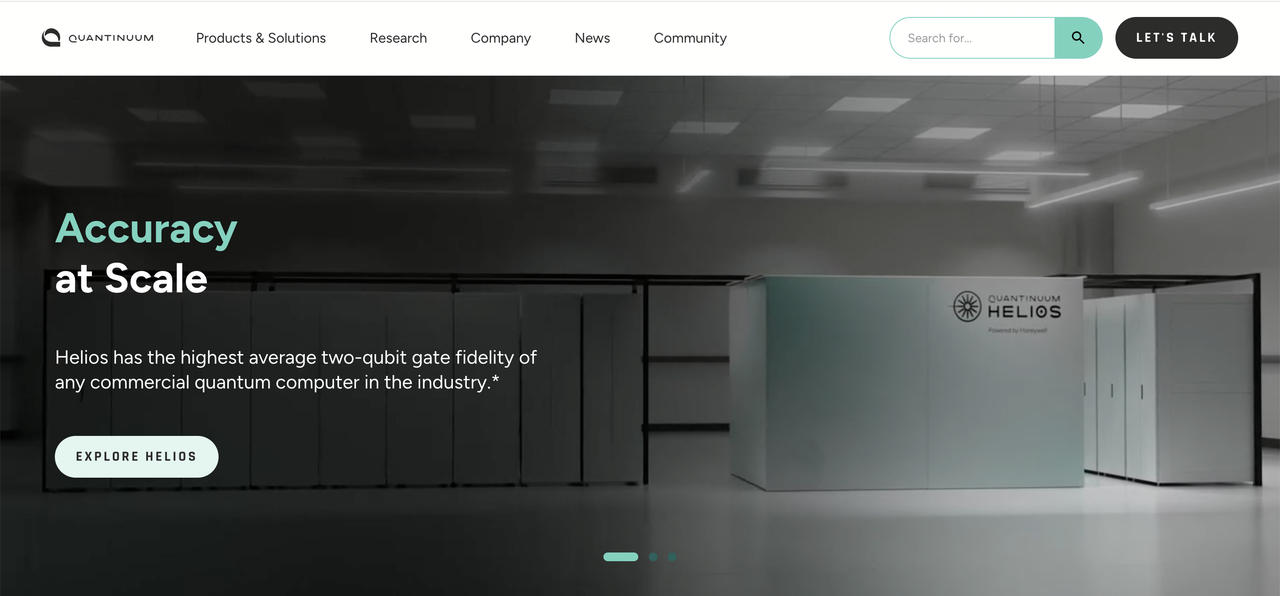
Quantinuum is an integrated quantum-computing company formed in 2021 from Honeywell Quantum Solutions and Cambridge Quantum. The company builds trapped-ion quantum computers and sells access through cloud services, direct systems and development contracts. Its software portfolio includes TKET for circuit optimization, InQuanto for computational chemistry, Nexus for managed application development and Quantum Origin for cryptographic key generation. Revenue comes from hardware access, services, software and research contracts across government, industrial, financial and scientific markets.
The long-term strategy combines better logical-qubit performance with broader enterprise distribution. Oracle plans to deploy Quantinuum's Helios system through Oracle Cloud Infrastructure, giving enterprise customers a direct cloud path to its quantum hardware, while HPE is integrating Quantinuum systems with high-performance computing environments for hybrid quantum-classical workloads. BMW has also expanded a multi-year materials-science collaboration. Quantinuum works with NVIDIA on quantum-AI research, Quanta Computer on future system manufacturing and the U.S. Department of Commerce on domestic supply-chain capacity. These relationships support the roadmap from Helios to Sol in 2027 and Apollo in 2029.
Read More: Top 10 Quantum Computing Stocks to Watch in 2026: Companies Driving Next-Gen Computation
Quantinuum (QNT) Q2 2026 Earnings Overview: Revenue Growth, Bookings and Quantum Roadmap
Quantinuum reported Q2 revenue of $8 million, up 279% from $2.1 million a year earlier, and an adjusted loss per share of $0.28 that matched published expectations. GAAP net loss widened to $597 million, adjusted EBITDA loss reached $68 million and adjusted gross margin held at 62%. Management set 2026 revenue guidance at $28 million to $32 million, then raised bookings expectations to at least $120 million after the Oracle agreement, separating faster commercial interest from continued heavy investment.
|
Financial Metric |
Guidance / Consensus |
Reported / Actual |
Surprise |
|
Q2 revenue |
$2.1M a year earlier |
$8.0M |
Grew. Up 279% year over year and slightly above published expectations. |
|
Q2 adjusted net loss per share |
$0.28 consensus loss |
$0.28 loss |
Met. The adjusted loss matched published expectations. |
|
Q2 GAAP net loss |
$57M loss a year earlier |
$597M loss |
Widened. IPO-related equity compensation and warrant remeasurement drove much of the increase. |
|
Q2 adjusted EBITDA |
$43M loss a year earlier |
$68M loss |
Widened. R&D and commercialization investment remained well above revenue. |
|
Q2 GAAP gross margin |
Negative 91.4% a year earlier |
Negative 64.4% |
Improved. Margin increased by 27 percentage points. |
|
Q2 adjusted gross margin |
62.6% a year earlier |
62.00% |
Stable. Down only 60 basis points despite contract timing. |
|
Cash and short-term investments |
N/A |
$2.1B |
Expanded. The $1.68B IPO provided runway for the hardware roadmap. |
|
FY2026 revenue outlook |
Prior implied outlook lower |
$28M-$32M |
Raised. First formal public-company guidance centers on $30M. |
|
FY2026 bookings outlook |
$81M booked through June 30 |
At least $120M |
Raised. The Oracle Helios agreement improved commercial visibility. |
- Revenue of $8 million grew 279% from $2.1 million: The quarter showed that system access, services and ecosystem activity are beginning to convert into sales. The small base still makes individual contracts important to quarterly comparisons.
- The adjusted loss of $0.28 per share matched expectations: That provides a cleaner operating view than the $1.93 GAAP loss attributable to Class A holders. Revenue still needs to grow faster than research and commercialization spending.
- GAAP gross margin improved 27 percentage points to negative 64.4%: Adjusted gross margin remained 62%, down only 60 basis points. The gap reflects large equity compensation and depreciation effects tied to the IPO and hardware base.
- Adjusted EBITDA loss widened to $68 million from $43 million: Spending supported Helios performance, Sol validation and Apollo prototyping. Revenue growth must accelerate meaningfully before those investments translate into operating leverage.
- Annual revenue guidance reached $28 million to $32 million: The $30 million midpoint remains well below the later $120 million bookings expectation because booked work converts over time. Oracle deployment and broader Nexus adoption still need to turn backlog into recognized revenue.
Quantinuum (QNT) 2026 Investment Outlook: $155 Bull Case vs. $35 Bear Case
QNT's 2026 outlook depends on whether commercial bookings and technical milestones can narrow the gap between a $12 billion-plus market value and $28 million to $32 million of expected annual revenue. Oracle, the $100 million CHIPS award and near five-nines logical fidelity support the strategic case. The $68 million quarterly adjusted EBITDA loss and dependence on a limited number of large contracts keep the valuation highly sensitive to execution.
The Bull Case: Stronger Quantum Adoption Pushes QNT Toward $155
The Bull Case assumes the Oracle Helios deployment produces visible revenue, bookings exceed the $120 million floor and Nexus adoption expands beyond 180 organizations. Near five-nines logical fidelity, Sol validation and federal manufacturing support strengthen confidence in Quantinuum's ability to scale reliable trapped-ion systems.
A move toward $155 would require more large commercial contracts, clear bookings conversion and continued progress toward the 2027 Sol and 2029 Apollo schedules. Adjusted gross margin near 62% and losses growing slower than revenue would strengthen the case.
The Base Case: Steady Commercial Progress Keeps QNT Between $80 and $105
The Base Case assumes 2026 revenue lands within the $28 million to $32 million range and Oracle, HPE and Quanta relationships advance without sharply accelerating recognized revenue. The $2.1 billion liquidity position supports development, though adjusted EBITDA remains deeply negative as Sol and Apollo absorb investment.
QNT could trade mainly between $80 and $105 under these conditions. Bookings above $120 million, stable technical milestones and broader customer diversification would support the range. Contract delays, weaker adjusted margins or higher cash use would cap the upper end.
The Bear Case: Slower Customer Adoption Pulls QNT Toward $35
The Bear Case assumes enterprise deployment remains experimental and contract revenue arrives later than planned. A few large customers continue to dominate sales, adjusted EBITDA losses stay near the Q2 pace and technical milestones require more capital before fault-tolerant systems support broad workloads.
A move toward $35 would become more likely if annual revenue misses $28 million, bookings convert slowly or Sol slips beyond 2027. Post-IPO selling pressure and a lower valuation multiple for unprofitable quantum companies would add further pressure.
QNT Stock Price Forecasts for 2026 By Wall Street Analysts
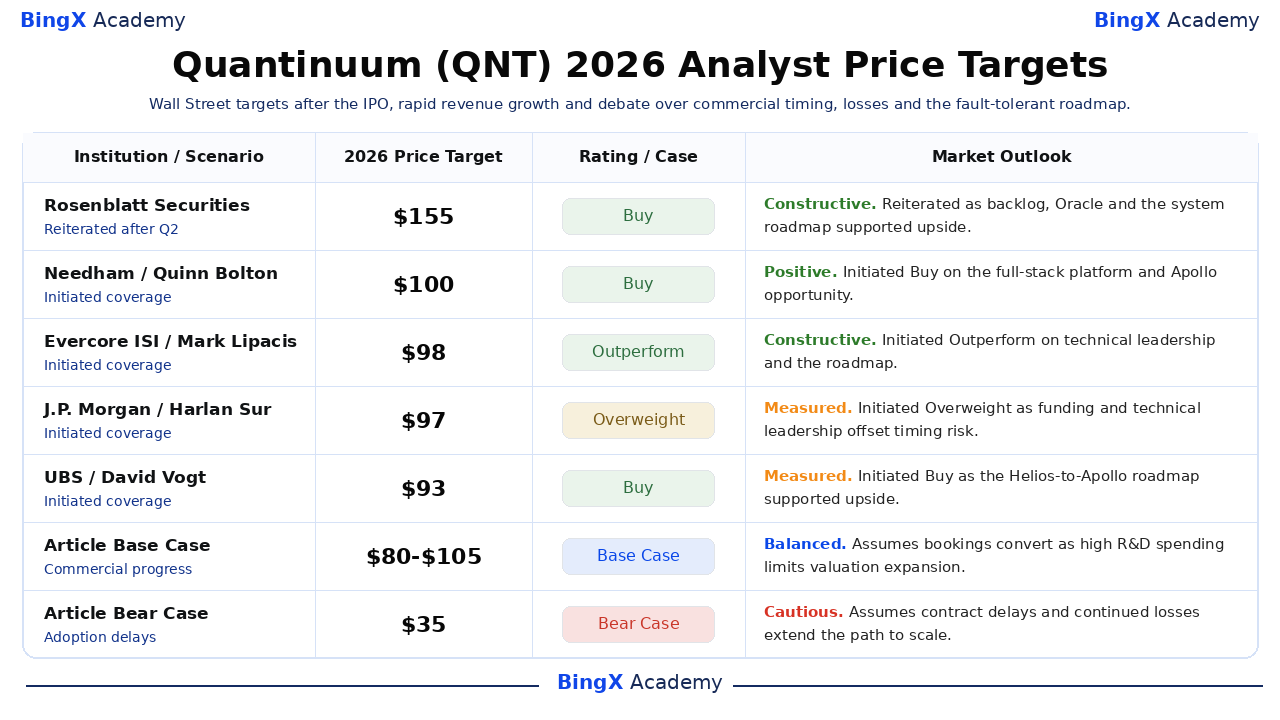
These dated analyst actions span $93 to $155 and reflect different assumptions about technical leadership, commercialization speed and the Helios-to-Apollo roadmap. They are third-party reference points rather than price promises. The final Base and Bear rows are BingX Academy editorial scenarios.
|
Institution / Scenario |
2026 Price Target |
Rating / Case |
Market Outlook |
|
Rosenblatt Securities / John McPeake |
$155 |
Buy |
Constructive. August 19: reiterated as commercial backlog, Oracle and the system roadmap supported upside. |
|
Needham / Quinn Bolton |
$100 |
Buy |
Positive. June 29: initiated Buy on the full-stack platform and long-term Apollo opportunity. |
|
Evercore ISI / Mark Lipacis |
$98 |
Outperform |
Constructive. June 29: initiated Outperform on technical leadership and a credible fault-tolerant roadmap. |
|
J.P. Morgan / Harlan Sur |
$97 |
Overweight |
Measured. June 29: initiated as funding and technology leadership offset commercialization risk. |
|
UBS / David Vogt |
$93 |
Buy |
Measured. June 29: initiated Buy as the Helios-to-Apollo roadmap supported upside. |
|
Article Base Case |
$80-$105 |
Base Case |
Balanced. Assumes bookings convert as high R&D spending limits valuation expansion. |
|
Article Bear Case |
$35 |
Bear Case |
Cautious. Assumes contract delays and continued losses extend the path to scale. |
How to Trade Quantinuum (QNT) Stock on BingX
Trade Quantinuum's Helios deployment, bookings growth and fault-tolerant roadmap using BingX TradFi and BingX AI tools. Because QNT can react sharply to technical milestones, government awards and contract timing, traders should define the catalyst and risk limits before entering a position.
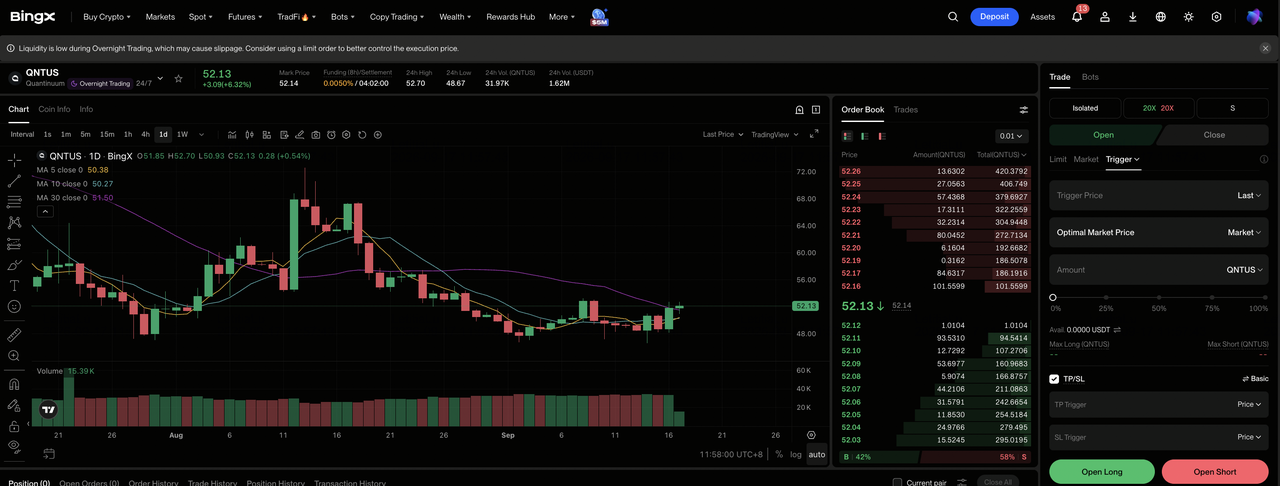
Step 1: Access BingX TradFi. Sign up and navigate to the specialized TradFi section on the BingX exchange dashboard.
Step 2: Select Quantinuum (QNT). Search for and select the QNT-USDT perpetual futures contract.
Step 3: Choose your direction. Select Open Long if bookings convert and technical milestones remain on schedule. Select Open Short if adoption delays or wider losses weaken the valuation.
Step 4: Select leverage and margin mode. Choose Isolated or Cross-Margin based on your risk tolerance. QNT closed 18.95% below its $60 IPO price, showing why conservative leverage and clear sizing are important.
Step 5: Execute strict risk protocols. Set Take-Profit and Stop-Loss (TP/SL) levels before or immediately after entering the trade. QNT can move quickly around system benchmarks, bookings, guidance and federal funding.
Top 5 Risks to Watch for Quantinuum Investors in 2026
Quantinuum's valuation depends on commercial adoption, technical execution, spending and post-IPO supply. These risks can affect revenue timing, cash use and per-share value.
- Bookings may convert more slowly than expected: The $120 million bookings outlook is well above the $30 million revenue midpoint because contracts convert over multiple periods. Delays could keep revenue small relative to the cost base and reduce the value assigned to backlog.
- Large losses could reduce the cash runway: Q2 adjusted EBITDA loss reached $68 million despite the $2.1 billion liquidity balance. Longer Sol and Apollo development schedules would increase cash use before broader commercialization.
- Customer concentration can make revenue uneven: RIKEN represented roughly 60% of 2025 revenue. Oracle improves diversification, though delayed acceptance milestones or government programs could still materially affect quarterly growth.
- The fault-tolerant roadmap could slip: Sol is planned for 2027 and Apollo for 2029. Hardware, error-correction or manufacturing delays would postpone commercial capacity and weaken confidence in the roadmap.
- Post-IPO share supply could pressure valuation: QNT already fell below its $60 IPO price after reaching $86.79. Lock-up expirations, equity compensation or a broader quantum selloff could compress the multiple even if technical milestones remain intact.
Final Thoughts: Should You Invest in Quantinuum in 2026?
Quantinuum has a differentiated full-stack platform, measurable logical-fidelity progress and more than $2.1 billion of liquidity. Revenue rose 279%, Oracle adds an important distribution channel and the $100 million CHIPS award supports domestic manufacturing. The commercial base remains small, however, and a $68 million adjusted EBITDA loss makes the path from technical achievement to durable cash flow the decisive question.
The Bull Case requires faster bookings conversion and on-time system delivery to support $155. The Bear Case reflects contract delays, continued losses and a lower valuation that could pull QNT toward $35. Conservative traders may wait for broader customer revenue, clearer Oracle economics and evidence that annual growth is narrowing the loss-to-revenue gap.
Risk Reminder: Trading and investing in equities like QNT involves a high risk of capital loss. Quantum-development setbacks, contract delays, customer concentration, cash burn, dilution and leveraged trading can produce rapid losses. Conduct independent research before allocating capital.
Related Reading
- Top 10 Quantum Computing Stocks to Watch in 2026: Companies Driving Next-Gen Computation
- Top High-Performance Computing (HPC) Stocks to Watch in 2026: Accelerated Computing Market Leaders
- Oracle (ORCL) Stock Price Outlook for 2026: Can AI Cloud Infrastructure Take ORCL Back to Its Highs?
- HPE Price Prediction 2026: Can AI and Networking Growth Push HPE Toward $90?
- IonQ (IONQ) Price Prediction 2026: Can Full-Stack Quantum Growth Push IONQ Toward $65?
