

Plug Power (PLUG) builds hydrogen fuel-cell systems, electrolyzers, hydrogen plants and related fueling infrastructure. Material handling remains its largest established market, while service, hydrogen fuel and large electrolyzer projects are intended to create recurring revenue and broaden demand. This integrated model creates several routes to growth, but it also leaves PLUG sensitive to project timing, manufacturing costs and external financing.
Plug Power Q2 2026 earnings showed measurable progress without removing the balance-sheet debate. Revenue reached $178.3 million, adjusted loss narrowed to $0.07 per share and gross margin improved to roughly breakeven from negative 31% a year earlier. Management raised 2026 revenue-growth guidance to 15% to 16%, but unrestricted cash of about $162 million means cash conversion still matters.
The PLUG stock forecast for 2026 now centers on two competing views:
- The margin and backlog conversion case: Material-handling refreshes, 1,666 quarterly GenDrive deployments and new electrolyzer final investment decisions could convert the 15% to 16% growth plan into positive Q4 EBITDAS.
- The liquidity and execution case: Negative fuel margins, long project schedules and about $61 million of quarterly net cash use could keep financing and dilution risk ahead of the operating recovery.
This guide breaks down the PLUG stock forecast, 2026 price scenarios, key risks and analyst outlooks, drawing on Plug Power's August 10 Q2 2026 earnings release, quarterly filing and market data through September 23, plus how to trade PLUG stock futures on BingX TradFi with USDT collateral.
Top 5 Things for Plug Power Investors to Know in September 2026
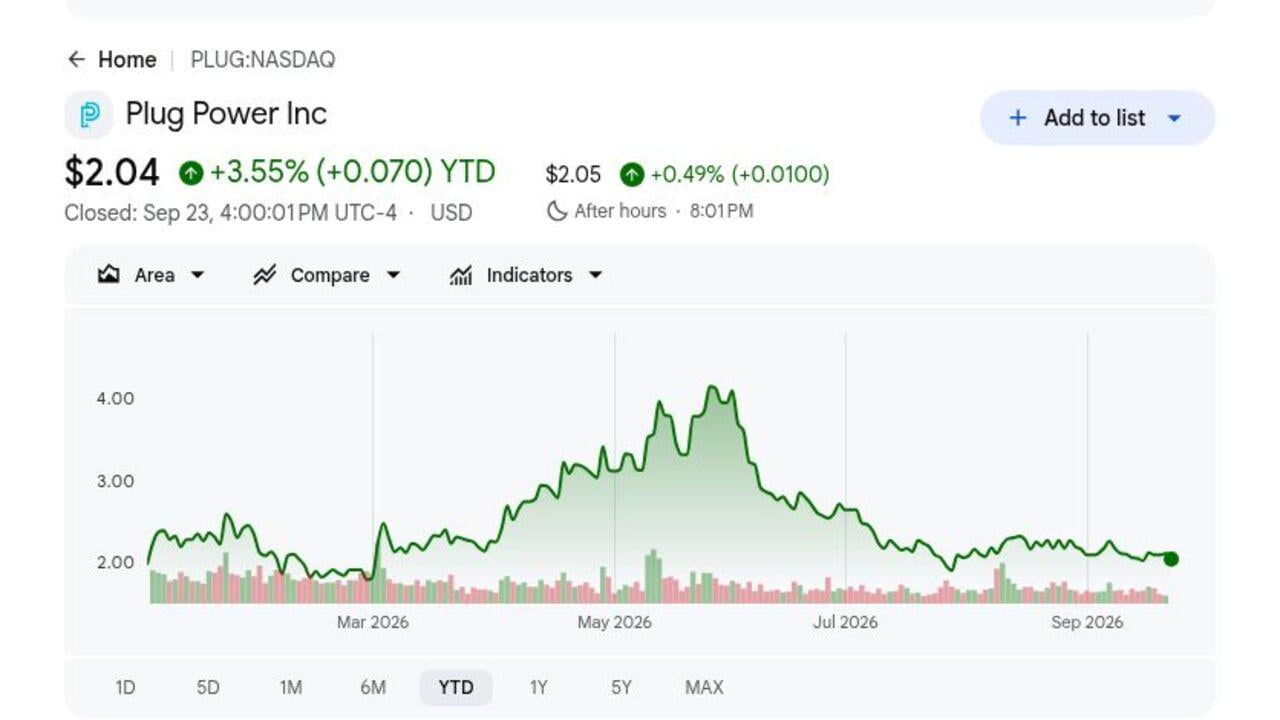
- PLUG closed at $2.04 and was up 3.55% in 2026: The modest gain masks a wide 2026 range of roughly $1.70 to $4.58. The volatility shows how quickly expectations shift around hydrogen demand, financing, and management's path toward operating breakeven.
- Q2 revenue reached $178.3 million: The result beat the roughly $168.8 million consensus by $9.5 million and rose about 9% sequentially. The beat matters because backlog conversion needs to support a business that is still consuming cash and investing across several hydrogen markets.
- GenDrive deployments rose 125% to 1,666 units: Deployments more than doubled from 739 a year earlier. Two large customers plan to refresh more than 20,000 units over three years, creating potential equipment, service, and hydrogen-fuel demand if the rollout stays on schedule.
- Management raised 2026 revenue growth guidance to 15% to 16%: The prior range was 13% to 15%, while management still targets positive EBITDAS in Q4. The outlook becomes more meaningful if stronger growth is matched by better mix and lower cash burn.
- The asset-monetization target remains $275 million: Transactions announced after quarter-end were expected to generate $80 million of near-term liquidity, with about $47 million received by early August. Progress reduces immediate financing pressure, though delayed closings could bring dilution risk back into focus.
What Is Plug Power (PLUG)?

Plug Power is an integrated hydrogen-technology company that designs proton-exchange-membrane fuel cells, GenDrive material-handling systems, GenSure stationary-power products and GenEco electrolyzers. It also develops hydrogen-production plants, liquefaction, storage, transport and fueling infrastructure. Revenue comes from equipment sales, service contracts and hydrogen fuel supplied to installed systems. The model is intended to combine upfront project revenue with recurring aftermarket demand.
The long-term strategy is to expand the installed fuel-cell base while converting large electrolyzer projects and improving economics across the hydrogen network. Amazon, Walmart and Carrefour are named material-handling customers, and two large customers intend to refresh more than 20,000 GenDrive units over three years. Plug is also advancing projects with Carlton Power, Hy2gen, Orica, Galp, Iberdrola and BP, giving the company exposure to industrial hydrogen beyond warehouse fleets.
Read More: Top AI Energy Stocks to Buy in 2026: Nuclear, Gas, Fuel Cells, and the AI Power Buildout
Plug Power (PLUG) Q2 2026 Earnings Overview: Revenue Beat and Margin Improvement Support the Turnaround
Plug reported $178.3 million of Q2 revenue versus roughly $168.8 million expected, adjusted loss of $0.07 per share versus a $0.10 loss expected, and gross margin near breakeven versus negative 31% a year earlier. Operating expenses fell about 50% to $62 million, net cash use declined 58% sequentially to $61 million, and 2026 revenue-growth guidance increased to 15% to 16%, leaving liquidity as the central tradeoff.
|
Financial Metric |
Guidance / Consensus |
Reported / Actual |
Surprise |
|
Q2 2026 revenue |
$168.8M consensus |
$178.3M |
Beat. $9.5M above consensus and up about 9% sequentially. |
|
Q2 adjusted EPS |
$0.10 loss |
$0.07 loss |
Beat. Loss was $0.03 narrower than consensus and $0.11 narrower YoY. |
|
Q2 GAAP EPS |
$0.17 loss |
$0.14 loss |
Beat. Improved from a $0.20 loss in Q2 2025. |
|
Q2 gross margin |
Improvement expected |
About breakeven |
Improved. Up from negative 31% YoY and negative 13% in Q1. |
|
Operating expenses |
Cost discipline |
About $62M |
Improved. Declined about 50% year over year. |
|
Net cash usage |
Lower burn |
About $61M |
Improved. Fell about 58% sequentially. |
|
Unrestricted cash |
Not applicable |
About $162M |
Measured. Liquidity still depends on monetization and financing. |
|
2026 revenue growth |
Prior 13% to 15% |
15% to 16% |
Raised. Stronger second-half backlog supports the new range. |
- Revenue of $178.3 million beat consensus by $9.5 million: Revenue rose about 9% sequentially, showing better shipment cadence. The next test is whether second-half backlog converts on schedule, because repeated delays would weaken confidence in both the raised annual outlook and liquidity plan.
- Adjusted loss narrowed to $0.07 per share: The result beat the $0.10 loss consensus and improved from a $0.18 loss a year earlier. Better unit economics are reaching the income statement, though positive EBITDAS still depends on sustained revenue growth, mix, and cost control.
- Gross margin improved by roughly 31 percentage points: Margin moved from negative 31% in Q2 2025 to around breakeven. That is one of the clearest turnaround signals, although deeply negative fuel margins still limit consolidated profitability.
- Operating expenses fell about 50% to $62 million: The lower cost base helped narrow losses alongside the gross-margin improvement. Sustaining those savings matters because Plug still needs to fund electrolyzer projects, customer support, and hydrogen infrastructure while targeting positive Q4 EBITDAS.
- Net cash use declined 58% to $61 million: Unrestricted cash was about $162 million, while asset transactions target $275 million in proceeds. Lower burn extends the runway, but monetization timing and non-dilutive financing remain critical given Plug's broader project ambitions.
Plug Power (PLUG) 2026 Investment Outlook: $5 Bull Case vs. $1.20 Bear Case
Plug Power's 2026 outlook depends on whether higher deployments, electrolyzer projects, and cost reductions can turn improving margins into positive operating results. The upside comes from stronger backlog conversion and lower cash burn, while project delays, weak fuel economics, and financing needs remain the main risks.
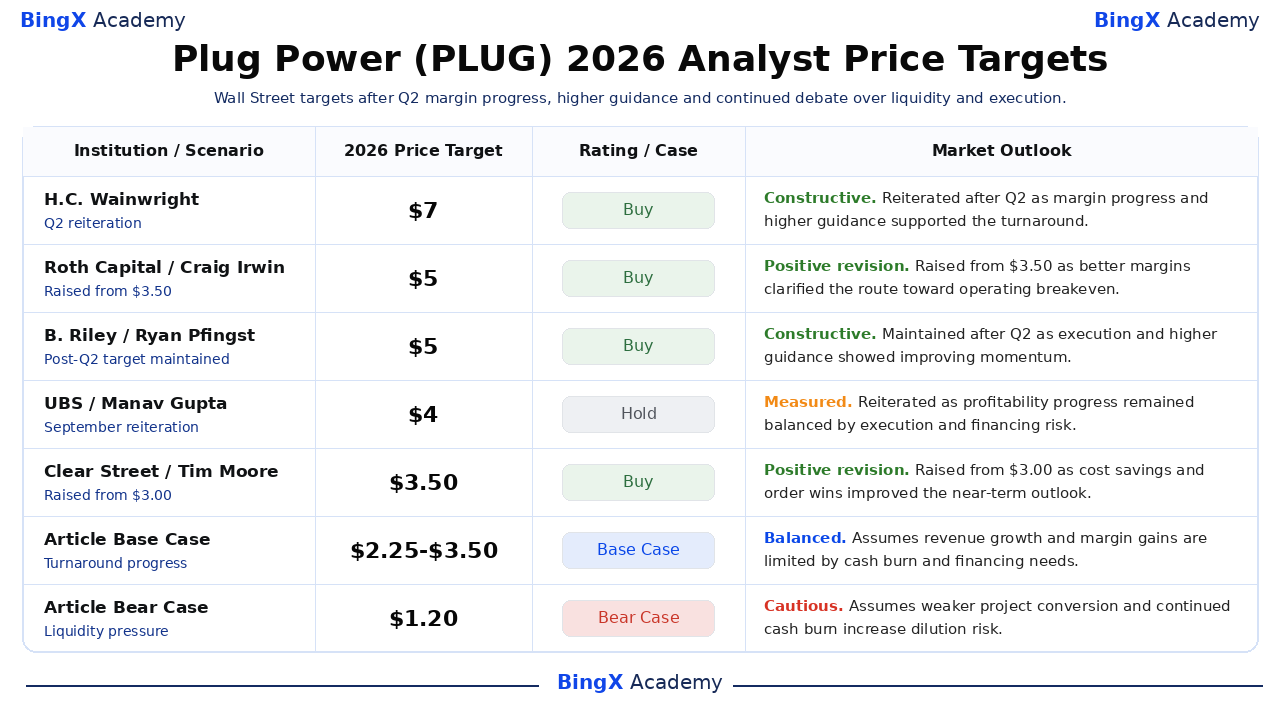
The Bull Case: Stronger Project Sales and Margins Push PLUG Toward $5
The Bull Case assumes the 20,000-unit refresh opportunity proceeds on schedule, electrolyzer projects such as Orica and Carlton Power convert into revenue, and service margins stay positive. Q2's roughly breakeven gross margin and 50% reduction in operating expenses show that higher sales can translate into better operating leverage.
A move toward $5 would require positive Q4 EBITDAS, further improvement from the negative 48% fuel margin, and visible progress toward the $275 million monetization target. Sustained 15% to 16% annual growth without a large dilutive equity raise would strengthen the case.
The Base Case: Steady Revenue Growth Keeps PLUG Between $2.25 and $3.50
The Base Case assumes material handling and service support the raised revenue outlook while electrolyzer projects progress unevenly. Gross margin stays near breakeven or modestly positive, but roughly $61 million of quarterly cash use and $162 million of unrestricted cash keep financing risk in focus.
PLUG could trade mainly between $2.25 and $3.50 under these conditions. Deployment growth, 27% service margin, and lower operating costs would support the range. Slower project approvals or delayed asset sales would limit the upper end.
The Bear Case: Project Delays and Cash Burn Pull PLUG Toward $1.20
The Bear Case assumes large electrolyzer projects slip, fuel economics remain deeply negative, and material-handling refreshes convert more slowly than planned. With about $162 million of unrestricted cash at quarter-end, continued burn could make external financing more urgent despite announced asset transactions.
A move toward $1.20 would become more likely if Q4 EBITDAS remains negative, 2026 growth falls below 15%, or monetization proceeds miss the $275 million target. Those outcomes would weaken the turnaround case and increase dilution risk.
PLUG Stock Price Forecasts for 2026 By Wall Street Analysts
Wall Street targets remain unusually dispersed because analysts agree that Q2 execution improved but differ on the durability of margin gains and available financing. The selected targets range from $2.75 to $7, compared with the $2.04 September 23 close, so investors should read each target alongside its dated operating assumptions rather than as a promise.
|
Institution / Analyst |
2026 Price Target |
Rating |
Market Outlook |
|
H.C. Wainwright / Amit Dayal |
$7.00 |
Buy |
Constructive. August 11: reiterated after Q2 as margin progress and higher guidance supported the turnaround. |
|
Roth Capital / Craig Irwin |
$5.00 |
Buy |
Positive revision. August 12: raised from $3.50 after better margins clarified the route toward breakeven. |
|
B. Riley / Ryan Pfingst |
$5.00 |
Buy |
Constructive. August 11: maintained as Q2 execution and raised guidance showed improving momentum. |
|
UBS / Manav Gupta |
$4.00 |
Hold |
Measured. September 16: reiterated as profitability progress remained balanced by financing risk. |
|
Clear Street / Tim Moore |
$3.50 |
Buy |
Positive revision. April 29: raised from $3.00 as cost savings and orders improved the outlook. |
|
RBC Capital / Christopher Dendrinos |
$2.75 |
Sector Perform |
Balanced. August 11: maintained a speculative-risk view as higher guidance faced liquidity questions. |
|
Article Base Case |
$2.25 to $3.50 |
Base Case |
Balanced. Assumes revenue growth and margin gains are limited by cash burn and financing needs. |
|
Article Bear Case |
$1.20 |
Bear Case |
Cautious. Assumes weaker project conversion and continued cash burn increase dilution risk. |
How to Trade Plug Power (PLUG) Stock on BingX
Trade Plug Power's hydrogen-demand, margin-recovery and liquidity outlook using BingX TradFi and BingX AI tools. Because PLUG can react sharply to project decisions, earnings and financing updates, traders should define both the catalyst and risk limits before entering a position.
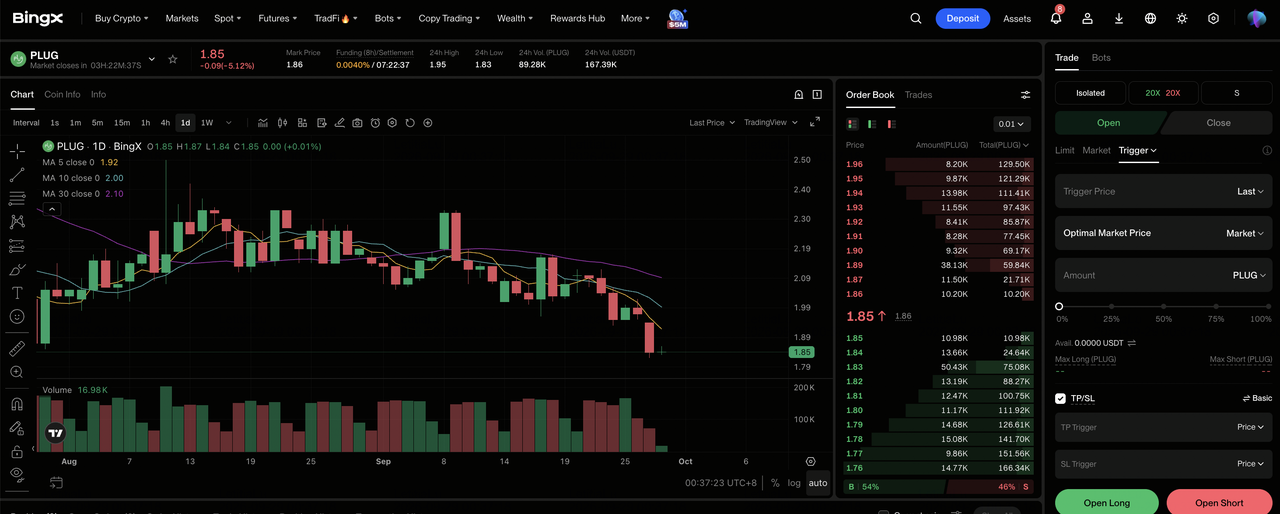
Step 1: Access BingX TradFi. Sign up and navigate to the specialized TradFi section on the BingX exchange dashboard.
Step 2: Select Plug Power (PLUG). Search for and select the PLUG-USDT perpetual futures contract.
Step 3: Choose your direction. Select Open Long if margins, deployments and liquidity strengthen. Select Open Short if project delays or financing pressure weaken expected per-share economics.
Step 4: Select leverage and margin mode. Choose Isolated or Cross-Margin based on your risk tolerance. The $1.70 to $4.58 annual range shows why conservative leverage and clear position sizing are important.
Step 5: Execute strict risk protocols. Set Take-Profit and Stop-Loss (TP/SL) levels before or immediately after entering the trade. PLUG can react quickly to earnings, guidance, project milestones, asset sales and capital raises.
Top 5 Risks to Watch for Plug Power Investors in 2026
Plug's recent improvement does not remove the financing, execution, and policy risks behind the stock's volatility. Each risk can affect cash flow, dilution, or the valuation investors assign to the turnaround.
- Liquidity pressure can dilute shareholders: Unrestricted cash was about $162 million against $61 million of quarterly net cash use. If the $275 million monetization plan slips, Plug may need equity or costly debt, reducing future value per share.
- Fuel margins remain deeply negative: Fuel gross margin improved from negative 91% to roughly negative 48%, but the business still loses money as volumes grow. Slow progress on utilization and production efficiency could offset gains from equipment and service.
- Electrolyzer projects can be delayed: The pipeline includes 30 MW, 50 MW, 100 MW, and 275 MW opportunities, but announced projects do not guarantee near-term revenue. Permitting, financing, or final investment decisions can push shipments into later periods.
- Large customer refreshes create concentration risk: Two customers may refresh more than 20,000 GenDrive units over three years. A slower rollout from either customer would affect equipment, service, and hydrogen demand at the same time.
- Policy and competition can pressure returns: Hydrogen tax rules, electricity prices, and subsidies affect project economics, while fuel cells compete with batteries and other clean-power systems. Weaker incentives or aggressive pricing could reduce order conversion and margins.
Final Thoughts: Should You Invest in Plug Power in 2026?
Plug Power has stronger operating evidence than it did a year earlier: $178.3 million of Q2 revenue, approximately breakeven gross margin, 50% lower operating expenses and a 15% to 16% annual growth target. The unresolved question is whether those gains can reach cash flow before liquidity constraints force financing that weakens the benefit for shareholders.
The Bull Case supports $5 if Q4 EBITDAS turns positive, fuel economics improve and the $275 million monetization program strengthens liquidity. The Bear Case points to $1.20 if project conversion slows or dilution dominates. Conservative traders may wait for the next gross-margin, cash-use and asset-sale updates before increasing exposure, because those figures directly test the turnaround.
Risk Reminder: Trading and investing in equities like PLUG involves a high risk of capital loss. Earnings misses, project delays, financing changes, valuation shifts and leveraged trading can produce rapid losses. Conduct independent research before allocating capital.
Related Reading
- Top AI Energy Stocks to Buy in 2026: Nuclear, Gas, Fuel Cells, and the AI Power Buildout
- Top Energy Stocks and ETFs to Buy in 2026: The AI Power Crunch Meets Geopolitical Volatility
- Bloom Energy (BE) Price Prediction 2026: Can AI Data-Center Power Push BE Toward $350?
- Oklo (OKLO) Price Prediction 2026: Can Nuclear Milestones Push OKLO Toward $100?
- NuScale Power (SMR) Price Prediction 2026: Can Project Conversion Push SMR Toward $20?
