


PayPal (PYPL) operates a global digital-payments platform spanning branded checkout, Venmo, merchant services and unbranded card processing. Its scale still produces high payment volume and substantial cash flow, yet the investment debate has shifted from network reach to the quality of growth. Branded-checkout momentum, competitive intensity and the profitability of lower-margin processing now matter more than headline volume alone.
The latest quarter captured that tension. Q2 2026 revenue increased 5% year over year and total payment volume rose 10%, although transaction margin dollars advanced only 1% and non-GAAP operating margin contracted. Stronger free cash flow and higher full-year profit guidance show that the turnaround has financial support. The slower conversion of volume into margin, however, keeps execution at the center of the valuation case.
The PYPL stock forecast for 2026 now centers on two competing views:
- The operating-recovery case: branded checkout stabilizes, Venmo becomes a more productive commerce channel and restructuring savings rebuild operating leverage.
- The competitive-pressure case: mobile wallets and large commerce platforms keep taking engagement, leaving PayPal reliant on lower-yield processing and continued cost reduction.
This guide breaks down the PYPL stock forecast, 2026 price scenarios, Q2 operating evidence, principal risks, named Wall Street outlooks and how to trade PYPL stock futures on BingX TradFi with USDT collateral.
Top 5 Things for PayPal Investors to Know in September 2026
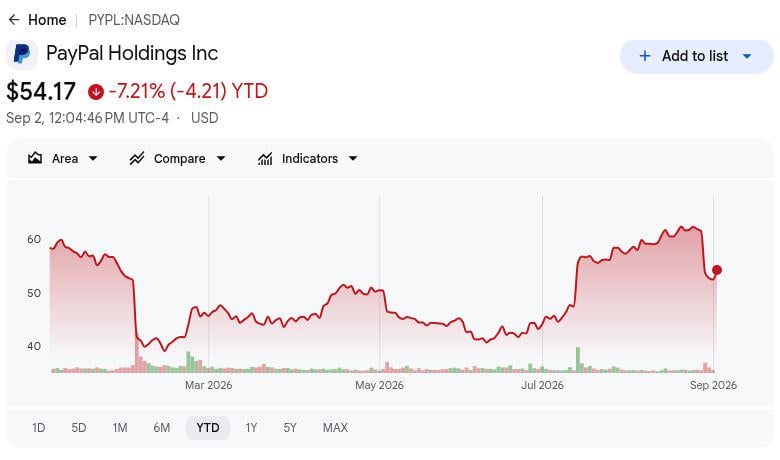
- PYPL was down 7.21% YTD through September 2: The decline came even as Q2 total payment volume reached $486.448 billion, showing that investors are still demanding stronger evidence from branded checkout, transaction margins, and earnings growth rather than rewarding volume alone.
- Q2 revenue increased 5% to $8.682 billion: Revenue remained above the tracked estimate, but the growth rate was well below the 10% increase in payment volume. That gap highlights the importance of take rate, product mix, and monetization quality.
- Total payment volume rose 10% to $486.448 billion: PayPal processed nearly half a trillion dollars in quarterly payment activity, but transaction margin dollars grew more slowly. That divergence shows why higher volume does not automatically translate into equivalent earnings growth.
- Adjusted free cash flow surged 179% to $1.832 billion: The sharp improvement gave management more flexibility for buybacks, investment, and balance-sheet use. The key question is whether cash generation can remain near that level once working-capital and timing benefits normalize.
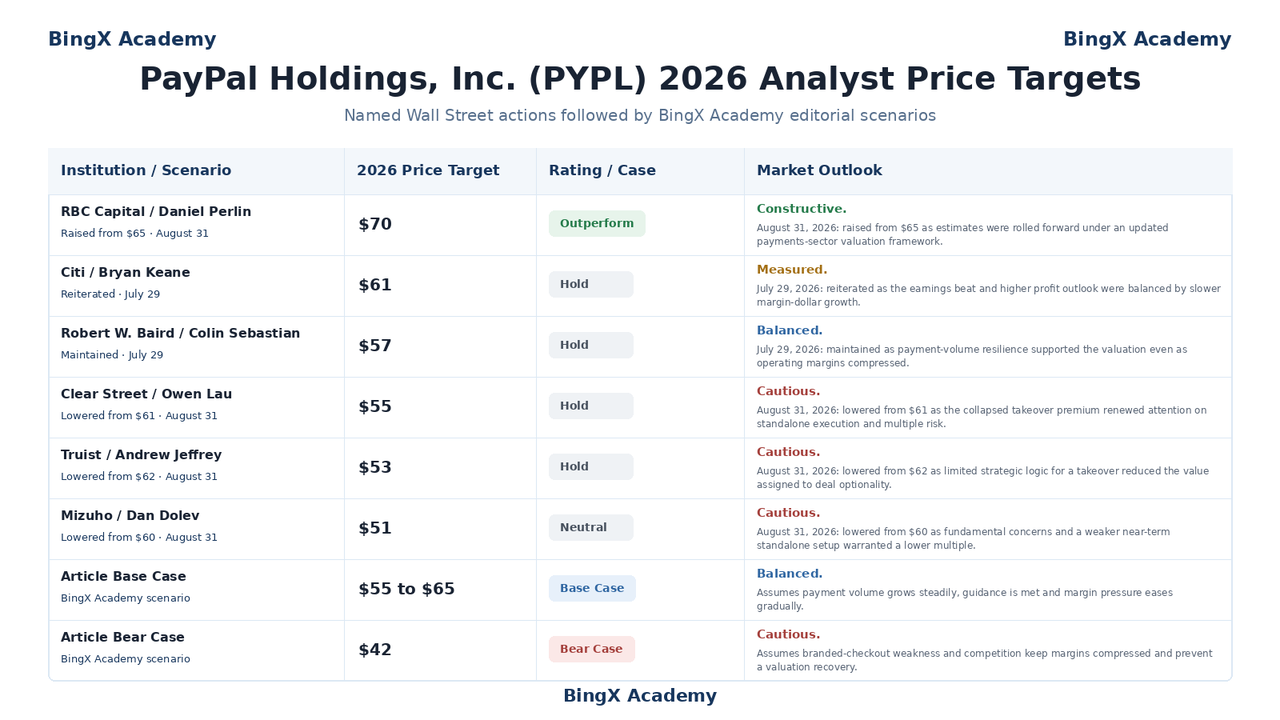
- Selected analyst targets range from $51 to $70: The $19 spread between the low and high references reflects materially different views on branded-checkout recovery, Venmo monetization, margins, and execution. RBC Capital’s Outperform stance sits at the bullish end, while Hold and Neutral ratings anchor the more cautious side.
What Is PayPal (PYPL)?
PayPal (PYPL) is a global digital-payments company that connects consumers and merchants across roughly 200 markets, with 439 million active accounts at the end of 2025. Its main products include PayPal branded checkout, Venmo, Braintree enterprise processing, buy now, pay later, debit and credit products, merchant financing, and risk-management tools. Revenue comes mainly from transaction fees, foreign exchange, credit products, and other value-added services across online and in-person commerce.
PayPal’s strategy is increasingly focused on improving monetization rather than simply processing more volume. Venmo reaches about 100 million active accounts, while Braintree competes with platforms such as Stripe for large merchants and enterprise processing. In 2026, Stripe and Advent International also reportedly explored a takeover of PayPal at about $60.50 per share, valuing the company at more than $53 billion, before abandoning the bid. That episode highlighted both PayPal’s strategic value and investor uncertainty around its standalone turnaround. Management is now focused on branded checkout, Venmo commerce, BNPL, and higher-value merchant services while improving Braintree’s economics and defending share against Stripe, Apple Pay, and other payment alternatives
Read More: Top Financial Services and Fintech Stocks to Buy in 2026 Amid Agentic AI, Stablecoin Rails Shift
PayPal (PYPL) Q2 2026 Earnings Overview: Revenue, EPS and Payment Volume
PayPal’s Q2 combined solid payment growth, an EPS beat, and much stronger cash generation with continued margin pressure. Revenue reached $8.682 billion versus $8.65 billion expected, non-GAAP EPS came in at $1.38 versus $1.28, and total payment volume rose 10% to $486.448 billion. Adjusted free cash flow increased 179% to $1.832 billion, but non-GAAP operating margin fell to 17.4%, showing that stronger volume and cash conversion have not yet translated into full margin recovery.
|
Financial Metric |
Guidance / Consensus |
Reported / Actual |
Surprise |
|
Q2 2026 revenue |
$8.65 billion |
$8.682 billion |
Beat. Slightly above the estimate and up 5%. |
|
Non-GAAP diluted EPS |
$1.28 |
$1.38 |
Beat. About 8% above consensus. |
|
Total payment volume |
— |
$486.448 billion |
Expanded. Up 10% year over year. |
|
Transaction margin dollars |
— |
$3.900 billion |
Improved. Up 1%, or 3% excluding interest. |
|
Non-GAAP operating margin |
— |
17.40% |
Contracted. Down 248 basis points. |
|
Adjusted free cash flow |
— |
$1.832 billion |
Strengthened. Up 179% year over year. |
|
FY2026 non-GAAP EPS guidance |
$5.31 |
Approximately $5.38 |
Raised. Above the prior growth range. |
|
FY2026 transaction margin dollars |
— |
Approximately $15.6 billion |
Raised. Prior decline view reversed. |
- Revenue of $8.682 billion grew 5% year over year: The result edged above the $8.65 billion estimate, showing continued top-line growth even as investors focus more closely on branded checkout and transaction economics.
- Non-GAAP EPS of $1.38 beat consensus by about 8%: EPS topped the $1.28 estimate, although it declined 1% year over year, showing that the earnings recovery remains uneven despite the quarterly beat.
- Total payment volume rose 10% to $486.448 billion: Consumer and merchant activity remained resilient, but volume growth continued to outpace transaction-margin growth, highlighting the importance of mix and take rate.
- Non-GAAP operating margin fell 248 basis points to 17.4%: Strategic investment and mix pressure offset some of the benefit from higher revenue, keeping margin restoration central to the investment case.
- Full-year non-GAAP EPS guidance increased to about $5.38: Management also raised transaction-margin-dollar guidance to approximately $15.6 billion, signaling greater confidence in execution despite near-term margin pressure.
Read More: PayPal (PYPL) Q2 2026 Earnings Overview: 8.68B Revenue and Raised FY EPS Drive a 4.01% Price Rally
PayPal (PYPL) 2026 Investment Outlook: $80 Bull Case vs. $42 Bear Case
The central test is whether PayPal can translate continued payment activity into stronger branded engagement, transaction economics and sustainable operating leverage.
The Bull Case: Branded Checkout and Venmo Push PYPL Toward $80
The Bull Case assumes branded checkout stabilizes, Venmo monetization improves, and transaction-margin growth begins catching up with payment volume. Cost actions and strong free cash flow would then support reinvestment, buybacks, and stronger per-share earnings.
A move toward $80 would require operating-margin pressure to ease, branded trends to improve, and full-year guidance to prove conservative. Better transaction-margin growth and sustained free cash flow would provide the clearest confirmation.
The Base Case: Steady Execution Keeps PYPL Between $55 and $65
The Base Case assumes payment volume keeps growing, branded checkout avoids further deterioration, and restructuring savings gradually offset mix pressure. Revenue growth remains moderate, guidance is achieved, and free cash flow stays supportive even if margin recovery takes several quarters.
Under this scenario, PYPL could trade mainly between $55 and $65. Stable branded volume, improving transaction-margin dollars, and consistent cash generation would support the range, while another sharp margin decline would weaken the case.
The Bear Case: Competition and Margin Pressure Pull PYPL Toward $42
The Bear Case assumes mobile wallets and merchant-controlled checkout options keep gaining share, limiting PayPal’s ability to improve branded economics. Lower-yield processing can still support payment volume, but the mix would keep transaction margins and operating income under pressure.
A move toward $42 would become more likely if guidance is cut, adjusted free cash flow weakens, or operating margin continues to contract. In that environment, lower earnings estimates and multiple compression could outweigh PayPal’s scale and payment-volume growth.
PYPL Stock Price Forecasts for 2026 By Wall Street Analysts
The six selected actions are named and dated. Their dispersion shows disagreement about PayPal's standalone recovery after the latest earnings and takeover-related volatility.
|
Institution / Scenario |
2026 Price Target |
Rating / Case |
Market Outlook |
|
RBC Capital |
$70 |
Outperform |
Constructive. August 31: raised from $65 as estimates were rolled forward under an updated payments-sector valuation framework. |
|
Citi |
$61 |
Hold |
Measured. July 29: reiterated as the earnings beat and higher profit outlook were balanced by slower margin-dollar growth. |
|
Robert W. Baird |
$57 |
Hold |
Balanced. July 29: maintained as payment-volume resilience supported the valuation even as operating margins compressed. |
|
Clear Street |
$55 |
Hold |
Cautious. August 31: lowered from $61 as the collapsed takeover premium renewed attention on standalone execution and multiple risk. |
|
Truist |
$53 |
Hold |
Cautious. August 31: lowered from $62 as limited strategic logic for a takeover reduced the value assigned to deal optionality. |
|
Mizuho |
$51 |
Neutral |
Cautious. August 31: lowered from $60 as fundamental concerns and a weaker standalone setup warranted a lower multiple. |
|
Article Base Case |
$55 to $65 |
Base Case |
Balanced. Assumes payment volume grows steadily, guidance is met and margin pressure eases gradually. |
|
Article Bear Case |
$42 |
Bear Case |
Cautious. Assumes branded-checkout weakness and competition keep margins compressed and prevent a valuation recovery. |
How to Trade PayPal (PYPL) Stock on BingX
Trade PayPal's payment-volume, branded-checkout and margin outlook using BingX TradFi and BingX AI tools. Because PYPL can react sharply to earnings, analyst revisions and strategic reports, traders should define the catalyst and risk limits before entering a position.
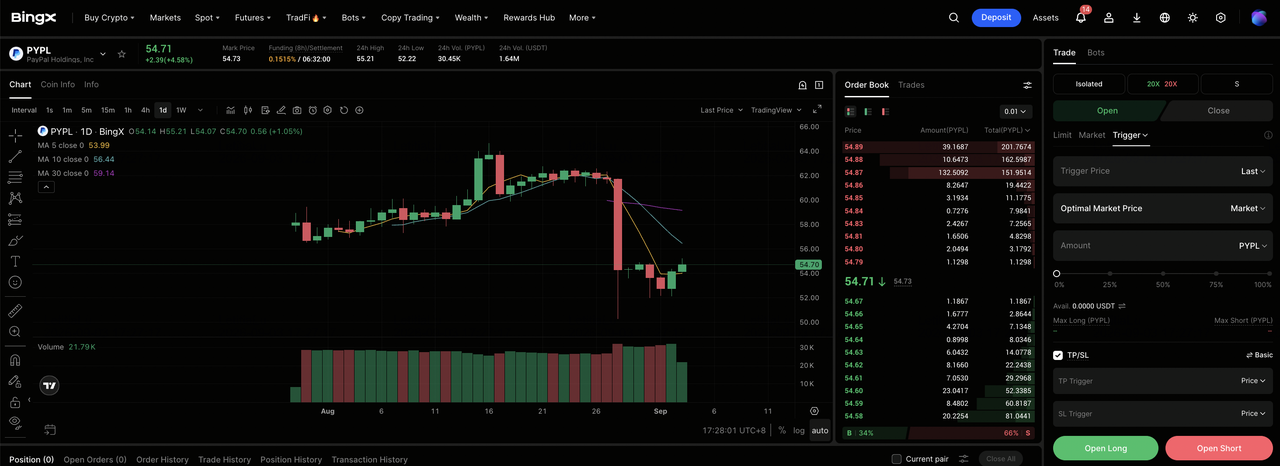
Step 1: Access BingX TradFi. Sign up and navigate to the specialized TradFi section on the BingX exchange dashboard.
Step 2: Select PayPal (PYPL). Search for and select the PYPL-USDT perpetual futures contract.
Step 3: Choose your direction. Select Open Long if branded trends, transaction margins and guidance improve. Select Open Short if competitive pressure or margin contraction weakens the outlook.
Step 4: Select leverage and margin mode. Choose Isolated or Cross-Margin based on your risk tolerance. Recent deal-related volatility makes conservative leverage and clear position sizing important.
Step 5: Execute strict risk protocols. Set Take-Profit and Stop-Loss (TP/SL) levels before or immediately after entering the trade. PYPL can react quickly to earnings guidance, payment trends, leadership execution and analyst revisions.
Top 5 Risks to Watch for PayPal Investors in 2026
PayPal’s outlook depends on whether stronger payment volume and cash flow can translate into better transaction economics, margins, and branded engagement.
- Branded-checkout share loss could weaken higher-value engagement: If consumers shift toward Apple Pay, Google Pay, or merchant-native checkout, PayPal may lose some of its higher-margin branded activity even if total payment volume continues growing.
- Unbranded processing can dilute transaction economics: Faster Braintree and other lower-yield processing volumes can support scale without producing equivalent transaction-margin dollars, limiting operating leverage.
- Turnaround costs could outlast expected savings: Restructuring, product investment, and checkout upgrades can pressure operating income before benefits are fully realized. A slower payoff would weaken confidence in margin recovery and annual guidance.
- Consumer or merchant weakness could slow payment activity: Softer discretionary spending or stress among small businesses would affect total payment volume, transaction revenue, and potentially credit performance across the platform.
- Strategic speculation can increase short-term volatility: Acquisition or partnership reports can temporarily move PYPL independently of operating fundamentals, making valuation and short-term price discovery more volatile.
Final Thoughts: Should You Invest in PayPal in 2026?
PayPal retains substantial payment scale, positive revenue growth and strong cash-generation capacity. Q2 also showed that volume and profitability are moving at different speeds. The investment case therefore depends less on whether digital payments expand and more on whether PayPal captures that growth through products with improving economics.
The bull case requires branded stability, Venmo monetization and visible margin restoration. The bear case follows from competitive share loss and continued earnings-conversion pressure. Conservative traders may wait for transaction-margin growth and operating margin to improve together before treating the turnaround as established.
Risk Reminder: Trading and investing in equities like PYPL involves a high risk of capital loss. Competitive, execution, margin, consumer-credit and leveraged-contract risks can change outcomes quickly. Conduct independent research before allocating capital.
Related Reading
- Top Financial Services and Fintech Stocks to Buy in 2026 Amid Agentic AI, Stablecoin Rails Shift
- Visa (V) Stock Forecast 2026: Can Cross-Border Payment Growth and AI Push V Toward $460?
- Mastercard (MA) Price Prediction 2026: Can Cross-Border Growth Push MA Toward $760?
- Robinhood (HOOD) Stock Forecast 2026: Can the Super-App Strategy Push HOOD Toward $160?
- Circle (CRCL) Price Prediction 2026: Can Stablecoin and Arc Momentum Push CRCL Stock Toward $130?
- JPMorgan Chase (JPM) Price Prediction 2026: Fortress Defense or AI-Driven Alpha at $341?
