



Novo Nordisk (NVO) is a Denmark-based pharmaceutical company focused on diabetes, obesity, and other chronic diseases. Ozempic, Wegovy, Rybelsus, and its insulin portfolio remain central to the business, while oral obesity medicines and the broader cardiometabolic pipeline are becoming more important to future growth. This expansion gives Novo Nordisk more routes to address a large chronic-disease market, but also leaves the ADR sensitive to Eli Lilly competition, U.S. pricing and reimbursement, and clinical or regulatory setbacks.
Its latest quarter showed improving operating momentum alongside continued pressure on reported earnings. Novo Nordisk Q2 sales reached DKK 78.488 billion (about $12.56 billion), adjusted sales grew 7% at constant exchange rates, and adjusted operating profit reached DKK 33.389 billion (about $5.34 billion), up 11% at constant exchange rates. Adjusted EPS was about $0.95 per ADR versus roughly $0.78 expected, but net profit fell 21% to DKK 20.989 billion (about $3.36 billion). The investment case depends on whether prescription volume and oral Wegovy can offset U.S. pricing pressure and defend market share.
The NVO stock forecast for 2026 now centers on two competing views:
- The obesity-franchise expansion case: oral Wegovy, international volume, and improved guidance rebuild estimate momentum and widen access.
- The competition and pricing case: Eli Lilly share gains, lower U.S. realized prices, or pipeline setbacks keep growth below the level required for a durable re-rating.
This guide breaks down the NVO stock forecast, 2026 price scenarios, key risks, and analyst outlooks, drawing on Novo Nordisk's August 4, 2026 Q2 earnings release, regulatory filing, and market data through September 2, 2026, plus how to trade NVO stock futures on BingX TradFi with USDT collateral.
Top 5 Things for Novo Nordisk Investors to Know in September 2026
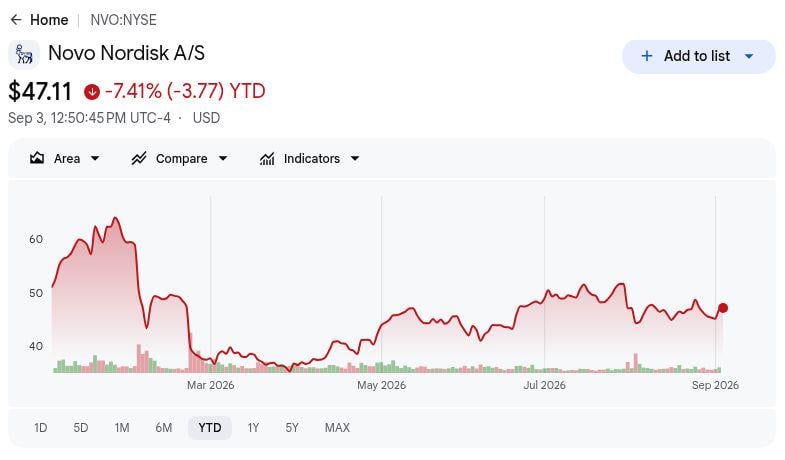
- NVO closed at $46.77 on September 2 after gaining 3.66%: The ADR remained slightly negative on the tracked 2026 return measure, showing that one strong session did not erase the earlier reset. Investors still face uncertainty around obesity-market share, U.S. pricing, and pipeline execution.
- Adjusted Q2 sales rose 7% at constant exchange rates: Reported sales increased 3% at CER to DKK 78.488 billion (about $12.2 billion), with GLP-1 volume and international Wegovy growth offsetting some U.S. pricing pressure.
- Adjusted operating profit increased 11% to DKK 33.389 billion (about $5.19 billion): The result beat the cited DKK 28.74 billion (about $4.47 billion) estimate by DKK 4.649 billion (about $722 million), though reported operating profit still fell 16% at CER because of rebates and pipeline charges.
- Management narrowed adjusted 2026 growth guidance to 0% to negative 6%: The prior range was negative 4% to negative 12%, reducing downside uncertainty even as growth remains well below earlier expansion rates.
- Pipeline impairments reached DKK 6.3 billion (about $979 million) as oral Wegovy neared commercialization: The pill could broaden obesity-treatment access, but the ziltivekimab failure shows that pipeline breadth does not guarantee successful value creation.
What Is Novo Nordisk (NVO)?
Novo Nordisk is a Denmark-based pharmaceutical company focused on diabetes, obesity, and other chronic diseases. Ozempic, Wegovy, and Rybelsus anchor its GLP-1 franchise, supported by insulin products and medicines in rare blood and endocrine disorders. The company develops, manufactures, and commercializes therapies through a global clinical, production, and physician network. The NYSE-listed NVO security is a U.S.-dollar American depositary receipt representing the Copenhagen-listed NOVO-B ordinary shares.
Novo Nordisk's current direction is centered on expanding obesity access, defending the injectable franchise, and adding oral and next-generation cardiometabolic treatments. Oral Wegovy creates a new route for patients who prefer a pill, while Ozempic, injectable Wegovy, Rybelsus, and the broader pipeline give the company several commercial and clinical levers. Global manufacturing expansion is intended to ease supply constraints, but volume growth must offset lower U.S. realized prices and stronger competition from Eli Lilly's Mounjaro and Zepbound. The strategy therefore combines franchise execution, payer access, manufacturing scale, and pipeline delivery rather than relying on a single quarterly prescription trend.
Read More: Top Pharma Stocks to Buy in 2026: Cancer Drugs, Weight-Loss Drugs, mRNA, and New Medicines
Novo Nordisk (NVO) Q2 2026 Earnings Overview: Sales, Profit and Revised Guidance
Novo Nordisk reported Q2 sales of DKK 78.488 billion (about $12.56 billion), with adjusted sales up 7% at constant exchange rates, adjusted operating profit of DKK 33.389 billion (about $5.34 billion) up 11%, and adjusted EPS of about $0.95 per ADR versus roughly $0.78 expected. Net profit fell 21% to DKK 20.989 billion (about $3.36 billion), while revised adjusted 2026 sales and operating-profit growth guidance improved to a range of 0% to negative 6%. The central tradeoff is whether prescription volume can offset weaker U.S. realized pricing.
|
Financial Metric |
Guidance / Consensus |
Reported / Actual |
Surprise |
|
Q2 2026 sales |
— |
DKK 78.488B (about $12.56B) |
Grew. Reported sales increased 3% at CER; adjusted sales rose 7%. |
|
Q2 adjusted operating profit |
DKK 28.74B (about $4.60B) cited expectation |
DKK 33.389B (about $5.34B) |
Beat. DKK 4.649B (about $744M) above the cited expectation; up 11% at CER. |
|
Q2 reported operating profit |
— |
Down 16% at CER |
Declined. The prior-year 340B rebate reversal and current pipeline impairments weighed on the comparison. |
|
Q2 net profit |
— |
DKK 20.989B (about $3.36B) |
Declined. Down 21% year over year. |
|
Q2 adjusted EPS per ADR |
About $0.78 consensus |
About $0.95 |
Beat. Approximately $0.17 above consensus. |
|
2026 adjusted sales growth outlook |
— |
0% to -6% at CER |
Improved. The revised range reduced downside uncertainty. |
|
2026 adjusted operating-profit growth outlook |
— |
0% to -6% at CER |
Improved. The updated range implies a less severe contraction. |
|
2026 free-cash-flow outlook |
— |
DKK 45B-DKK 55B (about $7.2B-$8.8B) |
Maintained. Cash generation supports investment and shareholder returns. |
|
2026 capital-expenditure outlook |
— |
About DKK 55B (about $8.8B) |
Elevated. Manufacturing expansion remains a major cash requirement. |
- Q2 sales of DKK 78.488 billion (about $12.56 billion) produced 7% adjusted growth at CER: Reported growth was only 3% at CER, with rebate and comparison effects obscuring the stronger underlying prescription-volume trend. The difference supports the demand case, but it also shows why volume growth must remain strong enough to absorb weaker U.S. realized pricing.
- Adjusted operating profit of DKK 33.389 billion (about $5.34 billion) exceeded the cited expectation by DKK 4.649 billion (about $744 million): The 11% CER increase showed that the core franchise retained operating leverage despite commercial pressure. Investors still need that adjusted strength to become visible in reported results after operating profit declined 16% at CER.
- Adjusted EPS of about $0.95 per ADR beat the roughly $0.78 consensus by $0.17: The earnings beat strengthened the near-term floor for the ADR and confirmed that adjusted operating momentum reached per-share results. A durable re-rating requires recurring product growth, however, rather than continued dependence on rebate normalization or excluded impairments.
- Net profit fell 21% to DKK 20.989 billion (about $3.36 billion) as reported earnings remained distorted: The prior-year 340B rebate reversal and current pipeline impairments widened the gap between adjusted and reported performance. That gap matters because repeated development charges would reduce cash available for manufacturing, pipeline investment, and shareholder returns.
- Revised 2026 growth guidance improved to 0% to negative 6% at CER: Free cash flow of DKK 45 billion to DKK 55 billion (about $7.2 billion to $8.8 billion) is expected alongside capital expenditure of about DKK 55 billion (about $8.8 billion). The outlook reduces immediate downside risk, but manufacturing investment must still translate into supply, prescription volume, and better cash returns.
Novo Nordisk (NVO) 2026 Investment Outlook: $65 Bull Case vs. $40 Bear Case
The central test is whether Novo Nordisk can convert oral Wegovy, international volume, and manufacturing investment into renewed growth before U.S. pricing pressure and stronger obesity-drug competition reduce the franchise's earnings power.
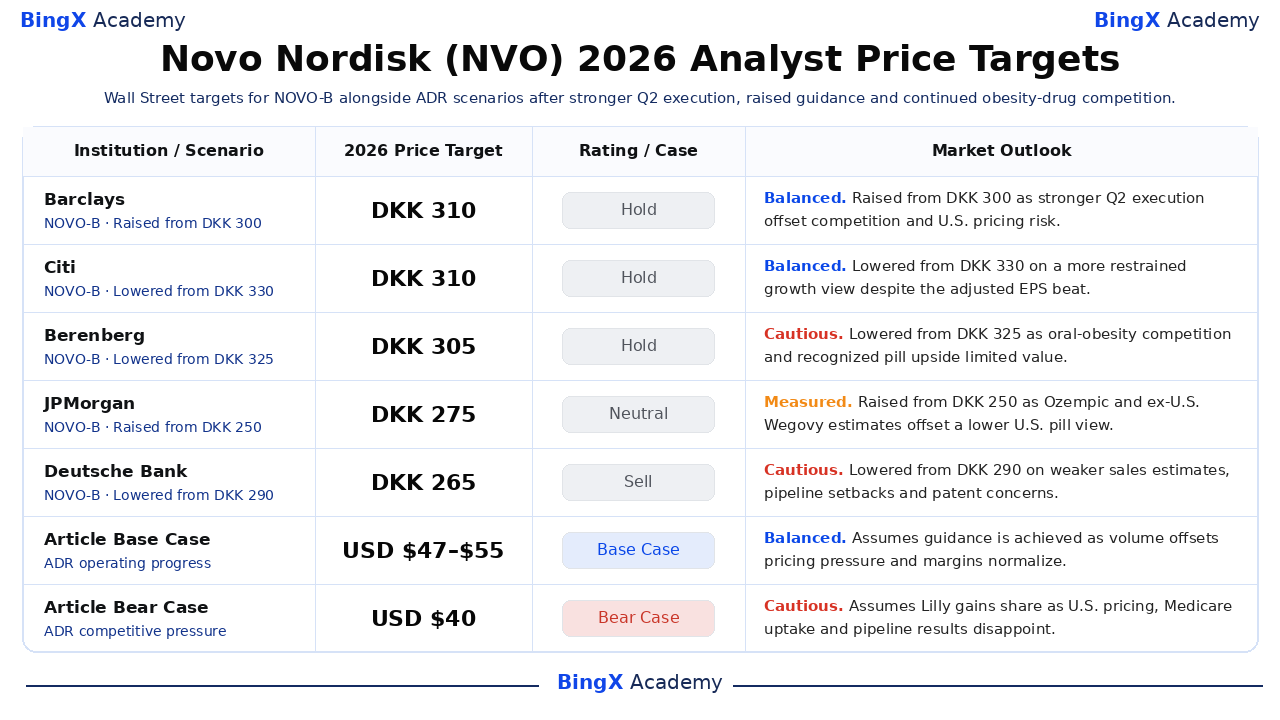
The Bull Case: Obesity-Drug Growth and International Demand Push NVO Toward $65
The Bull Case assumes Novo Nordisk keeps expanding the obesity-treatment market through both injectable products and oral Wegovy, while international GLP-1 volume offsets weaker U.S. realized pricing. A successful oral option could broaden access for patients who prefer pills over injections, while reliable supply and stronger product breadth would help adjusted sales growth move above the revised 0% to negative 6% range.
A move toward $65 would require sustained prescription gains, successful oral Wegovy uptake, and greater pipeline confidence after DKK 6.3 billion (about $1.0 billion) of impairments. Improving guidance, stable U.S. market share, and free cash flow above the midpoint of the DKK 45 billion to DKK 55 billion (about $7.2 billion to $8.8 billion) range would provide the clearest confirmation.
The Base Case: Improved Guidance Keeps NVO Between $47 and $55
The Base Case assumes Novo Nordisk delivers within its revised outlook as GLP-1 volume offsets part of the pricing pressure and oral products build gradually. International Wegovy growth and manufacturing expansion support the franchise, but Eli Lilly competition prevents earnings and valuation from returning quickly to their earlier trajectories.
Under this editorial scenario, NVO could trade mainly between $47 and $55. Stable U.S. prescription share, continued ex-U.S. growth, and normalized reported profit would support the range, while renewed guidance pressure or evidence that rebate movements drove most of the improvement would limit the upside.
The Bear Case: Competition and Pipeline Pressure Pull NVO Toward $40
The Bear Case assumes Eli Lilly captures additional obesity share as U.S. price pressure persists and Medicare uptake contributes less than expected. Another clinical setback or deeper patent concern would leave Novo Nordisk more dependent on Ozempic and Wegovy while manufacturing investment remains elevated.
A move toward $40 would become more likely if prescription growth slows, adjusted guidance moves below negative 6%, or further impairments weaken confidence in post-2026 products. Lower revenue estimates and underused capacity would then compress both earnings and the valuation multiple applied to the ADR.
Novo Nordisk Stock Price Forecasts for 2026 By Wall Street Analysts
These five dated institutional actions primarily cover the Copenhagen-listed NOVO-B ordinary share and therefore remain denominated in DKK rather than U.S. dollars. Their DKK 265 to DKK 310 range reflects different assumptions about obesity competition, U.S. pricing, oral Wegovy, and pipeline durability. The final Base and Bear rows are separate BingX Academy editorial scenarios for the USD-traded NVO ADR.
|
Institution / Scenario |
2026 Price Target (security shown) |
Rating / Case |
Market Outlook |
|
Barclays |
DKK 310 (about $49.60; NOVO-B) |
Hold |
Balanced. August 6: raised from DKK 300 (about $48.00) to DKK 310 (about $49.60). The modest increase recognizes stronger Q2 execution and raised guidance, with competition and U.S. pricing limiting conviction. |
|
Citi |
DKK 310 (about $49.60; NOVO-B) |
Hold |
Balanced. August 7: lowered from DKK 330 (about $52.80) to DKK 310 (about $49.60). The lower target reflects a more restrained medium-term growth view despite Q2's adjusted earnings beat. |
|
Berenberg |
DKK 305 (about $48.80; NOVO-B) |
Hold |
Cautious. August 12: lowered and downgraded from DKK 325 (about $52.00) to DKK 305 (about $48.80). The downgrade reflects stronger oral-obesity competition and a view that much of the Wegovy pill upside had already been recognized. |
|
JPMorgan |
DKK 275 (about $44.00; NOVO-B) |
Neutral |
Measured. August 25: raised from DKK 250 (about $40.00) to DKK 275 (about $44.00). Higher Ozempic and ex-U.S. Wegovy expectations supported the increase, partly offset by a lower U.S. Wegovy pill forecast. |
|
Deutsche Bank |
DKK 265 (about $42.40; NOVO-B) |
Sell |
Cautious. August 27: lowered and downgraded from DKK 290 (about $46.40) to DKK 265 (about $42.40). The downgrade reflects lower medium-term sales estimates, limited expected Medicare benefit, ziltivekimab failure and patent-cliff concerns. |
|
Article Base Case |
$47-$55 per ADR |
Base Case |
Balanced. Assumes raised 2026 guidance is achieved, volume growth offsets pricing pressure, and margins normalize after impairment and rebate distortions. |
|
Article Bear Case |
$40 (ADR) |
Bear Case |
Cautious. Assumes Lilly gains further obesity share, U.S. pricing and Medicare benefits disappoint, and pipeline or patent concerns deepen. |
How to Trade Novo Nordisk (NVO) Stock on BingX
Trade Novo Nordisk's obesity-drug volume, U.S. pricing, oral Wegovy, and pipeline outlook using BingX TradFi and BingX AI tools. Because NVO can react sharply to prescription data, reimbursement changes, clinical results, guidance, and earnings, traders should define both the catalyst and risk limits before entering a position.
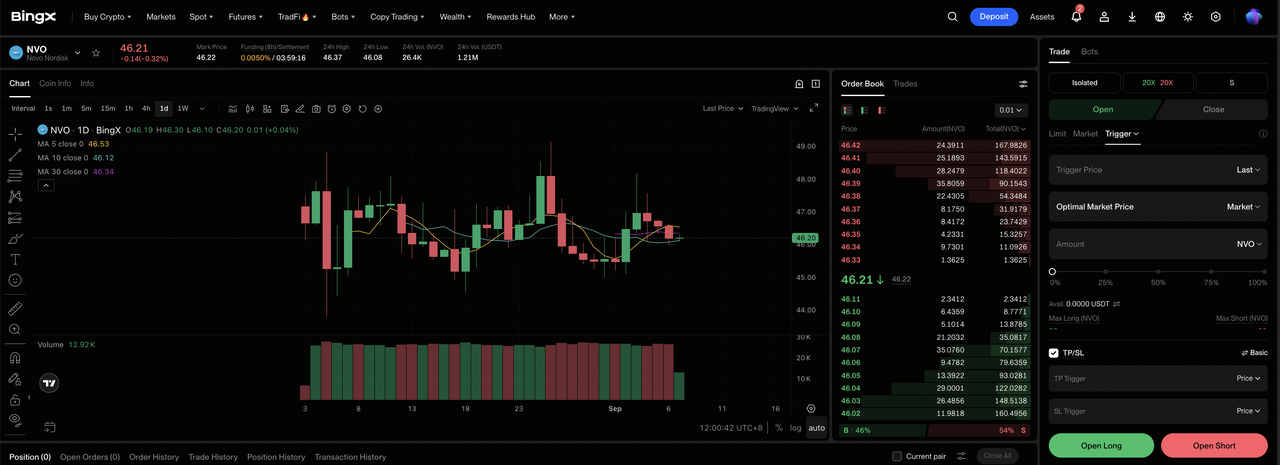
Step 1: Access BingX TradFi. Sign up and navigate to the specialized TradFi section on the BingX exchange dashboard.
Step 2: Select Novo Nordisk (NVO). Search for and select the NVO-USDT perpetual futures contract. Confirm the current price, fees, and contract specifications before placing an order.
Step 3: Choose your direction. Select Open Long if prescription volume, oral Wegovy, and improved guidance support the Bull or Base Case. Select Open Short if pricing pressure, Eli Lilly competition, or pipeline setbacks support the Bear Case.
Step 4: Select leverage and margin mode. Choose Isolated or Cross-Margin based on your risk tolerance. NVO's sensitivity to clinical and reimbursement news makes conservative leverage and clear position sizing important.
Step 5: Execute strict risk protocols. Set Take-Profit and Stop-Loss (TP/SL) levels before or immediately after entering the trade. NVO can react quickly to prescription data, reimbursement changes, clinical results, guidance, and earnings.
Top 5 Risks to Watch for Novo Nordisk Investors in 2026
Novo Nordisk faces commercial, pricing, clinical, patent, and manufacturing risks that could weaken earnings growth or compress the valuation of its obesity franchise.
- Obesity-drug competition could pressure share and pricing: Mounjaro, Zepbound, and future oral alternatives may slow Ozempic and Wegovy growth while heavier rebates reduce profit per prescription.
- U.S. pricing and reimbursement could offset volume growth: Government negotiation, commercial rebates, and weaker Medicare uptake may reduce realized revenue even if prescription counts continue rising.
- Pipeline failures could increase dependence on GLP-1 products: The ziltivekimab setback contributed to DKK 6.3 billion of impairments. More failures would narrow diversification beyond obesity and diabetes.
- Patent exposure could shorten the growth runway: Approaching expirations or faster biosimilar competition would shift more value toward replacement products that are still unproven.
- About DKK 55 billion of capex raises execution risk: New manufacturing capacity must come online on schedule to support oral and injectable demand. Delays could constrain supply and weaken free cash flow from the guided DKK 45 billion to DKK 55 billion range.
Final Thoughts: Should You Invest in Novo Nordisk in 2026?
Novo Nordisk's Q2 results established a firmer near-term earnings floor: adjusted sales grew 7% at CER, adjusted operating profit rose 11% to DKK 33.389 billion, and adjusted EPS of about $0.95 per ADR exceeded the tracked consensus. The improved 2026 outlook and oral Wegovy create credible recovery drivers, although reported profit, U.S. pricing, and recent pipeline impairments keep the thesis conditional.
The $47 to $55 Base Case assumes execution within revised guidance, while the $65 Bull Case requires stronger oral uptake, international growth, and renewed pipeline confidence. The $40 Bear Case reflects deeper share loss, pricing pressure, and further clinical setbacks. Conservative traders may wait for stable U.S. prescription share, normalized reported profit, and proof that manufacturing investment is improving cash-generating sales.
Risk Reminder: These scenarios are conditional research estimates, not investment advice or guaranteed returns. Shares and leveraged contracts can lose value, and leveraged positions may be liquidated.
Related Reading
- Top Pharma Stocks to Buy in 2026: Cancer Drugs, Weight-Loss Drugs, mRNA, and New Medicines
- Eli Lilly (LLY) Stock Outlook 2026: Can Mounjaro and Zepbound Momentum Drive LLYON Stock to $1,200+?
- Moderna (MRNA) Price Prediction 2026: Can Cancer Vaccine Momentum Push MRNA Stock Toward $180?
- Merck (MRK) Price Prediction 2026: Can Pipeline Momentum Push MRK Stock Toward $170?
- Pfizer Stock Price Prediction 2026: High-Yield Value Opportunity or Structural Value Trap?
- Corbus Pharmaceuticals Stock Price Prediction 2026: $54 Street-High Oncology Surge or Binary Obesity
