


Marvell Technology (MRVL) designs the custom compute, networking, optical-connectivity, and storage silicon used to move data through modern infrastructure. Its data-center portfolio now dominates the growth story, with custom accelerators and high-speed interconnect products gaining importance as hyperscalers build larger AI clusters. That concentration increases Marvell's exposure to structural AI investment, yet it also makes the equity sensitive to program timing, customer expectations, manufacturing capacity, and valuation.
The latest quarter showed that the operating transition has real scale. Fiscal Q2 FY2027 revenue reached a record level as data-center sales grew 46% year over year and represented about four-fifths of company revenue. Management also raised its fiscal 2027 and fiscal 2028 outlooks. The post-earnings selloff showed the unresolved tension: investors want proof that recently announced custom-chip agreements create incremental near-term revenue, rather than confirming growth that was already expected.
The MRVL stock forecast for 2026 now centers on two competing views:
- The AI infrastructure scale case: custom silicon, 1.6T optics, switching, and connectivity ramps can translate exceptional bookings into faster revenue growth and operating leverage.
- The expectations-reset case: delayed hyperscaler contributions, custom-mix pressure, and a premium multiple can outweigh strong reported growth when guidance lacks an immediate upside surprise.
This guide breaks down the MRVL stock forecast, 2026 price scenarios, key risks and analyst outlooks, drawing on Marvell’s August 27 fiscal Q2 FY2027 earnings release, regulatory disclosures and market data through September 2, 2026, plus how to trade MRVL stock futures on BingX TradFi with USDT collateral.
Top 5 Things for Marvell Investors to Know in September 2026
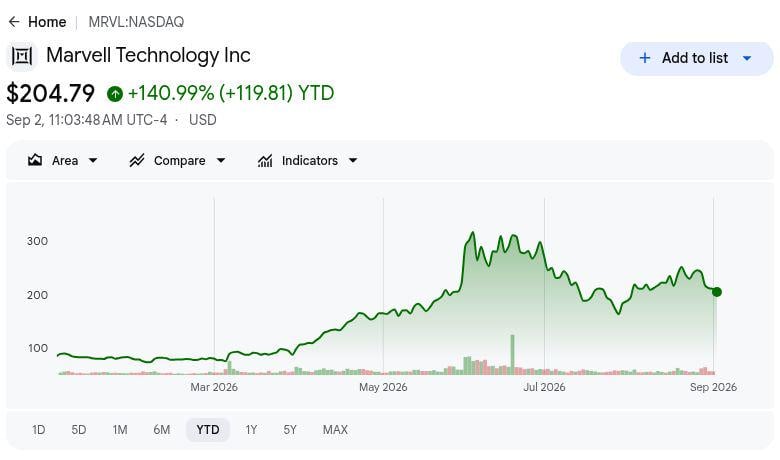
- MRVL was up 141% YTD through September 2: The rally reflects how aggressively investors repriced Marvell around custom AI accelerators and data-center connectivity. After earnings, shares still fell as investors weighed strong growth against the timing of the Google custom-silicon opportunity.
- Quarterly revenue reached a record $2.739 billion, up 37% year over year: Revenue came in $39 million above management’s prior midpoint and slightly above the roughly $2.72 billion consensus. Non-GAAP EPS of $0.94 also edged past the $0.93 estimate.
- Data-center revenue rose 46% to about $2.17 billion: The segment represented roughly 79% of total sales, confirming that Marvell is increasingly driven by AI infrastructure, custom silicon, optical connectivity, and networking demand.
- Management raised fiscal 2027 revenue to $12 billion and fiscal 2028 to $18 billion: The FY2027 outlook was lifted by $500 million, while the FY2028 target increased by $1.5 billion from the prior $16.5 billion view. Q3 revenue guidance also reached $3.15 billion, above the roughly $3.04 billion Street estimate.
- The Google partnership could represent up to $120 billion of revenue through 2033: Alphabet also committed a $12.2 billion investment, but management indicated that the larger revenue contribution is expected from fiscal 2029 onward. That timing gap helps explain why investors remain divided despite the stronger long-term outlook.
What Is Marvell Technology (MRVL)?

Marvell Technology (MRVL) is a fabless semiconductor company focused on data center infrastructure. It designs custom compute chips, Ethernet and switching products, electro-optics, storage controllers, security silicon, and carrier-networking solutions used across cloud, enterprise, telecom, and data-center systems. Because Marvell does not manufacture wafers itself, it works with external foundry and packaging partners to bring its chip designs into high-volume production.
Its growth strategy is increasingly centered on AI data centers and large hyperscale customers. Marvell has a multi-year strategic relationship with Amazon Web Services (AWS) covering custom AI silicon, optical DSPs, PCIe retimers, Ethernet switching, and other connectivity products, and in 2026 expanded a major custom-silicon partnership with Google across AI inference accelerators, storage controllers, network interfaces, and near-memory compute. Marvell also joined NVIDIA’s NVLink Fusion ecosystem, strengthening its role across both custom compute and high-speed connectivity as AI clusters scale.
Read More: Top AI Networking Stocks 2026: AI Fabric, Switches, Copper, Fiber, and Optics Connectivity
Marvell Technology (MRVL) Q2 FY2027 Earnings Overview: Revenue, EPS and Data-Center Growth
Marvell delivered record fiscal Q2 revenue with strong data-center growth, positive GAAP earnings, and higher full-year targets, but the quarter only modestly exceeded near-term expectations. Revenue reached $2.739 billion versus a $2.70 billion guidance midpoint, non-GAAP EPS came in at $0.94 versus $0.93 expected, and data-center revenue rose 46% to about $2.17 billion. Management also raised fiscal 2027 revenue to roughly $12.0 billion and fiscal 2028 to about $18.0 billion, while the next-quarter margin outlook showed that custom silicon growth still carries some profitability tradeoffs.
|
Financial Metric |
Guidance / Consensus |
Reported / Actual |
Surprise |
|
Q2 FY2027 revenue |
$2.70B company guidance midpoint |
$2.739B |
Beat. $39M above guidance midpoint; up 37% YoY. |
|
Q2 non-GAAP diluted EPS |
$0.93 |
$0.94 |
Beat. One cent above consensus. |
|
Q2 GAAP diluted EPS |
— |
$0.33 |
Improved. Returned to positive GAAP earnings. |
|
Q2 GAAP net income |
— |
$308.0M |
Improved. Profit expanded with revenue scale. |
|
Q2 data-center revenue |
— |
$2.17B; +46% YoY |
Accelerated. AI infrastructure drove 79% of sales. |
|
Q2 GAAP gross margin |
— |
53.10% |
Expanded. Up from 50.4% a year earlier. |
|
Q2 non-GAAP gross margin |
— |
58.90% |
Stable. Held sequentially despite mix changes. |
|
Q2 operating cash flow |
— |
$605.5M |
Positive. Supported investment and capacity commitments. |
|
Q3 FY2027 revenue outlook |
— |
$3.150B ±5% |
Raised. Implies another sequential step-up. |
|
FY2027 revenue outlook |
Prior: ~$11.5B |
~$12.0B |
Raised. Data-center demand added $500M. |
|
FY2028 revenue outlook |
Prior: ~$16.5B |
~$18.0B |
Raised. Custom silicon and connectivity expand the runway. |
- Revenue of $2.739 billion set a record and grew 37%: The result finished $39 million above Marvell’s prior guidance midpoint, confirming strong data-center demand even though the upside versus expectations was relatively modest.
- Non-GAAP diluted EPS of $0.94 edged past consensus: The one-cent beat showed that revenue growth continued to reach the bottom line while Marvell invested heavily in custom silicon and connectivity programs.
- Data-center revenue reached about $2.17 billion and rose 46%: The segment represented roughly 79% of sales, reinforcing Marvell’s position in AI infrastructure across custom compute, optics, and networking.
- Gross margin remained strong but mix pressure is emerging: GAAP gross margin improved to 53.1% and non-GAAP margin held at 58.9%, while the next-quarter outlook suggests custom silicon could weigh on margin before operating leverage offsets the effect.
- Fiscal 2027 and fiscal 2028 revenue targets moved higher: Management lifted FY2027 revenue to about $12.0 billion from $11.5 billion and FY2028 to about $18.0 billion from $16.5 billion, extending the growth runway even as the timing of newer custom-silicon programs remains important.
Read More: Marvell (MRVL) Q2 FY2027 Earnings Overview: $2.739B Record Revenue Triggers a 10.28% Price Selloff
Marvell Technology (MRVL) 2026 Investment Outlook: $350 Bull Case vs. $150 Bear Case
The central test is whether Marvell can convert its expanding AI design pipeline into near-term revenue and operating leverage quickly enough to justify the valuation.
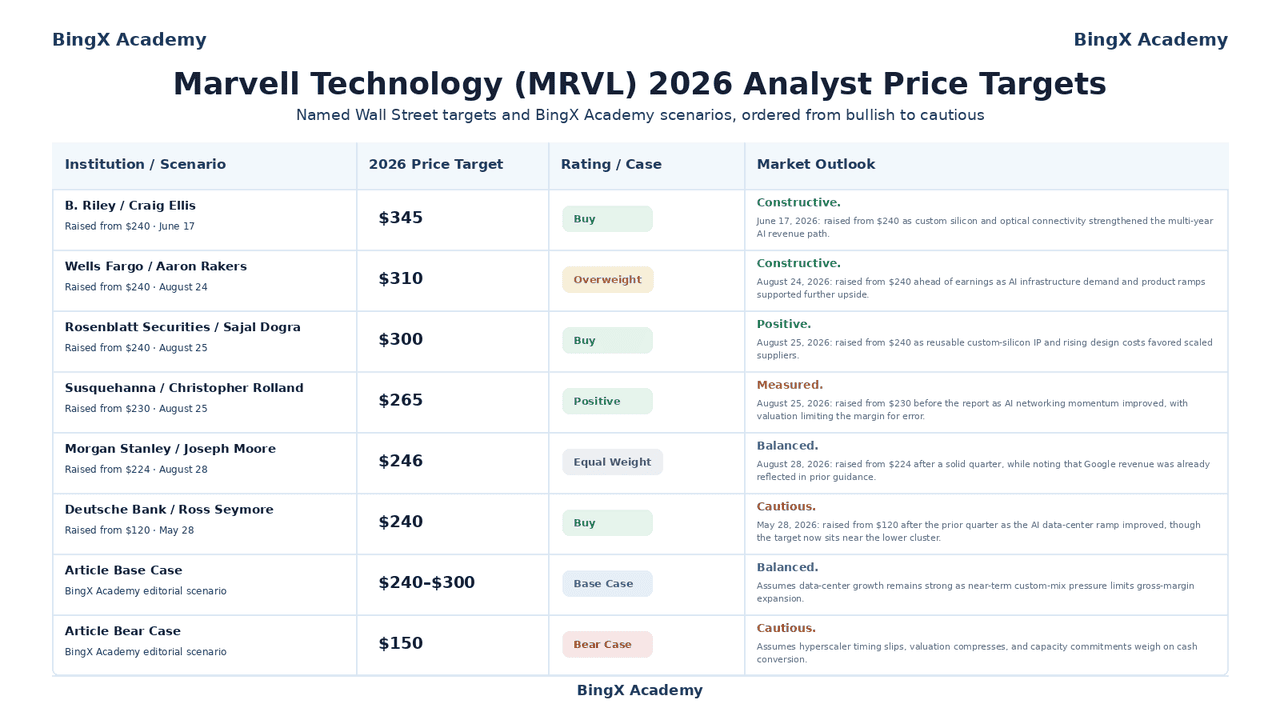
Marvell Technology (MRVL) 2026 analyst price targets and article scenarios. Third-party targets are reference points, not price promises. Updated September 2, 2026.
The Bull Case: Custom Silicon and Optics Push MRVL Toward $350
The Bull Case assumes custom compute programs accelerate through the second half, while 1.6T optics, switching, and other connectivity products broaden growth beyond any single hyperscaler. Revenue expands faster than operating expenses, allowing operating margin to improve even if a heavier custom-silicon mix limits gross-margin upside.
A move toward $350 would require major programs to enter production on schedule, capacity commitments to convert into shipments, and hyperscaler demand to remain strong. Continued estimate upgrades and improving operating leverage would provide the clearest confirmation.
The Base Case: Strong AI Demand Keeps MRVL Between $240 and $300
The Base Case assumes data-center growth remains durable while investors wait for clearer proof of incremental Google-related revenue. Custom silicon and connectivity support the raised annual outlooks, but mix pressure and elevated investment keep profitability from accelerating as quickly as revenue.
Under this scenario, MRVL could trade mainly between $240 and $300. Sequential revenue growth, stable program schedules, and continued operating-margin progress would support the range, while delays in custom programs would limit the upside.
The Bear Case: Program Delays and Multiple Compression Pull MRVL Toward $150
The Bear Case assumes major custom-silicon contributions shift further into later fiscal years as customers adjust capacity or platform schedules. Fixed development costs and supply commitments would then weigh more heavily on margins and cash conversion.
A move toward $150 would become more likely if revenue revisions flatten, program timing slips, or hyperscaler visibility weakens. MRVL could still post growth under this scenario, but slower estimate revisions and a lower valuation multiple would pressure the stock.
MRVL Stock Price Forecasts for 2026 By Wall Street Analysts
|
Institution / Scenario |
2026 Price Target |
Rating / Case |
Market Outlook |
|
B. Riley |
$345 |
Buy |
Constructive. June 17: raised from $240 as custom silicon and optical connectivity strengthened the multi-year AI revenue path. |
|
Wells Fargo |
$310 |
Overweight |
Constructive. August 24: raised from $240 ahead of earnings as AI infrastructure demand and product ramps supported further upside. |
|
Rosenblatt Securities |
$300 |
Buy |
Positive. August 25: raised from $240 as reusable custom-silicon IP and rising design costs favored scaled suppliers. |
|
Susquehanna |
$265 |
Positive |
Measured. August 25: raised from $230 before the report as AI networking momentum improved, with valuation limiting the margin for error. |
|
Morgan Stanley |
$246 |
Equal Weight |
Balanced. August 28: raised from $224 after a solid quarter, while noting that Google revenue was already reflected in prior guidance. |
|
Deutsche Bank |
$240 |
Buy |
Cautious. May 28: raised from $120 after the prior quarter as the AI data-center ramp improved, though the target now sits near the lower cluster. |
|
Article Base Case |
$240–$300 |
Base Case |
Balanced. Assumes data-center growth remains strong as near-term custom-mix pressure limits gross-margin expansion. |
|
Article Bear Case |
$150 |
Bear Case |
Cautious. Assumes hyperscaler timing slips, valuation compresses, and capacity commitments weigh on cash conversion. |
The table maps assumptions rather than probabilities. Higher targets emphasize custom silicon and optical scale; the neutral reference gives more weight to valuation and previously embedded Google revenue.
How to Trade Marvell Technology (MRVL) Stock on BingX TradFi
BingX TradFi provides a USDT-margined perpetual contract linked to MRVL price movement. Perpetual futures add leverage, funding, and liquidation risk, so the investment thesis and trade construction should be evaluated separately.
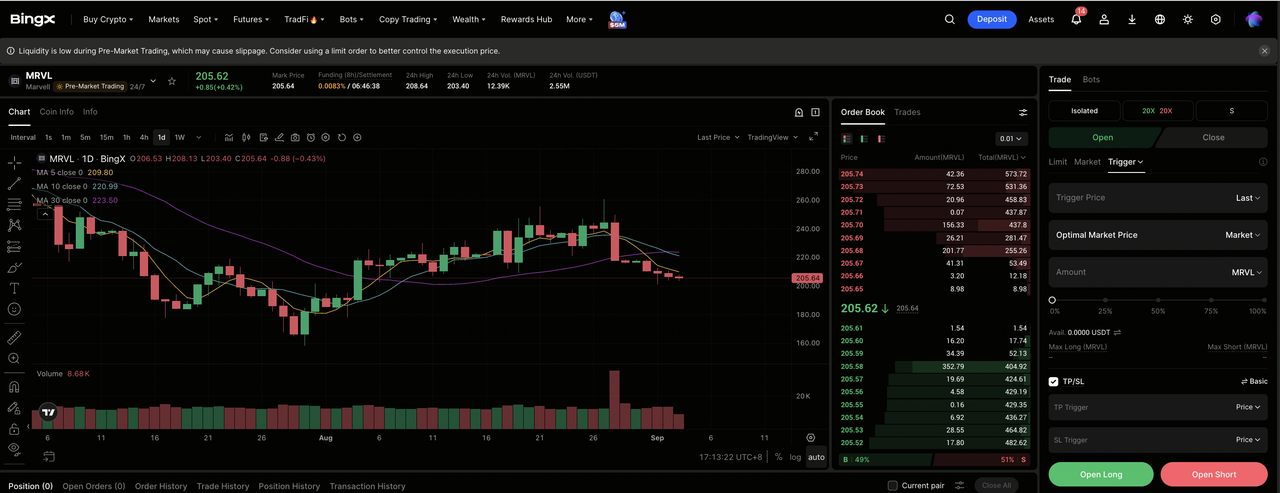
Step 1: Create and fund a BingX account. Sign up for BingX, complete the required identity verification, enable two-factor authentication, and deposit USDT.
Step 2: Select Marvell Technology (MRVL). Navigate to the BingX TradFi section and choose the verified MRVL-USDT perpetual futures contract.
Step 3: Choose your direction. Select Open Long if custom ramps, annual guidance, and operating leverage are improving. Select Open Short if program timing weakens, gross-margin pressure deepens, or valuation compresses.
Step 4: Select leverage and margin mode. Choose Isolated or Cross-Margin based on risk tolerance. The sharp post-earnings reaction and high beta make conservative leverage and explicit position sizing important.
Step 5: Execute strict risk protocols. Set Take-Profit and Stop-Loss levels before or immediately after entry. MRVL can react quickly to hyperscaler commentary, custom-chip schedules, margin guidance, foundry capacity, and semiconductor-sector positioning.
Top 5 Risks to Watch for Marvell Technology Investors in 2026
Marvell’s AI growth outlook is strong, but execution, customer concentration, margin mix, cash conversion, and valuation remain the main risks.
- Hyperscaler timing can shift revenue across fiscal years: Custom programs have long design and production cycles. A delay can push revenue into later periods and lower near-term estimates even when the total program value remains unchanged.
- Customer concentration can amplify one roadmap change: A small number of cloud customers account for a large share of Marvell’s custom-silicon opportunity. Changes in budgets, internal architectures, or supplier allocation could materially reduce revenue visibility.
- Custom-silicon growth can pressure gross margin: Faster revenue growth does not guarantee equal margin expansion. A heavier custom-compute mix may carry lower gross margins than connectivity products and slow earnings leverage.
- Capacity commitments can weaken cash conversion: Prepayments help secure advanced manufacturing supply, but they also tie up cash before related revenue is recognized. Delays could therefore reduce free cash flow and capital-allocation flexibility.
- A premium valuation leaves little room for disappointment: MRVL’s re-rating assumes sustained AI demand and clean execution. A modest guidance miss, program delay, or sector-wide de-risking could compress the multiple faster than earnings grow.
Final Thoughts: Should You Invest in Marvell Technology in 2026?
Marvell has established a credible position across custom AI compute, optical connectivity, switching, and storage infrastructure. Record revenue, 46% data-center growth, higher annual outlooks, and positive cash generation show that the AI thesis is supported by reported results. The remaining debate concerns timing, mix, and how much of the opportunity the current valuation already discounts.
The bull case needs faster program conversion and operating leverage; the bear case needs a timing disappointment plus multiple compression. Conservative traders may wait for proof that custom revenue is incremental and capacity commitments are converting into cash-generating sales.
Risk Reminder: Trading and investing in equities like MRVL involves a high risk of capital loss. Hyperscaler concentration, program delays, manufacturing constraints, gross-margin mix, valuation, and leveraged-futures liquidation can produce rapid losses. Conduct independent research before allocating capital.
Related Reading
- Top 10 AI Infrastructure Stocks to Buy in 2026: Chip Manufacturing and Design Leaders
- Top AI Networking Stocks 2026: AI Fabric, Switches, Copper, Fiber, and Optics Connectivity
- Top AI Optical Stocks to Buy in 2026: Photonics, Optics, Fiber, and Data Center Interconnects
- Nvidia (NVDA) Stock Price Outlook for 2026: Can Blackwell and Vera Rubin Take NVDA Back to $300?
- Amazon (AMZN) Price Prediction 2026: Can AWS and AI Growth Push AMZN Past $400?
- Alphabet (GOOGL) Price Prediction 2026: Can 82% Cloud Growth and AI Push GOOGL Stock to $430?
